
Ainos Launches Atmosphere Engine, Extending Physical AI from Environmental Sensing to Active Environmental Management
Sentiment and the balance of points
Rhea-AI Sentiment reads the wording of the document, how positive or negative its language is on a 1 to 5 scale. The balance of points shown with the takes weighs what the document actually discloses, so the two can disagree, for example when a trial that missed its main goal is described in upbeat language.
Rhea-AI Summary
Ainos (NASDAQ:AIMD) announced the global launch of Atmosphere Engine™, a modular platform that generates high-purity nitrogen and oxygen from ambient air on-site, extending the company’s AI-powered environmental sensing and Chemical Intelligence into active environmental management for AI infrastructure and semiconductor manufacturing.
The system is designed to create nitrogen-rich inert environments to help reduce oxidation and environmental degradation around high-value computing and fab equipment, while its building-block architecture allows capacity to scale from individual tools or zones to larger facilities. According to Ainos, engineering calculations indicate Atmosphere Engine is designed to use roughly one-third of the electricity of conventional molecular sieve-based systems under comparable conditions.
Positive
- Global launch of Atmosphere Engine extending Ainos from sensing into active environmental management for AI and semiconductor applications
- Modular, building-block architecture enables point-of-use deployment and scalable capacity for specific equipment and production zones
- Lower energy requirement claim: designed to use about one-third of the electricity of conventional molecular sieve systems under comparable gas-output conditions
Negative
- None.
Details
Market move: AIMD +5.00% in the Aug 19 session. AI platform launch
On Aug 19, the day this news came out, AIMD closed 5.00% above the previous close. Relative volume reached 4.4x the daily average during tracking.
Data tracked by StockTitan Argus for the Aug 19 session.
Key Figures
- Electricity requirement
- approximately one-third
- Comparable gas-output and operating conditions versus conventional molecular sieve-based systems
Previous AI Reports
-
Second-generation AI Nose platform launched with upgraded software, firmware, Edge AI and hardware.
-
Reported 878 million data points and advanced planned deployment of 1,400 AI Nose systems.
-
Announced SEMICON Taiwan 2026 showcase with distribution partner Topco Scientific.
-
Research coverage cited a $2.1 million subscription backlog and $350,000 prepaid.
-
Zacks published research covering AI Nose, Smell AI strategy and potential applications.
24h Move is the share-price change in the day after each event; other market factors may also have contributed.
Key Terms
electrochemical air-separation technology technical
molecular sieve-based systems technical
total cost of ownership (tco) financial
AI-generated analysis. How Rhea-AI works. Not financial advice.




High-efficiency, on-site nitrogen generation is designed to protect high-value AI infrastructure, reduce oxidation and environmental degradation, and bring greater flexibility and resilience to semiconductor manufacturing
HOUSTON, TX / ACCESS Newswire / August 19, 2026 / Ainos, Inc. (NASDAQ:AIMD)(NASDAQ:AIMDW) ("Ainos" or the "Company") today announced the global launch of Atmosphere Engine™, a new platform that extends the Company's capabilities in AI-powered environmental sensing, Chemical Intelligence and smart manufacturing into active environmental management.
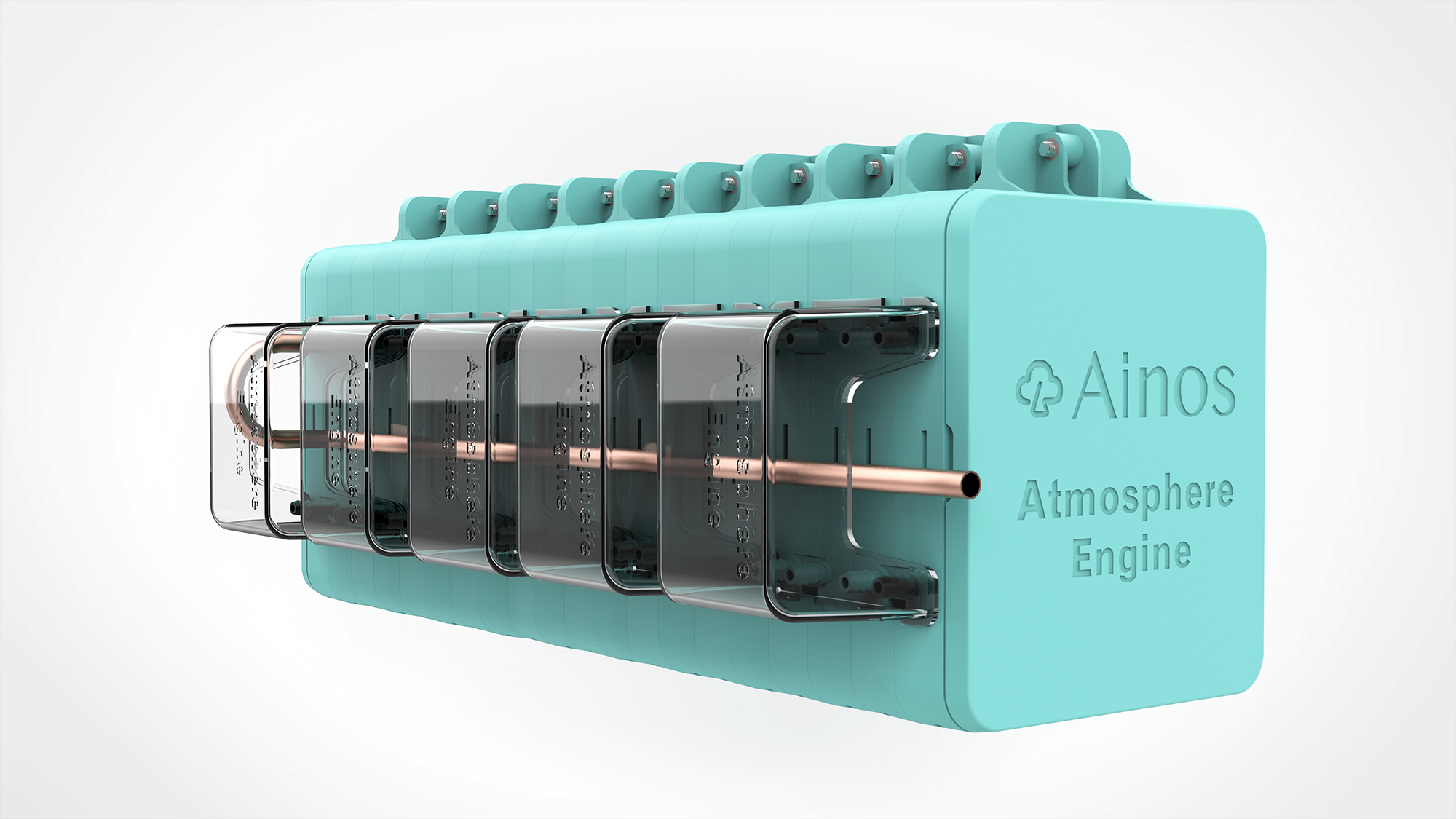
Atmosphere Engine is designed to generate high-purity nitrogen and oxygen directly from ambient air, on-site and closer to the point of use. By enabling nitrogen-rich inert environments where appropriate, the platform is designed to help reduce oxidation and environmental degradation around high-value equipment. Ainos is initially targeting AI servers, high-density computing infrastructure and semiconductor manufacturing, where equipment reliability, asset utilization and operating efficiency are increasingly critical economic considerations.
Protecting the Growing Investment in AI Infrastructure
As generative AI and Physical AI continue to scale, the power density, value and capital intensity of AI servers, GPUs and high-performance computing infrastructure are rising rapidly. Protecting these increasingly valuable assets and extending their productive operating life are becoming important economic considerations for infrastructure operators.
Atmosphere Engine is designed to address this challenge not simply by generating nitrogen, but by using nitrogen to create controlled inert environments that can help reduce oxidation and environmental degradation around high-value computing equipment.
For AI infrastructure operators, this means the atmosphere surrounding critical equipment can become more than a passive operating condition - it can become an actively managed layer of asset protection.
Combined with lower energy requirements, on-site generation, reduced transportation and storage needs, and the ability to deploy capacity incrementally, Ainos believes Atmosphere Engine has the potential to improve equipment reliability, asset utilization and long-term total cost of ownership (TCO).
Semiconductor Manufacturing: As Fabs Get Larger, Local Control Matters More
Semiconductor manufacturing represents another key target application for Atmosphere Engine.
Modern fabs and advanced packaging facilities continue to grow in scale and complexity. Larger facilities mean longer distribution networks, more equipment clusters and increasingly diverse gas requirements across different production areas.
Centralized gas supply remains highly effective for large and predictable base-load demand. Atmosphere Engine is designed to add another layer of flexibility by bringing modular gas generation closer to specific areas and equipment where it is needed.
This allows capacity to be deployed according to local demand. Additional modules can be added as requirements grow, while individual units can be serviced or isolated independently - providing greater flexibility for expansion, maintenance and localized operations.
The concept is intentionally simple: Atmosphere Engine works like a building-block system.
Each unit can operate independently, or multiple units can be connected in series or parallel to support higher gas-flow requirements and larger applications. Customers can begin with a single unit, a specific piece of equipment or one production zone, and add capacity as demand grows.
Deploy the capacity you need, where you need it.
For large semiconductor facilities, Ainos therefore sees centralized and distributed supply as complementary rather than competing approaches:
Central Supply + Distributed Point-of-Use
Central systems can continue supporting large, stable base loads, while distributed Atmosphere Engine units can provide additional flexibility at specific equipment, zones or points of demand.
This approach extends Ainos' role in semiconductor smart manufacturing from using AI Nose to sense and understand environmental conditions toward using Atmosphere Engine to help actively manage those conditions.
Producing Gas Where It Is Needed - With Lower Energy Requirements
Atmosphere Engine is based on Ainos' electrochemical air-separation technology and is designed to generate nitrogen and oxygen directly from ambient air.
Based on the Company's current engineering calculations, under comparable gas-output and operating conditions, Atmosphere Engine is designed to require approximately one-third of the electricity used by conventional molecular sieve-based systems.
On-site generation may also reduce reliance on gas transportation, bulk storage and long-distance distribution infrastructure, potentially reducing associated logistics requirements, energy use and carbon footprint.
For customers, the business case ultimately comes down to practical questions: How much energy is required? How much infrastructure is needed? How easy is the system to maintain? Can capacity scale with demand? And can the overall cost of operation be improved?
"Atmosphere Engine started with a very simple question," said Eddy Tsai, Chairman, President and CEO of Ainos. "Why should gas always be produced far away, stored, transported or moved through extensive distribution infrastructure before it reaches the equipment that actually needs it?"
"If we can generate the required gas closer to the point of use, with lower energy requirements, we have an opportunity to simplify parts of that infrastructure and improve its economics. For AI infrastructure, our goal is to use controlled inert environments to help protect increasingly valuable computing assets. For semiconductor manufacturing, our goal is to give operators greater flexibility in how gas capacity is deployed and managed across increasingly complex facilities."
"What matters to us is not how big a story we can tell about a technology. What matters is whether it solves a real customer problem and creates measurable economic value."
Nitrogen and Oxygen Expand the Long-Term Opportunity
Because Atmosphere Engine separates ambient air into nitrogen-rich and oxygen-rich outputs, the platform has potential applications beyond a single industry.
Ainos is initially prioritizing AI infrastructure and semiconductor smart manufacturing, while planning to progressively evaluate applications across data centers, energy infrastructure and other environments where localized gas generation or controlled atmospheric conditions may provide value.
The platform's oxygen output also creates additional long-term possibilities. In healthcare and other appropriate environments, Ainos may evaluate localized oxygen generation and controlled oxygen environments based on specific market needs. Any such applications will be developed and validated in accordance with applicable technical, safety and regulatory requirements.
The modular architecture allows Atmosphere Engine to begin at the level of an individual piece of equipment or a specific operating zone and scale progressively as customer requirements grow - without requiring customers to build substantially more capacity than they initially need.
Building Physical AI from Sensing to Action
Atmosphere Engine represents another step in Ainos' broader Environmental Intelligence Physical AI architecture.
Through AI Nose, Ainos enables machines to sense and digitize odors and chemical signals in the physical world that historically have been difficult for AI systems to perceive.
Through ScentAI and Chemical Intelligence, continuously accumulated real-world data can be transformed into recognition, understanding, correlation and, over time, predictive capabilities.
Through Atmosphere Engine, Ainos is extending that intelligence back into the physical environment - creating a pathway for intelligent systems to move beyond understanding what is happening toward determining what can be done about it.
AI Nose - Sense
ScentAI - Understand
Chemical Intelligence - Predict
Atmosphere Engine - Act / Control
Together, these capabilities form the Physical AI closed loop Ainos is building: Sense → Data → Intelligence → Prediction → Action / Control → Sense Again
"AI Nose gave us a way to bring real-world chemical signals into AI," Tsai said. "As those real-world data continue to accumulate, we can build greater understanding and predictive capability. Atmosphere Engine takes the next step by creating a pathway for that intelligence to translate into action in the physical world."
"We believe the real value of Physical AI comes when sensing, data, intelligence and action form a continuous loop. We intend to build that capability methodically - guided by real industry needs, engineering data and field validation."
About Ainos, Inc.
Ainos, Inc. (NASDAQ:AIMD)(NASDAQ:AIMDW) develops AI-powered sensing and environmental technologies that connect digital intelligence with the physical world. Through AI Nose, ScentAI, Chemical Intelligence and Atmosphere Engine, Ainos is building technologies designed to enable machines to sense, understand, predict and ultimately respond to chemical and environmental changes in real-world environments.
The Company is advancing these technologies across smart manufacturing, semiconductor, AI infrastructure, healthcare and other high-value applications.
Follow Ainos on X, formerly known as Twitter, (@AinosInc) and LinkedIn to stay up-to-date. Visit media room https://ainos.suite.accessnewswire.com
Forward-Looking Statements
Certain statements in this press release are forward-looking statements within the meaning of Section 27A of the Securities Act of 1933, as amended, and Section 21E of the Securities Exchange Act of 1934, as amended. All statements other than statements of historical fact are forward-looking statements. Forward-looking statements are based on management's current assumptions and expectations of future events and trends, which affect or may affect the Company's business, strategy, operations or financial performance, and actual results and other events may differ materially from those expressed or implied in such statements due to numerous risks and uncertainties. Forward-looking statements are inherently subject to risks and uncertainties, some of which cannot be predicted or quantified. There are a number of important factors that could cause actual results, developments, business decisions or other events to differ materially from those contemplated by the forward-looking statements in this press release. These factors include, among other things, our expectation that we will incur net losses for the foreseeable future; our ability to become profitable; our ability to raise additional capital to continue our product development; our ability to accurately predict our future operating results; our ability to advance our current or future product candidates through clinical trials, obtain marketing approval and ultimately commercialize any product candidates we develop; the ability to obtain and maintain regulatory approval of our product candidates; delays in completing the development and commercialization of our current and future product candidates; developing and commercializing additional products, including diagnostic testing devices; our ability to compete in the marketplace; compliance with applicable laws, regulations and tariffs, and factors described in the Risk Factors section of our public filings with the Securities and Exchange Commission (SEC). Because forward-looking statements are inherently subject to risks and uncertainties, you should not rely on these forward-looking statements as predictions of future events. These forward-looking statements speak only as of the date of this press release and, except to the extent required by applicable law, the Company undertakes no obligation to update or revise these statements, whether as a result of any new information, future events and developments or otherwise.
Contact Information
Investor Relations
ir@ainos.com
SOURCE: Ainos, Inc.
View the original press release on ACCESS Newswire
FAQ
AI-generated questions and answers. How Rhea-AI works. Not financial advice.