
Alaska Energy Metals Achieves High Extraction Rates of Metals from Hydromet Testing, Nikolai Nickel Project, Alaska
Further testing will assess whether the lower-grade flotation concentrate can achieve similar metal extraction rates.
Sentiment and the balance of points
Rhea-AI Sentiment reads the wording of the document, how positive or negative its language is on a 1 to 5 scale. The balance of points shown with the takes weighs what the document actually discloses, so the two can disagree, for example when a trial that missed its main goal is described in upbeat language.
Rhea-AI Summary
Alaska Energy Metals (AKEMF) reported pressure-oxidation test results for nickel-copper concentrate from its Eureka Deposit at the Nikolai Project in Alaska. Testing extracted 97.2% nickel, 99.3% copper and 98.9% cobalt into solution, alongside 99.5% platinum, 86.1% palladium and 47.8% gold. These are concentrate extraction rates, not overall recoveries from ore.
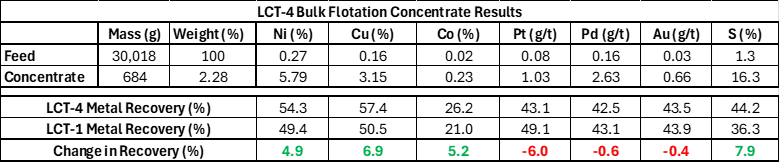
A subsequent flotation test, LCT-4, achieved recoveries of 54.3% nickel, 57.4% copper and 26.2% cobalt, improving on results reported July 16, 2026. Platinum, palladium and gold recoveries declined to 43.1%, 42.5% and 43.5%, respectively. The lower-grade LCT-4 concentrate will undergo further testing to determine whether similar extraction rates are achievable. The company said on-site refining could improve metal payability, but increased capital costs must be weighed against potential economic benefits.
Positive
- Minor pointPressure-oxidation testing achieved 97.2% nickel extraction from the composite flotation concentrate.
- Minor pointPressure-oxidation testing achieved 99.3% copper extraction from the composite flotation concentrate.
- Minor pointPressure-oxidation testing achieved 98.9% cobalt extraction from the composite flotation concentrate.
- Minor pointPressure-oxidation testing achieved 99.5% platinum extraction from the composite flotation concentrate.
- Minor pointPressure-oxidation testing achieved 86.1% palladium extraction from the composite flotation concentrate.
6 minor points
- Minor pointPressure-oxidation testing achieved 47.8% gold extraction from the composite flotation concentrate.
- Minor pointLCT-4 nickel recovery reached 54.3%, improving on results reported July 16, 2026.
- Minor pointLCT-4 copper recovery reached 57.4%, improving on results reported July 16, 2026.
- Minor pointLCT-4 cobalt recovery reached 26.2%, improving on results reported July 16, 2026.
- Minor point. Forward-looking: it has not happened yet and may not happen.Further hydrometallurgical testing is planned on lower-grade concentrate to assess extraction performance.
- Minor point. Forward-looking: it has not happened yet and may not happen.On-site refining could increase metal payability, particularly for copper, the company said.
Negative
- Minor point. Forward-looking: it has not happened yet and may not happen.On-site hydrometallurgical refining would require increased capital costs, the company said.
- Minor point. Forward-looking: it has not happened yet and may not happen.Lower-grade concentrate achieving similar extraction rates remains subject to further testing.
- Minor pointLCT-4 platinum recovery fell to 43.1% versus results reported July 16, 2026.
- Minor pointLCT-4 palladium recovery fell to 42.5% versus results reported July 16, 2026.
- Minor pointLCT-4 gold recovery fell to 43.5% versus results reported July 16, 2026.
- Minor pointLCT-4 produced lower-grade concentrate, assaying 5.79% nickel, 3.15% copper and 0.23% cobalt.
AI-generated analysis. How Rhea-AI works. Not financial advice.


VANCOUVER, BC / ACCESS Newswire / November 6, 2026 / Alaska Energy Metals Corporation (TSXV:AEMC)(OTCQB:AKEMF) ("AEMC" or the "Company") is pleased to report high extraction results from Pressure Oxidation ("POX") hydromet testing of the Eureka Deposit's bulk Ni-Cu concentrate produced during flotation locked cycle testing. The hydromet test work was completed by Simulus Laboratories in Welshpool, Western Australia using Lifezone's proprietary hydromet technology. These positive results are an important step in understanding the potential downstream value of metals that could be produced for the Eureka Deposit, Alaska.
AEMC CEO Gregory Beischer commented: "On-site hydrometallurgical refining would eliminate the need to ship concentrate to an existing smelter. No nickel smelters exist in the US. Additionally, we would realize much higher metal payability, particularly for copper, which is an important by-product for Nikolai. Strong metal extraction rates and better metal payablity should serve to improve project economics but must be balanced against increased capital costs. Importantly, hydrometallurgical processing at Nikolai would result in production of refined nickel and other critical and strategic metals in Alaska for American industrial markets and the US Department of War. Additionally, the increase in recovery rates in our most recent flotations tests are encouraging."
HYDROMET OBJECTIVES AND RESULTS
The objective of this hydromet study was to examine how bulk nickel - copper - cobalt sulfide concentrates from the Eureka Deposit respond to POX testing. To accomplish this objective, a composite flotation circuit sample from Locked Cycle Tests ("LCT") was subjected to pressure oxidation and solution treatment to determine the extraction rates of nickel, copper, cobalt, platinum, palladium and gold into solution from the concentrate. Head assay of the composite LCT sample was
Table 1. Concentrate Grades and POX Extraction Results

The results indicate several possible processing options including total or partial pressure oxidation, recovering the base and precious metals in a single stage via chlorinated pressure oxidation, or two stage leaching to recover the base and precious metals in two distinct streams.
AEMC plans further hydrometallurgical testing on lower grade concentrate samples that will be collected to maximize nickel recovery. If similar extraction rates can be realized on lower-grade concentrate samples there will be benefits to the project.
Economic assessment of the various options may be performed with this additional information in hand, including trade-off analysis of incremental metals recoveries against reagent consumptions and materials of construction and for the selected case, further refining test work planned.
ADDITONAL LOCKED CYCLE FLOTATION TESTING
Based on these successful results from hydromet POX testing, an additional flotation Locked Cycle test (LCT-4) was completed to determine if metal recovery rates could be increased. To achieve this, the secondary grind following the 1st cleaner cell was removed from LCT-4. The flow sheet illustrated below was completed for this additional locked cycle test (Figure 1).
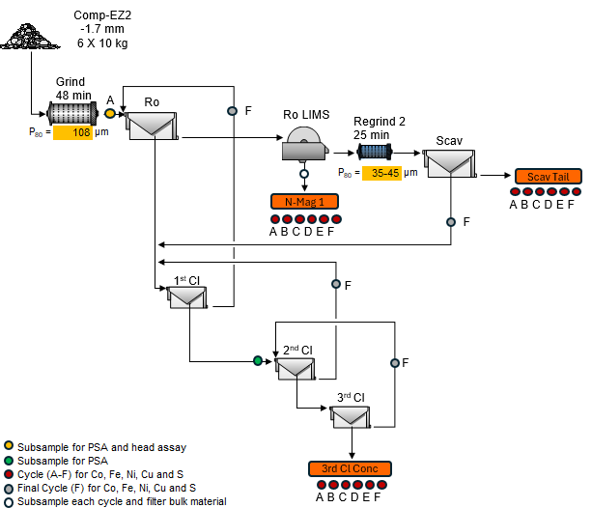
Figure 1. LCT-4 Flowsheet
Locked cycle test four (LCT-4) successfully achieved metal recoveries of
Table 2. LCT-4 Bulk Flotation Concentrate Metal Recoveries and Grades
FUTURE METALLURGICAL TEST WORK
The LCT-4 concentrate will be sent to Simulus Laboratories to determine if a lower grade bulk concentrate can achieve similar high metal extraction rates from hydrometallurgical testing.
QUALIFIED PERSON
Gregory Beischer, the Company's President & CEO, is the qualified person, as defined under National Instrument 43-101 Standards of Disclosure for Mineral Projects, responsible for, and having reviewed and approved, the technical information contained in this news release.
For additional information, visit: https://alaskaenergymetals.com/
ABOUT ALASKA ENERGY METALS
Alaska Energy Metals Corporation (AEMC) is an Alaska-based corporation with offices in Anchorage and Vancouver working to sustainably deliver the critical materials needed for U.S. national security and a bright energy future, all while generating superior returns for shareholders.
AEMC is focused on delineating and developing the large-scale, bulk tonnage, polymetallic Nikolai Project and related Eureka deposit containing nickel, copper, cobalt, chromium, iron, platinum, palladium, and gold. Located in Interior Alaska near existing transportation and power infrastructure, its flagship project, Nikolai, is well-situated to become a significant domestic source of strategic metals for North America. In January 2026, AEMC's Nikolai Project was accepted for Fast-41 Transparency Dashboard listing to streamline federal permitting for overland access and man camp placement for the next phase of Eureka deposit drilling. AEMC also holds a secondary project in western Quebec; the Angliers - Belleterre project. Today, material sourcing demands excellence in environmental performance, technological innovation, carbon mitigation and the responsible management of human and financial capital. AEMC works every day to earn and maintain the respect and confidence of the public and believes that environmental, social and governance performance is measured by action and led from the top.
ON BEHALF OF THE BOARD
"Gregory Beischer"
Gregory Beischer, President & CEO
FOR FURTHER INFORMATION, PLEASE CONTACT:
Gregory A. Beischer, President & CEO
Toll-Free: 877-217-8978 | Local: 604-609-7149
Some statements in this news release may contain forward-looking information (within the meaning of Canadian securities legislation), including but not limited to: further metallurgical including hydrometallurgical testing and economic analysis. These statements address future events and conditions and, as such, involve known and unknown risks, uncertainties, and other factors which may cause the actual results, performance, or achievements to be materially different from any future results, performance, or achievements expressed or implied by the statements. Forward-looking statements speak only as of the date those statements are made. Although the Company believes the expectations expressed in such forward-looking statements are based on reasonable assumptions, such statements do not guarantee future performance and actual results may differ materially from those in the forward-looking statements. Factors that could cause the actual results to differ materially from those in forward-looking statements include but are not limited to uncertainty relating to the estimation of mineral resources, regulatory actions, market prices, and continued availability of capital and financing, and general economic, market or business conditions. Investors are cautioned that any such statements are not guarantees of future performance and actual results or developments may differ materially from those projected in the forward-looking statements. Forward-looking statements are based on the beliefs, estimates and opinions of the Company's management on the date the statements are made. Except as required by applicable law, the Company assumes no obligation to update or to publicly announce the results of any change to any forward-looking statement contained or incorporated by reference herein to reflect actual results, future events or developments, changes in assumptions, or changes in other factors affecting the forward-looking statements. If the Company updates any forward-looking statement(s), no inference should be drawn that it will make additional updates with respect to those or other forward-looking statements.
Neither the TSX Venture Exchange nor its Regulation Services Provider (as that term is defined in the policies of the TSX Venture Exchange) accepts responsibility for the adequacy or accuracy of this press release.
SOURCE: Alaska Energy Metals Corp.
View the original press release on ACCESS Newswire
FAQ
AI-generated questions and answers. How Rhea-AI works. Not financial advice.
What metal extraction rates did Alaska Energy Metals achieve in Nikolai hydromet testing?
Pressure-oxidation testing extracted 97.2% nickel, 99.3% copper, 98.9% cobalt, 99.5% platinum, 86.1% palladium and 47.8% gold into solution from the tested concentrate. Simulus Laboratories completed the work using Lifezone's proprietary hydromet technology.
How did Alaska Energy Metals' LCT-4 flotation recoveries change?
LCT-4 improved nickel, copper and cobalt recoveries to 54.3%, 57.4% and 26.2%, respectively, compared with results reported July 16, 2026. Platinum, palladium and gold recoveries declined to 43.1%, 42.5% and 43.5%, respectively.
What processing options is Alaska Energy Metals considering for the Eureka concentrate?
Potential options include total or partial pressure oxidation, single-stage recovery of base and precious metals using chlorinated pressure oxidation, or two-stage leaching into separate streams. An economic assessment may follow additional testing, comparing incremental metal recoveries against reagent consumption and construction materials, with further refining test work planned for the selected option.