
New Report Highlights Security Gaps and Growing Need for Gunshot Detection in U.S. Sports & Entertainment Venues
Sentiment and the balance of points
Rhea-AI Sentiment reads the wording of the document, how positive or negative its language is on a 1 to 5 scale. The balance of points shown with the takes weighs what the document actually discloses, so the two can disagree, for example when a trial that missed its main goal is described in upbeat language.


Shooter Detection Systems analysis reveals critical gaps in venue security preparedness, emerging threats and opportunities to strengthen protection across stadiums, arenas and entertainment venues
TYSONS, Va.--(BUSINESS WIRE)-- Shooter Detection Systems (SDS), an Alarm.com company and a leading provider of automated gunshot detection technology, today released The State of Active Shooter Security at
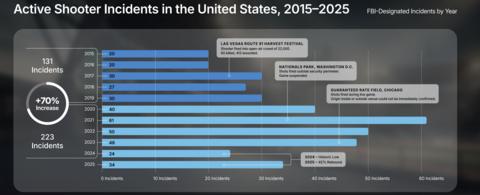
Active shooter incidents in
The report examines preparedness across
Key findings from the report include:
- Active shooter incidents remain a significant threat: There were 223 active shooter incidents in the
U.S . between 2020 and 2024, a70% increase over the previous five-year period. In 2025, incidents rose42% from the previous year, increasing from 24 to 34. - The threat extends beyond the venue entrance: Of the 223 active shooter incidents recorded between 2020 and 2024,
41% occurred in open spaces, a category that includes parking lots, public streets and other outdoor gathering areas similar to those surrounding sports and entertainment venues. - Venues have made significant security investments, but gunshot detection remains less widely deployed: Two-way radios and surveillance cameras are used at
96% of surveyed professional sports venues, while walk-through magnetometers are deployed at94% . By comparison, automated gunshot detection is deployed at just13% , despite30% of venue security directors identifying it as a priority investment if additional funding were available. - Security staffing shortages add to preparedness challenges:
65% of surveyed venue security directors experienced staffing shortages within the previous two years, while74% of professional sports venues rely on contracted security personnel to some extent on game days. - Preparedness varies between professional and collegiate venues:
64% of professional sports venues have obtained or are pursuing DHS SAFETY Act Certification for their security programs, compared with50% of collegiate venues. - Fans place significant trust in venue security: Approximately
80% of surveyed fans trust venues to have measures in place to protect them against an active shooter, while nearly three-quarters consider safety and security precautions when deciding whether to attend a sporting event.
“Sports and entertainment venues have built some of the most sophisticated security operations in the country, and security leaders are constantly adapting as threats and technology evolve,” said Billy Borho, Director at SDS. “Our goal with this report is to bring together the available research, highlight what the industry is already doing well and identify areas venue leaders may want to consider as they continue strengthening their security programs.”
The findings point to opportunities for venue leaders to strengthen security beyond traditional screening checkpoints. Approximately half of sports fans tailgate before events, while
“Throughout my career protecting critical infrastructure, one lesson has held true: resilience comes from layers that work together,” said Brian Harrell, former Assistant Secretary for Infrastructure Protection at the
The report outlines seven recommendations for venue security leaders, including evaluating outdoor security coverage, improving integration between existing systems, balancing staffing with automation and strengthening emergency preparedness. It also encourages venues to consider technology certification standards such as the
The analysis underscores the importance spectators place on security. Nearly three-quarters of surveyed fans consider safety and security precautions when deciding whether to attend a sporting event, reinforcing the role preparedness plays not only in operational planning but also in maintaining fan confidence.
The full report is available at www. shooterdetectionsystems.com/venuesecurityreport/.
About Shooter Detection Systems
Shooter Detection Systems (SDS) accelerates life-saving response for organizations during active shooter incidents by delivering immediate, precise threat intelligence to security teams and first responders. By enabling responders to pinpoint the location and progression of gunfire within seconds, SDS helps reduce response time and mitigate harm.
Using multi-mode acoustic and infrared technology, edge processing architecture, and more than 50 certified integrations with existing security platforms, SDS provides highly accurate, near-instant detection-to-alert capabilities — operating with privacy at the forefront. The system enhances existing security infrastructure without recording conversations or compromising privacy.
SDS is the only manufacturer whose indoor gunshot detection system holds the highest level of U.S. Department of Homeland Security SAFETY Act Certification and has been validated by premier third-party security authorities worldwide. The indoor system is also NPSA rated and approved for government use in the United Kingdom and Australia. SDS technology also undergoes annual third-party cybersecurity penetration testing.
Trusted by Fortune 500 companies, major universities, healthcare systems, critical infrastructure operators, and government facilities, Shooter Detection Systems is an Alarm.com (NASDAQ: ALRM) company. For more information, visit ShooterDetectionSystems.com or call 1-844-SHOT911. Follow SDS on Twitter @ShooterDetect and on LinkedIn.
View source version on businesswire.com: https://www.businesswire.com/news/home/20261119673992/en/
Media Contact:
Alexandra Pony
alexandra@ponycommunications.com
250.858.0656
Source: Shooter Detection Systems