Ameresco Delivers $7.8M Infrastructure Upgrade for Tacoma Public Schools to Enhance Energy Efficiency
Ameresco Delivers $7.8M Infrastructure Upgrade for Tacoma Public Schools to Enhance Energy Efficiency
Ameresco (NYSE: AMRC) announced substantial completion of a $7.8M Progressive Design‑Build HVAC upgrade for Tacoma Public Schools’ McKinley Swing School, finished December 31, 2025.
Rhea-AI Sentiment reads the wording of the document, how positive or negative its language is on a 1 to 5 scale. The balance of points shown with the takes weighs what the document actually discloses, so the two can disagree, for example when a trial that missed its main goal is described in upbeat language.
Progressive Design-Build project modernizes HVAC systems at a historic learning facility, improving efficiency and long-term cost-savings for the local community
FRAMINGHAM, Mass. & TACOMA, Wash.--(BUSINESS WIRE)--
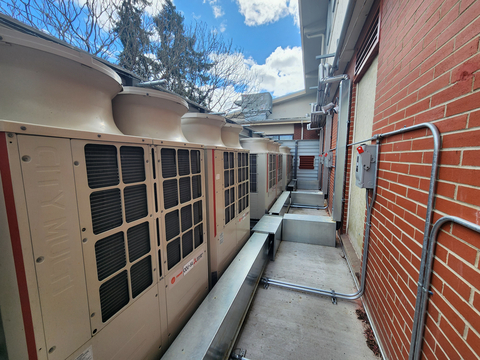
Ameresco, Inc., (NYSE: AMRC), a leading energy infrastructure solutions provider, today announced the substantial completion of a Progressive Design‑Build project for Tacoma Public Schools to modernize the HVAC system at McKinley Swing School, supporting improved energy efficiency and a more optimized learning environment for students and staff.
Ameresco delivers a modernized HVAC system for the district’s historic learning facility through innovative Progressive Design-Build model, driving efficiency.
The project, valued at $7.8 million, included an upgrade of the McKinley Swing School’s aging HVAC system, which had reached the end of its life, while also navigating the requirements of the historical registry, ensuring upgrades were sensitive to the school’s historic character and preservation guidelines. As portions of the building remained occupied throughout construction, the team coordinated closely with the district to maintain safe and functional educational spaces. The project achieved substantial completion on December 31, 2025.
In addition to modernizing energy infrastructure, the project supported Pierce County’s utilization goals, including a 30 percent engagement of local contractors and participation by small and minority/women-owned business enterprises (MWBE).
“This project represents a major step forward for our school and community,” said Greg Stidham, Project Manager, at Tacoma Public Schools. “By replacing the aged boiler system with a modern HVAC system, we’re creating a more comfortable and reliable learning environment so students and staff can focus on what matters most. Collaborating with Ameresco allowed our district to plan carefully, prioritize student needs, and progress the work with minimal disruption to learning.”
Building on a longstanding partnership with Tacoma Public Schools, the project followed a Progressive Design-Build model, an emerging approach that allows scope and cost to be defined collaboratively during an initial development phase. Unlike traditional Design-Build, where scope and pricing are fixed at procurement, Progressive Design-Build emphasizes qualifications and establishes a guaranteed project cost after design development, making it particularly well suited for end-of-life infrastructure replacement projects.
“We’re proud to further our partnership with Tacoma Public Schools through this project,” said Lou Maltezos, Co-President of Ameresco. “Leveraging a Progressive Design-Build model allowed us to work collaboratively to define scope, manage costs, and deliver energy infrastructure that supports the needs of a historic school facility and the community it serves.”
Founded in 2000, Ameresco, Inc. (NYSE:AMRC) is a leading energy infrastructure solutions provider dedicated to helping customers reduce costs, enhance resilience, and decarbonize to net zero in the global energy transition. Our comprehensive portfolio includes implementing smart energy efficiency solutions, upgrading aging infrastructure, and developing, constructing, and operating distributed energy resources. As a trusted full-service partner, Ameresco shows the way by reducing energy use and delivering energy infrastructure solutions to Federal, state and local governments, utilities, data centers, educational and healthcare institutions, housing authorities, and commercial and industrial customers. Headquartered in Framingham, MA, Ameresco has more than 1,500 employees providing local expertise in North America and Europe. For more information, visit www.ameresco.com.
The announcement of completion of a customer’s project contract is not necessarily indicative of the timing or amount of revenue from such contract, of Ameresco’s overall revenue for any particular period or of trends in Ameresco’s overall total project backlog. This project was included in Ameresco’s previously reported contracted backlog as of December 31, 2025.
Media Contact:
Ameresco: Leila Dillon, 508-661-2264, news@ameresco.com
Source: Ameresco, Inc.
Key Terms
progressive design-buildtechnical
A progressive design-build is a project delivery method where an owner hires a single team of designers and builders early and lets the project details, scope and price evolve together as design work advances. Think of it like hiring a contractor to sketch and refine a house with you step by step, rather than agreeing a fixed plan up front; it can speed delivery, improve coordination, and reduce costly surprises. Investors care because it can improve schedule certainty and cost control while shifting more accountability for delivery to one party.
hvactechnical
HVAC stands for heating, ventilation and air conditioning — the systems that control temperature, airflow and indoor air quality in buildings. Investors care because HVAC drives operating costs, energy use, tenant comfort and regulatory compliance; like the engine and insulation of a building, efficient modern systems can lower bills, reduce repair and replacement spending, and preserve property value, while outdated units can create unexpected expenses and vacancy risk.
historical registryregulatory
A historical registry is an organized archive of past records, filings or registrations that preserves original information and timestamps so users can see how facts, ownership, approvals or disclosures evolved over time. For investors it acts like a searchable logbook or library, enabling verification of claims, tracking of trends or corporate actions, and supporting due diligence and regulatory compliance by showing an audit trail of what happened and when.
minority/women-owned business enterprises (mwbe)regulatory
Minority/women-owned business enterprises (MWBE) are companies that are at least partly owned and controlled by people from underrepresented racial or ethnic groups or by women, often verified by a formal certification. For investors, MWBE status matters because it can open extra business opportunities—like access to government or corporate set-aside contracts—and signal management diversity and community ties, which can affect growth prospects, stability, and reputational value much like a company joining a preferred supplier network.