
Aptiv Introduces Advanced Occupancy Classification, The Industry’s First Camera-Only Occupant Detection System
Aptiv (NYSE: APTV) launched its Advanced Occupancy Classification (AOC), a camera-only occupant detection system that replaces traditional in-seat hardware.




Aptiv’s Advanced Occupancy Classification (AOC) delivers smarter safety, simpler design and up to
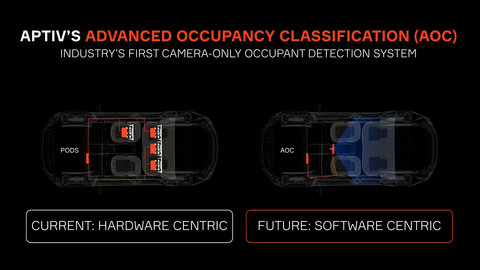
Aptiv’s Advanced Occupancy Classification (AOC) replaces traditional in-seat hardware with a vision-based software solution—reducing both system complexity and cost.
Built on more than two decades of Aptiv leadership in occupant detection, AOC is an advanced software solution that leverages artificial intelligence (AI) and computer vision to accurately classify occupants based on parameters such as height, weight, and body position. This enables optimized airbag deployment decisions while significantly reducing system complexity and cost for automakers.
“Aptiv’s Advanced Occupancy Classification represents a strategic leap forward in cabin innovation,” said Matthew Cole, Senior Vice President, Sensors and Compute, Aptiv. “By moving to a camera-only architecture, we are leading a new generation of intelligent, software-defined safety features enabled through a single sensor. AOC provides automakers with a smarter, more scalable foundation for the future of the in-cabin experience, delivering the proven performance, safety and reliability they expect from Aptiv.”
Unlike conventional pressure‑based occupant detection systems, AOC can work with most existing vehicle interior cameras to accurately distinguish adults, children, infants in carriers, and inanimate objects, while also recognizing posture, size, seating position, and orientation. This enables the airbag system to suppress deployment or tailor inflation force and timing to reduce injury risk — especially important for children, smaller occupants, or out-of-position passengers.
Advanced Occupancy Classification achieved
A Platform for Smart‑Cabin Intelligence at Lower Cost
By removing airbag in‑seat hardware, AOC significantly streamlines system architecture. A single interior camera replaces multiple sensors and wiring, lowering bill‑of‑materials cost by up to
The simplified architecture also gives automakers greater flexibility, enabling thinner seat profiles and easier integration of comfort features such as heating, cooling and massage, without compromising safety performance.
OEMs can also leverage the same interior camera to deliver more than 15 additional safety and comfort functions, including seatbelt-status monitoring, driver-attention tracking, gesture recognition, body‑pose analysis and hands-on-wheel detection, among others.
Aptiv’s machine learning and logic fusion capabilities integrate inputs from multiple sensors, AI models and key vehicle data to deliver highly stable, robust occupant classification, while the over-the-air upgradable system provides OEMs with a future-resilient solution that adapts as safety regulations evolve. This reduces redesign costs, extends hardware life, and enables new features over time without adding sensors or increasing integration complexity.
Advanced Occupancy Classification extends Aptiv’s commitment to continuous innovation and helping customers deliver safer, more intelligent, and more cost‑effective vehicles.
AOC will be showcased as part of a live vehicle demo at InCabin
To learn more, visit Aptiv’s AOC webpage.
About Aptiv
Aptiv PLC (NYSE: APTV) is a global industrial technology leader delivering advanced solutions people trust when it matters most across automotive, commercial vehicle, aerospace and defense, telecom and datacom, and other diversified industrial end markets. Our differentiated portfolio enables devices and systems to sense, think, act, and continuously optimize performance. Building on decades of innovation, Aptiv brings global scale and a resilient, localized value chain to customers across the globe. Learn more at Aptiv.com.
View source version on businesswire.com: https://www.businesswire.com/news/home/20260608385007/en/
Lisa Scalzo
Aptiv Corporate Communications
lisa.scalzo@aptiv.com
Ariel Gavilan
Aptiv Corporate Communications
ariel.gavilan@aptiv.com
Source: Aptiv PLC