
Aris Mining Announces Positive PFS Results for the Toroparu Gold Project
Sentiment and the balance of points
Rhea-AI Sentiment reads the wording of the document, how positive or negative its language is on a 1 to 5 scale. The balance of points shown with the takes weighs what the document actually discloses, so the two can disagree, for example when a trial that missed its main goal is described in upbeat language.


5.9 Moz of Proven and Probable Gold Mineral Reserves at
5.6 Moz of Planned Gold Production Over 29 Years; 258 koz Annually in Years 1–17
Initial funding requirement of
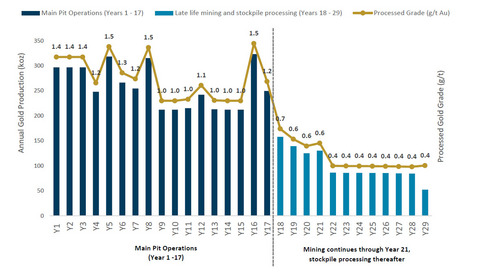
Figure 1 – Toroparu annual gold production and processed gold grade
Neil Woodyer, Chair and CEO, commented “Toroparu is positioned to become our next major growth project. The PFS confirms a large-scale, long-life operation with compelling economics, a substantially larger mineral resource base compared to the 2025 PEA1, and a practical development plan designed to reduce execution risk. Our large-scale mining licence application, submitted in August, is progressing through the regulatory review process. We appreciate the constructive engagement with the Government of
The PFS incorporates an execution strategy suited to the Project’s large scale and remote location, with a planned 32-month construction schedule. We have also replaced the owner-mining approach contemplated in the 2025 PEA with the use of experienced mining contractors, with costs supported by competitive international quotations.
We are sequencing Toroparu within our broader growth strategy, targeting a construction decision in early 2027, subject to the required approvals, and following first gold from the Marmato CIP plant expected in December 2026. In parallel, we are expanding our
Project Highlights: a Large-Scale, Long-Life Open Pit Mine
- Proven and probable mineral reserves of 5.1 Moz at 1.18 g/t Au (above 0.50 g/t) and 0.9 Moz at 0.40 g/t Au (below 0.50 g/t and the marginal cut-off grade) for a total mineral reserve of 5.9 Moz. See Table 3 for the detailed technical disclosure.
-
Step-change increase in the mineral resource estimate compared to the 2025 PEA:
-
Measured and indicated gold mineral resources increased to 9.3 Moz, up
74% from the PEA -
Inferred gold mineral resources increased by 1.4 Moz, up
115% from the PEA. - See Table 4 for the detailed technical disclosure.
-
Measured and indicated gold mineral resources increased to 9.3 Moz, up
-
Lower-grade tonnes add value and extend operating life: material previously treated as waste in the 2025 PEA is now planned to be stockpiled for processing later in the mine life, generating positive operating margin at the mineral reserve gold price of
$1,950 - 32-month construction schedule for development of a conventional truck-and-shovel open pit mine with a 3.3 to 1 life-of-mine strip ratio, a 7.0 Mtpa processing plant and other mine infrastructure.
-
Conservative mine design and robust mining schedule. Mineral reserve pit designs are based on a
$1,950 $3,600 - Contractor mining strategy aligned with project scale and workforce development objectives. The PFS incorporates mining by experienced third-party contractors, reflecting the scale of the operation and the importance of accessing specialized mining expertise while supporting local employment, training and skills development opportunities. Mining cost estimates are informed by quotations from multiple international mining contractors. This approach replaces the owner-operated, equipment-leasing model contemplated in the 2025 PEA.
- Tailored construction delivery strategy reflecting the Project’s large scale and remote location. The PFS incorporates a combination of engineering, procurement and construction management (EPCM), design-and-construct (D&C), engineering, procurement and construction (EPC), and self-performed work. The delivery model for each project area has been selected based on specific scope and execution requirements, with the objectives of strengthening cost and schedule control while managing execution risk.
-
Large-scale mining licence application submitted in August 2026. The Government of
Guyana is advancing their review of the large-scale mining license application.
Production and Costs
-
Production of doré and copper concentrates containing 5.6 Moz gold, 5.3 Moz silver, and 235 million pounds (Mlb) of copper over the processing life.
- Average annual gold production of 291 thousand ounces (koz) over the first five years.
- Average annual gold production of 258 koz during the main pit operations (first 17 years), followed by 103 koz during late-life mining and stockpile processing (years 18-29).
-
Low life-of-mine cash costs2,3 of
$1,119 $1,494
Capital Costs and Returns
-
Initial funding requirement of
$1,005 million $1,017 million $102 million $24 million $138 million -
Compelling base case economics at metal prices of
$3,600 $50 $5.00 $19.9 billion $1.3 billion -
Average annual EBITDA2 of
$588 million $176 million -
After-tax net present value at a
5% discount rate (NPV5% ) of$2.8 billion -
Internal rate of return (IRR) of
31.5% . - Payback period of 2.2 years from the start of operations.
-
Average annual EBITDA2 of
-
Robust economics at lower gold prices, with an after-tax NPV
5% $1.8 billion 24.3% at a gold price of$3,000 -
Significant additional value at higher gold prices, with after-tax NPV
5% of$3.8 billion 37.8% at a gold price of$4,200
Figure 1 illustrates Toroparu's planned gold production and processed grade profile. Higher-grade ore is prioritized in the earlier years, while lower-grade stockpiles extend processing through Year 29. Gold production averages 258 koz per year during the first 17 years of main-pit operations and 195 koz over the full 29-year processing life, with peak annual production of approximately 323 koz in Year 16.
The open pit optimization and mineral reserve pit designs were based on a
PFS Report Availability
A complete National Instrument 43-101 – Standards of Disclosure for Mineral Projects (NI 43-101) compliant Technical Report titled “NI 43-101 Technical Report Prefeasibility Study for the Toroparu Project, Cuyuni-Mazaruni Region, Guyana” dated November 12, 2026 and with an effective date of November 12, 2026 (the Technical Report) has been filed on SEDAR+ and with the SEC on EDGAR, and is also available on the Company’s website at https://www.aris-mining.com/operations-and-projects/technical-reports.
Positioned to be Guyana’s next major gold mine
With the PFS complete and the large-scale mining license application under review, Toroparu is progressing through pre-development activities. Aris Mining continues to target a construction decision in early 2027, subject to receiving the large-scale mining licence and other necessary approvals. The PFS contemplates a 32-month construction period and supports Toroparu's potential to become a major new long-life gold mine in
Table 1 – Toroparu PFS economic evaluation sensitivity to gold price
Gold price Indicator |
|
|
|
After-tax NPV |
|
|
|
After-tax IRR (%) |
|
|
|
Payback period (years) |
2.7 |
2.2 |
1.9 |
The sensitivity analysis in Table 1 shows that at higher gold prices, returns increase substantially beyond the attractive levels of the base case scenario while remaining robust at lower gold prices.
The economic analysis also includes the historic precious metals stream agreement with Wheaton Precious Metals International Ltd. (Wheaton), originally entered into in 2013 and amended in 2015, when Toroparu was owned by Sandspring Resources Ltd., a single-asset junior developer. Under this agreement, Wheaton may elect to provide
Table 2 – PFS Economic evaluation results
Key indicators |
Units |
Main Pit Operations
|
Late-life Mining & Stockpile Processing (Years 18-29)
|
Total / Life-of-operation average |
Total gold produced in period |
Moz |
4.4 |
1.2 |
5.6 |
Mining Years |
Years |
1 to 17 |
18 to 21 |
21 |
Processing Years |
Years |
1 to 17 |
18 to 28.6 |
28.6 |
Average annual gold production |
koz |
258 |
103 |
195 |
Average cash cost2,3 |
$/oz Au |
1,003 |
1,529 |
1,119 |
Average all in sustaining cost2,3 |
$/oz Au |
1,395 |
1,841 |
1,494 |
Average annual EBITDA2 |
$M |
588 |
176 |
423 |
Summary cash flow ($M) at |
|
|
|
|
Revenue from payable gold sales |
$M |
15,592 |
4,267 |
19,859 |
Less: royalties |
$M |
1,262 |
347 |
1,609 |
Less: operating costs |
$M |
5,238 |
2,191 |
7,429 |
Less: sustaining capital |
$M |
437 |
22 |
459 |
Add: by-product copper and silver revenues, net of TCRCs |
$M |
(896) |
(363) |
(1,259) |
Operating margin |
$M |
9,551 |
2,069 |
11,620 |
Less: income tax |
$M |
2,420 |
613 |
3,033 |
Working capital (inflows)/outflows |
$M |
(109) |
114 |
5 |
After-tax cash flow |
$M |
7,241 |
1,342 |
8,583 |
Less: construction capital with contingency allowances |
$M |
1,119 |
- |
1,119 |
Credit: construction funding from Toroparu PMPA |
$M |
(138) |
- |
(138) |
Less: additional project capital during operations |
$M |
175 |
27 |
202 |
Less: closure costs |
$M |
- |
60 |
60 |
Net cash flow, before costs of Toroparu PMPA financing |
$M |
6,085 |
1,255 |
7,340 |
Less: costs of Toroparu PMPA financing |
$M |
1,477 |
412 |
1,888 |
Net cash flow |
$M |
4,608 |
843 |
5,451 |
Pre-tax indicators at |
|
|
|
|
NPV at |
$M |
|
|
4,374 |
IRR |
% |
|
|
|
Payback period (from start of operations) |
Years |
|
|
1.8 |
After-tax indicators at |
|
|
|
|
NPV at |
$M |
|
|
2,828 |
IRR |
% |
|
|
|
Payback period (from start of operations) |
Years |
|
|
2.2 |
After-tax indicators at |
|
|
|
|
NPV at |
$M |
|
|
3,819 |
IRR |
% |
|
|
|
Payback period (from start of operations) |
Years |
|
|
1.9 |
Table 3 - Toroparu mineral reserves, effective November 12, 2026
Gold cut-off grade |
Classification |
Tonnes (Mt) |
Grade gold (g/t) |
Grade silver (g/t) |
Grade copper (%) |
Contained gold (koz) |
Contained silver (koz) |
Contained copper (Mlb) |
Total above marginal1 |
Proven |
91.2 |
0.96 |
1.4 |
0.10 |
2,808 |
3,995 |
209 |
Probable |
109.1 |
0.89 |
0.9 |
0.05 |
3,114 |
3,029 |
113 |
|
Proven + Probable |
200.2 |
0.92 |
1.1 |
0.07 |
5,922 |
7,024 |
322 |
|
Including above 0.50 g/t |
Proven |
61.4 |
1.23 |
1.5 |
0.12 |
2,423 |
2,937 |
156 |
Probable |
72.2 |
1.14 |
0.9 |
0.05 |
2,635 |
2,159 |
80 |
|
Proven + Probable |
133.6 |
1.18 |
1.2 |
0.08 |
5,058 |
5,096 |
236 |
|
Including between 0.50 g/t and marginal |
Proven |
29.8 |
0.40 |
1.1 |
0.08 |
385 |
1,058 |
53 |
Probable |
36.9 |
0.40 |
0.7 |
0.04 |
479 |
870 |
33 |
|
Proven + Probable |
66.6 |
0.40 |
0.9 |
0.06 |
864 |
1,928 |
85 |
|
Notes:
|
||||||||
Table 4 - Toroparu mineral resources, effective November 12, 2026
Gold cut-off grade |
Classification |
Tonnes (Mt) |
Grade gold (g/t) |
Grade silver (g/t) |
Grade copper (%) |
Contained gold (koz) |
Contained silver (koz) |
Contained copper (Mlb) |
Total above marginal1 |
Measured |
115.0 |
0.87 |
1.3 |
0.10 |
3,232 |
4,908 |
255 |
Indicated |
246.0 |
0.76 |
0.7 |
0.04 |
6,022 |
5,911 |
228 |
|
Measured + Indicated |
360.9 |
0.80 |
0.9 |
0.06 |
9,254 |
10,820 |
483 |
|
Inferred |
115.4 |
0.68 |
0.2 |
0.02 |
2,535 |
644 |
62 |
|
Including above 0.60 g/t |
Measured |
55.1 |
1.39 |
1.6 |
0.12 |
2,459 |
2,797 |
149 |
Indicated |
105.5 |
1.24 |
0.8 |
0.05 |
4,216 |
2,881 |
113 |
|
Measured + Indicated |
160.6 |
1.29 |
1.1 |
0.07 |
6,675 |
5,679 |
262 |
|
Inferred |
43.6 |
1.15 |
0.2 |
0.03 |
1,617 |
247 |
25 |
|
Including between 0.60 g/t and marginal |
Measured |
59.9 |
0.40 |
1.1 |
0.08 |
773 |
2,111 |
106 |
Indicated |
140.5 |
0.40 |
0.7 |
0.04 |
1,806 |
3,030 |
115 |
|
Measured + Indicated |
200.4 |
0.40 |
0.8 |
0.05 |
2,578 |
5,141 |
221 |
|
Inferred |
71.8 |
0.40 |
0.2 |
0.02 |
918 |
396 |
37 |
|
Notes:
|
||||||||
Endnotes
- See superseded technical report entitled “NI 43-101 Technical Report, Preliminary Economic Assessment for the Toroparu Project, Cuyuni-Mazaruni Region, Guyana” with an effective date of October 21, 2025 and a report date of October 28, 2025. This preliminary economic assessment was preliminary in nature and included inferred mineral resources that were considered too speculative geologically to have the economic considerations applied to them that would enable them to be categorized as mineral reserves. Accordingly, there is no certainty that the preliminary economic assessment would be realized.
- Cash costs ($ per oz sold), AISC ($ per oz sold) and EBITDA are non-GAAP financial measures without standardized meanings under IFRS and may not be comparable to similar measures used by other issuers or considered in isolation or as substitutes for IFRS measures; refer to the Non-GAAP Financial Measures section of this document for further information.
- Cash costs per ounce and AISC per ounce are calculated on a payable gold ounce basis and include open pit mining, treatment, transport, refining, processing, logistics, surface, G&A and other costs, net of silver and copper by-product credits.
About Aris Mining
Aris Mining is a Canadian gold mining company focused on South America. The Company operates the Segovia and Marmato underground gold mines in Colombia, which together produced approximately 257,000 ounces of gold in 2025. Aris Mining is listed on the Toronto Stock Exchange and the New York Stock Exchange under the symbol ARIS.
The Company is advancing expansion projects at Segovia and Marmato that are expected to increase annual gold production to 500,000 ounces1, driven by the ramp-up at Segovia following the installation of the second mill and construction of the new Marmato bulk mine and CIP plant, with first gold expected in December 2026.
Aris Mining’s portfolio supports a longer-term objective of approximately 1 million ounces of annual gold production2. Key projects include the high-grade Soto Norte gold project in Colombia, where preparation of the Environmental and Social Impact Assessment (ESIA) has been completed for community engagement, and the Toroparu gold project in Guyana, where a construction decision is targeted for early 2027.
Additional information on Aris Mining can be found at www.aris-mining.com, www.sedarplus.ca, and on www.sec.gov.
Qualified Persons and Cautionary Language
Qualified Persons
The Toroparu Gold Project Prefeasibility Study “NI 43-101 Technical Report Prefeasibility Study for the Toroparu Project, Cuyuni-Mazaruni Region, Guyana” was prepared in accordance with NI 43-101 by the following Qualified Persons, all of whom are independent of Aris Mining for the purposes of NI 43-101, with the exception of Pamela De Mark, P.Geo., Senior Vice President Geology and Exploration of Aris Mining Corporation, and Ignacio Vélez, FAusIMM, Vice President Technical Services Colombia, Aris Mining Corporation:
- Ignacio Vélez, FAusIMM, Vice President Technical Services Colombia, Aris Mining Corporation;
- Jan Eklund, P.E., Process Consultant, LogiProc Pty. Ltd.;
- Dawie le Roux, Pr.Eng., Partner and SMPP Engineering Manager, LogiProc Pty. Ltd.;
- Kevin Leahy, C.Geol., Geologist and Associate Partner, Environmental Resource Management Ltd.;
- Chris Fourie, Pr.Eng., Director of Tailings Engineering, Eco Elementum Engineering; and
- Pamela De Mark, P.Geo., Senior Vice President of Geology and Exploration, Aris Mining Corporation.
Pamela De Mark, P.Geo., Senior Vice President Geology and Exploration of Aris Mining, is a Qualified Person as defined by NI 43-101, and has reviewed and approved the technical information contained in this news release.
Non-GAAP Financial Measures
Cash costs ($ per oz sold), AISC ($ per oz sold) and EBITDA are non-GAAP financial measures and ratios that lack standardized meanings under IFRS or US GAAP and may not be comparable to those of other issuers or considered in isolation or as substitutes for IFRS measures. Cash costs per ounce and AISC per ounce are calculated by dividing total cash costs and AISC, respectively, by projected payable gold ounces produced, while EBITDA represents earnings before interest, income taxes, depreciation, depletion and amortization.
Forward-Looking Information
This news release contains "forward-looking information" or "forward-looking statements" within the meaning of Canadian and United States securities legislation. All statements included herein, other than statements of historical fact, including, without limitation, statements relating to the results of the PFS, including projected production of gold, silver and copper, mining and processing life, projected capital and operating costs, funding requirements and financial returns, the sensitivity of the Project’s economics to gold prices, projected metal prices and other assumptions underlying the PFS, the mineral reserve and mineral resource estimates for the Project, the expected benefits of the contractor mining and fit-for-purpose construction delivery strategies, the anticipated construction schedule, the mining licence application review process and the timing of receipt of that licence and other necessary approvals, the targeted construction decision for Toroparu, the potential for Toroparu to become a major long-life gold mine in Guyana, the availability of construction funding, , the intention of Aris Mining and Wheaton to explore opportunities for amending the Wheaton precious metals purchase agreement, the building of the Company’s Guyana team and the advancement of engineering and pre-construction activities, the timing of the first gold pour at the Marmato CIP plant, and statements included in the "About Aris Mining" section of this news release relating to the Segovia and Marmato expansions, the expected increase in annual gold production to 500,000 ounces, the objective of reaching approximately 1 million ounces of annual gold production, are forward-looking. Generally, the forward-looking information and forward looking statements can be identified by the use of forward looking terminology such as "plans", "expects" or "does not expect", "is expected", "budget", "scheduled", "estimates", "forecasts", "intends", "anticipates" or "does not anticipate", "will continue" or "believes", or variations of such words and phrases or state that certain actions, events or results "may", "could", "would", "might" or "will be taken", "occur" or "be achieved”. The material factors or assumptions used to develop forward looking information or statements are disclosed throughout this news release and include, among others, the metal price assumptions of
Forward looking information and forward looking statements, while based on management's best estimates and assumptions, are subject to known and unknown risks, uncertainties and other factors that may cause the actual results, level of activity, performance or achievements of Aris Mining to be materially different from those expressed or implied by such forward-looking information or forward looking statements, including but not limited to risks relating to the timing of receipt of the large-scale mining licence and other necessary approvals for the Project, variations in metal prices, capital and operating costs and other assumptions underlying the PFS, the availability and performance of mining and construction contractors and internal teams involved in the construction delivery strategy, the receipt of the Wheaton construction funding, the negotiation of any amendments to the Wheaton precious metals purchase agreement, and those factors discussed in the section entitled "Risk Factors" in Aris Mining's annual information form dated March 11, 2026 which is available on SEDAR+ at www.sedarplus.ca and included as part of the Company’s Annual Report on Form 40-F, filed with the SEC at www.sec.gov.
Although Aris Mining has attempted to identify important factors that could cause actual results to differ materially from those contained in forward-looking information and forward-looking statements, there may be other factors that cause results not to be as anticipated, estimated or intended. There can be no assurance that such information or statements will prove to be accurate, as actual results and future events could differ materially from those anticipated in such information or statements. The Company has and continues to disclose in its Management's Discussion and Analysis and other publicly filed documents, changes to material factors or assumptions underlying the forward-looking information and forward-looking statements and to the validity of the information, in the period the changes occur. The forward-looking statements and forward-looking information are made as of the date hereof and Aris Mining disclaims any obligation to update any such factors or to publicly announce the result of any revisions to any of the forward-looking statements or forward-looking information contained herein to reflect future results. Accordingly, readers should not place undue reliance on forward-looking statements and information.
________________________________________ |
1 Reflects expected steady-state annual gold production of approximately 300 thousand ounces (koz) at |
2 There can be no assurance that the projected production will be achieved. Such production also remains subject to obtaining all necessary permits and to formal construction decisions by the Company, in each case for both Soto Norte and Toroparu. |
View source version on businesswire.com: https://www.businesswire.com/news/home/20261112013692/en/
Aris Mining Contact
Oliver Dachsel
Senior Vice President, Capital Markets
+1.917.847.0063
Lillian Chow
Director, Investor Relations & Communications
info@aris-mining.com
Source: Aris Mining Corporation