
Astra Provides Progress Update on Phase II Drill Program at La Manchuria Gold and Silver Project, Argentina
Astra Exploration (OTCQB: ATEPF) reports it is about halfway through a 10,000 metre Phase II diamond drill program at La Manchuria, with 5,119 metres in 25 holes completed.
Sentiment and the balance of points
Rhea-AI Sentiment reads the wording of the document, how positive or negative its language is on a 1 to 5 scale. The balance of points shown with the takes weighs what the document actually discloses, so the two can disagree, for example when a trial that missed its main goal is described in upbeat language.
Rhea-AI Summary
Astra Exploration (OTCQB: ATEPF) reports it is about halfway through a 10,000 metre Phase II diamond drill program at La Manchuria, with 5,119 metres in 25 holes completed. Initial assays are expected in December 2025 with most results in early 2026; drilling is paused pending results and will resume in early 2026.
Key technical highlights include a strike extension of the West Feeder from ~500 m to 800 m, veins or veinlets in every hole, a first continuous vein in the Eastern Zone (~200 m strike, up to 150 m depth), a new parallel structure ~350 m northeast (Road Zone), and a 3-D resistivity model that is successfully predicting subsurface veins.
Positive
- 5,119 metres drilled in Phase II across 25 holes
- Phase II ~50% complete of a 10,000 metre program
- Main Zone strike extended from ~500m to ~800m
- Continuous Eastern Zone vein ≥200m strike, up to 150m deep
- Veins or veinlets intercepted in every drill hole
- 3-D geophysical model accurately predicting subsurface veins
Negative
- Drilling paused pending assays; restart expected early 2026
- Assays for 25 Phase II holes remain pending
- Major assay dataset expected mainly in early 2026
Details
News Market Reaction – ATEPF
On Dec 1, the day this news came out, ATEPF closed 1.81% above the previous close.
Data tracked by StockTitan Argus for the Dec 1 session.
Key Figures
- Phase II program size
- 10,000 metres DDH
- Planned Phase II drill program at La Manchuria
- Phase II completed
- 5,119 metres in 25 holes
- Phase II progress as of Dec 1, 2025
- Main Zone strike
- Extended from ~500 m to 800 m
- West Feeder vein system
- Eastern Zone vein
- ≥200 m strike, up to 150 m deep
- First continuous vein in Eastern Zone
- New parallel structure
- ≈350 metres northeast
- New vein structure near Eastern Zone
- Ground magnetics
- 150 line-kilometres
- Regional ground magnetics expansion
- Phase I drilling
- 11 holes, 2,468 metres
- Maiden La Manchuria drill program
- Treasury balance
- Over C$7,000,000
- Funding Phase II drilling (Oct 29, 2025)
Historical Context
-
Halfway Phase II drilling with extended strike and new vein structures.
-
Commencement of fully funded 10,000 m Phase II drilling at La Manchuria.
-
Mobilization of ground crews and mapping ahead of Phase II program.
-
Webinar showcasing high-grade drilling intercepts at La Manchuria.
-
Release of multiple high-grade gold-silver veins from Phase I drilling.
24h Move is the share-price change in the day after each event; other market factors may also have contributed.
Key Terms
epithermal vein system medical
3-D geophysical model technical
resistivity technical
ground magnetics technical
fault blocks technical
ohm-m technical
diamond drill holes technical
resistivity highs technical
AI-generated analysis. How Rhea-AI works. Not financial advice.




Vancouver, British Columbia--(Newsfile Corp. - December 1, 2025) - Astra Exploration Inc. (TSXV: ASTR) (OTCQB: ATEPF) (FSE: S3I) ("Astra" or the "Company") is pleased to provide a progress update on exploration activities at the La Manchuria Gold and Silver Project in Santa Cruz, Argentina.
The Company is approximately halfway through its 10,000 metre Phase II drill program, with 5,119 metres of DDH in 25 holes currently completed. Initial assays are expected in December, with the bulk of results returned in early 2026. Drilling has paused for results and will resume in early 2026.
Current Phase II Highlights include:
- Significant strike extension of the West Feeder vein system;
- A newly constructed 3-D geophysical model is accurately predicting veins below surface;
- Veins and/or veinlets encountered in every drill hole;
- Definition of the first continuous vein at Eastern Zone;
- A new parallel vein structure approximately 350 metres northeast of the Eastern Zone.
Astra's Exploration Director, Diego Guido commented:
"The Phase II drill program was designed to test lateral extensions of the shallow epithermal vein system, and to test a new 3-D geophysical targeting model. All of the drill holes intersected veins and/or veinlets with clear evidence of mineralization in some of them.
"The strike length of the Main Zone has been extended from approximately 500 to 800 metres, particularly in the West Feeder veins. We have also confirmed the first continuous vein of at least 200 metres of strike length and up to 150 meters deep in the Eastern Zone, and have intersected a new parallel structure about 350 metres northeast of the Eastern Zone. The recently constructed 3-D geophysical model has demonstrated to be a powerful tool for targeting mineralized veins beneath surface. We will continue testing the model with more drilling inside the existing survey boundary, and will expand that survey to other areas of the project prior to restarting drilling."
Program Details
Prior to drilling, the company completed a comprehensive program of detailed geological mapping, together with the compilation and reprocessing of geophysical data. Regional ground magnetics were expanded with an additional 150 line-kilometres, and raw geophysical data was reprocessed to improve the delineation of known vein hosting structures. This work supported the development of a predictive 3-D geophysical model for targeting new epithermal veins.
The resistivity reprocessing clearly identifies fault blocks and the best elevations to target prospective veins in the downthrown blocks to the northwest and southeast areas of the West Feeder in the Main Zone (Figure 1). The West Feeder hosts some of the thickest veins and highest grades currently known in the system.
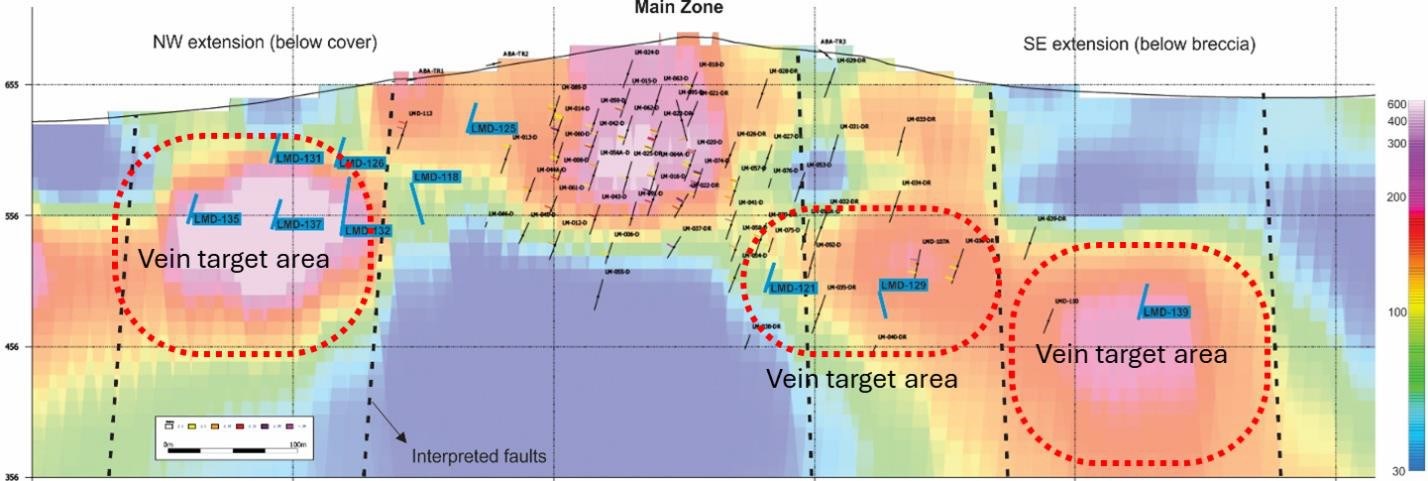
Figure 1: Long section of the West Feeder in the Main Zone with interpreted downthrown target areas with completed holes (in blue) pending assay results. Long section location shown in Figure 2. Resistivity values expressed in ohm-m.
To view an enhanced version of this graphic, please visit:
https://images.newsfilecorp.com/files/8951/276334_f318fea0a4b7f827_002full.jpg
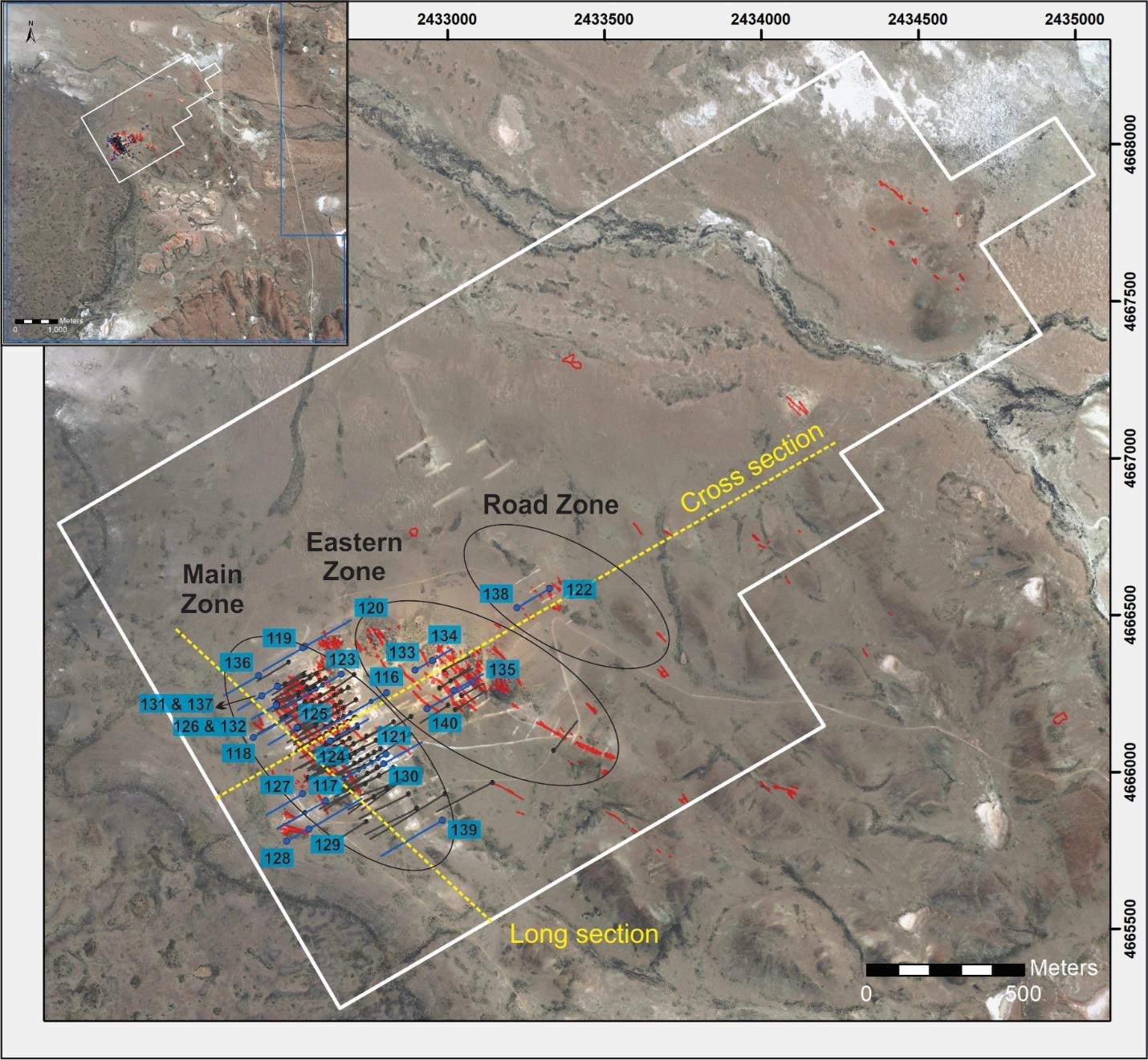
Figure 2: Phase II holes drilled to date with pending assays in blue. Previous drill hole traces and collars in black. Limit of reprocessed geophysical survey in white. Locations of long (Figure 1) and cross (Figure 3) sections in yellow.
To view an enhanced version of this graphic, please visit:
https://images.newsfilecorp.com/files/8951/276334_f318fea0a4b7f827_003full.jpg
Long (Figure 1) and cross (Figure 3) sections of the 3-D model show the relationship with the resistivity highs, particularly the edges of the anomalies and the location of known veins. This model was used to predict the location of the new veins confirmed by the Phase II drill program.
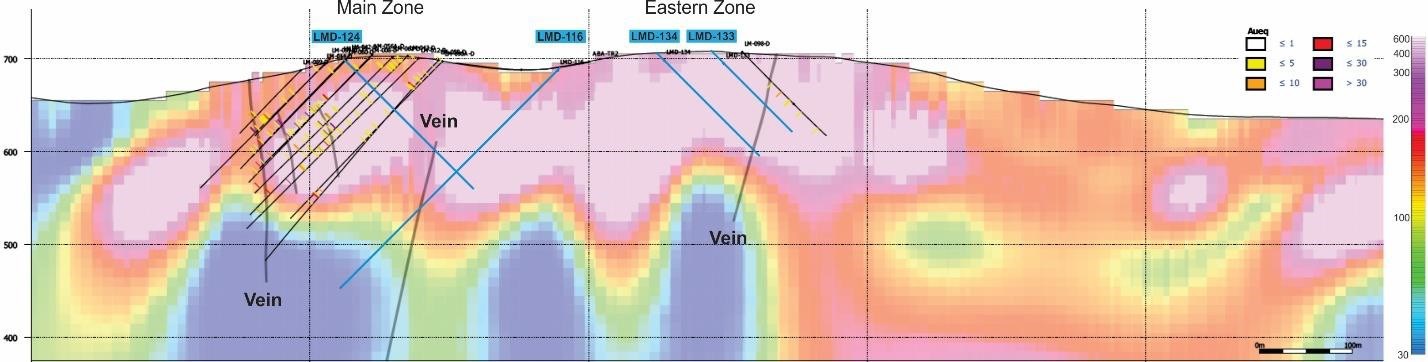
Figure 3: 3-D resistivity cross section showing known veins and their correlation with resistivity high/low margins. Phase II holes in blue. Cross section location shown in Figure 2. Resistivity values expressed in ohm-m.
To view an enhanced version of this graphic, please visit:
https://images.newsfilecorp.com/files/8951/276334_f318fea0a4b7f827_004full.jpg
An additional four holes were drilled at the Eastern Zone, allowing for the first interpretation of vein continuity within this previously underexplored area of the shallow epithermal vein system. These new holes confirmed a fault-related vein with a minimum strike length of approximately 200 metres and 150 meters deep below the surface.
The Company also completed the first two drill holes at a newly defined target located 350 metres east of the Eastern Zone, now referred to as the Road Zone.
Astra to Present at the Precious Metals & Critical Minerals Virtual Investor Conference
Astra’s CEO, Brian Miller, will give a live presentation followed by an open Q&A session at 4pm Eastern Time on December 3rd. Those wishing to attend Astra’s presentation can register here.
Investors may also request to schedule a 1:1 meeting with Astra’s CEO on December 5th, 8th, and 9th by confirming a time here.
This will be a live, interactive online event where investors are invited to ask the company questions in real-time. If attendees are not able to join the event live on the day of the conference, an archived webcast will also be made available after the event.
It is recommended that online investors pre-register and run the online system check to expedite participation and receive event updates.
Learn more about the event at www.virtualinvestorconferences.com.
About the Company
Astra Exploration Inc. is a precious metals exploration company based out of Vancouver, BC that is actively building a portfolio of high-quality projects in some of the most important mining jurisdictions in Latin America.
The La Manchuria gold-silver project in Santa Cruz, Argentina, over which Astra has an option to acquire
The
The
Qualified Person
The technical data and information as disclosed in this news release has been reviewed and approved by Darcy Marud, who is an Independent Director of Astra. Mr. Marud is a Practicing Member of the Association of Professional Geoscientists of Ontario and is a qualified person as defined under the terms of National Instrument 43-101 - Standards of Disclosure for Mineral Projects.
For further information, please contact:
Brian Miller
Chief Executive Officer Tel. 604.428.0939
Email: brian.miller@astra-exploration.com
Neither the TSXV nor its Regulation Services Provider (as that term is defined in the policies of the TSXV) accepts responsibility for the adequacy or accuracy of this release.
This news release may contain certain "Forward-Looking Statements" within the meaning of the United States Private Securities Litigation Reform Act of 1995 and applicable Canadian securities laws. When or if used in this news release, the words "anticipate", "believe", "estimate", "expect", "target, "plan", "forecast", "may", "schedule" and similar words or expressions identify forward-looking statements or information. These forward-looking statements or information may relate to the Company's business activities; exploration on the Company's properties including drilling at the La Manchuria project. Such statements represent the Company's current views with respect to future events and are necessarily based upon a number of assumptions and estimates that, while considered reasonable by the Company, are inherently subject to significant business, economic, competitive, political and social risks, contingencies and uncertainties. Many factors, both known and unknown, could cause results, performance or achievements to be materially different from the results, performance or achievements that are or may be expressed or implied by such forward-looking statements. Such factors include, without limitation: development of the industry in which the Company operates; risks associated with the conduct of the Company's business activities; risks relating to reliance on the Company's management team and outside contractors; currency fluctuations; risks regarding the failure to generate sufficient cash flow from operations; laws and regulations governing the industry in which the Company operates; the ability of the communities in which the Company operates to manage and cope with the implications of COVID-19; the economic and financial implications of COVID-19 to the Company; operating or technical difficulties; employee relations, labour unrest or unavailability; stock market volatility; conflicts of interest among certain directors and officers; lack of liquidity for shareholders of the Company; litigation risk; and other risk factors disclosed in the Company's public disclosure documents available on the Company's profile at www.sedarplus.ca. Readers are cautioned against attributing undue certainty to forward-looking statements or forward-looking information. Although the Company has attempted to identify important factors that could cause actual results to differ materially, there may be other factors that cause results not to be anticipated, estimated or intended. The Company does not intend, and does not assume any obligation, to update these forward-looking statements or information to reflect changes in assumptions or changes in circumstances or any other events affecting such statements and information other than as required by applicable laws, rules and regulations.

To view the source version of this press release, please visit https://www.newsfilecorp.com/release/276334
FAQ
AI-generated questions and answers. How Rhea-AI works. Not financial advice.