
Auro Metals Intersects 625.12m Grading 0.64 g/t Gold and 0.10% Copper at the Santa Barbara Gold-Copper Project, Ecuador
Auro Metals (OTC: AURFF, TSXV: AURO) reported the second batch of assay results from its 2026 Phase I drill program at the 100%-owned Santa Barbara Gold-Copper Project in southeastern Ecuador.
Sentiment and the balance of points
Rhea-AI Sentiment reads the wording of the document, how positive or negative its language is on a 1 to 5 scale. The balance of points shown with the takes weighs what the document actually discloses, so the two can disagree, for example when a trial that missed its main goal is described in upbeat language.
Rhea-AI Summary
Auro Metals (OTC: AURFF, TSXV: AURO) reported the second batch of assay results from its 2026 Phase I drill program at the 100%-owned Santa Barbara Gold-Copper Project in southeastern Ecuador. Three holes (DSB-57, DSB-58, DSB-59) drilled in the Santa Barbara South area tested continuity and up-/down-dip extensions of known porphyry mineralization.
Key intercepts include 625.12 m grading 0.64 g/t gold and 0.10% copper from 81.43 m to end of hole in DSB-59, 130 m grading 0.60 g/t gold and 0.09% copper from 12.0 m in DSB-58, and 59 m grading 0.67 g/t gold and 0.10% copper from surface plus 37.5 m grading 0.50 g/t gold and 0.10% copper from 92.5 m in DSB-57.
According to Auro Metals, mineralization in these holes starts at or near surface, remains open up- and down-dip, and shows consistent gold-copper grades. Six holes now have assays, ten are pending, and four drill rigs remain active. QA/QC procedures were carried out by independent, ISO/IEC 17025-accredited SGS laboratories.
Positive
- DSB-59 intersected 625.12 m at 0.64 g/t Au and 0.10% Cu from 81.43 m to 706.55 m, ending in mineralization
- Near-surface mineralization in all three holes, including 59 m from surface in DSB-57 and 130 m from 12 m depth in DSB-58
- Multiple consistent intercepts in DSB-57 (59 m at 0.67 g/t Au, 37.5 m at 0.50 g/t Au) and DSB-58 (130 m at 0.60 g/t Au)
- Mineralization remains open both up-dip toward surface and down-dip at depth at Santa Barbara South, indicating potential for further extension
- Six of sixteen holes from the 2026 Phase I program already assayed, with ten more pending and four rigs continuing work
- Independent QA/QC controls with ~20% control samples and analysis at ISO/IEC 17025-accredited SGS labs in Ecuador and Peru
Negative
- True widths unknown as all reported drill intercepts are core lengths with no stated true thickness
- DSB-59 terminated early in mineralization due to drilling difficulties, leaving the extent of diorite-hosted mineralization unknown
- Copper recoveries in AuEq calculation use a relatively low assumed processing recovery of 19.6% Cu compared with 85.5% Au
Details
News Market Reaction – AURFF
On Jul 14, the first trading day after this news, AURFF closed 21.73% above the previous close.
Data tracked by StockTitan Argus for the Jul 14 session.
AI-generated analysis. How Rhea-AI works. Not financial advice.




Vancouver, British Columbia--(Newsfile Corp. - July 13, 2026) - Auro Metals Inc. (TSXV: AURO) (OTC Pink: AURFF) ("Auro" or the "Company") is pleased to announce the second batch of drill assay results for three drillholes from the 2026 Phase I Drill Program at its
SUMMARY OF DRILL RESULTS
These three holes were drilled at the southern part of the known mineralized porphyry system of the Project ("Santa Barbara South") which is believed to be the core area of the known porphyry mineralization system. These holes were designed to test the continuity of mineralization between historical drill intercepts and the extension of mineralization in up-dip and down-dip directions. Results of the drilling are as follows:
- Drillhole DSB-59 intersected 625.12 metres ("m") grading 0.64 grams per tonne ("g/t") gold ("Au") and
0.10% copper ("Cu") from 81.43m to the end of hole. This hole terminated in mineralized porphyritic diorite due to drilling difficulties. - Drillhole DSB-58 intersected 130m grading 0.60 g/t Au and
0.09% Cu from 12.0m right below overburden sediments. - Drillhole DSB-57 intersected 59 m grading 0.67 g/t Au and
0.10% Cu from surface, and 37.5m grading 0.5 g/t Au and0.10% Cu from 92.5m.
All three holes intersected wide mineralization starting from surface or near-surface, with drill intercepts summarized in Table 1 below. These drill results demonstrate that mineralization is open in both up-dip and down-dip directions, and show good consistency of gold-copper grades. Drillhole specifications of all completed drillholes are provided in Table 2, and a drill plan view is shown in Figure 1.
"This second batch of drill assay results from our Phase I Drill Program at Santa Barbara South continue to highlight the scale and consistency of the Project," said Victor Feng, CEO of Auro. "DSB-59 intersected 625 metres of continuous gold-copper mineralization starting from near surface and ended in mineralization at depth. The gold grade from this hole is roughly
| Table 1: Summary of Drill Intercepts | ||||||
| Hole_ID | Depth_from | Depth_to | Interval_m | Au_g/t | Cu_% | AuEq_g/t |
| DSB-57 | 0.00 | 59.00 | 59.00 | 0.67 | 0.10 | 0.70 |
| 92.50 | 130.00 | 37.50 | 0.50 | 0.10 | 0.53 | |
| DSB-58 | 12.00 | 142.00 | 130.00 | 0.60 | 0.09 | 0.63 |
| DSB-59 | 81.43 | 706.55 | 625.12 | 0.64 | 0.10 | 0.67 |
Notes:
- Drill location, altitude, azimuth, and dip of drill holes are provided in Table 2.
- Drill intercept is core length, and grade is length weighted. True width of mineralization is unknown.
- A cut-off of 0.2 g/t Au is applied for calculation of drill intercept.
- Calculation of gold equivalent ("AuEq") is defined as AuEq (g/t) = Au (g/t) + Cu (%) x 0.259, based on a gold price of US
$3,200 /oz, and copper price of US$12,000 /t metal, assuming average processing recoveries of85.5% Au and19.6% Cu.
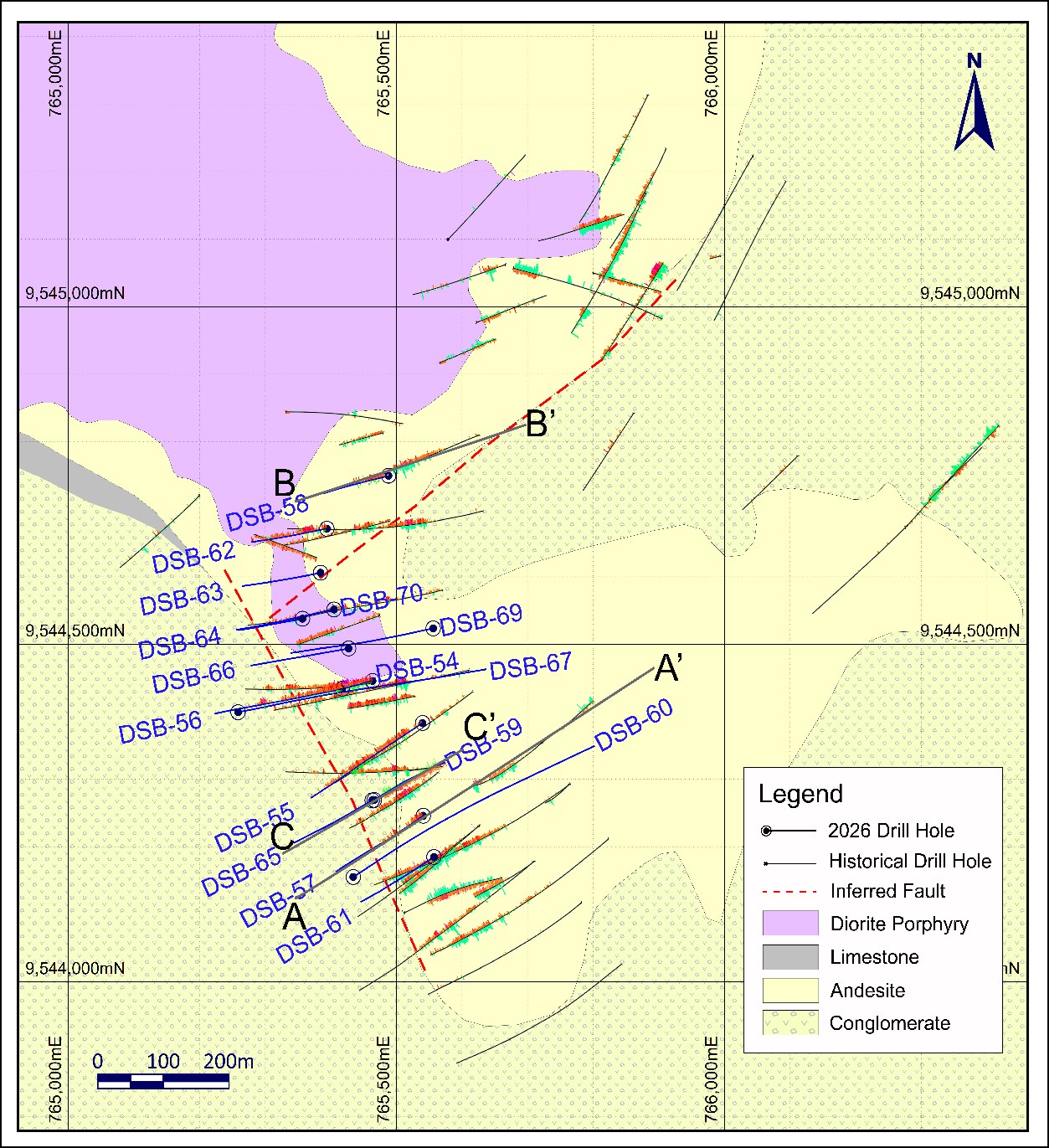
Figure 1: Plan view of drill holes
To view an enhanced version of this graphic, please visit:
https://images.newsfilecorp.com/files/7553/305022_0d5dbdc67413090f_001full.jpg
DESCRIPTION OF HOLES
Hole DSB-57 was drilled to a depth of 315.7m to test the up-dip extension of the mineralized zone intercepted by historical holes DSB-23 and DSB-33A at the southern portion of Santa Barbara South, and intersected 59m (from 0.00m to 59m) grading 0.67 g/t Au and
Lithology in the upper half of the hole is aphanitic basaltic andesite which is cut by quartz-hematite veining associated with potassic, chlorite and epidote alteration in patches and along fractures (Figure 3). Mineralization is characterized by pyrite and chalcopyrite in fine dissemination and narrow veinlets. The low portion until the end of the hole is dominated by volcano-sediments with disseminated primary pyrite and local patchy epidote and jasperoid alteration cut by calcite veining, but generally lacks potassic alteration and chalcopyrite. Between the mineralized basaltic andesite and unmineralized volcano-sediment sequence is interpreted to be a roughly north-south striking subvertical fault.
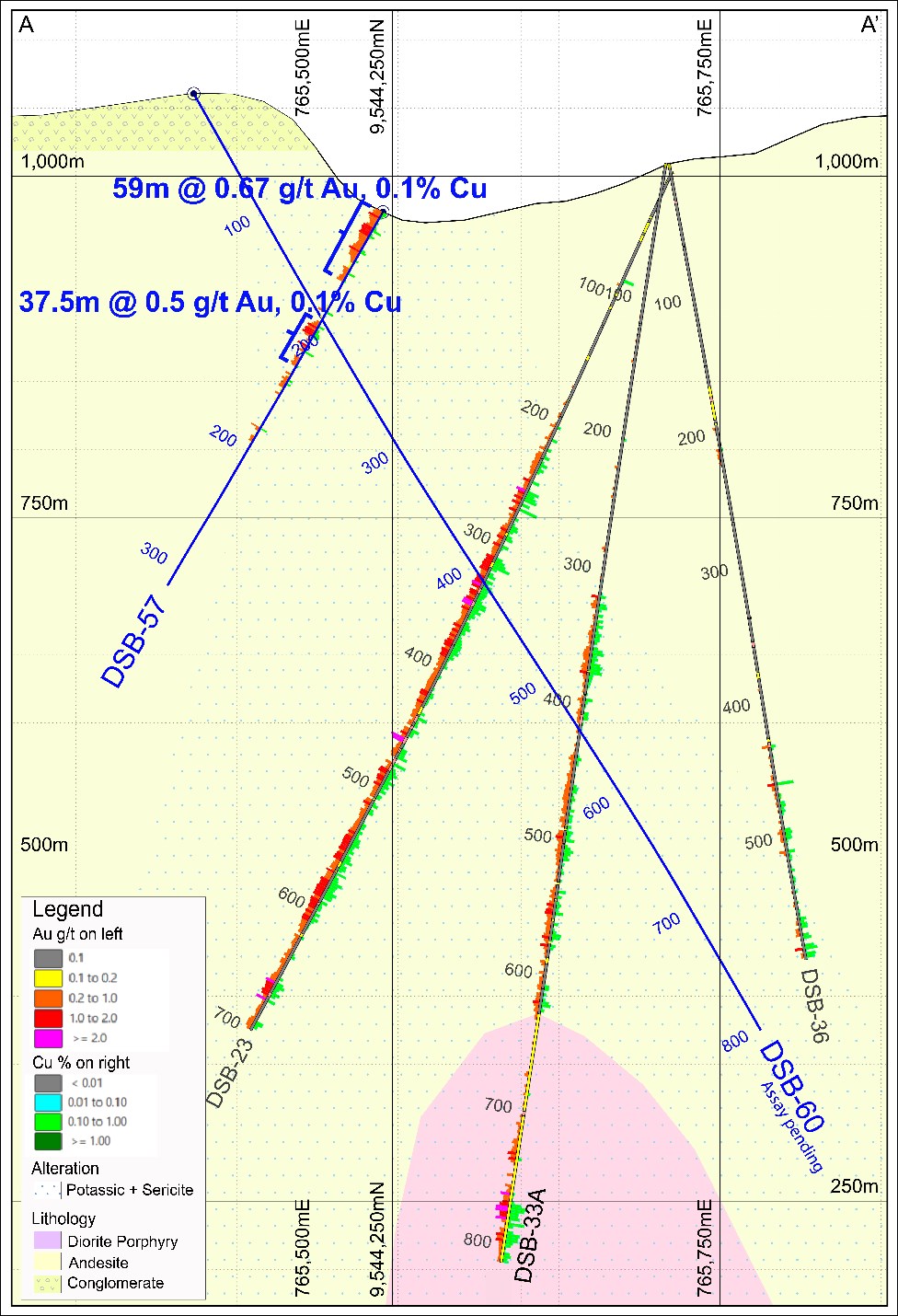
Figure 2: Section A-A'
To view an enhanced version of this graphic, please visit:
https://images.newsfilecorp.com/files/7553/305022_0d5dbdc67413090f_002full.jpg
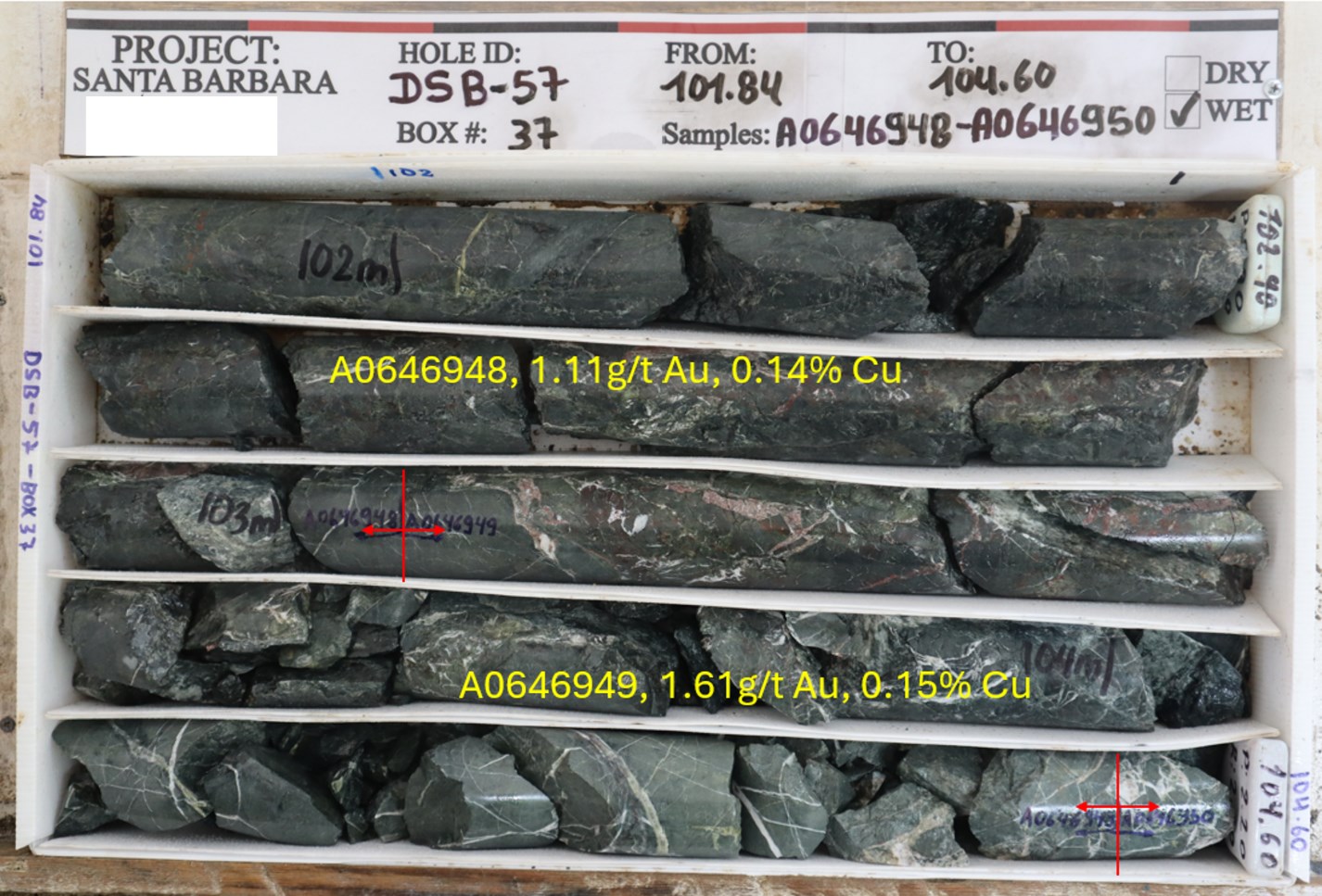
Figure 3: Core photo of DSB-57, Box 37, from 101.84m to 104.96m, mineralized basaltic andesite cut by quartz-hematite veining overprint by post-mineralization calcite veining.
To view an enhanced version of this graphic, please visit:
https://images.newsfilecorp.com/files/7553/305022_0d5dbdc67413090f_003full.jpg
Hole DSB-58 was drilled to a depth of 274.80m to test the up-dip extension of the mineralized zone intercepted by the historical hole DSB-34 at the north end of Santa Barbara South, and intersected 130m (from 12.0m to 142m) grading 0.60 g/t Au and
Lithology in the upper portion of the hole is dominated by dark aphanitic basaltic andesite sporadically cut by narrow lighter color post-mineralization andesite dykes. From surface to a depth of 12m is overburden sediments. Basaltic andesite extends from a depth of 12m throughout to a depth of 142m and is contacted by porphyritic diorite intrusion which continues to the end of the hole at a depth of 274.80m. Gold-copper mineralization occurs in the upper portion of dark basaltic andesite, characterized by quartz veining (Figure 5) with pyrite and chalcopyrite in forms of both dissemination and veinlets in surrounding basaltic andesite, usually with patchy secondary biotite (potassic alteration). In the lower diorite intrusion pyrite is identified as dissemination and narrow veinlets, but the amount of chalcopyrite is much less than in the upper basaltic andesite, which well explains the generally barren nature.
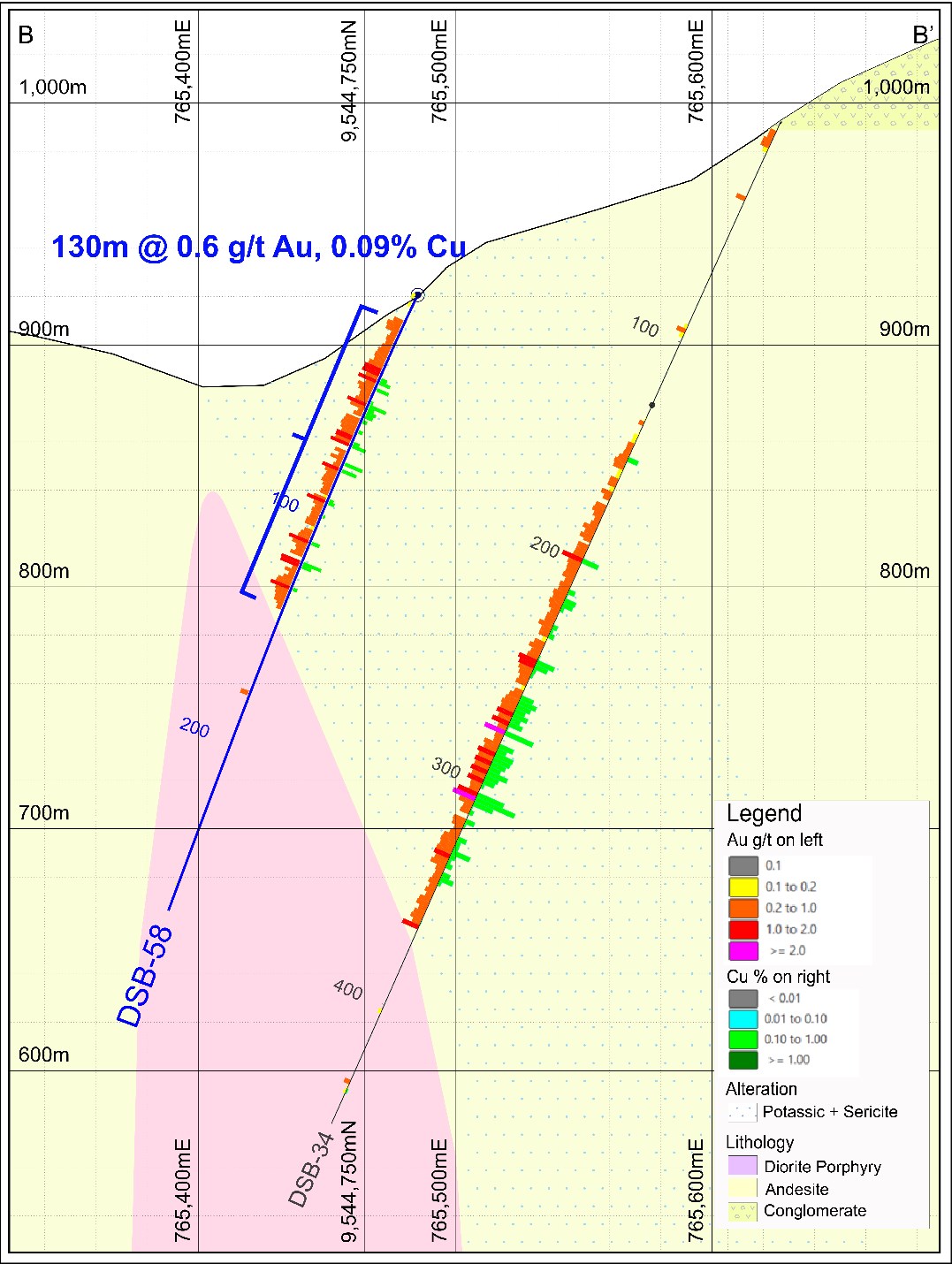
Figure 4: Section B-B'
To view an enhanced version of this graphic, please visit:
https://images.newsfilecorp.com/files/7553/305022_0d5dbdc67413090f_004full.jpg
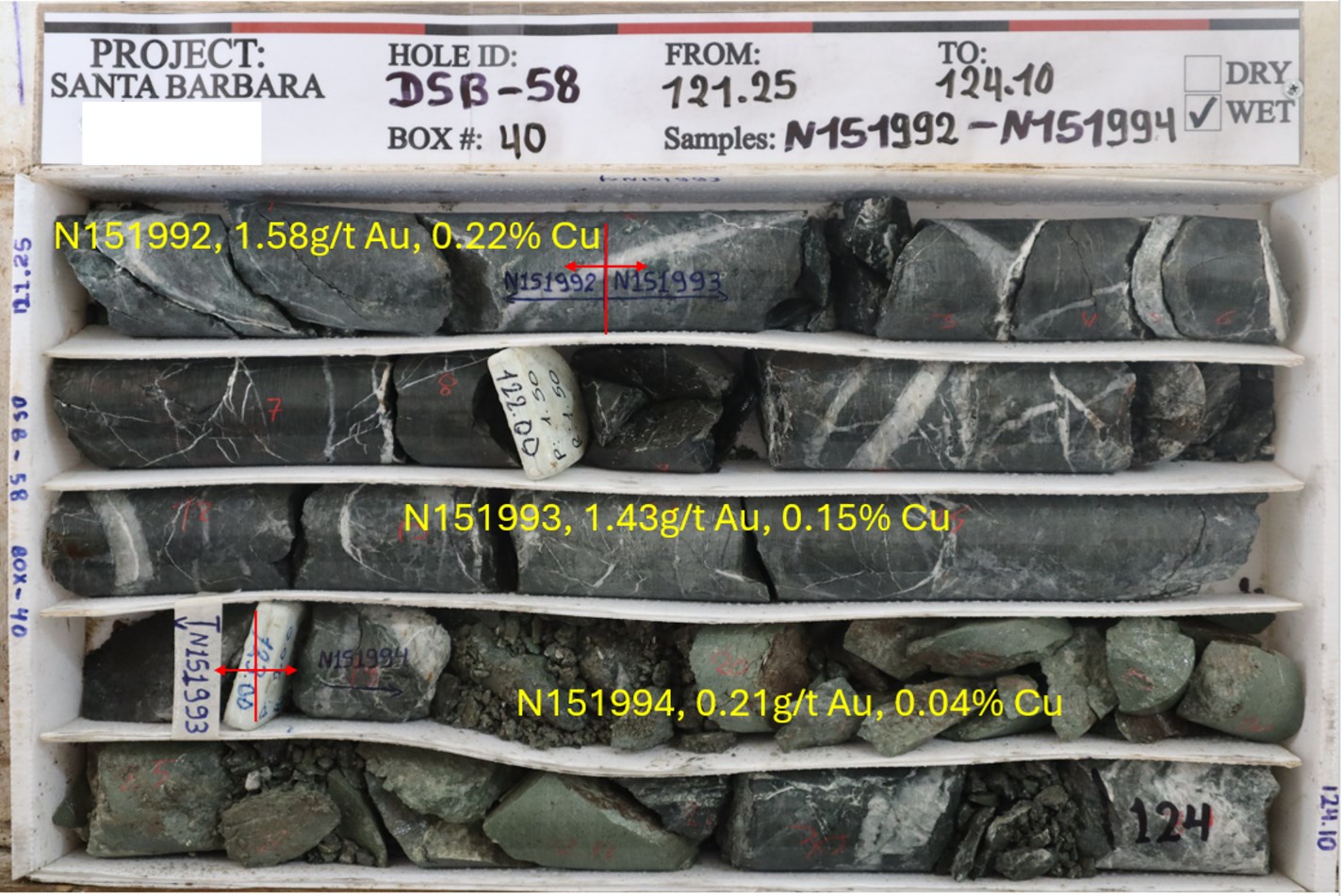
Figure 5: Core photo of DSB-58, Box 40, from 114.10 to 121.25m, mineralized basaltic andesite with quartz veining. Note that the sample N151994 contains a 0.7m wide post-mineralization grayish green andesite dyke, accordingly the grades of gold and copper of the sample are diluted.
To view an enhanced version of this graphic, please visit:
https://images.newsfilecorp.com/files/7553/305022_0d5dbdc67413090f_005full.jpg
Hole DSB-59 was drilled in the approximately central area of Santa Barbara South from the top of the western hilltop in an easterly dipping direction to test the up-dip and down-dip extension of the mineralized zone intercepted by historical hole DSB-21 and intercepted 625.12m (from 81.43m to 706.55m at the end of hole) grading 0.64 g/t Au and
Lithology of the first 84 metres from surface is conglomerate and fine volcano-sediment with disturbed laminations. From 84m to 505m is dominated by dark basaltic andesite sporadically cut by dykes of andesite and diorite. Between the shallow sediments and the basaltic andesite is interpreted to be a fault. The basaltic andesite generally mineralized, cut by quartz and quartz-hematite veining (Figure 7), associated with alteration of potassic, chlorite and epidote. From 505m depth to the end of hole at 706.55m depth is porphyritic diorite with pervasive sericitic alteration plus local patchy potassic alteration and cut by numerous quartz veining, with mineralization of pyrite and chalcopyrite in forms of both dissemination and narrow veinlets (Figure 8). Hole DSB-59 is very important as it signifies that diorite intrusion is also an important host to mineralization in addition to the basaltic andesite. However, the extent of mineralization in the diorite intrusion remains unknown as the hole is terminated in mineralization due to drilling difficulties.
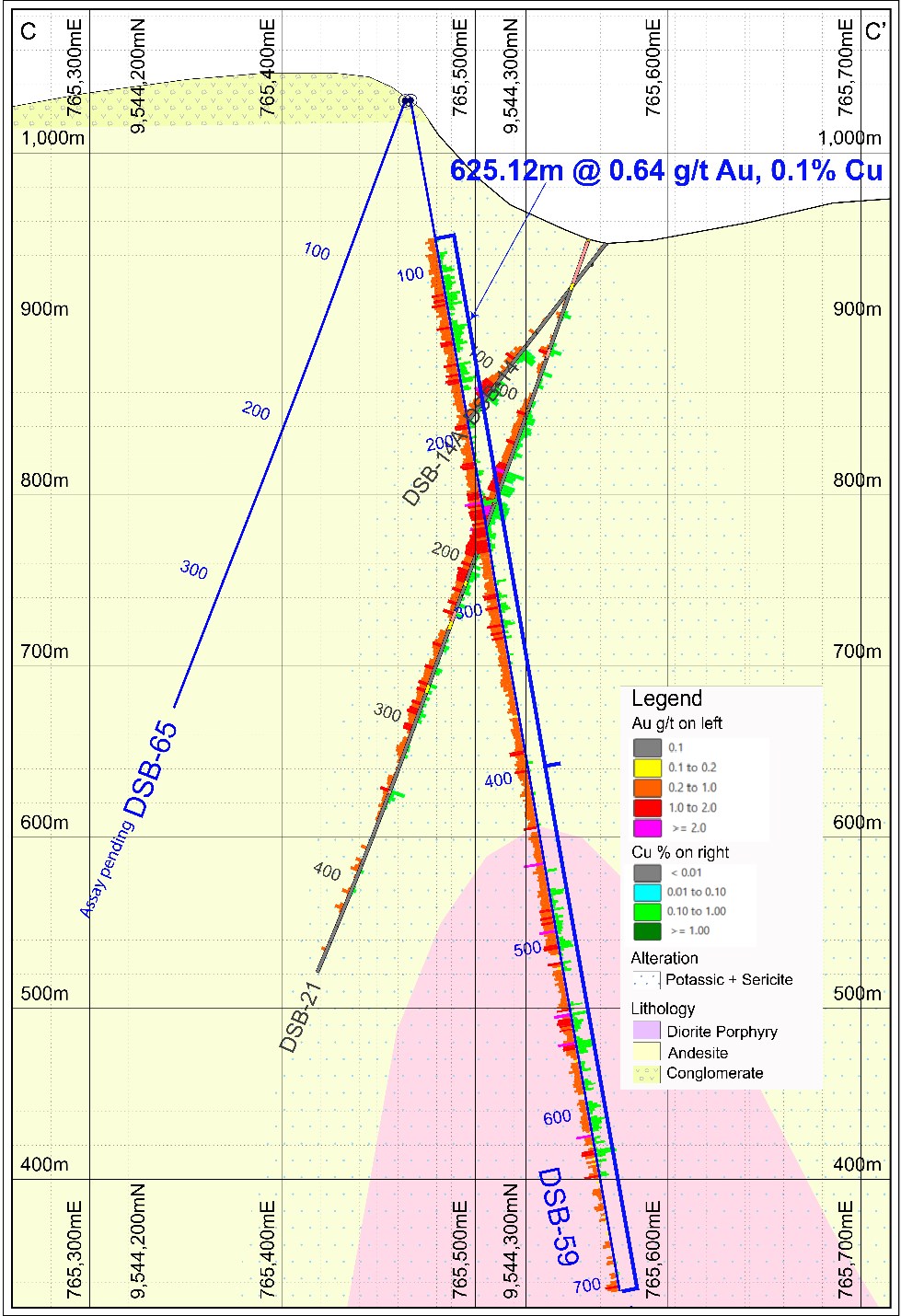
Figure 6: Section C-C'
To view an enhanced version of this graphic, please visit:
https://images.newsfilecorp.com/files/7553/305022_0d5dbdc67413090f_006full.jpg
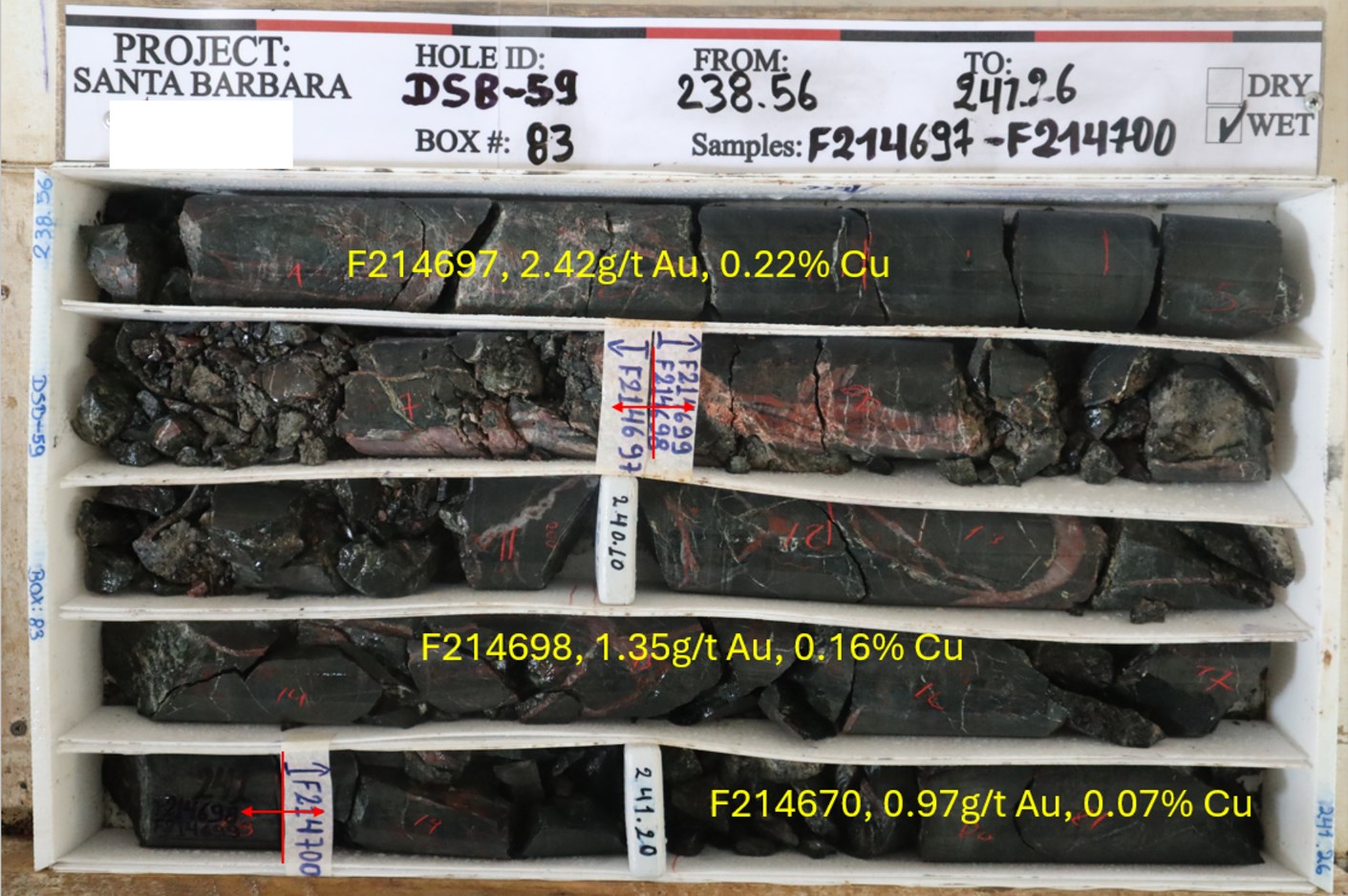
Figure 7: Core photo of DSB-59, Box 83, from 238.56m to 241.26m, mineralized basaltic andesite cut by quartz-hematite veining.
To view an enhanced version of this graphic, please visit:
https://images.newsfilecorp.com/files/7553/305022_0d5dbdc67413090f_008full.jpg
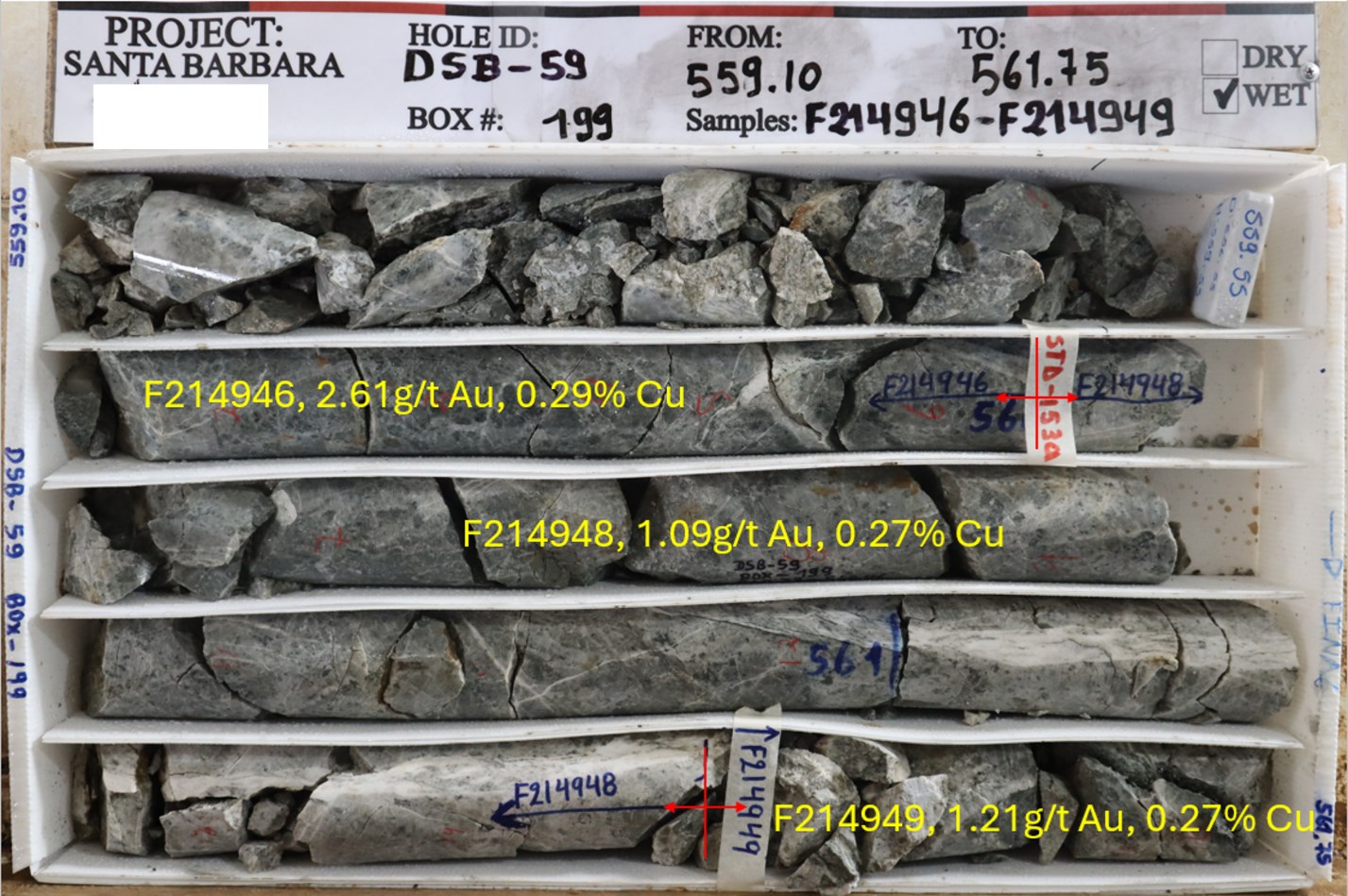
Figure 8: Core photo of DSB-59, Box 199, from 559.10m to 561.75m, mineralized porphyritic diorite cut by quartz veining with pervasive sericitic alteration and patchy potassic alteration.
To view an enhanced version of this graphic, please visit:
https://images.newsfilecorp.com/files/7553/305022_0d5dbdc67413090f_007full.jpg
| Table 2: Summary of Phase I Drill Holes of Santa Barbara Gold-Copper Project | |||||||
| Hole_ID | Easting | Northing | Altitude | Depth_m | Azimuth (°) | Dip (°) | Assay Results |
| DSB-54 | 765463.70 | 9544445.53 | 931.38 | 705.70 | 260 | -82 | complete |
| DSB-55 | 765539.93 | 9544383.21 | 940.76 | 285.50 | 240 | -45 | complete |
| DSB-56 | 765417.68 | 9544434.13 | 960.10 | 274.85 | 260 | -47 | complete |
| DSB-57 | 765541.01 | 9544245.95 | 973.91 | 315.70 | 240 | -60 | complete |
| DSB-58 | 765488.12 | 9544749.44 | 920.64 | 274.80 | 260 | -63 | complete |
| DSB-59 | 765466.41 | 9544269.27 | 1030.67 | 706.55 | 60 | -80 | complete |
| DSB-60 | 765434.27 | 9544155.26 | 1060.67 | 802.65 | 60 | -60 | pending |
| DSB-61 | 765557.28 | 9544184.88 | 990.14 | 720.60 | 236 | -77.5 | pending |
| DSB-62 | 765394.10 | 9544671.12 | 892.48 | 200.00 | 260 | -55 | pending |
| DSB-63 | 765384.50 | 9544605.71 | 891.07 | 253.90 | 260 | -60 | pending |
| DSB-64 | 765356.92 | 9544537.66 | 924.00 | 199.35 | 260 | -60 | pending |
| DSB-65 | 765463.12 | 9544268.74 | 1030.43 | 379.80 | 240 | -70 | pending |
| DSB-66 | 765427.24 | 9544493.67 | 909.15 | 312.15 | 260 | -60 | pending |
| DSB-67 | 765258.71 | 9544399.36 | 1040.33 | 599.00 | 80 | -52 | pending |
| DSB-69 | 765556.17 | 9544523.38 | 922.05 | 490.05 | 260 | -63 | pending |
| DSB-70 | 765404.89 | 9544551.38 | 900.01 | 306.60 | 260 | -60 | pending |
| Total | 6827.20 | ||||||
Notes:
- Drill collar coordinate system is PSAD56 UTM Zone 17S.
- Coordinate of drill collar is picked with Real Time Kinematics (RTK) GPS.
QUALITY ASSURANCE AND QUALITY CONTROL
All samples in respect of the exploration program at the Project discussed in this news release were shipped in securely-sealed bags by a chartered commercial truck, directly from the field to the sample preparation facilities of SGS in Guayaquil, Ecuador for preparation, and to SGS in Lima, Peru for geochemical analysis. SGS is a global leader in inspection, verification, testing, and certification. It is an ISO/IEC 17025 accredited laboratory independent from Auro. All samples go through fire assay (SGS code FAA313) for gold and multi-acid digestion ICP-AES multi-element assay (SGS code ICP40B) for other elements. Certified reference materials, various types of blank samples and duplicate samples are inserted into normal drill core sample sequences prior to delivery to the laboratory for preparation and analysis. The overall ratio of quality control samples in sample sequences is around twenty percent.
QUALIFIED PERSON
The scientific and technical information contained in this news release has been reviewed and approved by Alex Zhang, P. Geo., a Director of the Company, who is a Qualified Person for the purposes of National Instrument 43-101 - Standards of Disclosure for Mineral Projects ("NI 43-101"). The Qualified Person has verified the information disclosed herein, including the sampling, preparation, security and analytical procedures underlying such information, and is not aware of any significant risks and uncertainties that could be expected to affect reliability or confidence in the information discussed herein.
ABOUT AURO METALS INC.
Auro Metals Inc. is a mineral exploration company which holds a
On Behalf of Auro Metals Inc.
signed "Victor Feng"
Victor Feng, CEO and Director
For further information, please contact:
Victor Feng
CEO and Director
Phone: +1 (604) 336-5919
Email: info@aurometals.ca
www.aurometals.ca
Neither the TSX Venture Exchange nor its Regulation Services Provider (as that term is defined in the policies of the TSX Venture Exchange) accepts responsibility for the adequacy or accuracy of this news release.
Cautionary Note Regarding Forward-Looking Statements
This news release contains forward-looking statements and forward-looking information (collective, "forward-looking statements") within the meaning of applicable Canadian and U.S. securities legislation. All statements, other than statements of historical fact included in this release, including, without limitation, statements regarding the potential of the Project; the anticipated exploration, drilling, development, and other activities or achievements of the Company; timing of receipt of permits and regulatory approvals; timing of future assay results; and other future plans, objectives or expectations of the Company. Estimates of mineral reserves and mineral resources are also forward-looking information because they incorporate estimates of future developments including future mineral prices, costs and expenses and the amount of minerals that will be encountered if a property is developed.
Forward-looking statements are often, but not always, identified by words or phrases such as "expects", "is expected", "anticipates", "believes", "plans", "projects", "estimates", "assumes", "intends", "strategies", "targets", "goals", "forecasts", "objectives", "budgets", "schedules", "potential" or variations thereof or stating that certain actions, events or results "may", "could", "would", "might" or "will" be taken, occur or be achieved, or the negative of any of these terms and similar expressions. Forward-looking statements are based on the opinions, assumptions, factors and estimates of management considered reasonable at the date the statements are made. The opinions, assumptions, factors and estimates which may prove to be incorrect, include, but are not limited to: the ability of drilling and other exploration activities to accurately predict mineralization; possible variations in mineralization, grade or recovery rates; fluctuations in commodity prices; actual results of current exploration activities; that the Company will be able to obtain and maintain governmental approvals, permits and licenses in connection with its current and planned operations, development and exploration activities, including at the Project; and other exploration, development, operating, financial market and regulatory factors; environmental risks; adverse weather conditions; ability to exploit successful discoveries; risks related to contractors and service providers; the current and future social, economic and political conditions in Ecuador.
Forward-looking statements involve known and unknown risks, uncertainties and other factors which may cause the actual results, performance or achievements of the Company to differ materially from any future results, performance or achievements expressed or implied by the forward-looking information. Readers are cautioned that such information may not be appropriate for other purposes. Although the Company has attempted to identify important factors that could cause actual actions, events or results to differ from those described in forward-looking statements, there may be other factors that cause such actions, events or results to differ materially from those anticipated. There can be no assurance that forward-looking statements will prove to be accurate and accordingly readers are cautioned not to place undue reliance on forward-looking statements.
Readers are cautioned not to place undue reliance on forward-looking statements. The Company undertakes no obligation to update any of the forward-looking statements in this news release or incorporated by reference herein, except as otherwise required by law.
Additional information in relation to the Company, including the Company's most recent management discussion & analysis, can be obtained under the Company's profile on SEDAR+ at www.sedarplus.ca and on the Company's website at www.aurometals.ca.

To view the source version of this press release, please visit https://www.newsfilecorp.com/release/305022
FAQ
AI-generated questions and answers. How Rhea-AI works. Not financial advice.