
A2GOLD INTERSECTS 20.96 G/T AUEQ OVER 1.5 METRES (5.24% ANTIMONY AND 0.52 G/T GOLD); RETURNS 209.4 G/T SILVER OVER 10.7 METRES FROM SURFACE AT TAYLOR
First four Taylor drill holes show shallow high-grade antimony-gold and broad silver zones, extending mineralization beyond past Merrimac mine workings.
Rhea-AI Summary
A2Gold (AUXXF) reported initial RC drill results from four holes at the Taylor Silver-Gold Project in Nevada, including shallow, high-grade antimony-gold and broad silver mineralization.
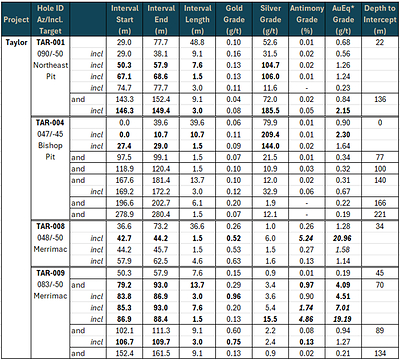
Hole TAR-008, 170 metres north of the past-producing Merrimac Mine, returned 1.28 g/t AuEq over 36.6 metres, including 20.96 g/t AuEq over 1.5 metres (5.24% antimony and 0.52 g/t gold). TAR-009 intersected 4.09 g/t AuEq over 13.7 metres, including 7.01 g/t AuEq over 7.6 metres and 19.19 g/t AuEq over 1.5 metres, confirming antimony-gold mineralization outside historical workings. Within the historical silver footprint, TAR-004 returned 79.9 g/t silver over 39.6 metres from surface, including 209.4 g/t silver over 10.7 metres, while TAR-001 reported up to 185.5 g/t silver over 3.0 metres. Assays from 11 additional holes are pending.
Positive
- TAR-008 1.28 g/t AuEq over 36.6 m, incl. 20.96 g/t AuEq over 1.5 m
- TAR-009 4.09 g/t AuEq over 13.7 m, incl. 19.19 g/t AuEq over 1.5 m
- TAR-004 79.9 g/t Ag over 39.6 m from surface, incl. 209.4 g/t Ag over 10.7 m
- 2018 historical estimate outlines ~11.6 Moz silver in historical resources at Taylor
- A2Gold controls ~230 km² of Nevada exploration tenure with existing inferred resources at Eastside
Negative
- Only 4 of 15 Taylor drill holes reported; assays for 11 holes pending
- 2018 Taylor silver estimate is historical and not treated as current mineral resources
- Reported drill lengths are as-drilled; true widths not yet determined
AI-generated analysis. How Rhea-AI works. Not financial advice.




TWO HOLES IDENTIFY SHALLOW, HIGH-GRADE ANTIMONY-GOLD MINERALIZATION 170 METRES NORTH OF PAST PRODUCING MERRIMAC MINE
Approximately 170 metres north of the past-producing Merrimac Mine, TAR-008 intersected 1.28 g/t AuEq over 36.6 metres (
TAR-004 intersected 209.4 g/t silver and 0.11 g/t gold over 10.7 metres from surface and 144.0 g/t silver over 1.5 m within 79.9 g/t silver over 39.6 metres. TAR-001 intersected 104.7 g/t silver over 7.6 metres and 106.0 g/t silver over 1.5 metres within 52.6 g/t silver and 0.10 g/t gold over 48.8 metres, and intersected a second, deeper interval of 185.5 g/t silver over 3.0 metres within 72.0 g/t silver over 9.1 metres. Results from the remaining 11 holes are pending.
Highlights
- TAR-008 intersected 20.96 g/t AuEq over 1.5 metres (
5.24% antimony and 0.52 g/t gold) within 1.28 g/t AuEq over 36.6 metres (0.26% antimony and 0.26 g/t gold). - TAR-009 intersected 19.19 g/t AuEq over 1.5 metres (
4.86% antimony, 0.13 g/t gold and 15.5 g/t silver), within 7.01 g/t AuEq over 7.6 metres (1.74% antimony, 0.20 g/t gold and 5.4 g/t silver), and within 4.09 g/t AuEq over 13.7 metres (0.97% antimony, 0.29 g/t gold and 3.4 g/t silver). - TAR-008 and TAR-009 were drilled approximately 170 metres north of the historical Merrimac Mine. The results support the interpretation that antimony-gold mineralization extends beyond the historical workings and remains to be tested to the north, south and east.
- TAR-001 intersected 104.7 g/t silver over 7.6 metres and 106.0 g/t silver over 1.5 metres within 52.6 g/t silver and 0.10 g/t gold over 48.8 metres.
- TAR-004 intersected 79.9 g/t silver over 39.6 metres from surface, including 209.4 g/t silver and 0.11 g/t gold over 10.7 metres from surface and a separate interval of 144.0 g/t silver over 1.5 metres.
High-Grade Antimony-Gold Mineralization Identified North of Historical Merrimac Mine
The historical Merrimac Mine is one of two past-producing antimony mines within the Taylor Project and provides an indication of the high-grade antimony endowment of the district. According to historical production records1, the Merrimac Mine operated during 1959–1960 and produced approximately 90 short tons of ore that averaged approximately
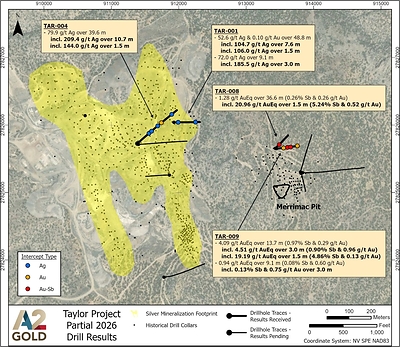
Approximately 170 metres north of the historical Merrimac workings, TAR-008 and TAR-009 returned the following antimony-gold intercepts (Figure 1):
- TAR-008 intersected 20.96 g/t AuEq over 1.5 metres (
5.24% antimony and 0.52 g/t gold) within 1.28 g/t AuEq over 36.6 metres (0.26% antimony and 0.26 g/t gold) from 36.6 metres downhole. - TAR-009 intersected 19.19 g/t AuEq over 1.5 metres (
4.86% antimony and 0.13 g/t gold) within 4.09 g/t AuEq over 13.7 metres (0.97% antimony and 0.29 g/t gold) from 79.2 metres downhole.
Together, TAR-008 and TAR-009 demonstrate that high-grade antimony-gold mineralization is not confined to the historical Merrimac workings. The two holes define a priority target area along an interpreted stratigraphic and structural trend that remains open to the north, south and east. Importantly, this antimony-gold target lies outside the historical silver mineralization footprint, and antimony was not included in the 2018 historical silver mineral resource estimate, which only considered silver.
|
1Historical production data are derived from Nevada Bureau of Mines publications and other historical sources and have not been independently verified. While not compliant with NI 43-101 standards, these data demonstrate the presence of high-grade antimony mineralization on the property. |
Peter Gianulis, CEO, commented: "Taylor's initial results demonstrate the significant multi-metal potential of the Project. This is A2Gold's first drill program at Taylor, and the first four holes reported have already returned shallow, high-grade antimony-gold mineralization, including 20.96 g/t AuEq over 1.5 metres, as well as broad, high-grade silver mineralization, including 209.4 g/t silver over 10.7 metres from surface. The drilling reported to date has evaluated only a small portion of Taylor's gold, silver and antimony potential, with substantial opportunities remaining to expand these mineralized zones and test additional targets across the property. Taylor also hosts prospective CRD, skarn and porphyry-style targets that have not yet been drill tested by A2Gold. With assays from 11 additional holes pending, we believe these results provide only an initial indication of Taylor's broader exploration potential."
Silver Mineralization
The Project hosts a historical silver mineral resource estimate prepared by SRK Consulting (
A qualified person has not done sufficient work to classify the 2018 Historical Estimate as current mineral resources, and A2Gold is not treating the 2018 Historical Estimate as current mineral resources.
TAR-001 and TAR-004 were drilled within the silver mineralization footprint but were extended below the maximum depth of historical drilling. These holes returned silver-mineralized intercepts and provided additional information on geology and mineralization controls.
- TAR-001 intersected 104.7 g/t silver over 7.6 metres and 106.0 g/t silver over 1.5 metres within 52.6 g/t silver and 0.10 g/t gold over 48.8 metres. A second, deeper interval intersected 185.5 g/t silver over 3.0 metres within 72.0 g/t silver over 9.1 metres.
- TAR-004 intersected 79.9 g/t silver over 39.6 metres from surface, including 209.4 g/t silver and 0.11 g/t gold over 10.7 metres from surface and a separate interval of 144.0 g/t silver over 1.5 metres.
In addition to the reported silver intercepts, TAR-001 and TAR-004 also provided important geological information including calcite-sulfide feeder veins, a weakly gold-mineralized lamprophyre dike, and narrow stratiform silver-gold mineralization below the limits of historical drilling. These observations provide geological vectors that can be used to refine future drill targets.
Exploration Significance
The first four holes from A2Gold's initial Taylor drill program have identified two distinct exploration opportunities. Approximately 170 metres north of the past-producing Merrimac Mine, TAR-008 and TAR-009 intersected shallow, high-grade antimony-gold mineralization and defined a priority target area that remains open to the north, south and east.
Within the historical silver mineralization footprint, TAR-001 and TAR-004 returned broad silver intervals, including mineralization beginning at surface in TAR-004 and a deeper high-grade interval in TAR-001 below the maximum depth of historical drilling. TAR-001 also provides evidence that silver mineralization may extend northeast of the historically drilled area.
Antimony was not included in the 2018 historical silver mineral resource estimate. The Company is integrating the new drill results with pre-existing data to refine additional antimony-gold and silver targets while assays from the remaining 11 holes are pending.
|
Table Notes |
|
*The gold equivalents ("AuEq") are based on assumed metals prices of |
|
Gold: Reported gold drill intercepts were calculated using a 0.10 g/t gold cut-off grade with a nominal maximum of 20 feet of consecutive internal dilution. No limit was applied to the total amount of non-consecutive internal dilution included within a composite. |
|
Silver: Reported silver drill intercepts were calculated using a 10.0 g/t silver cut-off grade with a nominal maximum of 20 feet of consecutive internal dilution. No limit was applied to the total amount of non-consecutive internal dilution included within a composite. |
|
Antimony: Reported antimony drill intercepts were calculated using a |
All reported intercepts begin and end with assays above the respective cut-off grade. Composite intervals were calculated using uncapped raw assay values. Reported lengths are as-drilled; true widths have not been determined.
Historical Mineral Resource Estimate
The historical estimate is described in the "NI 43-101 Technical Report on the Taylor Silver Project,
The Company considers the historical estimate relevant because it provides a basis for evaluating the historical Taylor silver mineralization and planning confirmation and expansion drilling. The estimate is considered reasonably reliable for these purposes because it was prepared by SRK Consulting (
To verify the historical estimate as a current mineral resource, the Company would need to validate the underlying historical drill and assay database, complete appropriate confirmation and infill drilling, update the geological model and technical assumptions, and prepare a new mineral resource estimate.
A qualified person has not done sufficient work to classify the historical estimate as current mineral resources, and A2Gold is not treating the historical estimate as current mineral resources.
Quality Assurance / Quality Control
The RC drilling program included the routine insertion of certified reference materials, blanks, and duplicates as part of the Company's quality assurance and quality control ("QA/QC") procedures. Drill samples were submitted to American Assay Laboratories in
Gold analyses were completed using a 30-gram fire assay with an ICP-OES (optical emission spectrometry) finish. Silver and antimony analyses were completed using a 5-acid digestion and an ICP-OES finish. Samples for gold and silver that exceed the laboratory's respective upper detection limits are reanalyzed using gravimetric methods.
Qualified Person
John Marma, CPG, a Certified Professional Geologist with the American Institute of Professional Geologists and a Qualified Person as defined by National Instrument 43-101, has reviewed and approved the scientific and technical information contained in this news release.
About A2Gold Corp
A2Gold Corp. has built a multi-asset gold-silver exploration platform in
Eastside hosts an inferred mineral resource of 1.4 million ounces of gold and 8.8 million ounces of silver*, while Taylor adds a highly prospective exploration district with gold, silver, antimony and porphyry-skarn upside. Backed by a fully funded exploration program and a strong pipeline of catalysts, A2Gold is focused on unlocking value through resource expansion, new discoveries and systematic district-scale exploration.
A2Gold is also supported by a strong shareholder base, including Kinross Gold Corporation, which owns approximately
|
* Updated Resource Estimate and NI 43-101 Technical Report, Eastside and Castle Gold-Silver Project Technical Report, |
On Behalf of the Board
Peter Gianulis, CEO
Certain statements and information contained in this press release constitute "forward-looking statements" within the meaning of applicable
Forward-looking statements in this news release include, but are not limited to, statements regarding A2Gold's exploration plans for the Taylor Project, the scope, timing and objectives of the drill program at Taylor, the potential expansion of the historical silver resource, the preparation of an updated NI 43-101 mineral resource estimate, the evaluation of gold mineralization, the testing of gold-antimony, CRD, skarn and porphyry targets, the potential contribution of gold and antimony mineralization to the broader Taylor system, the potential for Taylor to emerge as an important
Forward-looking statements are statements and information regarding possible events, conditions or results of operations that are based upon assumptions about future economic conditions and courses of action. All statements and information other than statements of historical fact may be forward-looking statements. In some cases, forward-looking statements can be identified by the use of words such as "seek," "expect," "anticipate," "budget," "plan," "estimate," "continue," "forecast," "intend," "believe," "predict," "potential," "target," "may," "could," "would," "might," "will" and similar words or phrases, including negative variations, suggesting future outcomes or statements regarding an outlook.
Such forward-looking statements are based on a number of material factors and assumptions and involve known and unknown risks, uncertainties and other factors which may cause actual results, performance or achievements, or industry results, to differ materially from those anticipated in such forward-looking information. You are cautioned not to place undue reliance on forward-looking statements contained in this press release.
Some of the known risks and other factors which could cause actual results to differ materially from those expressed in the forward-looking statements are described in the sections entitled "Risk Factors" in A2Gold's Listing Application, dated January 24, 2018, as filed with the TSX Venture Exchange and available on SEDAR+ under A2Gold's profile. Actual results and future events could differ materially from those anticipated in such statements. A2Gold undertakes no obligation to update or revise any forward-looking statements included in this press release if these beliefs, estimates and opinions or other circumstances should change, except as otherwise required by applicable law.
 View original content to download multimedia:https://www.prnewswire.com/news-releases/a2gold-intersects-20-96-gt-aueq-over-1-5-metres-5-24-antimony-and-0-52-gt-gold-returns-209-4-gt-silver-over-10-7-metres-from-surface-at-taylor-302885758.html
SOURCE A2 Gold Corp
FAQ
AI-generated questions and answers. How Rhea-AI works. Not financial advice.
How does A2Gold calculate the reported gold equivalent (AuEq) grades?
AuEq grades are based on assumed metals prices of US$3,000/oz gold, US$35/oz silver and US$40,000 per tonne antimony, and recoveries of 80% for gold, 70% for silver and 75% for antimony. The formula used is: AuEq (g/t) = Au (g/t) + [Ag (g/t) × 0.010208] + [Sb (%) × 3.887935]. Values are calculated from unrounded assays, so they may not be exactly reproducible from rounded grades.
What cut-off grades were used to report the gold, silver and antimony intercepts?
Reported gold intercepts use a 0.10 g/t gold cut-off, silver intercepts use 10.0 g/t silver, and antimony intercepts use 0.1% antimony, each with a nominal maximum of 20 feet of consecutive internal dilution and no limit on non-consecutive internal dilution. All reported intercepts start and end with assays above the respective cut-off grade.
What is the size of the 2018 historical silver mineral resource estimate at Taylor?
The 2018 historical estimate prepared by SRK Consulting reported approximately 10.995 million ounces of silver in the combined Measured and Indicated categories and approximately 603,000 ounces of silver in the Inferred category, at a cut-off grade of 1.6 oz/ton silver. A qualified person has not done sufficient work to classify this as a current mineral resource, and A2Gold is not treating it as current mineral resources.
What quality assurance and quality control (QA/QC) procedures were used for the drilling?
The RC program included routine insertion of certified reference materials, blanks and duplicates. Samples were analyzed at American Assay Laboratories in Sparks, Nevada, an ISO/IEC 17025 accredited lab. Gold was assayed by 30 g fire assay with ICP-OES finish, while silver and antimony used 5-acid digestion with ICP-OES finish. Over-limit gold and silver samples are reanalyzed using gravimetric methods.
What work is required to upgrade the Taylor historical estimate to a current mineral resource?
To verify the 2018 historical estimate as current mineral resources, A2Gold indicates it would need to validate the historical drill and assay database, complete appropriate confirmation and infill drilling, update the geological model and technical assumptions, and prepare a new mineral resource estimate in compliance with current standards.