
Oklo’s Groves-1 to Begin Research and Demonstration Phase after being Cleared by U.S. Department of Energy for Unrestricted Operations
Groves-1’s operating experience will inform the planned Groves-2 Forge isotope production and processing pilot facility.
Sentiment and the balance of points
Rhea-AI Sentiment reads the wording of the document, how positive or negative its language is on a 1 to 5 scale. The balance of points shown with the takes weighs what the document actually discloses, so the two can disagree, for example when a trial that missed its main goal is described in upbeat language.


Groves-1 to transition from reactor deployment demonstration to operating platform for research, testing, and training.
Groves Isotope Test Reactor (Groves-1) was taken critical in August 2026 under the
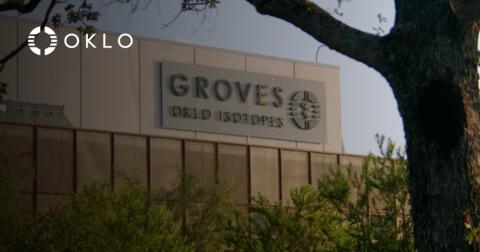
Groves Isotope Test Reactor. (Image: Oklo)
Groves-1, under DOE authorization through the DOE Reactor Pilot Program (RPP), reached first criticality at low power less than a year after groundbreaking. The test reactor demonstrated the ability to engineer, construct, authorize, commission, and operate a full nuclear facility. Its next phase will build on this experience to help Oklo prepare the teams and systems needed to support the efficient delivery and operation of additional nuclear projects.
That preparation has already begun. During a recent reactor startup, operators wore eye-tracking glasses to record what they were looking at and for how long, giving the team data to improve the facility’s human-machine interface and inform future design choices. Groves-1 will also serve as a key training and qualification platform for nuclear personnel at future reactor deployments, alongside further equipment testing, including continued evaluations of control rod drive mechanism performance and reliability.
Additionally, Groves-1 will enable criticality and reactivity benchmarking operations that support Oklo’s isotope production capabilities, its engineering and design models, and potentially light water reactors and the large light water reactor fleet. The resulting data could also help improve fuel performance and power output in small and large light water reactors.
“Taking Groves-1 from greenfield to criticality in less than a year was an important demonstration of what our team can accomplish,” said Oklo CEO and co-founder Jacob DeWitte. “Now we're building on that experience by operating the reactor, testing new capabilities, and learning directly from the work. Those lessons can help us develop the people, systems, and processes needed as we advance additional isotope projects and Aurora powerhouses.”
“DOE’s Reactor Pilot Program reset the nuclear industry’s expectations for how quickly we can move from advanced reactor design to demonstration while upholding best-in-class safety standards,” says acting Deputy Assistant Secretary for Nuclear Reactors Chimi Zacot. “Successes like Groves-1's criticality are now paving the way for what comes next.”
Groves-1’s operating experience will directly inform Groves-2 Forge, Oklo’s planned isotope production and processing pilot facility selected under DOE’s Nuclear Energy Launch Pad initiative. Groves-2 Forge will integrate historically fragmented parts of the isotope value chain, combining reactor irradiation with hot-cell processing capabilities. Facility capabilities will include isotope separation, product recovery, packaging, and transportation, with initial focus on lutetium-177, an isotope used in targeted cancer treatments.
About Oklo Inc.: Oklo Inc. is developing fast fission power plants to deliver clean, reliable, affordable energy at global scale; establishing a domestic supply chain for critical isotopes; and advancing nuclear fuel recycling to convert used nuclear fuel into clean energy. Oklo was the first to receive a site use permit from the U.S. Department of Energy for a commercial advanced fission plant, was awarded fuel from Idaho National Laboratory, and submitted the first custom combined license application for an advanced reactor to the U.S. Nuclear Regulatory Commission. Oklo is also developing advanced fuel recycling technologies in collaboration with the U.S. Department of Energy and U.S. National Laboratories.
FORWARD-LOOKING STATEMENTS
This press release contains forward-looking statements within the meaning of Section 27A of the Securities Act of 1933 and Section 21E of the Securities Exchange Act of 1934. These include statements concerning Oklo’s business strategy; the development, licensing, construction, deployment and operation of its powerhouses and fuel fabrication, fuel recycling and radioisotope facilities; anticipated schedules, costs and milestones; commercial and strategic arrangements and their expected benefits; customer demand and market opportunities; and capital requirements and funding. Words such as “expects,” “plans,” “believes,” “targets,” “anticipates,” “may,” “will” and similar expressions identify forward-looking statements, although not all forward-looking statements contain these words.
Forward-looking statements reflect current expectations and assumptions, are not guarantees of future performance, and are subject to risks and uncertainties that could cause actual results to differ materially. Important factors include our ability to complete first-of-a-kind design, testing, construction, commissioning and operations within anticipated costs and schedules; obtain and maintain Department of Energy, Nuclear Regulatory Commission, and other governmental approvals, including those needed to transition from demonstration to commercial operations; secure suitable sites and interconnection and transmission arrangements; obtain high-assay low-enriched uranium, plutonium and other fuels, uranium deconversion and fuel fabrication capacity, specialized components, qualified suppliers and construction services at acceptable costs and within anticipated timelines; satisfy contractual conditions and realize the expected benefits of commercial and strategic arrangements, including through counterparty performance; integrate acquired businesses and realize anticipated benefits; accurately estimate costs, schedules and market demand; obtain additional financing on acceptable terms; and navigate changes in laws, regulations and governmental policies.
Additional information about these and other factors appears in Part I, Item 1A, “Risk Factors,” of our Annual Report on Form 10-K for the year ended December 31, 2025, and in Part I, Item 2, “Management’s Discussion and Analysis of Financial Condition and Results of Operations,” and Part II, Item 1A, “Risk Factors,” of our Quarterly Report on Form 10-Q for the quarter ended September 30, 2026, as updated by subsequent SEC filings. Investors should not place undue reliance on forward-looking statements, which speak only as of the date made. We undertake no obligation to update or revise these statements, except as required by law.
View source version on businesswire.com: https://www.businesswire.com/news/home/20261111613764/en/
Media and Communications for Oklo:
Bonita Chester, Head of Communications and Media at media@oklo.com
Investor Contact:
Sam Doane, Senior Director of Investor Relations at investors@oklo.com
Source: Oklo Inc.