
STOCK TITAN

BofA Study: More Americans Favor Buying Over Renting for the First Time Since 2023

(Neutral)
(Neutral)
Tags

Bank of America (NYSE:BAC) released its latest Homebuyer Insights Report, showing 53% of surveyed consumers now prefer buying over renting for the first time since 2023. Sentiment toward homeownership improved, with 90% viewing a home as a valuable investment and 94% saying it provides stability.

The study also finds rising confidence in buying, persistent affordability concerns, easing “lock‑in” effects, and growing use of AI tools in the homebuying process, especially among Gen Z and Millennials.

Loading...
Loading translation...

Positive

  • None.

Negative

  • None.

News Market Reaction – BAC

+0.94%
+0.94% Session close to close

In the Jun 23 session, BAC gained 0.94%, reflecting a mild positive market reaction.

Data tracked by StockTitan Argus on the day of publication.

Market Context

This announcement highlights improving homebuying sentiment and growing AI use among consumers, whic...
Analysis

This announcement highlights improving homebuying sentiment and growing AI use among consumers, which reinforces BAC’s mortgage and digital strategies. With an active S‑3 shelf and recent insider Net Selling, ongoing issuance activity and governance signals remain key watchpoints alongside future housing data.

Key Figures

Prefer buying: 53% Home as investment: 90% Stability from ownership: 94% +5 more
8 metrics
Prefer buying 53% Survey respondents favoring buying over renting or moving in with family
Home as investment 90% Respondents saying a home is a valuable investment (vs. 79% in 2025)
Stability from ownership 94% Respondents saying homeownership provides stability (vs. 83% in 2025)
Using AI tools 20% Prospective buyers and homeowners using AI in past year for homebuying research
Down payment & closing help $17,500 Maximum combined down payment and closing cost assistance for eligible buyers
Minimum down payment 3% Competitive-rate mortgage option with low down payment requirement
Survey size 2,000 respondents National online survey of 1,000 homeowners and 1,000 renters
Total payments processed $4.52T Total payments in 2025 across Bank of America clients

Historical Context

5 past events · Latest: Jun 17 (Neutral)
Pattern 5 events
Date Event Sentiment 24h Move Catalyst
Jun 17 Wealth study release Neutral -0.6% Private Bank study on longevity, wealth transfer and portfolio trends.
Jun 16 Sports partnership Positive +1.7% Multi-year renewal with Kansas City Current emphasizing community programs.
Jun 15 Fraud education push Neutral -0.0% Expansion of in-person ‘Scaminar’ fraud-prevention events for clients.
Jun 11 Preferred dividends Positive +1.1% Declaration of regular cash dividends on multiple preferred series.
Jun 10 Digital tools launch Positive +0.2% New credit-card features for referrals, payment plans and credit tracking.

24h Move is the share-price change in the day after each event; other market factors may also have contributed.

Pattern Detected

Recent BAC news items, mostly positive operational and capital updates, have generally aligned with modestly positive share-price reactions.

Key Terms

lock-in effect, mortgage interest rate, down payment, closing cost assistance
4 terms
lock-in effect financial
"The lock-in effect1, while still present, appears to be easing."
The lock-in effect describes how customers, users, or partners become reluctant or unable to switch away from a product, service, or platform because changing would be costly, inconvenient, or risky—like staying with a phone plan because moving would mean losing contacts, apps, and setup. For investors, lock-in matters because it can create predictable revenue, pricing power, and higher long-term value, but it also concentrates risk if the locked-in product falls out of favor or becomes obsolete.
mortgage interest rate financial
"would mean giving up a low, favorable mortgage interest rate they secured in the past"
The mortgage interest rate is the percent fee a lender charges a borrower for the money used to buy a home. Think of it as the rental price for borrowed cash: higher rates make monthly payments larger and can reduce demand for houses, while lower rates make buying more affordable. Investors watch this rate because it influences home prices, mortgage-backed securities, consumer spending, and the risk of loan defaults.
down payment financial
"such as Bank of America's Down Payment Grant, America's Home Grant® or low down payment mortgages."
An initial upfront payment made by a buyer when purchasing a high-cost item—like a house, car, or large service—intended to cover part of the total price and reduce the amount financed. Think of it as a security deposit that shows commitment and lowers the lender’s risk; larger down payments typically mean smaller loans, lower monthly payments, and less chance of default. For investors, average down payment sizes signal buyers’ financial health, influence a lender’s credit exposure, and affect short‑term cash flow and long‑term demand in financing‑dependent markets.
closing cost assistance financial
"can receive up to $17,500 in combined down payment and closing cost assistance"
Closing cost assistance is when a buyer receives help paying the one-time fees charged when a property sale is finalized, such as loan fees, title insurance, and taxes. Think of it as the seller or lender chipping in to cover upfront costs so the buyer needs less cash at signing; for investors, it can affect sale prices, buyer demand, mortgage size, and the timing or volume of real estate transactions.

AI-generated analysis. How Rhea-AI works. Not financial advice.

See more from StockTitan in Google Search and AI answers. Adds StockTitan as a preferred source · opens Google
Add on Google

New data also shows one in five prospective buyers and homeowners are using AI in the homebuying process
CHARLOTTE, N.C., June 23, 2026 /PRNewswire/ -- For the first time since 2023, a majority of consumers say it's better to buy a home in the current market. According to the latest Bank of America Homebuyer Insights Report, conducted in partnership with Bank of America Institute, 53% of respondents now favor buying over renting or moving in with family (47%).

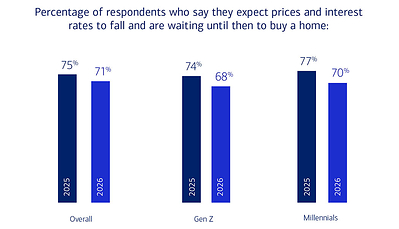
Grouped bar chart titled "Percentage of respondents who say they expect prices and interest rates to fall and are waiting until then to buy a home."

The survey also revealed positive shifts in consumer sentiment toward homeownership, including:

  • 90% of respondents say a home is a valuable investment, up from 79% in 2025.
  • 94% say homeownership provides stability, up from 83% in 2025.
  • 32% say they are more confident in their ability to buy a home this year, up from 27% last year.

"We are seeing meaningful changes in attitudes toward homeownership," said Matt Vernon, Head of Consumer Lending at Bank of America. "Despite real and persistent challenges in the market, buyers and owners are increasingly optimistic, and many are starting to move forward rather than waiting on the sidelines."

Insights point to movement in the market
Even as attitudes shift, prospective buyers increasingly cite affordability as the top barrier to homeownership, with 58% pointing to expensive home prices (vs. 46% in 2025) and 47% pointing to high interest rates (vs. 40% in 2025). Bank of America Institute's latest On the Move analysis also shows rent payments are declining, suggesting renters are trading down by opting for smaller units, fewer amenities, more remote areas, or shared living arrangements to cut costs.

Still, intent to purchase a home is rising:

  • Fewer prospective buyers are waiting for market conditions to improve before purchasing. In this latest survey, 71% said they expect prices and interest rates to fall and are waiting until then to buy a home, compared to 75% in 2025, with Gen Z (68% vs. 74%) and Millennials (70% vs. 77%) leading this shift.
  • 52% of current homeowners say they expect to buy another home (a new or additional one), and more are accelerating their timelines, with 22% planning to buy within the next year, compared to 15% in 2025.

The lock-in effect1, while still present, appears to be easing. The survey points to increased willingness to compromise, with more prospective homebuyers open to moving—even if it means paying a higher interest rate for:

  • A more affordable area (76% vs. 71% in 2025 and 68% in 2024).
  • Their dream home becoming available (75% vs. 69% in 2025 and 67% in 2024).
  • A better location (71% vs. 65% in 2025 and 63% in 2024).

AI becomes part of the homebuying journey
One in five prospective buyers and current homeowners (20%) used AI tools or chatbots in the past year for homebuying research, including 28% of Millennials and 32% of Gen Z. Among those prospective buyers who used AI, top use cases include:

  • Estimating affordability, mortgage payments, or closing costs (57%).
  • General education and research about the process (55%).
  • Researching neighborhoods, market trends, or property values (52%).

Although AI can be a useful tool, prospective buyers still prefer human expertise for key steps such as touring homes (55%) and legal or contractual advice (54%).

"AI is becoming a meaningful first step in the homebuying journey, especially for younger buyers. However, when it comes to high-stakes decisions, people still want trusted experts by their side," says Vernon. "We find that clients prefer a mix of high-tech solutions such as Bank of America's Digital Mortgage Experience – which streamlines the mortgage application process online or via mobile – paired with the high-touch experience and expertise of lending and real estate professionals along the way."

Gen Z adapts to today's market
Some Gen Z are taking on extra jobs (28%) or considering co-buying with friends or family (32%) to make homeownership more attainable, and 31% plan to leverage homebuyer assistance programs, such as Bank of America's Down Payment Grant, America's Home Grant® or low down payment mortgages. By leveraging these resources, eligible homebuyers can receive up to $17,500 in combined down payment and closing cost assistance, or lock in a mortgage with a competitive rate and 3% down payment. Bank of America also offers free financial education tools, including Better Money Habits® and Life Plan®, to help buyers build confidence and plan for long-term financial goals.

Methodology

Sparks Research conducted a national online survey on behalf of Bank of America from April 13 to May 10, 2026. A total of 2,000 surveys (1000 homeowners / 1000 renters) were completed with adults 18 years old or older, who make or share in household financial decisions, and who currently own a home/previously owned a home or plan to own a home in the future. Select questions allowed respondents to choose more than one answer, resulting in responses that may equate to more than 100 percent.

Bank of America Institute

Bank of America Institute is dedicated to uncovering powerful insights that move business and society forward. Established in 2022, the Institute is a think tank that draws on data and analyses from across the bank and the world to provide timely and original perspectives on the economy, sustainability, and global transformation. The Institute leverages the depth and breadth of the bank's proprietary data, from nearly 70 million consumer and small business clients, $4.52T in total payments in 2025 and $1.2T in consumer and wealth management deposits. From this robust data set, the Institute provides a unique perspective on the health of the economy. It also elevates thought leadership from throughout the bank that addresses long-term trends and shares these findings with the general public.

Bank of America

Bank of America is one of the world's leading financial institutions, serving individual consumers, small and middle-market businesses and large corporations with a full range of banking, investing, asset management and other financial and risk management products and services. The company provides unmatched convenience in the United States, serving nearly 70 million clients with approximately 3,500 retail financial centers, approximately 15,000 ATMs (automated teller machines) and award-winning digital banking with approximately 59 million verified digital users. Bank of America is a global leader in wealth management, corporate and investment banking and trading across a broad range of asset classes, serving corporations, governments, institutions and individuals around the world. As the #1 small business lender in the United States (FDIC), Bank of America offers industry leading support to approximately 4 million small business households through a suite of innovative, easy-to-use online products and services. The company serves clients through operations across the United States, its territories and more than 35 countries. Bank of America Corporation stock (NYSE: BAC) is listed on the New York Stock Exchange.

For more Bank of America news, including dividend announcements and other important information, visit the Bank of America newsroom and register for news email alerts.

Reporters may contact

Susan Atran, Bank of America 
Phone: 1.646.743.0791
susan.atran@bofa.com

Footnotes

1 The lock-in effect refers to the financial disincentive that prevents homeowners from selling their property because doing so would mean giving up a low, favorable mortgage interest rate they secured in the past and being forced to take on a new mortgage at today's much higher rates.
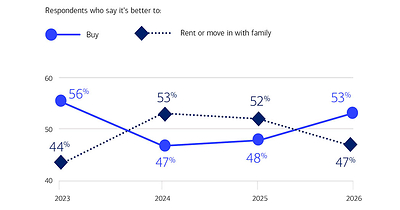
Line chart titled "Respondents who say it's better to:" tracking two trends from 2023 to 2026.

(PRNewsfoto/Bank of America Corporation)

Cision View original content to download multimedia:https://www.prnewswire.com/news-releases/bofa-study-more-americans-favor-buying-over-renting-for-the-first-time-since-2023-302807320.html

SOURCE Bank of America Corporation

FAQ

What did Bank of America (BAC) report about buying vs. renting in June 2026?

Bank of America reported that 53% of surveyed consumers now say it is better to buy a home than rent. According to Bank of America, this is the first majority favoring buying over renting since 2023, signaling a shift in housing sentiment.

How did homeownership sentiment change in the June 23, 2026 Bank of America (BAC) Homebuyer Insights Report?

Homeownership sentiment strengthened, with 90% calling a home a valuable investment and 94% saying it provides stability. According to Bank of America, both figures increased from 79% and 83% respectively in 2025, indicating more positive views of owning a home.

How are high prices and interest rates affecting buyers in Bank of America (BAC) 2026 housing study?

Affordability remains the top barrier, with 58% citing expensive home prices and 47% citing high interest rates. According to Bank of America, these shares rose from 46% and 40% in 2025, showing growing concern about costs despite improving buying sentiment.

How is artificial intelligence being used in the homebuying process according to Bank of America (BAC)?

One in five prospective buyers and homeowners used AI tools or chatbots for homebuying research in the past year. According to Bank of America, AI is mainly used to estimate affordability, learn about the process, and research neighborhoods and market trends.

What does the June 23, 2026 Bank of America (BAC) report say about Gen Z homebuyers?

Some Gen Z respondents are adapting by taking extra jobs, considering co-buying, and planning to use assistance programs. According to Bank of America, 28% report extra jobs, 32% consider co-buying, and 31% expect to leverage down payment or closing cost assistance.

What is the mortgage “lock-in effect” mentioned in Bank of America (BAC) 2026 study?

The lock-in effect describes homeowners’ reluctance to sell because they would lose a low existing mortgage rate and face higher current rates. According to Bank of America, survey data suggests this effect is easing as more buyers accept higher rates for better locations or homes.

What methodology did Bank of America (BAC) use for its June 2026 Homebuyer Insights Report?

The study is based on 2,000 online surveys conducted from April 13 to May 10, 2026, among U.S. adults 18+ who influence household finances. According to Bank of America, the sample included 1,000 homeowners and 1,000 renters interested in current or future ownership.
