
BioHarvest Reports Third Quarter 2026 Financial Results and Provides Business Update
BioHarvest plans development-site consolidation in 2027 while concentrating resources on fewer programs with manufacturing potential.
Sentiment and the balance of points
Rhea-AI Sentiment reads the wording of the document, how positive or negative its language is on a 1 to 5 scale. The balance of points shown with the takes weighs what the document actually discloses, so the two can disagree, for example when a trial that missed its main goal is described in upbeat language.
Rhea-AI Summary
BioHarvest Sciences (BHST) reported third-quarter 2026 revenue of $7.9 million as it shifted resources toward cash preservation and selected development programs. Revenue compared with $8.8 million in Q2 2026 and $9.1 million a year earlier. Gross margin fell to 54% from 58% sequentially and approximately 61% a year earlier. Net loss widened to $3.3 million from $2.5 million a year earlier.
Cash, cash equivalents and bank deposits were $12.5 million at September 30, down from $16.2 million at June 30. The company now expects 2026 revenue of $32-$33.5 million and an adjusted EBITDA loss of $5.5-$7.5 million. Its first contract development and manufacturing supply agreement covers an anticipated 20 tons of fragrance composition, estimated to generate $20-$30 million in 2027-2028 revenue. BioHarvest anticipates limited production could begin as early as Q1 2027 and plans phased capacity additions aligned with demonstrated demand.
How this balance works
Rhea-AI gives every point it takes from this document a weight. Minor counts 1, Moderate 3 and Major 9, so one Major point outweighs several Minor ones. The bar adds up the weights on each side, and when neither side holds more than 65% of the total the balance reads Mixed.
It reads the document as published, with the same rules for every company, and it does not look at what the market expected or at how the stock traded, so a point can be objectively good on a day the stock falls.
Rhea-AI Sentiment measures something else, the tone of the wording.
Hollow bars mark forward-looking points. How the balance works
Positive
- Major pointFragrance manufacturing agreement with a UAE-based customer covers exclusive production of an anticipated 20 tons.
- Major point. Forward-looking: it has not happened yet and may not happen.Fragrance supply agreement is estimated to generate $20-$30 million in revenue in 2027-2028.
- Moderate point. Forward-looking: it has not happened yet and may not happen.Consolidated 2026 revenue is now expected at $32-$33.5 million.
- Moderate point. Forward-looking: it has not happened yet and may not happen.Fixed operating cost reductions are planned, including development-site consolidation in 2027.
- Minor pointFragrance Stage 1 completed in March 2026; Stage 2 began in May.
9 minor points
- Minor point. Forward-looking: it has not happened yet and may not happen.Fragrance Stage 2 completion is expected within six to nine months; limited production could begin as early as Q1 2027.
- Minor point. Forward-looking: it has not happened yet and may not happen.VINIA direct-to-consumer 2026 revenue guidance is revised to $31-$32 million.
- Minor point. Forward-looking: it has not happened yet and may not happen.Contract development and manufacturing 2026 revenue is now expected at $1-$1.5 million.
- Minor pointSales and marketing expenses declined to $4.0 million in Q3 2026 from $4.1 million a year earlier.
- Minor point. Forward-looking: it has not happened yet and may not happen.Manufacturing capacity additions are planned gradually, in phases.
- Minor pointVINIA strategy prioritizes efficient acquisition, retention, margins and cash contribution.
- Minor point. Forward-looking: it has not happened yet and may not happen.VINIA marketing changes are expected to show benefits and revenue growth beginning in Q1 2027.
- Minor point. Forward-looking: it has not happened yet and may not happen.Development priorities target 2027 completion of fragrance, saffron and natural sweetener projects, including sweetener compounds with Tate & Lyle.
- Minor pointNew business development focuses on licensing proprietary molecule assets.
Negative
- Moderate pointQ3 2026 revenue fell to $7.9 million from $8.8 million sequentially and $9.1 million a year earlier.
- Moderate pointQ3 2026 gross margin fell to 54% from 58% sequentially and approximately 61% a year earlier.
- Moderate pointQ3 2026 net loss widened to $3.3 million, or $0.15 per share, from $2.5 million, or $0.14.
- Moderate pointQ3 2026 non-IFRS adjusted EBITDA loss widened to $2.041 million from $402,000 a year earlier.
- Moderate pointCash, equivalents and deposits totaled $12.5 million: below June's $16.2 million and December's $23 million, above September 2025's $11 million.
- Moderate point. Forward-looking: it has not happened yet and may not happen.Consolidated 2026 adjusted EBITDA loss is now expected at $5.5-$7.5 million.
- Moderate point. Forward-looking: it has not happened yet and may not happen.Faster fragrance development requires more resources, with fewer new projects than expected to start in 2026.
10 minor points
- Minor pointQ3 2026 gross profit fell to $4.2 million from $5.6 million a year earlier.
- Minor pointQ3 operating loss widened to $3.042 million from $920,000 a year earlier; Q2 2026 loss was $2.5 million.
- Minor pointContract development and manufacturing Q3 adjusted EBITDA loss widened to $1.414 million from $153,000 a year earlier.
- Minor pointProducts Q3 adjusted EBITDA loss widened to $627,000 from $249,000 a year earlier.
- Minor point. Forward-looking: it has not happened yet and may not happen.Contract development and manufacturing 2026 adjusted EBITDA loss is now anticipated at $4-$5 million.
- Minor point. Forward-looking: it has not happened yet and may not happen.VINIA direct-to-consumer 2026 adjusted EBITDA loss guidance remains $1.5-$2.5 million.
- Minor pointQ3 2026 research and development expenses rose to $1.8 million from $1.4 million a year earlier.
- Minor pointQ3 2026 general and administrative expenses rose to $1.5 million from $0.9 million a year earlier.
- Minor pointQ3 2026 cost of revenue rose to $3.6 million from $3.5 million a year earlier.
- Minor point. Forward-looking: it has not happened yet and may not happen.Manufacturing investment is conditional on demonstrated demand.
News Explained
The release adds a segment-level 2026 outlook: VINIA D2C is forecast at
Key Figures
- Q3 revenue
- $7.9 million
- Q3 2026; compared with $9.1 million in Q3 2025
- Gross margin
- 54%
- Q3 2026; compared with 61% in Q3 2025
- Net loss
- $3.3 million, or $0.15 per share
- Q3 2026
- Cash, cash equivalents and bank deposits
- $12.5 million
- At September 30, 2026
- VINIA D2C revenue guidance
- $31–$32 million
- Full-year 2026; revised guidance
- CDMO revenue guidance
- $1–$1.5 million
- Full-year 2026; revised guidance
- Consolidated revenue guidance
- $32–$33.5 million
- Full-year 2026; revised guidance
- Consolidated Adjusted EBITDA loss guidance
- $5.5–$7.5 million
- Full-year 2026
Previous Earnings Reports
-
Reported Q2 results and first 20-ton fragrance supply agreement; revised VINIA and EBITDA guidance.
-
Reported third-quarter revenue growth and a 61% gross margin alongside a net loss.
24h Move is the share-price change in the day after each event; other market factors may also have contributed.
Key Terms
cdmo technical
non-ifrs financial
d2c financial
AI-generated analysis. How Rhea-AI works. Not financial advice.


- Prioritizes cash preservation and controlled VINIA growth while concentrating CDMO resources on advanced programs with near-term manufacturing potential
Vancouver, British Columbia and Rehovot, Israel--(Newsfile Corp. - November 12, 2026) - BioHarvest Sciences Inc (NASDAQ: BHST) (TASE: BHST) (FSE: 8MV0), a leader in Botanical Synthesis technology and sustainable plant-based molecule development, today reported financial results for the three and nine months ended September 30, 2026, and outlined its strategic priorities for 2027. The Company is aligning capital allocation, operating expenses and development resources with a narrower set of commercial objectives designed to preserve liquidity and advance its most promising Botanical Synthesis programs toward manufacturing.
All figures stated in this news release are in U.S. dollars unless stated otherwise.
Third Quarter and 2026 Financial Results Highlights
- Q3 2026 revenue was
$7.9 million , compared with$8.8 million in Q2 2026 and$9.1 million in Q3 2025. The decline reflected the Company's deliberate moderation of lower-return customer acquisition in the Products Business Unit, as part of its strategy to build a healthier, more profitable revenue base, as well as the timing of CDMO development revenue. Gross margin was54% , compared with58% in Q2 2026 and approximately61% in Q3 2025, reflecting a revenue mix weighted toward Products, with a lower contribution from higher-margin CDMO development revenue. - Operating loss was
$3 million , compared with$2.5 million in Q2 2026 and$0.9 million in Q3 2025. The sequential increase reflected lower gross profit, partly offset by lower operating expenses quarter over quarter, while the year-over-year increase reflected higher gross profit in Q3 2025, as well as one-time, non-cash revaluation income recognized in that quarter, both of which resulted in a lower operating loss in Q3 2025 compared with Q3 2026. - Cash, cash equivalents and bank deposits totaled
$12.5 million at September 30, 2026, versus$16.2 million at June 30, 2026 and$23 million at December 31, 2025.
"Our third-quarter results reflect a period of deliberate transition," commented Dr. Zaki Rakib, CEO and Executive Chairman, adding, "Consistent with a cash-disciplined strategy, we are making a fundamental choice about how BioHarvest creates value: protecting our cash, growing VINIA with better economics, and concentrating our CDMO capabilities on fewer programs that can reach manufacturing sooner.
"Toward the end of the second quarter, we began implementing changes to VINIA's marketing and sales strategy designed to drive profitability. These changes have resulted in a moderate decline in revenue, which we anticipated as part of our sales and marketing efficiency initiatives, and we expect the benefits of these improvements along with revenue growth to become evident beginning in the first quarter of 2027. On the CDMO development side, we are focusing our resources on the fragrance compound, multiple sweetener compounds with Tate & Lyle, and the Saffron development projects. Our new business development activity is focused on licensing our unique molecules' assets.
"We believe focus—not the number of projects in development—will determine our speed of commercialization and ultimately our returns on invested capital."
Three execution priorities
- Cash preservation and conditional manufacturing investment.
- The Company intends to add manufacturing capacity gradually, in phases aligned with demonstrated demand, in order to preserve cash.
- Reduction of fixed operation costs, including consolidation of development sites in 2027.
- Controlled VINIA growth. Management intends to prioritize efficient customer acquisition, retention, margin discipline and cash contribution rather than pursuing top-line growth irrespective of economics.
- CDMO focus on select programs and faster progression. Resources will be concentrated on programs with the clearest commercial and manufacturing pathways.
2027 priorities include; completing development of three advanced projects - the rare, high-value, plant-based fragrance ingredient, the Saffron compound, and the natural sweetener molecules; and licensing our unique molecules' assets. The aim is to move advanced assets into production and commercialization with greater speed and lower resource dispersion.
Third Quarter and Recent Operational Highlights
- In August, the Company signed the CDMO division's first manufacturing and supply agreement, an exclusive agreement covering the scaled production of a rare, high-value, plant-based fragrance ingredient. The agreement extends an existing multi-stage development program with a UAE-based customer.
The source plant is endangered due to overharvesting and habitat loss, and the ingredient is widely regarded as one of the most valuable fragrance raw materials in the world, with premium grades commanding prices exceeding tens of thousands of U.S. dollars per kilogram.
Following the successful completion of Stage 1 development in March 2026, Stage 2 was initiated in May and is expected to be completed within six to nine months. The manufacturing and supply agreement provides for the production of an anticipated 20 tons of the fragrance composition, and BioHarvest anticipates that limited production of this ingredient could begin as early as the first quarter of 2027.
- In September, BioHarvest launched single-dose VINIA Daily Chews, designed to complement the existing VINIA portfolio, broaden consumer choice and provide an additional pathway for customer acquisition, retention, market expansion and revenue growth.
VINIA also demonstrates the commercial versatility of the Botanical Synthesis platform. Botanical Synthesis produces plant-based compositions in a versatile powder format, and VINIA gives prospective CDMO customers a commercial example of how a BioHarvest composition can progress from plant-cell development through scaled manufacturing and into differentiated consumer formats.
Third Quarter 2026 Financial Results Summary
Revenues for the third quarter of 2026 were
Cost of revenue was
Gross profit in the third quarter of 2026 was
R&D expenses totaled
Sales and marketing expenses totaled
G&A expenses totaled
Net loss for the third quarter of 2026 totaled
Adjusted EBITDA loss - a non-IFRS measure - totaled
Cash and cash equivalents, together with bank deposits, as of September 30, 2026 totaled
Full-Year 2026 Guidance
In order to set the Company for success in 2027 and creating substantial shareholder value, the actions taken in the beginning of Q3 have resulted in changes to the 2026 financial results.
Full-year revenue guidance for the VINIA D2C business has been revised to
Largely driven by the 20-ton plant-based fragrance supply agreement (estimated to generate revenue of
On a consolidated basis, the Company now expects full-year 2026 revenue of
Third Quarter 2026 Earnings Call Information
Date: Thursday, November 12, 2026
Time: 8:00 a.m. Eastern Time
Webcast: https://events.q4inc.com/attendee/792571252
The Q3 2026 Financial Results conference call webcast will be broadcast live, and attendees are encouraged to register via the webcast link at least 10 minutes prior to the call to ensure participation.
A recording of the webcast will be available for replay on the Company's website within the Investor Relations/Events & Presentations section.
Use of Non-IFRS Financial Measures
This press release includes Adjusted EBITDA, a non-IFRS measure, including on a segment basis for the CDMO Services and Products business units. Adjusted EBITDA is not a standardized financial measure under IFRS and might not be comparable to similar financial measures disclosed by other issuers. It should not be considered as an alternative to operating loss or any other measure of financial performance under IFRS. Adjusted EBITDA represents operating profit (loss) before depreciation and amortization, adjusted for share-based payment. The Company believes this non-IFRS measure, when considered together with the corresponding IFRS measures, provides useful information to investors and management regarding financial and business trends relating to the Company's results of operations. However, this non-IFRS measure has significant limitations in that it does not reflect all the costs and other items associated with the operation of the Company's business as determined in accordance with IFRS. Investors should consider non-IFRS measures in addition to, and not as a substitute for, or superior to, measures of financial performance in accordance with IFRS. A reconciliation of Adjusted EBITDA to operating loss, its most directly comparable IFRS measure, is shown below.
IFRS OPERATING LOSS TO ADJUSTED EBITDA RECONCILIATION
| Unaudited | ||||||
| In USD thousands | ||||||
| For the three-month period ended September 30, | ||||||
| 2026 | 2025 | |||||
| CDMO Services | Products | Total | CDMO Services | Products | Total | |
| Operating (Loss) | (2,099) | (943) | (3,042) | (514) | (406) | (920) |
| Depreciation and Amortization | 527 | 76 | 603 | 311 | 74 | 385 |
| Share Based Payment | 158 | 240 | 398 | 50 | 83 | 133 |
| Adjusted EBITDA (Non-IFRS) | (1,414) | (627) | (2,041) | (153) | (249) | (402)(*) |
(*) The Adjusted EBITDA figures for the three months ended September 30, 2025, as previously reported, included finance expenses of
About BioHarvest
BioHarvest (NASDAQ: BHST) (TASE: BHST) (FSE: 8MV0) is a leader in Botanical Synthesis, leveraging its patented technology platform to grow plant-based compounds, without the need to grow the underlying plant. BioHarvest is leveraging its botanical synthesis technology to develop the next generation of science-based and clinically proven therapeutic solutions within two major business verticals: as a contract development and manufacturing organization (CDMO) on behalf of customers seeking novel plant-based compounds, and as a creator of proprietary nutraceutical health and wellness products based on its botanical synthesis technology. To learn more, please visit www.bioharvest.com.
Forward-Looking Statements
This news release contains "forward-looking statements" within the meaning of the U.S. Private Securities Litigation Reform Act of 1995, Section 27A of the Securities Act of 1933, as amended, and Section 21E of the Securities Exchange Act of 1934, as amended, and "forward-looking information" within the meaning of applicable Canadian securities laws (together, "forward-looking statements"), which can often be identified by words such as "expects," "anticipates," "intends," "plans," "estimates," "will," "may" and similar expressions. These include statements regarding the Company's 2026 guidance and 2027 priorities; the expected return to VINIA revenue growth; the timing of fragrance development, production and revenue; manufacturing capacity and cost reductions; CDMO development, licensing and new projects; and the Company's need for, and ability to obtain, additional capital.
These statements are based on management's current assumptions, including that the Company can acquire and retain VINIA customers at an acceptable cost; CDMO development revenue is recognized in the fourth quarter of 2026 as currently expected; gross margin and operating expenses remain consistent with current levels; the Company can complete Stage 2 fragrance development within the expected timeframe, begin limited production as early as the first quarter of 2027, scale up production and deliver the anticipated 20 tons of fragrance composition in 2027-2028 at the agreed pricing; its fragrance customer performs its obligations under the supply agreement; it can rely on its other customers and partners; it can operate without material disruption in Israel; and it can obtain financing on acceptable terms. These assumptions may prove incorrect.
Actual results may differ materially due to risks including: the Products strategy may not improve profitability or restore growth; the Company may need to further revise its 2026 guidance; fragrance revenue depends on successful development and delivery, and near-term CDMO prospects depend largely on one customer; manufacturing scale-up; reliance on partners; regulatory risks for nutraceutical products; currency fluctuations; and conditions in Israel and the Middle East. There is no assurance of new CDMO contracts, that development agreements will proceed or that compounds will be commercialized, and higher revenue may not result in profitability. See "Risks and Uncertainties" in the Company's MD&A for the three and nine months ended September 30, 2026 and its other filings on EDGAR (www.sec.gov) and SEDAR+ (www.sedarplus.ca).
The 2026 guidance and the estimated 2027-2028 revenue under the fragrance supply agreement are "financial outlook" under Canadian securities laws, provided to help readers understand management's current expectations, and may not be appropriate for other purposes. Forward-looking Adjusted EBITDA is not reconciled to operating loss because items such as share-based payment cannot be predicted without unreasonable efforts. Readers should not place undue reliance on forward-looking statements, which speak only as of the date of this news release. The Company undertakes no obligation to update them, except as required by applicable law.
BioHarvest Company Contact:
Justin Meiklem
Head of Corporate Communications
(604) 622-1186 | 778.686.3855
info@bioharvest.com
BioHarvest Sciences Inc. and its subsidiaries
Unaudited Interim Condensed Consolidated Statements of Financial Position
USD dollars in thousands
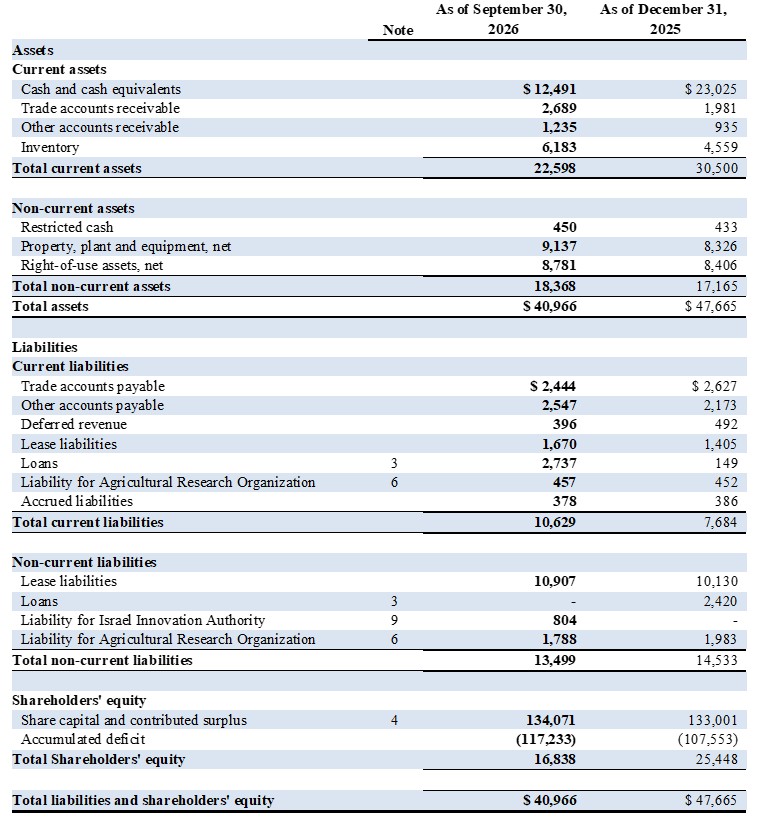
To view an enhanced version of this graphic, please visit:
https://images.newsfilecorp.com/files/6168/323713_biohtable1.jpg
BioHarvest Sciences Inc. and its subsidiaries
Unaudited Interim Condensed Consolidated Statements of Loss and Other Comprehensive Loss
USD in thousands, except per share data
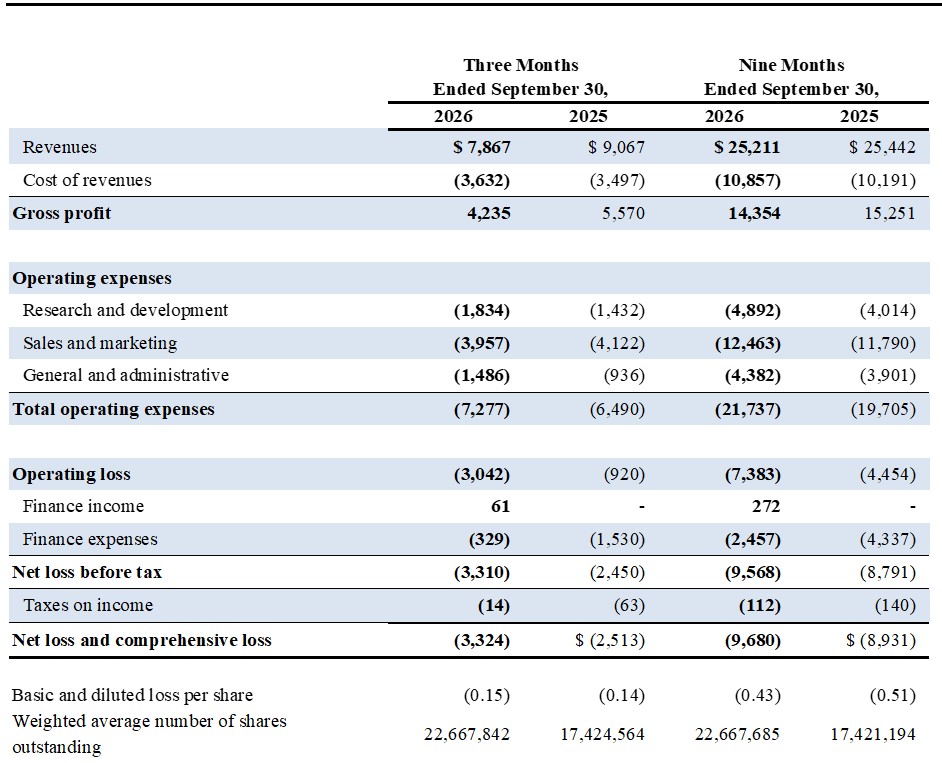
To view an enhanced version of this graphic, please visit:
https://images.newsfilecorp.com/files/6168/323713_biotable2.jpg
BioHarvest Sciences Inc. and its subsidiaries
Unaudited Interim Condensed Consolidated Statements of Changes in Shareholders' Equity
USD in thousands, except per share data
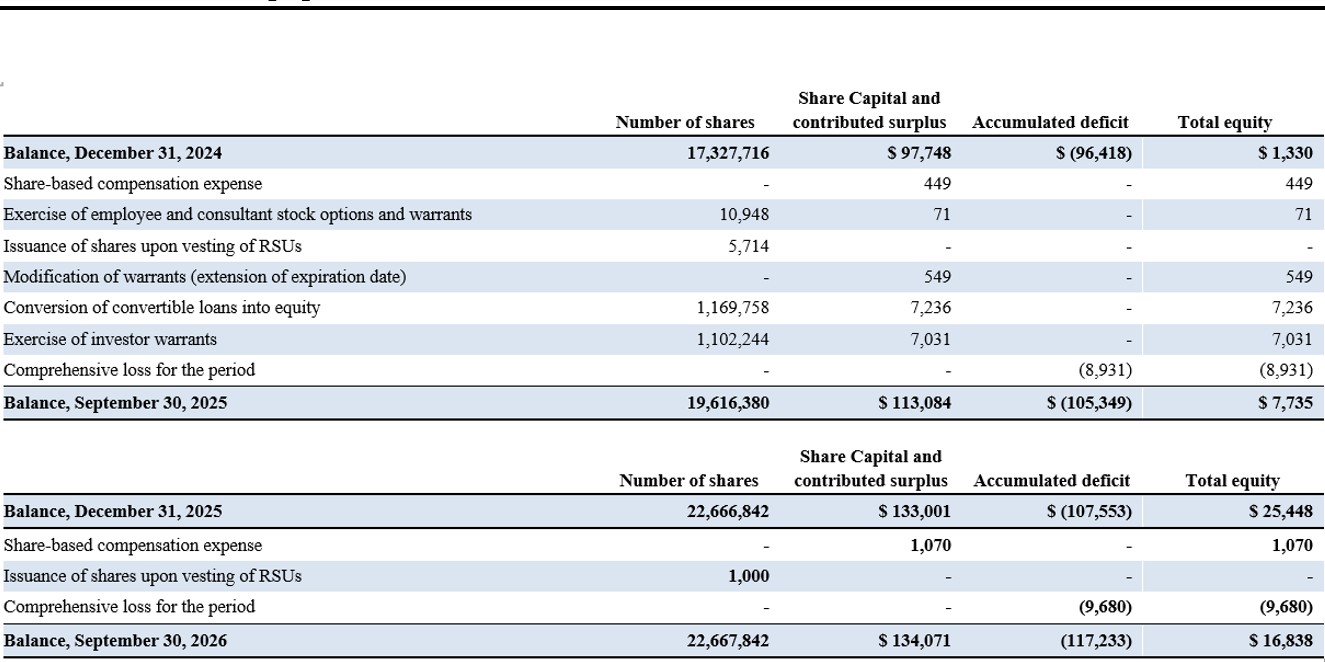
To view an enhanced version of this graphic, please visit:
https://images.newsfilecorp.com/files/6168/323713_biohtable3.jpg
BioHarvest Sciences Inc. and its subsidiaries
Unaudited Interim Condensed Consolidated Statements of Cash Flows
USD in thousands
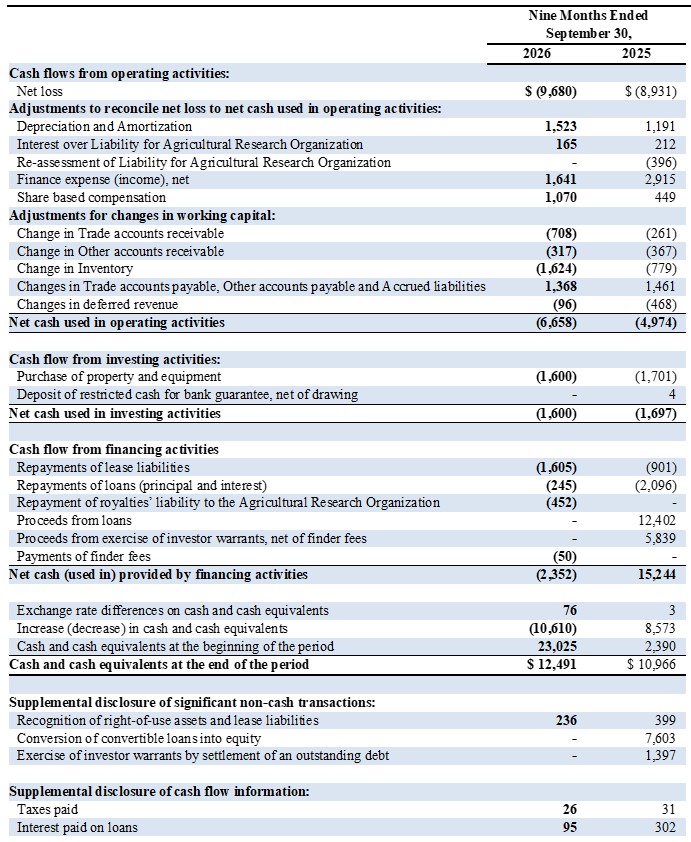
To view an enhanced version of this graphic, please visit:
https://images.newsfilecorp.com/files/6168/323713_biohtable4.jpg

To view the source version of this press release, please visit https://www.newsfilecorp.com/release/323713
FAQ
AI-generated questions and answers. How Rhea-AI works. Not financial advice.
What were BioHarvest BHST's third-quarter 2026 financial results?
BioHarvest reported $7.9 million in revenue and a $3.3 million net loss for Q3 2026. A year earlier, revenue was $9.1 million and net loss was $2.5 million. Basic and diluted loss per share increased to $0.15 from $0.14.
What is BioHarvest BHST's full-year 2026 guidance?
BioHarvest now expects $32-$33.5 million in consolidated revenue and a $5.5-$7.5 million adjusted EBITDA loss for 2026. Adjusted EBITDA is a non-IFRS measure. VINIA direct-to-consumer revenue guidance is $31-$32 million, while contract development and manufacturing revenue is expected at $1-$1.5 million.
Why did BioHarvest BHST's third-quarter 2026 revenue and gross margin decline?
BioHarvest attributes the revenue decline to moderated lower-return customer acquisition in Products and the timing of contract development and manufacturing revenue. The gross-margin decline reflected a revenue mix weighted toward Products, with a lower contribution from higher-margin development revenue.
How does BioHarvest BHST calculate adjusted EBITDA?
BioHarvest calculates adjusted EBITDA as operating profit or loss before depreciation and amortization, adjusted for share-based payments. The Q3 2025 comparative figures were restated to exclude $40,000 of finance expenses previously included, aligning them with the current-period methodology.