
Buffalo Potash Completes Initial Drill Hole and Spuds Second Well at Initial Production Module
Rhea-AI Summary
Buffalo Potash (OTCQB: BLPTF) reported completion of its first Initial Production Module well, 15-10, at the Disley potash project ahead of schedule and under budget, achieving 100% core recovery over more than 108 m and completing open-hole logging before casing the well for potential future use as a brackish-water source.
The drilling rig has been moved 1,600 m east and the second well, 2-14, was spudded on July 27, 2026; it is planned to be cored, logged and then extended to the Deadwood Formation to serve as a disposal well for excess brine. The IPM is designed for 125,000 TPA of potash with targeted first production in Q1 2027, as part of a phased plan that could reach up to 1,125,000 TPA across three facilities, for which a PEA outlines an after-tax NPV of US$1.1B and IRR of 30%, subject to significant technical and economic risks and without established mineral reserves.
Positive
- 15-10 source well completed ahead of schedule and under budget
- 100% core recovery over more than 108 m at 15-10 well
- Second well 2-14 spudded July 27, 2026 at Disley project
- IPM design capacity of 125,000 TPA soluble-grade potash
- Disley full build-out contemplates up to 1,125,000 TPA potash production
- PEA economics: after-tax NPV of US$1.1B and IRR of 30%
Negative
- IPM production decision made without a feasibility study of mineral reserves
- Disley project has no mineral reserves established to date
- PEA is preliminary and based on inferred resources without demonstrated economic viability
- Company warns of higher risk of economic and technical failure for the IPM
- No guarantee that projected production or PEA results will be achieved
Details
News Market Reaction – BLPTF
In the Jul 29 session, BLPTF declined 7.08%, reflecting a notable negative market reaction.
Data tracked by StockTitan Argus on the day of publication.
AI-generated analysis. How Rhea-AI works. Not financial advice.




Highlights
- Successfully completed drilling at 15-10 Well ahead of schedule and under budget;
- Flawless coring of 15-10 Well with
100% recovery on over 108m; - Cased the 15-10 Well for future optionality to become source well of underground brine;
- Successfully completed open hole logging program;
- Drilling rig safely and efficiently moved to the 2-14 Well location; and
- 2-14 Well spudded Monday, July 27, 2026.
Saskatoon, Saskatchewan--(Newsfile Corp. - July 29, 2026) - Buffalo Potash Corporation (TSXV: BUFF) (OTCQB: BLPTF) (FSE: VU5) (the "Company" or "Buffalo") is pleased to announce the completion of the first well (the "15-10 Well" or the "Source Well") at the Initial Production Module ("IPM") and the spudding of the second well (the "2-14 Well" or the "Disposal Well") located at the Company's flagship Disley property in Saskatchewan (the "Disley Project").
Completion of the Source Well (15-10) - Further to the Company's July 22, 2026 news release (see link), drilling of the 15-10 Well was completed ahead of schedule and under budget. The well was cored with
Spudding of the Disposal Well (2-14) - Following completion of the 15-10 Well, the drilling rig was moved to the 2-14 Well location, approximately 1,600m east of the 15-10 Well. The 2-14 Well was successfully spudded on Monday, July 27, 2026 and, upon reaching the initial target depth, will be cored and logged through the potash-bearing members of the Prairie Evaporite Formation. Core and log data from the vertical drilling program will enhance the Company's geological understanding of the IPM site and support a feasibility study for Disley West and Disley East (see Disley Project Development Plan below). Once coring and open hole logging are complete, the 2-14 Well will be extended to the top of the Deadwood Formation and cased to later serve as a disposal well for excess brine following surface processing under the IPM design.
Mr. Quinton Hardage, P.Eng., PMP, President and Chief Operating Officer of the Company, commented: "Completing our first well ahead of schedule and under budget is exactly the start we wanted as we enter the most exciting period in Buffalo's history. Saskatchewan is the largest producer of potash globally, and the world depends on this province to help feed a growing population. We take that responsibility seriously, which is why we are working tirelessly to build a more capital-efficient and lower-impact way to produce it. Seeing our vision take shape as we bring the Initial Production Module to life is enormously rewarding, and we look forward to carrying this momentum into the 2-14 Well and beyond."
Disley Project Development Plan
The IPM is designed to produce 125,000 tonnes per annum ("TPA") of soluble-grade potash and is the first of three planned solution mining facilities at the Disley Project. The IPM has a lower initial CAPEX requirement compared to the full Disley Project build-out and is targeted to reach first production in Q1 2027. At full build-out comprising the IPM and two 500,000 TPA mines ("Disley East" and "Disley West"), the Disley Project would be expected to produce up to 1,125,000 TPA of potash, as contemplated in Buffalo's recently released preliminary economic assessment titled "NI 43-101 Preliminary Economic Assessment Technical Report on the Disley Potash Project, Saskatchewan, Canada" dated May 21, 2026, and effective April 15, 2026 (the "PEA"), a copy of which is available on the Company's SEDAR+ profile at www.sedarplus.ca. On a standalone basis, the PEA attributes a payback period of approximately 12 months from the start of IPM production.(2) However, there is no guarantee that the Company will be able to achieve production.
The Company's production decision for the IPM is not based on a feasibility study of mineral reserves demonstrating economic and technical viability, and such production decisions are historically associated with a higher risk of economic and technical failure (see "Note 3 - Production Decision Cautionary Statement").
The IPM is intended to establish initial cash-flowing production at a lower upfront capital cost, while building the operational and technical foundation for full-scale development. Development of the IPM is anticipated to be broken down into five phases:
- Source and disposal wells;
- Horizontal Line-Drive ("HLD") drilling;
- Brine circulation;
- Site development; and
- Surface processing.
Disley Project - General Overview
The Disley Project is located approximately 50 kilometers northwest of Regina and covers 10,610 hectares (Crown and Freehold mineral rights). The property is situated immediately to the east of the K+S Bethune potash solution mine and north of the Mosaic Belle Plaine potash solution mine — both of which are among the largest producing potash solution mines in the world. In the opinion of management, the Disley Project is in one of the most favorable areas of Saskatchewan for potash solution mining (see Figure 1) as evidenced by the success of these neighboring operations.(1)
On May 22, 2026, Buffalo released the results of its maiden NI 43-101 Mineral Resource Estimate and PEA for the Disley Project, prepared by Micon International Co Limited. The PEA outlined a phased, modular development plan contemplating full-scale production of up to 1,125,000 TPA of potash across three solution mining facilities, with an estimated after-tax net present value (NPV) of US
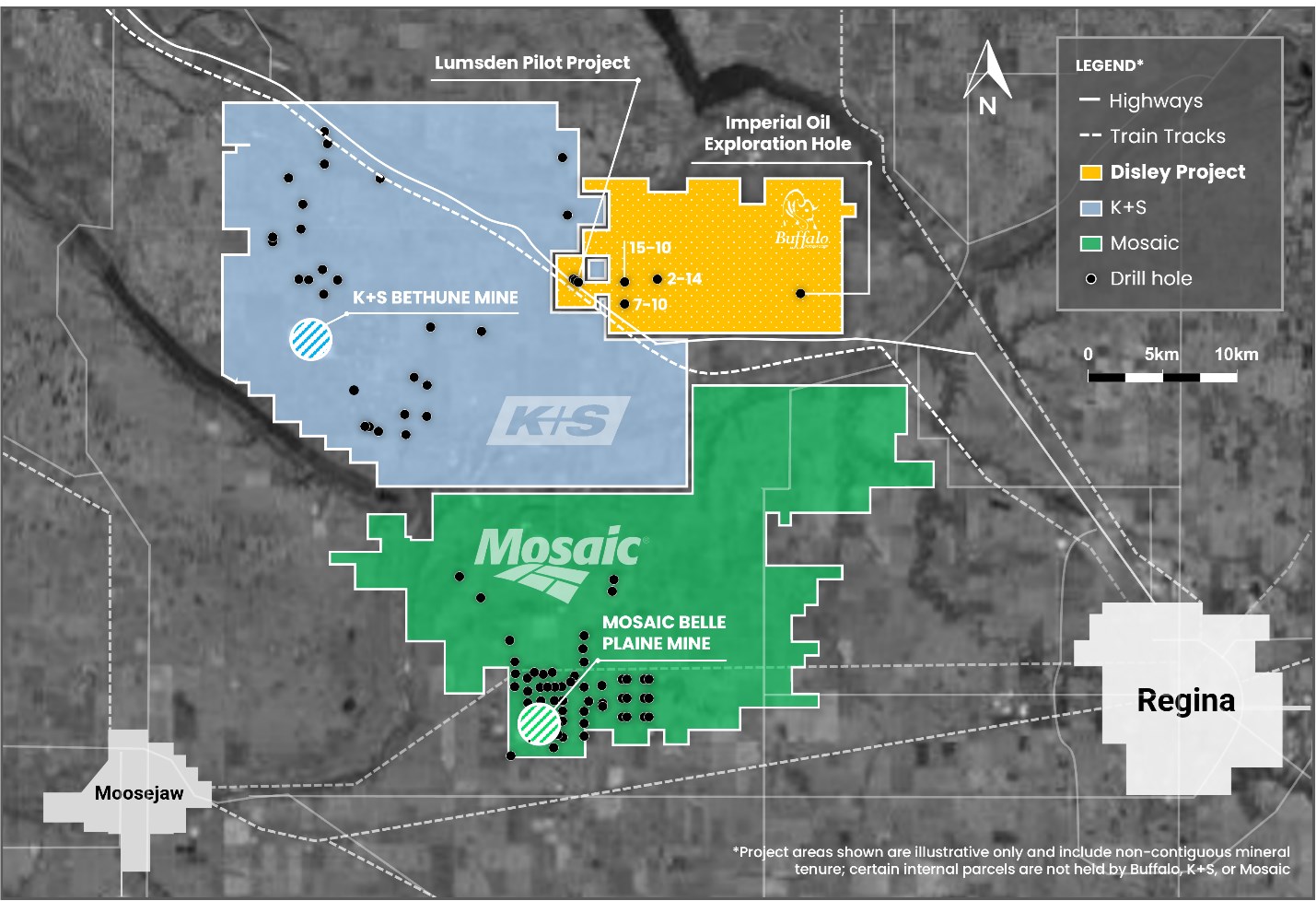
Figure 1: The Disley Property Situated Amongst Major Potash Solution Mines(1)
To view an enhanced version of this graphic, please visit:
https://images.newsfilecorp.com/files/12107/307069_78d5236944566a6d_001full.jpg
About Buffalo Potash
Buffalo Potash is an emerging Saskatchewan-based potash developer pursuing a modular approach to selective solution mining through its patented Horizontal Line-Drive (HLD) technology. Buffalo is advancing the Disley Project — located adjacent to two of the most prominent currently producing potash solution mines in the world — with the objective of establishing capital-efficient, lower-impact potash production in one of the world's leading potash jurisdictions.
Qualified Person
The technical information in this news release has been reviewed and approved by Douglas F. Hambley, PhD, PE, P.Eng., PG, an independent consultant to the Company, who is a Qualified Person within the meaning of National Instrument 43-101 - Standards of Disclosure for Mineral Projects. This news release does not contain new technical disclosure beyond information previously disclosed in the NI 43-101 technical report for the Disley Project filed under the Company's profile on SEDAR+ at www.sedarplus.ca. Readers are referred to that technical report, prepared by Micon International Co Limited, for complete details of the Mineral Resource Estimate and Preliminary Economic Assessment, including all data verification, methodology, assumptions, and qualifications.
All related and pertinent information has also been reviewed for this news release by Jared Galenzoski, P.Geo, FIMMM as an independent consultant to the Company who is a Qualified Person within the meaning of National Instrument 43-101 - Standards of Disclosure for Mineral Projects. Mr. Galenzoski is an expert in several potash-related fields including the drilling of potash horizontal wells and solution mining operations.
Contact
Steve Halabura | Chief Executive Officer & Director
Email: steve@buffalopotash.ca | Phone: 1-306-220-7715
Neither the TSX Venture Exchange nor its Regulation Services Provider (as that term is defined in the policies of the TSX Venture Exchange) accepts responsibility for the adequacy or accuracy of this release.
Notes
(1) The K+S Bethune potash solution mine and the Mosaic Belle Plaine potash solution mine (together, the "Adjacent Properties") may each be considered an "adjacent property" (within the meaning of NI 43-101) to the Company's Disley Project. The Company has no interest in either of the Adjacent Properties. The Company believes this context is useful in illustrating the proven endowment of the district, while noting that mineralization on adjacent or nearby properties is not indicative of mineralization on the Company's Disley Project. There is no guarantee that the Disley Project will yield comparable results to either of these mines.
(2) The PEA was prepared by Micon International Co Limited in accordance with National Instrument 43-101 Standards of Disclosure for Mineral Projects and is preliminary in nature. The PEA includes inferred mineral resources, which are considered too speculative geologically to have the modifying factors and economic considerations applied to them that would enable them to be categorized as mineral reserves. Mineral resources that are not mineral reserves do not have demonstrated economic viability. There is no certainty that the results of the PEA will be realized. Readers are encouraged to read the technical report filed under the Company's profile on SEDAR+ at www.sedarplus.ca in its entirety, including all qualifications, assumptions, and exclusions that relate to the PEA.
(3) Production Decision Cautionary Statement: The Company's decision to proceed with development of the IPM is not based on a feasibility study of mineral reserves demonstrating economic and technical viability. No mineral reserves have been established at the Disley Project, and the PEA is preliminary in nature (see Note 2). Historically, mineral projects advanced to production without first establishing mineral reserves supported by a feasibility study have a higher risk of economic and technical failure. Specific risks associated with the Company's production decision include, but are not limited to: 1) grade, continuity, or thickness of mineralization that differs from the Mineral Resource Estimate; 2) performance of the Company's Horizontal Line-Drive mining method, which has not been operated at commercial scale, that is not as anticipated; 3) recoveries, production rates, or capital and operating costs that differ materially from the PEA; and 4) production during the IPM that does not become sustainable or profitable, which would materially and adversely affect the Company's ability to generate revenue and cash flow.
Forward-Looking Information
This news release contains "forward-looking information" and "forward-looking statements" (collectively, "forward-looking information") within the meaning of applicable Canadian securities legislation. Forward-looking information is generally identifiable by the use of words such as "believes," "may," "plans," "will," "anticipates," "intends," "could," "estimates," "expects," "forecasts," "projects," or similar expressions, and the negative of such expressions.
Forward-looking information in this news release includes, but is not limited to, statements regarding: the timing, sequencing, and completion of the IPM development plan, including the drilling of the source, disposal, and horizontal wells, the development of the mining plane, site development, and the installation and commissioning of processing equipment; the anticipated role of the Source Well and Disposal Well in IPM construction and operations; the anticipated coring and open hole logging of the Source Well and Disposal Well and the expected use and benefits of the data obtained therefrom; the anticipated conversion of the Source Well to produce brackish water from the Mannville Formation and the expectation that such water will be saturated with sodium chloride and used as the solvent in the Company's solution mining methodology; the anticipated timing and completion of lease construction, rig mobilization, and the commencement of drilling operations; the anticipated timing of first production from the IPM; the anticipated timing and phasing of construction and commercial production for the IPM, Disley East, and Disley West; the preparation, timing, and expected benefits of a concurrent feasibility study for the full build-out of the Disley Project; the results, assumptions, and projections contained in or derived from the Mineral Resource Estimate and PEA for the Disley Project, including projected production rates and timing of production; expectations regarding the Disley Project's potential for solution mining; the Company's broader development plans and strategy for the Disley Project; and the fact that the Company's production decision for the IPM is not based on a feasibility study of mineral reserves demonstrating economic and technical viability, and the associated increased risk of economic and technical failure.
Forward-looking information is based on management's reasonable assumptions, estimates, analysis, and opinions made in light of its experience, perception of historical trends, current conditions, and expected future developments, as well as other factors that management believes are relevant and reasonable in the circumstances as of the date such statements are made. These assumptions include, but are not limited to, assumptions regarding geological continuity, potash grade and thickness, the applicability of historical data, the performance of solution mining methods, costs of production, the availability of services and equipment, the receipt of required permits and approvals, and the availability of financing on acceptable terms.
Forward-looking information is subject to known and unknown risks, uncertainties, and other factors that may cause actual results, performance, or achievements of the Company to differ materially from those expressed or implied by such forward-looking information. Such risks and uncertainties include, but are not limited to: the inherent uncertainty of PEA-level studies and the possibility that actual capital costs, operating costs, and production rates differ materially from estimates; risks related to exploration and development activities; risks related to the timing and completion of lease construction, rig mobilization, and drilling operations, including the availability and performance of drilling contractors, equipment, and services; uncertainty in geological interpretation; risks related to the development, commissioning, and operation of novel mining technology; risks inherent to solution mining operations and new or emerging technologies; regulatory approvals and permitting timelines; commodity price volatility; availability of capital; and general economic, market, and business conditions.
Although the Company has attempted to identify important factors that could cause actual results to differ materially from those contained in forward-looking information, there may be other factors that cause results not to be as anticipated, estimated, or intended. There can be no assurance that such information will prove to be accurate, as actual results and future events may differ materially from those anticipated in such forward-looking information. Accordingly, readers should not place undue reliance on forward-looking information. The forward-looking information contained herein is made as of the date of this news release, and the Company disclaims any obligation to update or revise such information, except as required by applicable securities laws.

To view the source version of this press release, please visit https://www.newsfilecorp.com/release/307069
FAQ
AI-generated questions and answers. How Rhea-AI works. Not financial advice.