
Brenmiller Energy and Rock Energy Storage to Present on Integrating SMRs with Thermal Energy Storage at IDEA Campus 2026
Brenmiller Energy (NASDAQ:BNRG) and Rock Energy Storage, together with Idaho National Laboratory, will present on integrating small modular reactors (SMRs) with thermal energy storage (TES) at IDEA Campus 2026 on February 18, 2026.
Sentiment and the balance of points
Rhea-AI Sentiment reads the wording of the document, how positive or negative its language is on a 1 to 5 scale. The balance of points shown with the takes weighs what the document actually discloses, so the two can disagree, for example when a trial that missed its main goal is described in upbeat language.
Rhea-AI Summary
Brenmiller Energy (NASDAQ:BNRG) and Rock Energy Storage, together with Idaho National Laboratory, will present on integrating small modular reactors (SMRs) with thermal energy storage (TES) at IDEA Campus 2026 on February 18, 2026.
The session covers how TES paired with SMRs can boost operational flexibility, resilience, and decarbonization for campus and district energy systems using Brenmiller's bGen TES technology.
Details
News Market Reaction – BNRG
On Feb 18, the day this news came out, BNRG closed 8.45% below the previous close.
Data tracked by StockTitan Argus for the Feb 18 session.
Historical Context
-
Construction milestone for Wolfson Medical Center TES clean heat project.
-
Early launch of bGen ONE modular TES system for industrial users.
-
Operational update completing electrical works at Tempo Beverages TES project.
-
Launch of BNRG360 integrated clean heat and power platform for industry.
-
Announcement of 7-for-1 reverse share split reducing outstanding shares.
24h Move is the share-price change in the day after each event; other market factors may also have contributed.
Key Terms
thermal energy storage technical
small modular reactors technical
baseload energy technical
decarbonization technical
AI-generated analysis. How Rhea-AI works. Not financial advice.




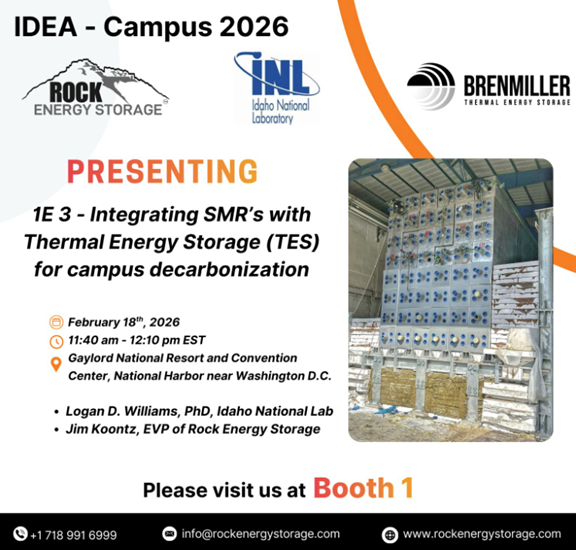
TEL AVIV, IL AND AURORA, CO / ACCESS Newswire / February 18, 2026 / Brenmiller Energy Ltd. (NASDAQ:BNRG) ("Brenmiller", "Brenmiller Energy" or the "Company"), a leading provider of thermal energy storage ("TES") solutions for industrial and utility applications, today announced that Rock Energy Storage ("Rock"), Brenmiller's exclusive distributor in the Northeastern United States, together with Idaho National Laboratory ("INL"), the U.S. Department of Energy's lead laboratory for advanced nuclear energy research and small modular reactors ("SMR") development, will present on the integration of SMRs with TES at the IDEA Campus 2026 conference.
The presentation will address how pairing SMRs with TES can enhance operational flexibility, strengthen economic performance, and accelerate campus and district energy decarbonization strategies.
Enabling Flexible and Resilient Nuclear Based Decarbonization
SMRs are designed to provide steady, carbon-free baseload energy. However, campus and district energy systems operate with variable thermal demand profiles. Integrating TES enables the storage of excess thermal output during low demand periods and dispatch of heat when required, improving overall system efficiency and reducing reliance on fossil fuel backup.
In addition to flexibility and economic benefits, TES can contribute to system level resilience as. TES can function as a thermal buffer or "hot sink," absorbing excess heat during transient conditions or demand fluctuations. By providing an additional pathway for controlled heat absorption and release, TES can support stable reactor operation and enhance overall system resilience.
Brenmiller's bGen™ TES system, based on its proven bCube architecture, stores high temperature heat in crushed rock and delivers saturated or superheated steam or hot air on demand. When integrated with SMRs, TES can enable:
Flexible thermal dispatch aligned with dynamic campus loads
Improved reactor utilization by reducing curtailment
Reduced thermal stress during load transitions
Lower peak demand exposure and reduced dependence on fossil based peaking assets
Scalable deployment aligned with phased infrastructure expansion
TES acts as a buffer between continuous nuclear heat generation and fluctuating end use demand, allowing SMR based systems to operate steadily while delivering demand driven thermal output.
"We believe that integrating TES with SMRs a practical way to unlock their full value for campuses and district energy systems," said Avi Brenmiller, Chairman and Chief Executive Officer of Brenmiller. "SMRs provide stable, carbon free heat. TES adds the flexibility and system level buffering that real world energy users require. Together, they can deliver reliable and cost competitive decarbonization without oversizing generation assets."
Advancing Campus Energy Resilience
The collaboration between Rock and INL reflects a broader industry effort to align advanced nuclear technologies with proven thermal storage solutions to support resilient, low carbon campus infrastructure.
"Campuses and district energy operators are focused on long term reliability, cost stability, and reduced dependence on fossil fuels," said Cory Glick, President and Chief Executive Officer of Rock Energy Storage. "Integrating SMRs with thermal energy storage will allow us to align steady nuclear generation with real world thermal demand while strengthening operational independence and economic performance."
Brenmiller's TES platform has been deployed and validated in grid connected, power generation, and industrial settings. The Company continues to advance collaborations that position TES as a core enabler of next generation clean heat infrastructure.
About Brenmiller Energy
Brenmiller Energy (NASDAQ:BNRG) provides TES solutions that enable industrial and utility customers to decarbonize heat, improve energy flexibility, and integrate renewable electricity. The Company's bGen™ systems convert electricity into dispatchable industrial heat, supporting electrification and emissions reduction across a range of applications.
About Rock Energy Storage
Rock Energy Storage is a U.S.-based energy infrastructure company focused on sales, service, and support for thermal energy storage systems that help domestic clients decarbonize their thermal systems and reduce carbon emissions in a cost-effective manner. The company promotes the adoption of long duration thermal energy storage (LDES) across U.S. regions with strong decarbonization priorities, works with government agencies and trade groups to support market growth, and educates the engineering community on the value of advanced thermal storage technologies. Rock Energy Storage is the North American distributor for Brenmiller Energy's long duration thermal storage solutions.
Forward-Looking Statements
This press release contains "forward-looking statements" within the meaning of the safe harbor provisions of the Private Securities Litigation Reform Act of 1995 and other federal securities laws. Statements that are not statements of historical fact may be deemed to be forward-looking statements. For example, the Company is using forward-looking statements when discussing: potential improvements in operational flexibility, economic performance, and system safety; the anticipated benefits of integrating TES with SMRs; potential cost reductions and deployment efficiencies; the scalability and adaptability of the Company's TES systems; and the Company's ability to position TES as an enabler of next-generation clean heat infrastructure. Without limiting the generality of the foregoing, words such as "plan," "project," "potential," "seek," "may," "will," "expect," "believe," "anticipate," "intend," "could," "estimate" or "continue" are intended to identify forward-looking statements. Readers are cautioned that certain important factors may affect the Company's actual results and could cause such results to differ materially from any forward-looking statements that may be made in this press release. Factors that may affect the Company's results include, but are not limited to: the Company's planned level of revenues and capital expenditures; risks associated with the adequacy of existing cash resources; the demand for and market acceptance of our products; impact of competitive products and prices; product development, commercialization or technological difficulties; the success or failure of negotiations; trade, legal, social and economic risks; and political, economic and military instability in the Middle East, specifically in Israel. The forward-looking statements contained or implied in this press release are subject to other risks and uncertainties, many of which are beyond the control of the Company, including those set forth in the Risk Factors section of the Company's Annual Report on Form 20-F for the year ended December 31, 2024 filed with the U.S. Securities and Exchange Commission ("SEC") on March 4, 2025, which is available on the SEC's website, www.sec.gov. The Company undertakes no obligation to update these statements for revisions or changes after the date of this release, except as required by law.
Contact: investors@bren-energy.com
SOURCE: Brenmiller Energy
View the original press release on ACCESS Newswire
FAQ
AI-generated questions and answers. How Rhea-AI works. Not financial advice.