
Benitec Biopharma Announces Positive Interim Phase 1b/2a Results for High Dose BB-301 and Continued Durable Improvements for Low Dose BB-301 Treatment at the 2026 Muscular Dystrophy Association Clinical & Scientific Conference
Benitec Biopharma (NASDAQ: BNTC) reported positive interim Phase 1b/2a results for BB-301 in Oculopharyngeal Muscular Dystrophy (OPMD) with dysphagia.
Rhea-AI Summary
Benitec Biopharma (NASDAQ: BNTC) reported positive interim Phase 1b/2a results for BB-301 in Oculopharyngeal Muscular Dystrophy (OPMD) with dysphagia. High dose BB-301 showed larger, faster improvements versus low dose at 3 months, including ~68% SSQ reduction and multi-metric radiographic gains. Low dose responses persisted and deepened at 12–24 months. No treatment-related SAEs reported for the first high-dose patient. Results presented as a late-breaking poster at the 2026 MDA Clinical & Scientific Conference.
Positive
- ~68% SSQ reduction with high dose BB-301 at 3 months
- Durable clinical and radiographic improvements at 24 months for low dose
- No treatment-related serious adverse events reported in first high-dose patient
Negative
- High-dose efficacy reported from a single patient at an early interim time-point
- ~6% worsening in overall throat emptying (TPR) with low dose at 3 months
Details
News Market Reaction – BNTC
In the Mar 9 session, BNTC gained 10.67%, reflecting a significant positive market reaction.
Data tracked by StockTitan Argus on the day of publication.
Key Figures
- Responder rate
- 100%
- All BB-301-treated OPMD patients to date in Phase 1b/2a
- SSQ reduction high dose
- ~68% reduction
- Total dysphagic symptom burden at 3 months, high dose BB-301
- SSQ reduction low dose
- ~7% reduction
- Total dysphagic symptom burden at 3 months, low dose BB-301
- Throat closure high dose
- ~19% improvement
- PhAMPC at 3 months, high dose BB-301
- Throat closure low dose
- ~8% improvement
- PhAMPC at 3 months, low dose BB-301
- Throat emptying high dose
- ~44% improvement
- TPR at 3 months, high dose BB-301
- Vallecular emptying high dose
- ~57% improvement
- NRRSv at 3 months, high dose BB-301
- Durability low dose
- 24 months
- Low dose BB-301 benefits continue and deepen two years post-treatment
Historical Context
-
Late-breaking abstract acceptance for BB-301 Phase 1b/2a MDA conference data.
-
Q2 FY2026 loss of $11.8M alongside BB-301 clinical progress and cash update.
-
Positive long-term BB-301 Phase 1b/2a data with durable swallowing improvements.
-
Q1 2026 update, 100% responder rate in Cohort 1 and ~$100M equity raise.
-
Proposed underwritten and registered direct offerings under an effective S-3.
24h Move is the share-price change in the day after each event; other market factors may also have contributed.
Key Terms
oculopharyngeal muscular dystrophy medical
dysphagia medical
dna-directed rna interference medical
sydney swallow questionnaire medical
videofluoroscopic swallowing studies medical
normalized residue ratio scale-valleculae medical
pharyngeal area at maximum constriction medical
patient-reported outcome instrument medical
AI-generated analysis. How Rhea-AI works. Not financial advice.




- Oculopharyngeal Muscular Dystrophy (OPMD) Patients treated with low dose BB-301 and high dose BB-301 experienced significant improvements in throat closure, throat emptying, and total dysphagic symptom burden
- OPMD Patients treated with low dose BB-301 experienced highly durable improvements, with clinical and radiographic improvements continuing to deepen two years post BB-301 treatment
-The first OPMD Patient treated with high dose BB-301 experienced an extraordinarily robust dose-response at an early interim follow-up time-point, indicating the continued potential for BB-301 to achieve disease-modifying outcomes for OPMD patients with dysphagia
- BB-301 is the only clinical-stage therapeutic in development designed to treat dysphagia in patients with OPMD
HAYWARD, Calif., March 09, 2026 (GLOBE NEWSWIRE) -- Benitec Biopharma Inc. (NASDAQ: BNTC) (“Benitec” or “Company”), a clinical-stage, gene therapy-focused, biotechnology company developing novel genetic medicines based on its proprietary “Silence and Replace” DNA-directed RNA interference ("ddRNAi") platform, today announced promising interim clinical results from the BB-301 Phase 1b/2a first-in-human study (NCT06185673) evaluating low dose and high dose BB-301 treatment for Oculopharyngeal Muscular Dystrophy (OPMD) with moderate dysphagia. Interim and long-term clinical results for patients enrolled into Cohort 1 (low dose BB-301 ), and interim clinical results for the first patient enrolled into Cohort 2 (high dose BB-301) in the ongoing clinical trial will be presented as a late-breaking poster presentation at the Muscular Dystrophy Association (MDA) Clinical and Scientific Conference, in Orlando, Florida on March 9, 2026.
“We are strongly encouraged by the
BB-301 Phase 1b/2a Clinical Treatment Study Background:
The BB-301 Phase 1b/2a clinical study (NCT06185673) is an open-label, dose escalation study evaluating the safety and clinical activity of intramuscular doses of BB-301 to treat moderate dysphagia in patients with OPMD.
The following parameters represent the core assessments of BB-301 efficacy for each study participant: Sydney Swallow Questionnaire (SSQ), pharyngeal area at maximum constriction (PhAMPC), total pharyngeal residue (TPR) and normalized residue ratio scale-valleculae (NRRSv). The SSQ is a validated 17-item patient-reported outcome instrument that assesses the total dysphagic symptom burden experienced by a patient. The PhAMPC is assessed by videofluoroscopic swallowing studies (VFSS) and serves as a surrogate for the functional capacity of the pharyngeal constrictor muscles during the swallowing cycle. The TPR is assessed by VFSS and represents the quantity of food and liquid material (residue) remaining in the throat upon completion of a swallow (post-swallow residue). The NRRSv is assessed by VFSS and represents the quantity of food and liquid material (residue) remaining in the vallecular region of the throat upon completion of a swallow (post-swallow residue).
Key interim clinical study results to be presented at the 2026 MDA Clinical & Scientific Conference include:
Interim Clinical Results for High Dose BB-301 (Cohort 2):
- High dose BB-301 is being evaluated for the potential to facilitate more rapid clinical improvements and/or greater magnitudes of clinical improvements across the core functional, anatomical, and symptom-focused elements of the dysphagic symptom burden experienced by OPMD patients
- Patient B (Cohort 2, high dose BB-301) safely received the high dose of BB-301 with no treatment-related SAEs
- Patient B (Cohort 2, high dose BB-301) and Patient A (Cohort 1, low dose BB-301) had comparable baseline functional, anatomical, and symptom-focused deficits prior to the administration of BB-301
- When comparing 3-month post-BB-301-treatment clinical results for Patient A and Patient B, Patient B experienced a significant improvement in depth of response to high dose BB-301
Patient B, the first OPMD Patient treated with high dose BB-301, experienced an extraordinarily robust dose-response at an early interim follow-up time-point, indicating the continued potential for BB-301 to achieve disease-modifying outcomes for OPMD patients with dysphagia.
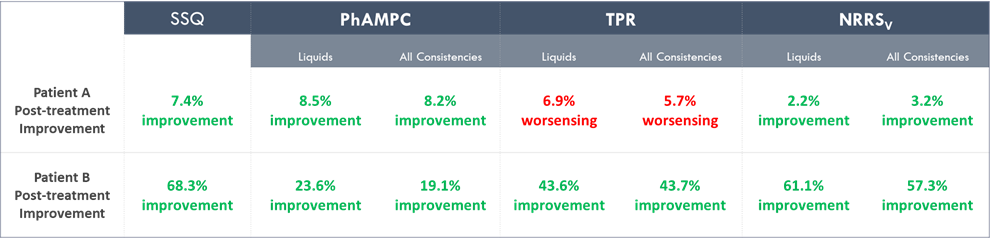
When comparing the interim clinical results for the low dose BB-301 treatment and the high dose BB-301 treatment at the 3-month post-treatment time-point in Patients with comparable pre-treatment baseline deficits, the high dose BB-301 treatment demonstrated significantly improved results across all radiographic and patient-reported assessments employed in the BB-301 Phase 1b/2a Clinical Treatment Study:
- Significantly differentiated levels of dysphagic symptom burden reduction were observed, with a ~
7% reduction in total dysphagic symptom burden (SSQ) achieved with low dose BB-301 as compared to a ~68% reduction in SSQ achieved with high dose BB-301 - Significantly differentiated levels of throat closure were observed, with an ~
8% improvement in throat closure (PhAMPC) achieved with low dose BB-301 as compared to a ~19% improvement in PhAMPC achieved with high dose BB-301 - Significantly differentiated levels of overall throat emptying were observed, with a ~
6% worsening in overall throat emptying (TPR) observed with low dose BB-301 as compared to a ~44% improvement in TPR achieved with high dose BB-301 - Significantly differentiated levels of throat emptying from the vallecular region were observed, with a ~
3% improvement in throat emptying from the vallecular region (NRRSv) achieved with low dose BB-301 as compared to a ~57% improvement in NRRSv with high dose BB-301
Interim Clinical Results for Low Dose BB-301 (Cohort 1):
- All Study Completers in Cohort 1 (low dose BB-301) are formal Responders to BB-301
- Completers are Patients that have reached the 12-month post-BB-301-treatment assessment time-point in the BB-301 Phase 1b/2a Clinical Treatment Study
- Completers are Patients that have reached the 12-month post-BB-301-treatment assessment time-point in the BB-301 Phase 1b/2a Clinical Treatment Study
- Long-term efficacy trends for low dose BB-301 at 24-months post BB-301 treatment continue to demonstrate robust disease-modifying outcomes for throat closure, throat emptying, and total dysphagic symptom burden
Late-Breaking Poster Presentation
An interim clinical study update for the Phase 1b/2a Clinical Treatment Study of BB-301 in OPMD subjects with moderate dysphagia will be provided in a late-breaking poster presentation, (poster number 501 LB) entitled “Durable Responses to Low Dose BB-301 in Oculopharyngeal Muscular Dystrophy at 12- and 24-months and Improved Depth of Response to High Dose BB-301” during poster sessions from 10:15-10:45 am, 12:00-1:30 pm, 3:30-4:00 pm and 6:00-8:00 pm Eastern Time on March 9th in the Exhibit Hall at the 2026 Muscular Dystrophy Association Clinical & Scientific Conference. The poster is available on the Benitec website, and a link to the poster is found here.
About OPMD
There are currently no approved therapies for OPMD, a rare autosomal-dominant degenerative muscle disorder, that impacts nearly 15,000 patients in North America, Europe and Isreal. OPMD is caused by a mutation in the poly(A)-binding protein nuclear 1 (PABPN1) gene; PABPN1 is a ubiquitous protein that controls the length of mRNA poly(A) tails, mRNA export from the nucleus and alternative poly(A) site usage. OPMD is a debilitating progressive disease that weakens the pharyngeal muscles, causing severe swallowing difficulties (dysphagia).1 Progressive dysphagia impacts
About BB-301
BB-301 is a novel, modified AAV9 capsid expressing a unique, single bifunctional construct promoting co-expression of both codon-optimized Poly-A Binding Protein Nuclear-1 (PABPN1) and two small inhibitory RNAs (siRNAs) against mutant PABPN1 (the causative gene for OPMD). The two siRNAs are modeled into microRNA backbones to silence expression of faulty mutant PABPN1, while allowing expression of the codon-optimized PABPN1 to replace the mutant with a functional version of the protein. We believe the silence and replace mechanism of BB-301 is uniquely positioned for the treatment of OPMD by halting mutant PABPN1 expression while providing a functional replacement protein. BB-301 has received Orphan Drug Designation from the EMA and Orphan Drug and Fast Track Designations from the FDA.
About Benitec Biopharma Inc.
Benitec Biopharma Inc. (“Benitec” or the “Company”) is a clinical-stage biotechnology company focused on the advancement of novel genetic medicines with headquarters in Hayward, California. The proprietary “Silence and Replace” DNA-directed RNA interference platform combines RNA interference, or RNAi, with gene therapy to create medicines that simultaneously facilitate sustained silencing of disease-causing genes and concomitant delivery of wildtype replacement genes following a single administration of the therapeutic construct. The Company is developing Silence and Replace-based therapeutics for chronic and life-threatening human conditions including Oculopharyngeal Muscular Dystrophy (OPMD). A comprehensive overview of the Company can be found on Benitec’s website at www.benitec.com.
Forward Looking Statements
Except for the historical information set forth herein, the matters set forth in this press release include forward-looking statements, including statements regarding Benitec’s plans to develop and commercialize its product candidates, the timing of the completion of pre-clinical and clinical trials, the timing of the availability of data from our clinical trials, the timing and sufficiency of patient enrollment and dosing in clinical trials, the timing of expected regulatory filings and other regulatory steps, and the clinical utility and potential attributes and benefits of ddRNAi and Benitec’s product candidates, and other forward-looking statements.
These forward-looking statements are based on the Company’s current expectations and subject to risks and uncertainties that may cause actual results to differ materially, including unanticipated developments in and risks related to: the success of our plans to develop and potentially commercialize our product candidates; the timing of the completion of preclinical studies and clinical trials; the timing and sufficiency of patient enrollment and dosing in any future clinical trials; the timing of the availability of data from our clinical trials; the timing and outcome of regulatory filings and approvals; the development of novel AAV vectors; our potential future out-licenses and collaborations; the plans of licensees of our technology; the clinical utility and potential attributes and benefits of ddRNAi and our product candidates, including the potential duration of treatment effects and the potential for a “one shot” cure; our intellectual property position and the duration of our patent portfolio; expenses, ongoing losses, future revenue, capital needs and needs for additional financing, and our ability to access additional financing given market conditions and other factors; the length of time over which we expect our cash and cash equivalents to be sufficient to execute on our business plan; unanticipated delays; further research and development and the results of clinical trials possibly being unsuccessful or insufficient to meet applicable regulatory standards or warrant continued development; the ability to enroll sufficient numbers of subjects in clinical trials; determinations made by the FDA and other governmental authorities and other regulatory developments; the Company’s ability to protect and enforce its patents and other intellectual property rights; the Company’s dependence on its relationships with its collaboration partners and other third parties; the efficacy or safety of the Company’s products and the products of the Company’s collaboration partners; the acceptance of the Company’s products and the products of the Company’s collaboration partners in the marketplace; market competition; sales, marketing, manufacturing and distribution requirements; greater than expected expenses; expenses relating to litigation or strategic activities; the impact of, and our ability to remediate, the identified material weakness in our internal controls over financial reporting; the impact of local, regional, and national and international economic conditions and events; and other risks detailed from time to time in the Company’s reports filed with the Securities and Exchange Commission. The Company disclaims any intent or obligation to update these forward-looking statements.
References:
- https://www.mayoclinic.org/diseases-conditions/dysphagia/symptoms-causes/syc-20372028
Media Contact:
Audra Friis
Sam Brown Healthcare Communications
(917) 519-9577
audrafriis@sambrown.com
Investor Relations Contact:
Irina Koffler
LifeSci Advisors, LLC
(917) 734-7387
ikoffler@lifesciadvisors.com
A photo accompanying this announcement is available at https://www.globenewswire.com/NewsRoom/AttachmentNg/898abdaf-6d60-4063-8b30-b75497df9259

FAQ
AI-generated questions and answers. How Rhea-AI works. Not financial advice.