
Bruker Announces Major Strides in 4D Proteomics Performance, Further Advances In Intact and Top-Down Functional Proteoform Analysis, and Innovations in Hybrid Qual/Quant 4D Metabolomics – all to Enable Deeper Insights into Disease Biology
Bruker (Nasdaq: BRKR) announced major advances in 4D proteomics, metabolomics and air exposomics at ASMS.




Bruker Also Launches Two Novel Mass Spectrometry Systems for Unique Applications in Energy Industry Research, and in Semiconductor Manufacturing
- Launch of eXtreme 10M resolution novel timsMRMS™ mass spectrometer for ultra-complex mixture analysis in energy industry and life-science research
- Breakthrough timsUltra™ AIP bottom-up proteomics performance: instrument improvements, new razor-PASEF™ methods and Spectronaut 21 software enable ID and LFQ beyond 10,000 proteins in cell lines and tissue, with >6,500 proteins at 500 SPD, and leading plasma proteomics performance with single-particle P2 enrichment
- Revolutionary timsOmni™ enables unmatched multi-stage, ultra-sensitive trapped ExD (tExD) fragmentation for deeper structural and functional characterization of proteoforms and PTMs, with even greater top-down 4x sensitivity, including for glycoproteomics and small molecule structural characterization
- New partnership with Integrated Protein Technologies for high-throughput sample preparation for intact and top-down biotherapeutic characterization on timsOmni
- Launch of KOL early-access program to ‘holy grail’ hybrid workflow combining targeted metabolomics with absolute quantitation using Biocrates kits, and simultaneous untargeted 4D metabolomics discovery
- Launch of novel TOFWERK airborne molecular contaminants (AMC) TOF-MS solutions for yield optimization in semiconductor manufacturing; multi-million-dollar multiple-systems order received from leading global memory manufacturer
At ASMS, Bruker Corporation (Nasdaq: BRKR) announced the launch of the unique timsMRMS system, bringing the power of trapped ion mobility separation to ultra-high-resolution magnetic resonance mass spectrometry (MRMS).
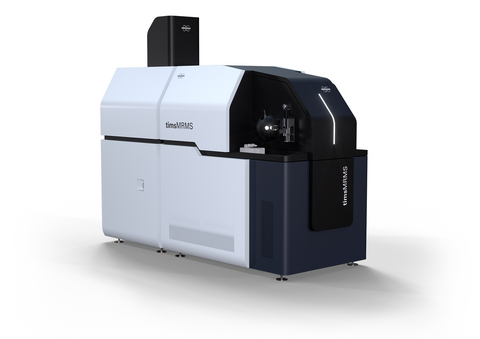
The novel timsMRMS
A translational oncology research initiative by Prof. Stephan Singer at University Hospital Tübingen enables therapy selection, measuring more than 10,000 proteins in FFPE biopsies to reveal actionable tumor biology when precision genomics is inconclusive.
Major timsUltra AIP and further timsOmni advances, razor-PASEF workflows, Spectronaut 21 and OmniScape software advance proteomics to >10,000 proteins per sample, more than 6,500 proteins at 500 samples per day (SPD), and make sensitive and information-rich top-down characterization 4x more sensitive for proteoforms, antibodies, glycoproteins, oligonucleotides.
Frank H. Laukien, PhD, Bruker’s President and CEO, said: “Proteoforms are the fundamental unit of molecular disease. A single gene encodes one protein group but can give rise to over 50 protein variants through genetic variation, alternative splicing, post-translational modifications and protein processing. From just 20,000 human genes, these biological processes generate more than one million distinct functional – and sometimes pathological – human proteoforms.”
He continued: “The revolutionary timsOmni combines trapped ion mobility and trapped ExD technologies to give scientists higher dimensionality, unmatched top-down sensitivity and information-rich structural information for deeper insights. The unique OmniScape AI-driven top-down software transforms this biological complexity into clarity and insights. Deep functional proteoform analysis can now compress the path from discovery to biomarkers, precision medicine and novel therapies. We have entered the era of deep, differentiated proteoform structural variant analysis for functional proteomics 2.0 at scale, with profound benefits for a much deeper understanding of the molecular drivers of disease. This opens an unprecedented opportunity to accelerate drug discovery with meaningfully higher drug candidate success rates in humans.”
A: Introducing the novel timsMRMS
The timsMRMS redefines extreme-resolution mass spectrometry of complex mixtures, delivering mass resolving power of 1M to 10M, down to ppb mass accuracy, and a four orders of magnitude single-acquisition dynamic range through a fundamental breakthrough of TIMS gas-phase separation from MRMS detection. The unique timsMRMS delivers unrivaled performance for diverse applications, from molecular-level characterization in petroleomics to dissolved organic matter to biofuel fingerprinting and battery research in the energy industry.
B. Major strides in 4D bottom-up proteomics performance with timsUltra AIP
Further instruments improvements, razor-PASEF methods and Spectronaut 21 software now further enhance deep proteome coverage at high throughput on the timsUltra AIP, enabling ID and quantification of >10,000 proteins in HeLa, and >6,500 proteins at 500 SPD.
A translational oncology initiative by Prof. Stephan Singer at University Hospital Tübingen, and Prof. Oliver Schilling at University of Freiburg, focused on FFPE tissue biopsy samples to elucidate actionable tumor biology, uncovering pathways that are invisible at the DNA/RNA level.
Stephan Singer commented: “In complex cancer cases, genomics does not always provide decision‑relevant answers, particularly with FFPE tissue. With timsTOF-based proteomics we routinely quantify more than 10,000 proteins across clinical samples, adding functional pathway activity, metabolic dependencies, and tumor‑specific resistance programs. This can enable proteomics‑driven therapy strategies exploiting signaling vulnerabilities and metabolic reprogramming, or new target discovery, where NGS remained inconclusive.”
C: New Argon option for timsOmni
Further enhancing CID sensitivity by 4x for biomolecules, Argon offers advantages as a collision gas. As a heavy, mono-atomic noble gas with no internal vibrational or rotational modes, it transfers collision energy efficiently to precursor ions to drive efficient, reproducible dissociation.
D: New Partnership with Integrated Protein Technologies
Integrated Protein Technologies now interfaces their SampleStream directly with timsOmni under HyStar control, delivering automated, high-throughput buffer exchange via a molecular weight cutoff membrane that concentrates protein in a microfluidic flow cell while flushing buffers, salts, and adduct-forming excipients to waste, achieving MS-ready sample elution in under two minutes per sample with no carryover.
Dr. Phil Compton, CEO, IPT said: “We’ve always believed the future of proteomics depends on making high-performance intact and top-down workflows accessible. Combining SampleStream with timsOmni is a major step, and this technology can now reach scientists worldwide.”
E: AI-Software Innovations: OMNISCAPE, PROTEOSCAPE and GLYCOSCAPE 2027
Bruker’s software makes a leap forward with releases of OmniScape 2027, ProteoScape 2027, and GlycoScape 2027, for confidence in top-down proteoform sequence and PTM analysis.
A novel addition to Omniscape 2027 is LYRA, a de novo algorithm that transforms high-quality sequence reads from complex top-down spectra into annotated protein sequences. LYRA features ultrafast PTM screening for proteoform ID across billions of possibilities and an advanced result combination module for higher sequence coverage and safer proteoform and PTM assessment.
New automated glycoproteomics workflows incorporate both trapped electron capture dissociation (tECD) with low-energy electrons and complementary trapped electron ionization dissociation (tEID) using higher-energy electrons, for dissociation reaction times as short as 10 ms.
All glycoproteomics workflows are now compatible with MSFragger. Professor Alexey Nesvizhskii, University of
tims-Casanovo, a collaboration with Professor William Nobel at University of
Bill Noble stated: “tims-Casanovo expands the training datasets significantly, improving precision, enabling robust peptide detection across challenging applications, including immunopeptidomics, antibody characterization, and analyses with incomplete reference databases.”
F: Advancements in 4D Metabolomics and Air Exposomics
MetaboScape® now supports ecTOF™ dual ionization, enabling processing of simultaneous EI and CI spectra for GC-HRAM chemical exposure coverage. Bruker launches an early-access program for hybrid metabolomics on timsMetabo™, combining kit-based absolute quantitation with discovery in a ‘holy grail’ qual/quant simultaneous targeted and discovery experiment.
Dr. Michael Witting, Helmholtz Munich, said: "Metabolomics research demands both quantitative data and broad exploratory coverage, but combining these has meant separate workflows, adding complexity. Bringing targeted and untargeted metabolomics together in a single experiment simplifies large-scale studies for a more complete picture of metabolic changes driving disease."
Following its acquisition of TOFWERK in January 2026, Bruker is launching an Air Exposomics initiative that combines TOFWERK Vocus™ real-time VOC monitoring and mipTOF™ field-deployable trace-metal aerosol analyzer with 4D metabolomics and lipidomics. This portfolio can connect real-time environmental exposure measurements to respiratory illness, neurodegeneration, and cancer. Professor Peter DeCarlo, Department of Environmental Health and Engineering, Johns Hopkins University, said: “This is a pivotal moment for air exposomics, combining real-time air monitoring with multiomics capabilities to advance our understanding of how air pollutant exposures are expressed in human biological systems.”
About Bruker Corporation – Leader of the Post-Genomic Era (Nasdaq: BRKR)
Bruker is enabling scientists and engineers to make breakthrough post-genomic discoveries and develop new applications that improve the quality of human life. Bruker’s high performance scientific instruments and high value analytical and diagnostic solutions enable scientists to explore life and materials at molecular, cellular, and microscopic levels. In close cooperation with our customers, Bruker is enabling innovation, improved productivity, and customer success in post-genomic life science molecular and cell biology research, in applied and biopharma applications, in microscopy, as well as in industrial and cleantech research, and semiconductor metrology in support of AI. Bruker offers differentiated, high-value life science and diagnostics systems and solutions in preclinical imaging, proteomics and multiomics, spatial and single-cell biology, structural and condensate biology, as well as in clinical microbiology and molecular diagnostics. For more information, please visit www.bruker.com.
View source version on businesswire.com: https://www.businesswire.com/news/home/20260601894575/en/
Investor Contact:
Joe Kostka
Director, Investor Relations
Bruker Corporation
T: +1 (978) 313-5800
E: Investor.Relations@bruker.com
Media Contact:
Nora Williams
VP, Global Marketing and Communications
Bruker Daltonics
T: +44 2476855225
E: pr@bruker.com
Source: Bruker Corporation