
BWXT Announces Contract with Antares for TRISO Nuclear Fuel Production
Fuel will be manufactured on the same Lynchburg fabrication line used for Antares’ Mark-0 reactor.
Sentiment and the balance of points
Rhea-AI Sentiment reads the wording of the document, how positive or negative its language is on a 1 to 5 scale. The balance of points shown with the takes weighs what the document actually discloses, so the two can disagree, for example when a trial that missed its main goal is described in upbeat language.


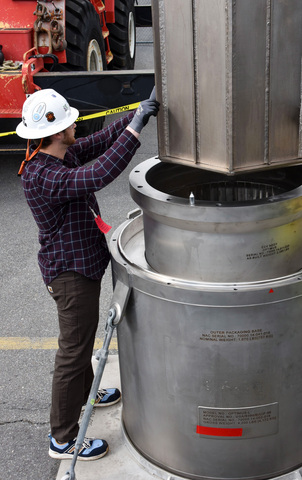
Under the agreement, the fuel will be manufactured at BWXT’s
The fuel will be manufactured at BWXT’s
“BWXT’s decades of experience in advanced fuel manufacturing give us the foundation to support Antares as they accelerate toward commercial deployment,” said Joe Miller, president, BWXT Government Operations. “Our team has refined the processes for high‑performance TRISO fuel, and this agreement enables us to apply those strengths in a sustained, predictable way. As demand grows across the advanced reactor sector, BWXT is prepared to scale.”
“We achieved criticality with BWXT fuel, and it’s what will power our electricity producing reactor, Mark-1, in 2027,” said Jordan Bramble, CEO and Co-Founder of Antares. “Securing that same line through the end of the decade means our first production deployments run on fuel from a team and a process we’ve already proven.”
The TRISO fuel manufactured under the agreement will be delivered in accordance with a series of future task orders that define specific quantities, delivery schedules and technical requirements as Antares’ reactor program progresses.
Forward-Looking Statements
BWXT cautions that this release contains forward-looking statements, including, without limitation, statements relating to TRISO nuclear fuel production and capabilities and BWXT’s contract with Antares for nuclear fuel production. These forward-looking statements involve a number of risks and uncertainties, including, among other things, modification or termination of the contract, funding of current and future work and delays in performance. If one or more of these or other risks materialize, actual results may vary materially from those expressed. For a more complete discussion of these and other risk factors, please see BWXT’s annual report on Form 10-K for the year ended December 31, 2025, and subsequent quarterly reports on Form 10-Q filed with the Securities and Exchange Commission. BWXT cautions not to place undue reliance on these forward-looking statements, which speak only as of the date of this release and undertakes no obligation to update or revise any forward-looking statement, except to the extent required by applicable law.
About BWXT
At BWX Technologies, Inc. (NYSE: BWXT), we are People Strong, Innovation Driven. A U.S.-based company with more than 11,000 employees, BWXT is a Fortune 1000 and Defense News Top 100 manufacturing and engineering innovator that provides safe and effective nuclear solutions for global security, clean energy, nuclear medicine, space exploration and environmental restoration. BWXT owns and operates 19 manufacturing facilities globally, and its 14 strategic partnerships support the U.S. and Canadian governments at more than two dozen additional locations.
For more information, visit www.bwxt.com. Follow us on LinkedIn, X, Facebook and Instagram.
About Antares
Antares is a nuclear fission energy company developing compact microreactors for defense and space applications, delivering safe, reliable power where traditional energy sources cannot. Founded in 2023 and backed by over
View source version on businesswire.com: https://www.businesswire.com/news/home/20261027676843/en/
Media Contact
John Dobken
Senior Manager, Media & Public Relations
202.428.6913
jcdobken@bwxt.com
Investor Contact
Chase Jacobson
Vice President, Investor Relations
980.365.4300
investors@bwxt.com
Media Contact – Antares
Kayla Haas
Communications Manager
kayla.haas@antaresindustries.com
Source: BWX Technologies, Inc.