
Instacart Acquires Arpalus to Advance Real-Time Shelf Intelligence Across Grocery Retail
Instacart (NASDAQ: CART) announced the acquisition of Arpalus, a computer vision company specializing in grocery-specific shelf intelligence, to improve real-time inventory accuracy for ecommerce fulfillment and in-store operations across its retail network.
Rhea-AI Summary
Instacart (NASDAQ: CART) announced the acquisition of Arpalus, a computer vision company specializing in grocery-specific shelf intelligence, to improve real-time inventory accuracy for ecommerce fulfillment and in-store operations across its retail network.
Arpalus technology converts short shelf videos into an on-shelf inventory view with over 95% item-recognition accuracy, running on any smartphone or camera-equipped device. Instacart plans to activate its community of 600,000 shoppers to capture shelf data, feeding into grocery-specific AI models built from 1.6 billion lifetime orders and real-time inventory from nearly 100,000 stores. The technology will also integrate with Caper Carts equipped with external cameras, enhancing Store View and other AI Solutions, and supporting Instacart’s broader Physical AI strategy to connect online and in-store grocery through a unified intelligence layer.
Positive
- Acquisition of Arpalus adds grocery-specific shelf intelligence technology to Instacart’s AI stack
- 95%+ shelf recognition accuracy from Arpalus models for real-time on-shelf visibility
- 600,000 shoppers can capture shelf data using existing Instacart apps and devices
- 1.6 billion lifetime orders and data from nearly 100,000 stores power Instacart’s inventory models
- Caper Carts in 100+ cities gain enhanced real-time shelf data via Arpalus integration
Negative
- None.
Details
News Market Reaction – CART
In the Jul 16 session, CART declined 2.90%, reflecting a moderate negative market reaction.
Data tracked by StockTitan Argus on the day of publication.
Key Figures
- Shelf recognition accuracy
- more than 95%
- Average item identification accuracy for Arpalus computer vision models
- Shopper network size
- 600,000 shoppers
- Instacart shoppers able to generate real-time shelf intelligence
- Lifetime orders
- 1.6 billion orders
- Instacart’s grocery-specific intelligence built on historical order data
- Store coverage
- nearly 100,000 stores
- Real-time inventory views across North America
- Shopper visit frequency
- more than 15 times a day
- Average daily large-format store visits per Instacart shopper
- Daily data points
- over 10 million
- Unique daily data points generated by Instacart shoppers
- Caper Carts cities
- more than 100 cities
- Global deployment footprint of Caper Carts
- Shopper community size
- 600,000 shoppers
- Instacart shoppers central to Physical AI data collection
Previous Acquisition Reports
-
Acquisition of Instaleap to expand global enterprise grocery platform footprint.
-
Acquisition of Wynshop to enhance enterprise technology solutions for grocers.
24h Move is the share-price change in the day after each event; other market factors may also have contributed.
Key Terms
computer vision technical
ai technical
physical ai technical
forward-looking statements regulatory
AI-generated analysis. How Rhea-AI works. Not financial advice.




Acquisition strengthens Instacart's AI capabilities and purpose-built partner technology to improve inventory accuracy for ecommerce fulfillment and in-store operations across its network
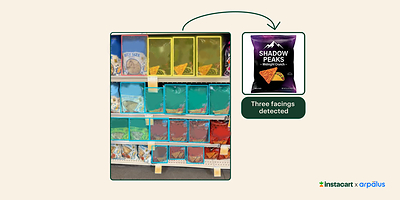
Arpalus' technology turns a quick video scan of a store shelf into an accurate, real-time picture of what is actually there. Using computer vision models built specifically for the complexity of real grocery store environments, including low or unreliable Wi-Fi, inconsistent lighting, and thousands of visually similar products packed tightly together, Arpalus can identify individual items on shelves with more than
Instacart has spent more than a decade building the most comprehensive grocery-specific intelligence in the industry — built on more than 1.6 billion lifetime orders, real-time inventory views from nearly 100,000 stores across
Arpalus' computer vision technology extends to Caper Carts equipped with external cameras as they move through store aisles, updating in-store on-shelf inventory insights in real-time. Combined, Instacart and Arpalus are expected to drive even more fulfillment efficiencies that create a better customer experience and new earning opportunities for shoppers, while improving inventory accuracy for retailers and brands. Data will be used in accordance with all applicable laws, including privacy laws, and contractual requirements.
"We believe the future of grocery retail is a unified experience powered by Instacart intelligence, where what happens in store connects seamlessly to ecommerce in real time," said David McIntosh, Chief Connected Stores Officer at Instacart. "The Arpalus team has spent years building exceptional shelf intelligence technology, solving the problem of understanding what's actually on store shelves, at any given moment. With our leadership in Physical AI for grocery retail and by activating our network of shoppers, we can feed even more accurate shelf information back into our models, delivering better outcomes for customers, shoppers, and our retail and brand partners."
"Arpalus was founded to solve one of retail's most fundamental challenges: bridging the gap between what happens in-store and the decisions driving business performance," said Ofir Zilberberg, Founder and CEO of Arpalus. "We built an AI platform that gives retailers real-time visibility into inventory and store execution, enabling faster and smarter decisions at scale. Joining Instacart is a transformative milestone. By combining Arpalus' AI innovation with Instacart's scale and retail reach, we are accelerating the future of intelligent retail and redefining how stores operate."
Richer shelf data strengthens Instacart's platform across both online and in-store environments. For consumers shopping on the Instacart Marketplace, or on their preferred retailer's owned-and-operated website powered by Storefront Pro, more accurate inventory data means a more reliable shopping experience. For retailers, it directly enhances Store View — Instacart's real-time computer vision solution, part of the company's AI Solutions, being piloted by retailers including McKeevers and Sprouts, among others — improving shelf availability and accuracy at the store level. It also enriches the sensor data generated by Caper Carts, which have scaled to more than 100 cities around the globe. Together, these capabilities advance Instacart's Physical AI strategy and its broader investment in connecting online and in-store grocery experiences through a unified intelligence layer.
Forward-Looking Statements
This press release contains forward-looking statements within the meaning of Section 27A of the Securities Act of 1933, as amended, and Section 21E of the Securities Exchange Act of 1934, as amended. All statements other than statements of historical fact could be deemed forward-looking, including without limitation statements regarding anticipated benefits and outcomes of the acquisition of Arpalus. These forward-looking statements are subject to known and unknown risks, uncertainties, assumptions, and other factors that may cause actual results or outcomes to be materially different from any future results or outcomes expressed or implied by the forward-looking statements. These risks, uncertainties, assumptions, and other factors include the risks described from time to time in Instacart's filings with the Securities and Exchange Commission (SEC), including in Instacart's Quarterly Report on Form 10-Q for the quarter ended March 31, 2026 filed with the SEC on May 7, 2026. You should not rely on forward-looking statements as predictions of future events. Instacart has based these forward-looking statements on information available to it as of the date of this press release and undertakes no obligation to update these forward-looking statements, except as required by law.
About Instacart
Instacart is a leading grocery technology company that partners with more than 2,200 retail banners – representing nearly 100,000 stores – to transform how people shop for the groceries they need from the retailers they trust, while creating flexible earning opportunities for shoppers. Through the Instacart Marketplace, Instacart Enterprise platform, and Instacart Ads ecosystem, the company powers ecommerce, fulfillment, in-store technology, AI offerings, and advertising for partners. For more information, visit www.instacart.com/company. Maplebear Inc. is the registered corporate name of Instacart.
About Arpalus
Arpalus is an AI-powered retail intelligence company that helps retailers and CPG brands improve product availability, inventory accuracy, and store execution through real-time computer vision. Founded in 2019, the company serves leading retailers and consumer brands, and its proprietary technology is protected by patents in the United States and Europe.

 View original content to download multimedia:https://www.prnewswire.com/news-releases/instacart-acquires-arpalus-to-advance-real-time-shelf-intelligence-across-grocery-retail-302827054.html
SOURCE Maplebear Inc. dba Instacart