
Critical Elements Announces the Beginning of a 10,000-Meter Drill Program at Rose West
Critical Elements (OTCQX:CRECF) launched a 10,000-meter Phase 1 winter 2026 drill program at the 100% owned Rose West discovery in Eeyou Istchee, Québec.
Rhea-AI Summary
Critical Elements (OTCQX:CRECF) launched a 10,000-meter Phase 1 winter 2026 drill program at the 100% owned Rose West discovery in Eeyou Istchee, Québec. The program uses two rigs on a 100 m grid to expand a spodumene-bearing pegmatite footprint and target a potential resource estimate.
Rose West showed wide, near-surface lithium intercepts in 2024 (up to 1.43% Li2O over 24.95 m and 1.31% Li2O over 40.40 m); the program targets growth to ~950 m x 1,200 m Main Zone and an East Target Zone ~750 m x 600 m.
Positive
- Planned 10,000 m systematic drill program (Winter 2026)
- Previous wide high-grade intercepts up to 1.31% Li2O over 40.40 m
- Targets potential Main Zone expansion to 950 m x 1,200 m
- Site within 10 km of Rose project and nearby infrastructure
Negative
- No formal resource estimate exists yet for Rose West
- Current continuity and depth extent remain unproven beyond 140 m
- Only nine holes planned to test deeper potential to ~300 m
Details
News Market Reaction – CRECF
In the Feb 3 session, CRECF gained 5.54%, reflecting a notable positive market reaction.
Data tracked by StockTitan Argus on the day of publication.
AI-generated analysis. How Rhea-AI works. Not financial advice.




MONTRÉAL, QC / ACCESS Newswire / February 3, 2026 / Critical Elements Lithium Corporation (TSXV:CRE)(US OTCQX:CRECF)(FSE:F12) ("Critical Elements" or the "Corporation") is pleased to announce the details of its Phase 1 Winter 2026 drill program, including 10,000 meters of systematic drilling around the
Several of the 2024 drillhole results returned wide high grade lithium assays, as highlighted:
1.39% Li2O and 157 ppm Ta2O5 over 35.30 m, including2.33% Li2O and 152 ppm Ta2O5 over 9.00 m in hole RD-24-25A*1.29% Li2O and 121 ppm Ta2O5 over 31.50 m, including1.69% Li2O and 127 ppm Ta2O5 over 13.50 m in hole RD-24-24*1.22% Li2O and 250 ppm Ta2O5 over 20.50 m, including1.60% Li2O and 181 ppm Ta2O5 over 15.00 m in hole RD-24-17*1.31% Li2O and 235 ppm Ta2O5 over 40.40 m, including1.64% Li2O and 219 ppm Ta2O5 over 22.50 m in hole RD-24-20*2.22% Li2O and 95 ppm Ta2O5 over 20.30 m, including2.78% Li2O and 92 ppm Ta2O5 over 10.50 m in hole RD-24-23A*1.30% Li2O and 142 ppm Ta2O5 over 31.60 m, including1.59% Li2O and 130 ppm Ta2O5 over 25.50 m in hole RD-24-22*1.43% Li2O and 178 ppm Ta2O5 over 24.95 m, including1.91% Li2O and 145 ppm Ta2O5 over 13.50 m in hole RD-24-16A*
* Core length; the true thickness is between 80 to
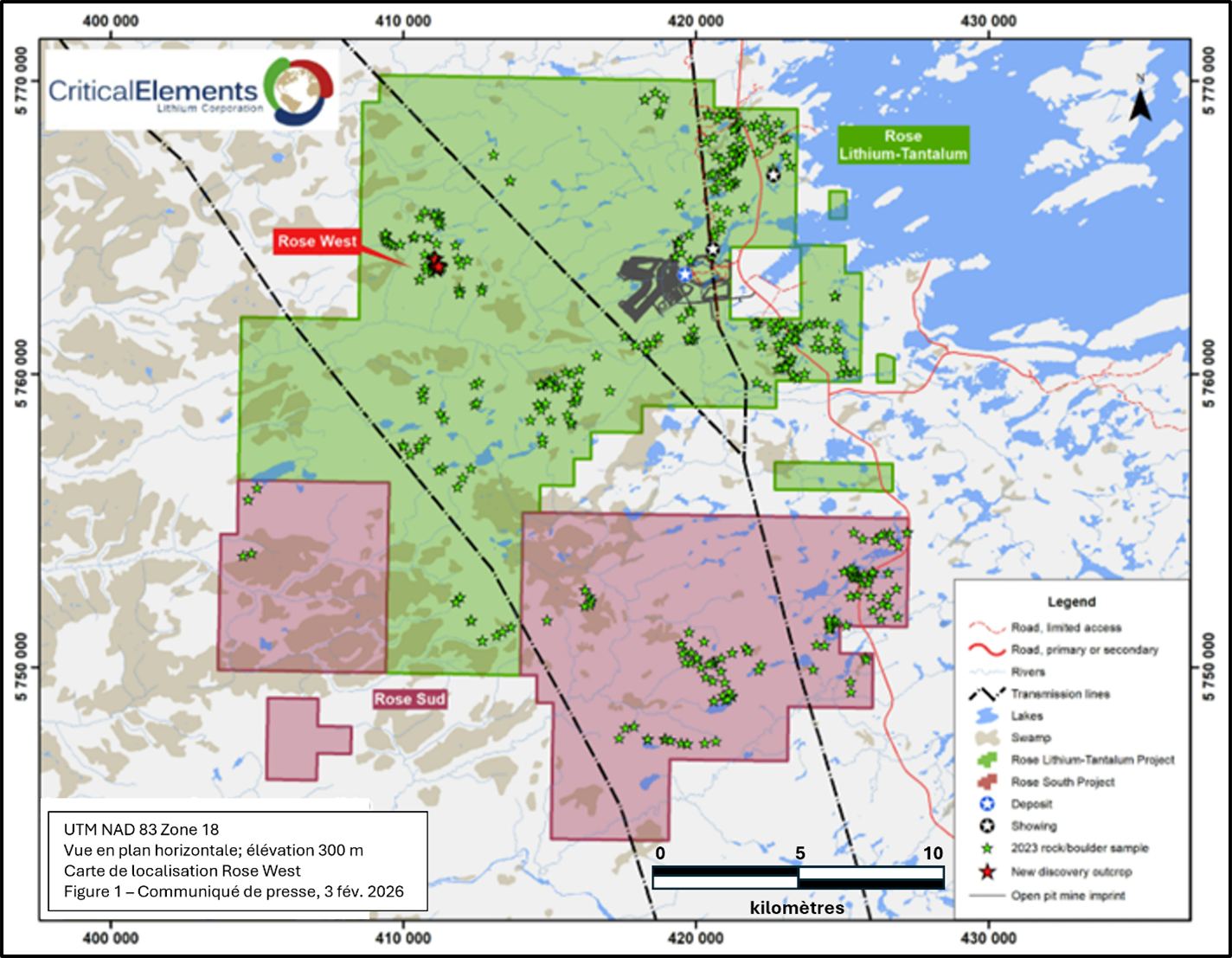
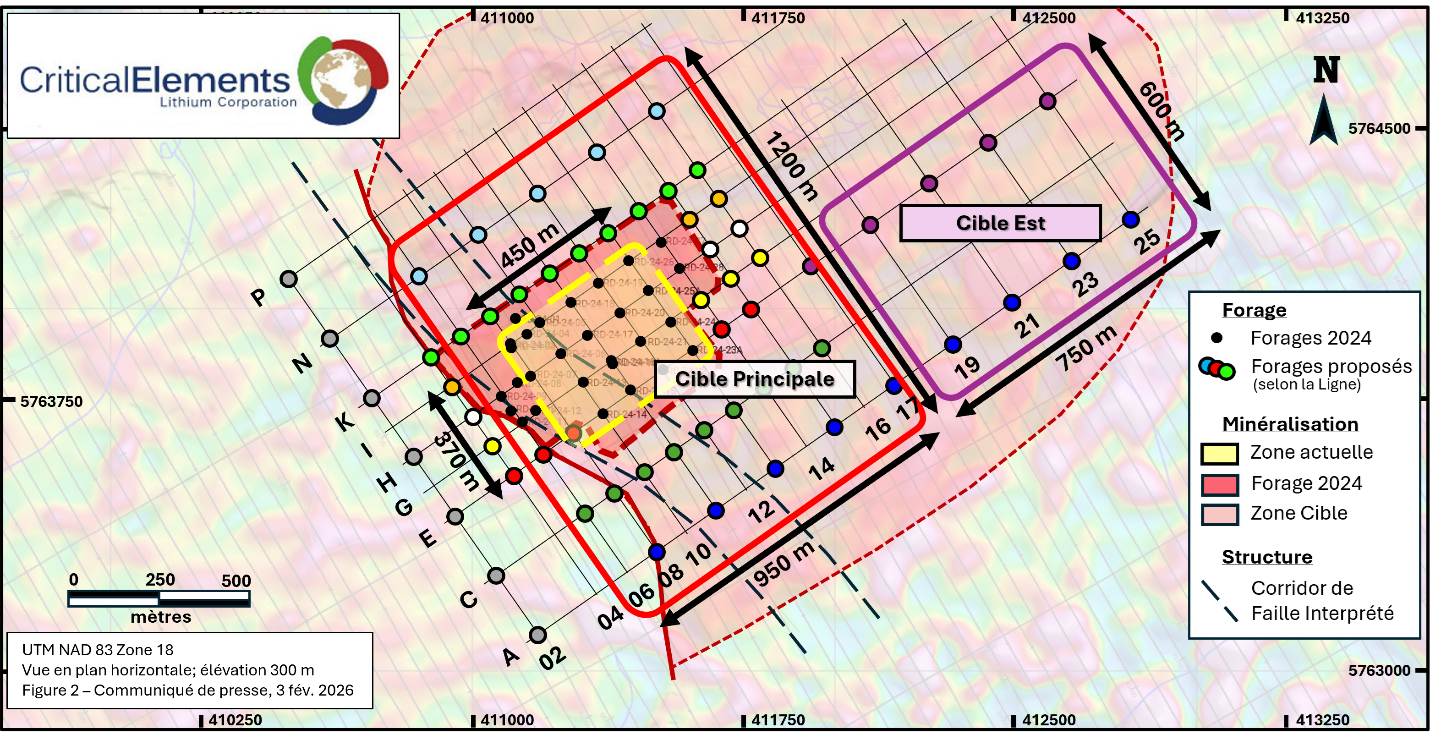
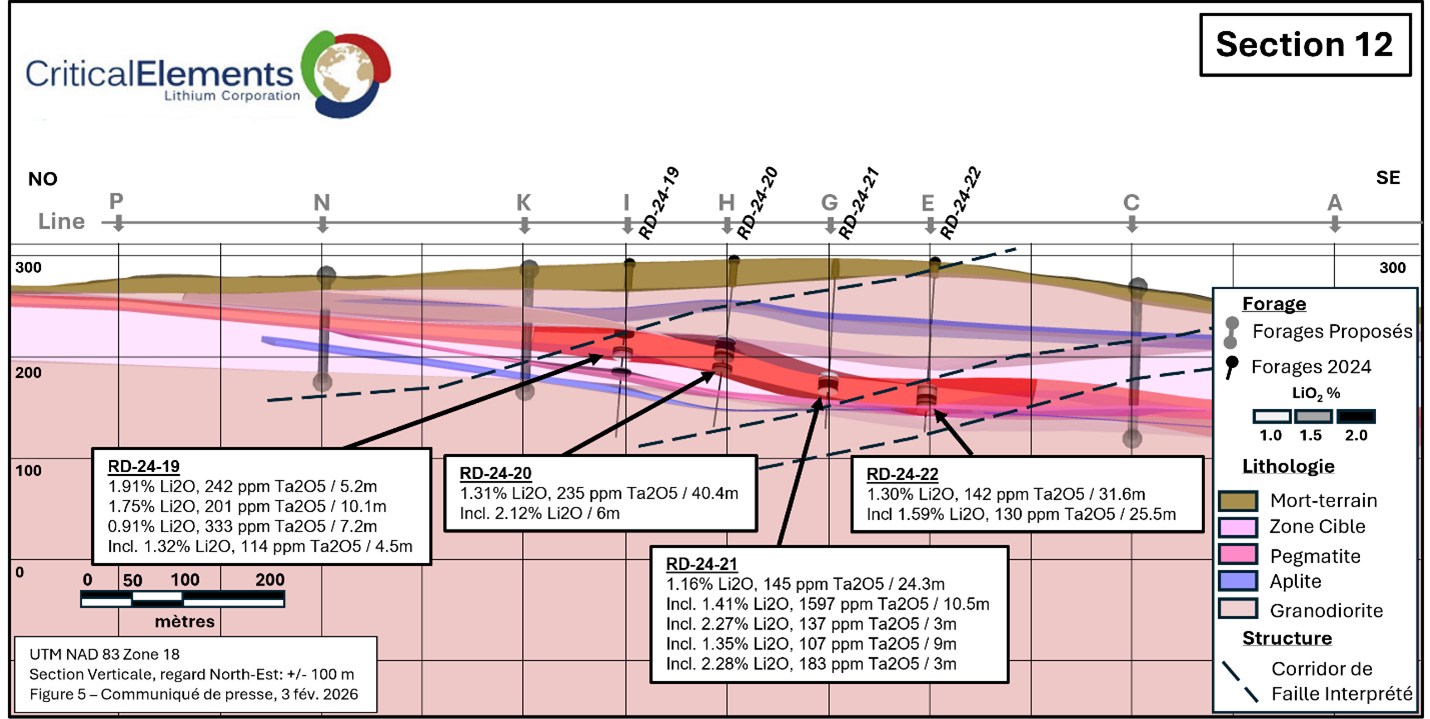
Rose West is situated within the Rose and Rose South property blocks (Figure 1). The 2024 winter drill campaign successfully completed 3,670 meters of drilling in 31 holes on the spodumene-bearing pegmatite. Drilling results to date have demonstrated the continuity of a mineralized pegmatite body, which thus far extends over 450 m strike, 370 m down dip and to a vertical depth of 140 m (Figure 2). In the west, the body is comprised of multiple near surface mineralized pegmatites that range up to an apparent thickness of 12.40 m individually. These bodies appear to coalesce into a more substantial spodumene-bearing pegmatite in the east with an apparent width of up to 40.40 m. The main pegmatite body appears to be sitting in between two shallow dipping aplite dykes. This volume is the primary target of the current drilling program.
Figure 1: Location map of the Rose West Discovery. Note proximity to the well-maintained Eastmain-1 Road from the community of Nemaska and multiple Hydro-Québec transmission lines crossing the Project area.
The Winter 2026 drill program is designed to reach three specific goals:
Expand laterally all around the existing mineralized footprint;
Test the northeastern area for continuity; and
Verify the potential of discovering additional lithium-bearing pegmatites below the currently defined area (Figure 2).
Two drill rigs are being deployed to optimize the duration of the program. The drilling strategy is straightforward: apply a 100 m grid approach to grow the known mineralized volume from its current boundary outward. The program targets expansion of the Main Zone to a potential footprint of approximately 950 m x 1200 m, and the addition of an East Target Zone of approximately 750 m x 600 m.
Figure 2: Location map of drillholes from the winter 2024 campaign and proposed 2026 drillholes.
Drilling depth will depend on the location of the hole but is expected to average 175 m. End-of-hole depth will be established 10 m below the bottom contact of the projected target volume, but nine specific drillholes will be extended to a depth of about 300 m to verify the presence of any deeper potential.
Recent geological interpretation has identified a northwest-trending, moderately dipping (45-60° northeast) structural corridor, which appears to be cutting through the host tonalitic country rocks (Figure 2). While the timing of such deformation likely pre-dates the pegmatitic event, observations suggest that the geometry of the main pegmatites is locally influenced by the structural fabric, acting as weakness planes, developed within the deformation corridor. As a result, the main pegmatite body appears to "drop deeper" by apparent offset of roughly 100 m on the east side of the deformation corridor.
Figures 3 and 4 present vertical sections, along the grid lines, looking northwest through the core of the defined mineralized zone and highlighting the high-grade nature of the targeted pegmatite body. Figure 5 presents a vertical section along the grid sections, looking northeast. All three figures provide views on the 2024 results, as well as some of the drill holes planned in the current drilling program.
"Given good lateral continuity of the zone, this drilling program has the potential to significantly increase the footprint of the Rose West Discovery. Should mineralized intercepts continue to measure between 10 to 40 m and grades remain consistent with those reported in 2024, Rose West could have a material impact on the total Rose Project resource and, consequently, a potential economic impact for Critical Element's shareholders", commented Jean-Sébastien Lavallée, Chief Executive Officer.
Figure 3: Vertical section - looking northwest
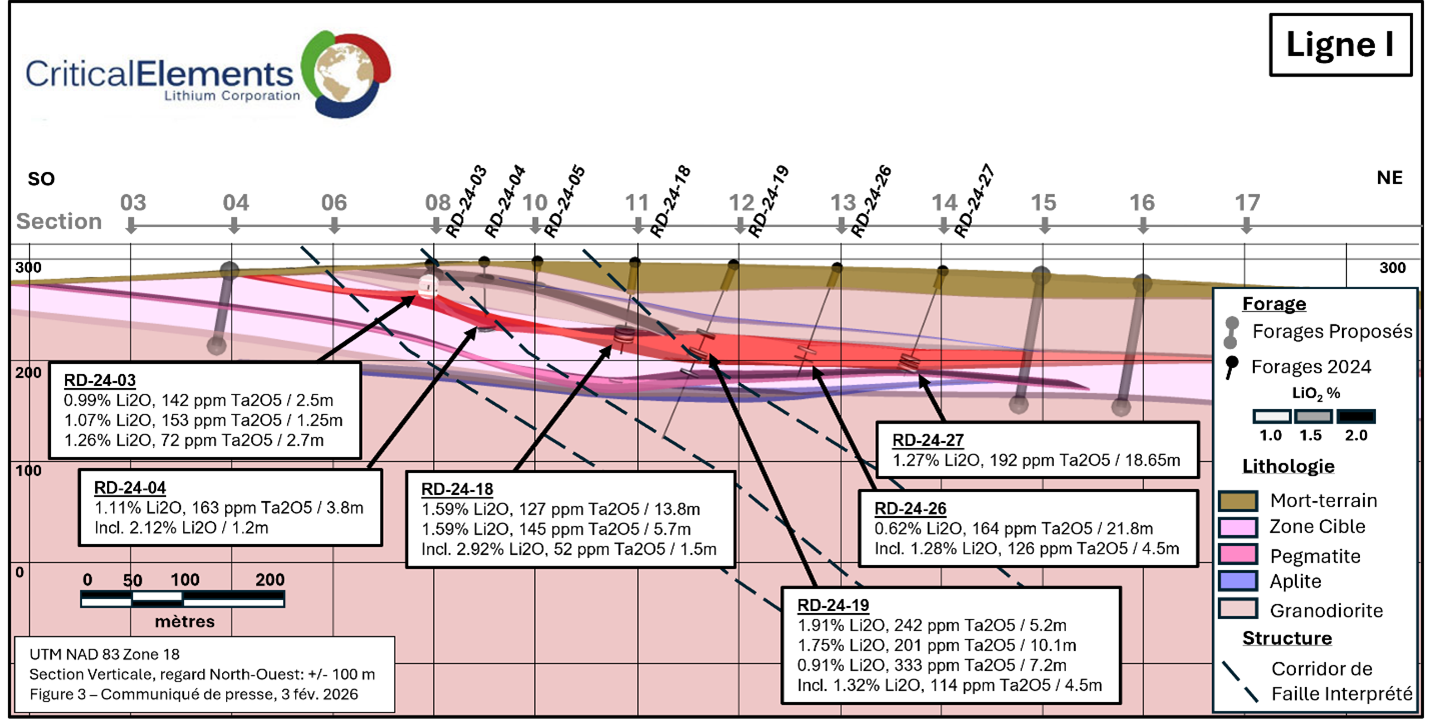
Figure 4: Vertical section - looking northwest
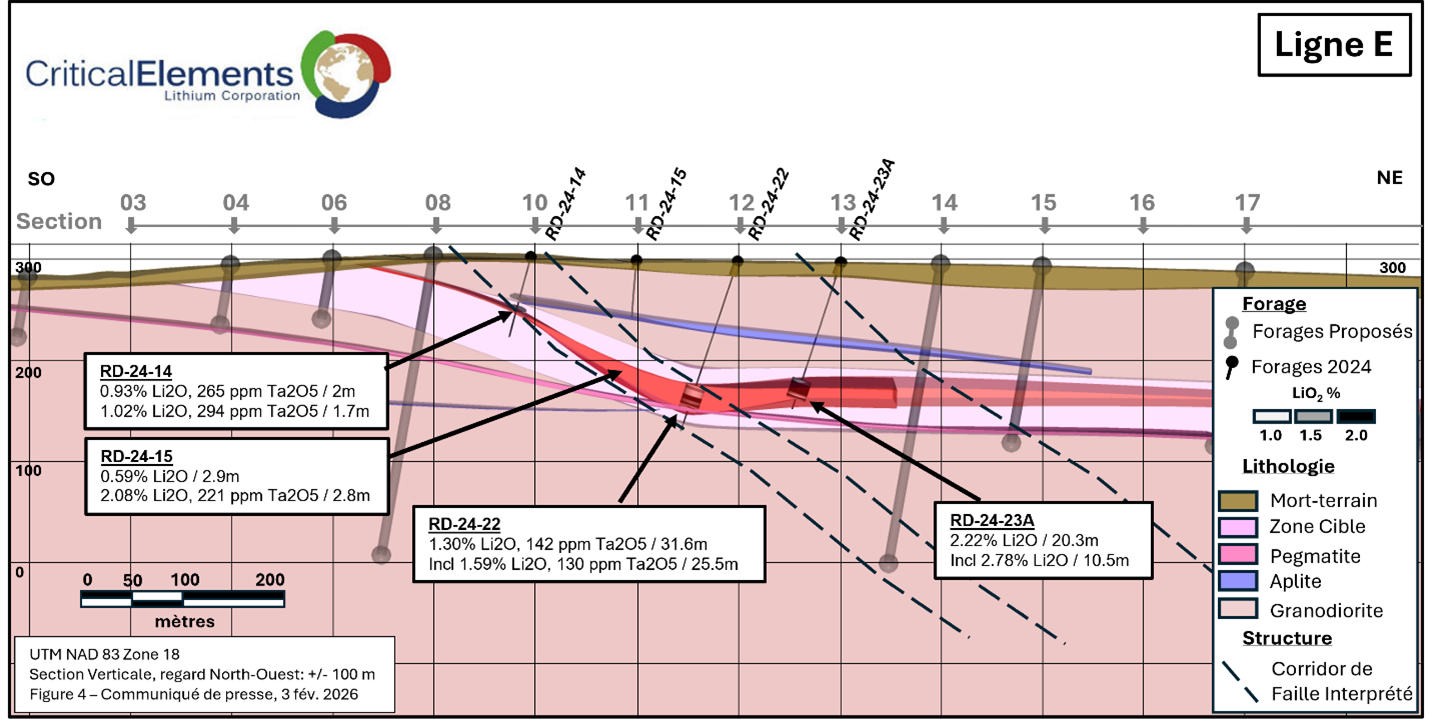
Figure 5: Vertical section - looking northeast
Qualified Person
Kenneth Williamson, Géo, M.Sc. Exploration Director at Critical Elements Lithium, is the Qualified Person that has reviewed and approved the technical contents of this news release on behalf of the Corporation.
About Critical Elements Lithium Corporation
Critical Elements aspires to become a large, responsible supplier of lithium to the flourishing electric vehicle and energy storage system industries. To this end, Critical Elements is advancing the wholly-owned, high-purity Rose Lithium-Tantalum project in Québec, the Corporation's first lithium project to be advanced within a land portfolio of over 1,016 km2. On August 29, 2023, the Corporation announced results of a new Feasibility Study on Rose for the production of spodumene concentrate. The after-tax internal rate of return for the Project is estimated at
For further information, please contact:
Jean-Sébastien Lavallée, P. Géo.
Chief Executive Officer
819-354-5146
jslavallee@cecorp.ca
www.cecorp.ca
Neither the TSX Venture Exchange nor its Regulation Services Provider (as that term is described in the policies of the TSX Venture Exchange) accepts responsibility for the adequacy or accuracy of this release.
Cautionary statement concerning forward-looking statements
This news release contains "forward-looking information" within the meaning of Canadian Securities legislation. Generally, forward-looking information can be identified by the use of forward-looking terminology such as "scheduled", "anticipates", "expects" or "does not expect", "is expected", "scheduled", "targeted", or "believes", or variations of such words and phrases or statements that certain actions, events or results "may", "could", "would", "might" or "will be taken", "occur" or "be achieved". Forward-looking information contained herein include, without limitation, statements relating to the anticipated receipt of the final assay results from the 2026 drilling program on the Corporation's Rose West property, the results and completion of the 2026 exploration drilling program and its related objectives. Forward-looking information is based on assumptions management believes to be reasonable at the time such statements are made. There can be no assurance that such statements will prove to be accurate, as actual results and future events could differ materially from those anticipated in such statements. Accordingly, readers should not place undue reliance on forward-looking information.
Although Critical Elements has attempted to identify important factors that could cause actual results to differ materially from those contained in forward-looking information, there may be other factors that cause results not to be as anticipated, estimated or intended. Factors that may cause actual results to differ materially from expected results described in forward-looking information include, but are not limited to: delays in obtaining final assay results from the laboratory facility, the final and complete results of the Corporation's 2026 exploration drilling program on the Corporation's Rose West property not delivering the anticipated results and the effects on the Corporation's stated objectives, as well as those risk factors set out in the Corporation's Management Discussion and Analysis for its most recent quarter ended November 30, 2025 and other disclosure documents available under the Corporation's SEDAR+ profile. Forward-looking information contained herein is made as of the date of this news release and Critical Elements disclaims any obligation to update any forward-looking information, whether as a result of new information, future events or results or otherwise, except as required by applicable securities laws.
Forward-looking information contained herein is made as of the date of this news release. Although the Corporation has attempted to identify important factors that could cause actual results to differ materially from those contained in the forward-looking information or implied by forward-looking information, there may be other factors that cause results not to be as anticipated, estimated or intended. Accordingly, readers should not place undue reliance on forward-looking statements or information. The Corporation undertakes no obligation to update or reissue forward-looking information as a result of new information or events except as required by applicable securities laws.
SOURCE: Critical Elements Lithium Corp.
View the original press release on ACCESS Newswire
FAQ
AI-generated questions and answers. How Rhea-AI works. Not financial advice.