
CoreWeave to Offer NVIDIA Vera, the First CPU Built for AI Agents
The rack-scale Vera system combines 128 CPUs and 11,264 cores, with room for more than 11,000 concurrent environments.
Sentiment and the balance of points
Rhea-AI Sentiment reads the wording of the document, how positive or negative its language is on a 1 to 5 scale. The balance of points shown with the takes weighs what the document actually discloses, so the two can disagree, for example when a trial that missed its main goal is described in upbeat language.




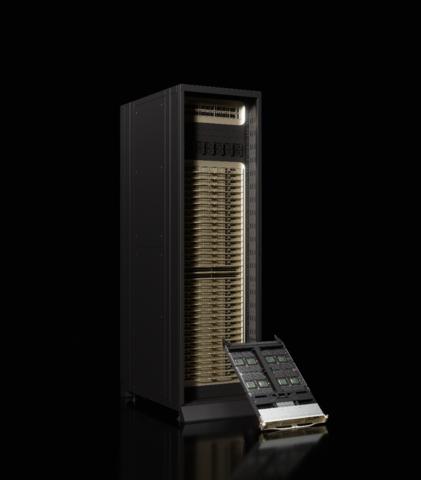
The NVIDIA Vera CPU rack-scale system, designed to support demanding agentic AI workloads, now on CoreWeave.
Agentic AI operates through a continuous AI loop of run, observe, curate, improve, and evaluate. GPUs power model training and reasoning, while CPUs execute the work surrounding every step: isolated sandboxes, reinforcement learning environments, tool calls, code execution, and data pipelines. Demand for data preprocessing pipelines and reinforcement learning training episodes is bursty and hard to predict. A single step in the loop can demand thousands of environments for an hour, then virtually nothing until the next run.
As post-training and agentic workloads grow, that CPU-intensive work increasingly determines how quickly the AI loop can turn. Infrastructure must provide both the density to support that demand and the flexibility to scale as it changes. On CoreWeave, NVIDIA Vera CPU runs the way the rest of the fleet does: bare metal, under the same platform, consumption models and economics.
“General-purpose infrastructure bottlenecks agentic AI; Vera is the first CPU explicitly designed to accelerate it,” said Chen Goldberg, executive vice president of product & engineering at CoreWeave. “Our platform natively enables Vera with products like CoreWeave Sandboxes out of the box. Teams can instantly spin up thousands of isolated environments, removing operational friction and accelerating the entire AI loop on day one.”
NVIDIA Vera supports the demanding workloads behind agentic AI. A critical measure of performance for agentic AI is how many isolated agent environments a team can run concurrently, and how consistent per-sandbox performance stays as that number climbs. Rack-scale Vera at CoreWeave puts 128 CPUs and 11,264 cores in a single rack, with BlueField-4 DPUs and Spectrum-X Ethernet switching delivering secure, high-performance connectivity between Vera nodes; that’s room for more than 11,000 concurrent environments. Through CoreWeave Sandboxes, these agents can be deployed securely and efficiently, fully hardware-isolated, and situated directly alongside the training jobs they support. In testing, CoreWeave achieved more than 3x faster agent sandbox startup times on NVIDIA Vera CPU compared to an x86 CPU.
“AI infrastructure conversations have centered on accelerators, and agentic systems are changing that," said Ryan Shrout, president & general manager at Signal65. “A growing share of every agent cycle is CPU work, and that share is only going to increase as post-training and agentic deployments scale. What decides whether teams can use that capacity is the platform around it. Running it on bare metal, beside the training fleet, under orchestration that already exists, is where the operational difference shows up.”
CoreWeave consistently delivers industry-leading performance, demonstrated by record-breaking MLPerf benchmark results in inference and training and its position as the only AI cloud to earn the top Platinum ranking in SemiAnalysis ClusterMAX™ three times in a row.
About CoreWeave
CoreWeave is The Essential Cloud for AI™. Built for pioneers by pioneers, CoreWeave delivers a fully integrated platform of technology and teams that enables innovators to move at the pace of innovation, building and scaling AI with confidence. Trusted by 9 of the 10 leading foundation model providers, CoreWeave serves as a force multiplier by combining superior infrastructure performance with deep technical expertise to accelerate human discovery. Established in 2017, CoreWeave completed its public listing on Nasdaq (CRWV) in March 2025.
View source version on businesswire.com: https://www.businesswire.com/news/home/20260930651069/en/
Media contact
press@coreweave.com
Source: CoreWeave Inc.