
Decade Drills Into Porphyry-Style Copper Mineralization in First-Ever Deep Test Beneath a High Chargeability Anomaly at Bonaparte
Sentiment and the balance of points
Rhea-AI Sentiment reads the wording of the document, how positive or negative its language is on a 1 to 5 scale. The balance of points shown with the takes weighs what the document actually discloses, so the two can disagree, for example when a trial that missed its main goal is described in upbeat language.
Rhea-AI Summary
Decade Resources (OTC: DECXF) reported that the first hole (DDH 1) of its Phase I drill program at the Bonaparte copper-gold property in British Columbia intersected porphyry-style copper mineralization at depth beneath a strong induced polarization chargeability anomaly near the Discovery Zone.
DDH 1 cut a sequence from diorite with feldspar porphyry at surface to propylitic alteration (252.1–452 m), potassic alteration (421–557 m) and then altered, mineralized feldspar porphyry from 557 m to the 621.6 m end of hole. Mineralization with chalcopyrite and occasional molybdenite is open to depth and supports a buried porphyry model first proposed by the British Columbia Geological Survey. Core sampling is in progress and assays from MSA LABS, along with >750 soil and 30 rock samples from a July surface program, are pending.
Positive
- First deep hole intersected porphyry-style mineralization to 621.6 m
- Alteration zonation matches porphyry model predicted for Bonaparte
- Mineralization with chalcopyrite and molybdenite remains open to depth
- Large 3x4 km chargeability anomaly successfully drill tested
- Extensive surface sampling program with 750 soil and 30 rock samples
Negative
- No assay results yet for DDH 1 mineralized intervals
- Assay results for July soil and rock sampling still pending
- Historic geophysical data not verified by a Qualified Person
- Too early to assess size or grade of Bonaparte system
Details
News Market Reaction – DECXF
On Aug 31, the day this news came out, DECXF closed 41.98% above the previous close.
Data tracked by StockTitan Argus for the Aug 31 session.
AI-generated analysis. How Rhea-AI works. Not financial advice.




Stewart, British Columbia--(Newsfile Corp. - August 31, 2026) - Decade Resources Ltd. (TSXV: DEC) (OTC Pink: DECXF) ("Decade" or the "Company") is pleased to announce that the first hole of its Phase I drill program at the Bonaparte copper-gold property has intersected porphyry-style copper mineralization at depth, in the first hole ever drilled to test beneath a high chargeability anomaly. The Bonaparte property is located approximately 50 km north of Kamloops, B.C., within the Kamloops Mining Division, in a region that hosts some of British Columbia's major porphyry copper mines, including Highland Valley and New Afton.
Highlights
DDH 1 has intersected porphyry-style mineralization consisting of chalcopyrite with occasional molybdenite at depth beneath the high chargeability anomaly
The hole encountered a textbook porphyry alteration sequence, passing from a propylitic zone into potassic alteration and then into mineralization in an altered feldspar porphyry
A sequence of diorite intrusive rock with feldspar porphyry was intersected from surface to 252.1 m, then propylitic altered rocks (epidote and chlorite) from 252.1 to 452 m, potassic altered rocks (biotite bands and potassium feldspars) from 421 to 557m with altered mineralized feldspar porphyry (quartz replacements, quartz veins and feldspar alteration) from 557 to bottom of hole at 621.6m.
Mineralization is open to depth. Very fine grained sulphides are present in dark mafic portions between the feldspar grains as well as along narrow veinlets.
The intersection supports the buried porphyry model for Bonaparte first proposed by geologists of the British Columbia Geological Survey (Logan and Mihalynuk, 2013)
Core sampling is under way, with assays to follow from MSA LABS
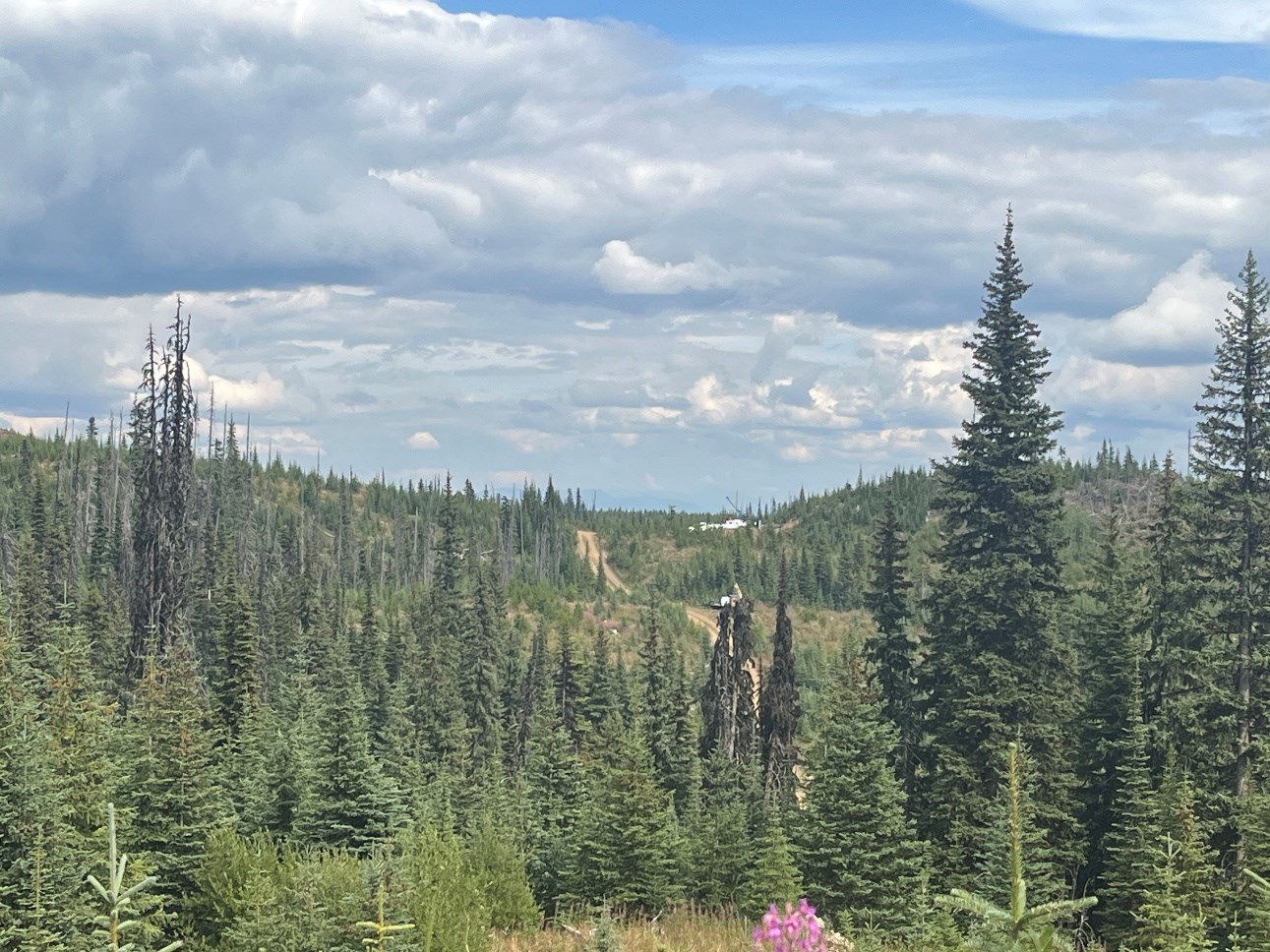
Photo showing DDH-1 (white trucks beside drill mast) and access road leading to it.
To view an enhanced version of this graphic, please visit:
https://images.newsfilecorp.com/files/3615/312097_fc71dc4e6434394b_001full.jpg
DDH 1 was collared to test the porphyry copper-gold potential of a large chargeability anomaly related to the Discovery Zone, where multi-ounce gold assays were intersected in historic drilling, trenching, and underground workings. Geologists of the British Columbia Geological Survey speculated that these veins may represent the upper level of a buried porphyry system (Logan and Mihalynuk, 2013), an interpretation supported by a strong chargeability (induced polarization) anomaly beginning at approximately 300 m depth, as outlined in a historic National Instrument 43-101 technical report prepared for previous operators. The hole was 500m east of the Discovery area to test a separate 3x4 km anomaly. Readers are cautioned that a Qualified Person has not verified the historic geophysical results and the Company is not treating them as current. DDH 1 represents the first drill test of this concept in the property's history, and the alteration zonation now observed in core is characteristic of the porphyry environment the model predicted.
Porphyry copper systems are the world's principal source of copper and molybdenum and rank among the largest mineral deposit types by contained metal. While it is far too early to speculate on the size or grade of the system at Bonaparte, the Company believes the geological sequence intersected in DDH 1 is a significant step forward for the project.
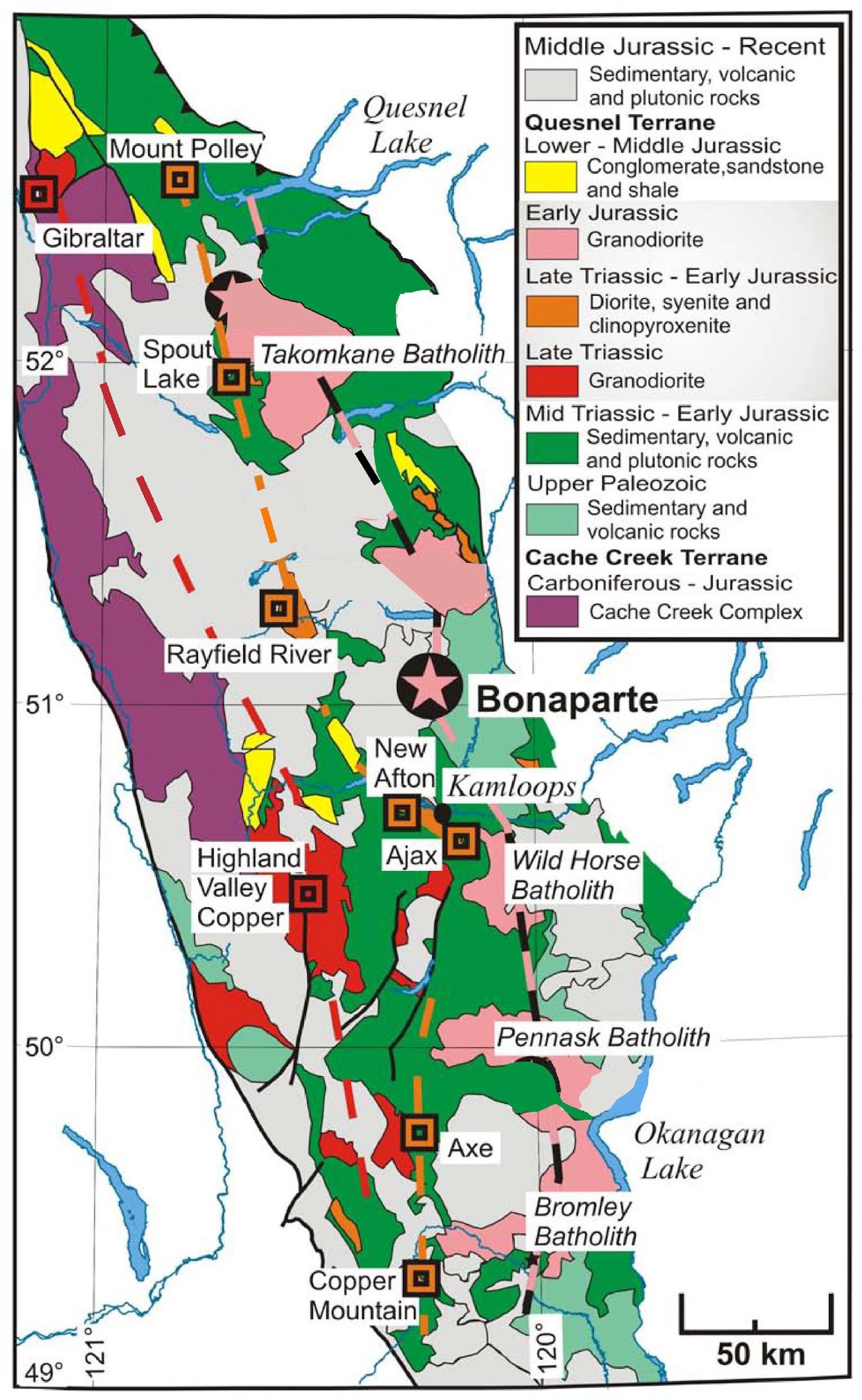
Map showing the porphyry belt in southern BC with the location of the Bonaparte project. The project is located 30 km north of the operating New Afton mine.
To view an enhanced version of this graphic, please visit:
https://images.newsfilecorp.com/files/3615/312097_fc71dc4e6434394b_002full.jpg
The photo showing the end of the potassic altered argillites and the start of the mineralized feldspar porphyry at 557m. The potassic altered rocks are the dark green-black ones while the grey-white specled rock is the feldspar porphyry. A one meter quartz vein with sparse pyrite is located near the contact of the 2 units.
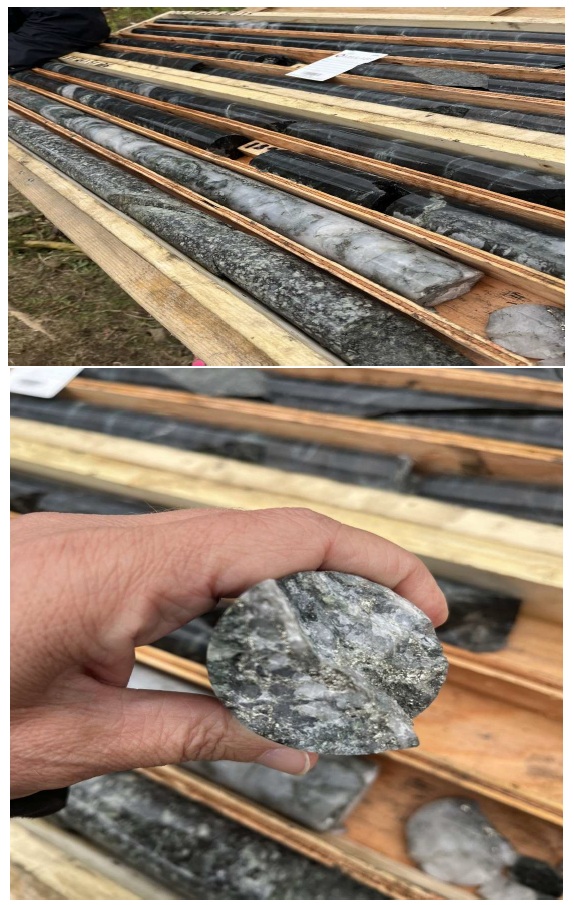
Photo showing interstial sulphide mineralization in the feldspar porphyry.
To view an enhanced version of this graphic, please visit:
https://images.newsfilecorp.com/files/3615/312097_image.jpg
Ed Kruchkowski, President of Decade Resources, stated: "This is exactly the hole you hope to drill when testing a porphyry concept for the first time. DDH 1 passed through a propylitic halo into potassic alteration and is now cutting porphyry-style mineralization with chalcopyrite and occasional molybdenite. That is the classic zonation pattern that vectors toward the heart of a porphyry system, and we intersected it in the very first deep hole ever drilled on this property. The Discovery Zone veins told us something bigger might be sitting underneath, the Geological Survey said the same thing, and the drill is now bearing that out. In my years of exploration in British Columbia, few first holes have delivered this kind of geological confirmation. Core is being logged and sampled as drilling advances, and we look forward to putting numbers to what we are seeing as assays are returned
Important Cautionary Note Regarding Visual Results
Visual observations of mineralization and alteration in drill core are preliminary in nature, are not a substitute for laboratory analysis, and should not be relied upon as a measure of grade. The presence of chalcopyrite and molybdenite does not indicate that economic grades of copper or molybdenum are present. Core samples from DDH 1 will be submitted to MSA LABS in Langley, B.C. for assay, and results will be released once received, compiled, and reviewed by the Company's Qualified Person.
Surface Program Update
Assay results from the July soil sampling survey, comprising over 750 soil samples and 30 rock samples submitted to MSA LABS, remain pending.
Qualified Person
Ed Kruchkowski, P. Geo., President of Decade Resources Ltd., is a Qualified Person as defined by National Instrument 43-101 and has reviewed and approved the technical contents of this news release.
About Decade Resources Ltd.
Decade Resources Ltd. is a Canadian based mineral exploration company actively seeking opportunities in the resource sector. Decade holds numerous properties at various stages of development and exploration, from grassroots to advanced. Its properties and projects are mostly located in the "Golden Triangle" area of northern British Columbia. For a complete listing of the Company's assets and developments, visit the Company website at www.decaderesources.ca.
For further information contact:
Decade Resources Ltd.
Telephone: 250-636-2264
Gary Assaly: 604-377-7969
Forward-Looking Statements
This news release contains certain statements that may be deemed "forward-looking statements" within the meaning of applicable securities laws, including statements regarding the continuation and results of the Phase I drill program, the interpretation of alteration and mineralization observed in drill core, the timing and receipt of assay results, and the exploration potential of the Bonaparte property. Forward-looking statements are based on the current beliefs, estimates, and assumptions of management and are subject to known and unknown risks and uncertainties that could cause actual results to differ materially from those expressed or implied, including, without limitation, the risk that assay results do not confirm visual observations, drilling and equipment availability, assay laboratory turnaround times, results of exploration that differ from expectations, availability of financing, and receipt of regulatory and other approvals. The Company undertakes no obligation to update forward-looking statements except as required by applicable securities laws.
Neither TSX Venture Exchange nor its Regulation Services Provider (as that term is defined in the policies of the TSX Venture Exchange) accepts responsibility for the adequacy or accuracy of this release.
References
Logan, J.M., and Mihalynuk, M.G., 2013. Bonaparte gold: another 195 Ma Au-Cu porphyry deposit in southern British Columbia? In: Geological Fieldwork 2012, British Columbia Ministry of Energy, Mines and Natural Gas. British Columbia Geological Survey Paper 2013-1, 71-80.
Minfile BC
NI 43-101 Technical Report on the Bonaparte Gold Project by R. Kemp, P.Geo.
**Reduced intrusion-related gold systems (RIRGS) are characterized by widespread arrays of sheeted auriferous quartz veins that preferentially form in the brittle carapace at the top of small plutons, where they form bulk-tonnage, low-grade Au deposits characterized by a Au-Bi-Te-W metal assemblage, such as the Fort Knox and Dublin Gulch deposits. https://www.researchgate.net/publication/277131625_Reduced_Intrusion-related_Gold_Systems.

To view the source version of this press release, please visit https://www.newsfilecorp.com/release/312097
FAQ
AI-generated questions and answers. How Rhea-AI works. Not financial advice.