
Equifax National Market Pulse Data Shows U.S. Consumer Debt Accelerating
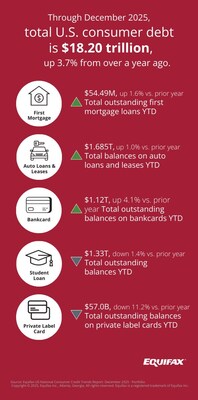
Equifax (NYSE: EFX) released its Market Pulse Q4 2025 U.S. consumer credit trends showing total consumer debt reached $18.20 trillion in December 2025, with year-over-year growth accelerating to +3.7%.
Rhea-AI Summary
Equifax (NYSE: EFX) released its Market Pulse Q4 2025 U.S. consumer credit trends showing total consumer debt reached $18.20 trillion in December 2025, with year-over-year growth accelerating to +3.7%. Delinquencies eased from recent highs but remain elevated versus pre-pandemic norms.
Bankcard balances rose while private label credit contracted; auto leasing and student loan delinquency dynamics also stood out.
Positive
- Total consumer debt $18.20 trillion (+3.7% YoY)
- Bankcard balances $1.12 trillion (+4.1% YoY)
- Outstanding lease balances $95.8 billion (+7.6% YoY)
Negative
- 60+ day delinquency at 5.7%, still above pre-pandemic levels
- Private label balances down 11.2% YoY; accounts -21.4%
- Student loan severe delinquency 16.39% on non-deferred balances
Details
News Market Reaction – EFX
In the Feb 25 session, EFX gained 1.96%, reflecting a mild positive market reaction.
Data tracked by StockTitan Argus on the day of publication.
Key Figures
- Total U.S. consumer debt
- $18.20T
- Total consumer debt balance as of December 2025
- Consumers 60+ DPD
- 5.7%
- Share of consumers with at least one payment 60+ days past due in Dec 2025
- Peak 60+ DPD rate
- 6.8%
- Peak share of consumers 60+ days past due in Q3 2025
- Bankcard balances
- $1.12T
- Total bankcard balances in December 2025
- Bankcard YoY growth
- 4.1%
- Year-over-year change in bankcard balances for December 2025
- Bankcard 60+ DPD
- 3.03%
- Bankcard 60+ day delinquency rate in December 2025
- Subprime card utilization
- 75.6%
- Average subprime credit card utilization in Q4 2025
- Student severe delinquency
- 16.39%
- Severe student loan delinquency rate on non-deferred balances (90+ DPD or bankruptcy)
Historical Context
-
Launch of Optimal Path AI credit score action plans in myEquifax app.
-
Expanded partnership with Gen Digital to integrate Equifax data into AI products.
-
Q4 2025 revenue and EPS above guidance with 2026 growth outlook.
-
Launch of Credit Abuse Risk model to detect first-party fraud for lenders.
-
New Employment Insights solutions giving auto dealers verified income data.
24h Move is the share-price change in the day after each event; other market factors may also have contributed.
Key Terms
subprime financial
delinquency financial
bankcard financial
private label credit cards financial
severe delinquency financial
wage garnishment regulatory
AI-generated analysis. How Rhea-AI works. Not financial advice.




While Delinquency Rates Have Begun to Ease, They are Still Elevated Relative to Pre-Pandemic Norms
"Average subprime credit card utilization remained flat at
In the fourth quarter of 2025, Equifax data shows that delinquency rates across several major lending products have begun to ease from more recent highs, though they remain elevated relative to pre-pandemic norms. As of December 2025,
Looking ahead, seasonal patterns are expected to support near-term credit performance. Delinquencies typically ease as tax refunds arrive and larger refunds could provide additional relief to pay down debt.
Key Insights
- Bankcard Balances Continue to Grow While Private Label Credit Contracts
Total bankcard balances increased to$1.12 trillion 4.1% year-over-year, while 60+ day bankcard delinquency declined to3.03% from3.16% a year ago. Average bankcard utilization edged down slightly to21.2% , a decline driven primarily by rising credit limits—which have risen roughly6.5% year-over-year—rather than being driven by a pullback in card usage. Importantly, utilization levels have remained broadly stable around21% since August 2023, underscoring a steady consumer reliance on revolving credit.
At the same time, private label card balances fell11.2% year-over-year and accounts declined21.4% , reflecting a continued consumer shift toward general-purpose credit products.
- Auto Credit Stays Resilient as Leasing Gains Momentum
Auto loan and lease balances reached$1.685 trillion 1% year-over-year, as consumers continue adapting to elevated vehicle prices via longer loan terms and alternative financing structures. Severe auto delinquency (share of balance 60+ DPD increased to1.61% , up three basis points year-over-year, while auto write-offs decreased to 25.9 basis points. Delinquency trends have remained largely stable since late 2023, including within the subprime segment, where auto loans continue to rank as the top payment priority for borrowers.
Leasing activity accelerated in the fourth quarter, with outstanding lease balances up7.6% year-over-year to$95.8 billion
- Student Loan Delinquencies Stabilize as New Risks Emerge
Outstanding student loan balances totaled$1.33 trillion 1.4% year-over-year. The severe delinquency rate (calculated as the share of non-deferred balances 90+ DPD or in bankruptcy) measured16.39% , showing signs of leveling off following earlier repayment disruptions tied to the resumption of payments. Looking ahead, the restart of wage garnishment is expected to influence repayment behavior and could affect how consumers prioritize student loan payments relative to other financial obligations.
"Historically, consumers have prioritized mortgage and auto obligations over other forms of debt," said Urtubey. "However, renewed enforcement on student loans, persistent inflation, and high borrowing costs may begin to reshape payment hierarchies and introduce stress into credit categories that have been relatively insulated in the past."
Month-Over-Month and Year-Over-Year Results
Total Consumer Debt Balances | |||
Month | Total Consumer Debt | MoM Change (%) | YoY Change (%)
|
October 2025 | 0.3 % | 2.9 % | |
November 2025 | 0.1 % | 2.9 % | |
December 2025 | 0.5 % | 3.7 % | |
First Mortgage Balances | |||
Month | First Mortgage Balances | MoM Change (%) | YoY Change (%) |
October 2025 | 0.3 % | 2.9 % | |
November 2025 | 0.1 % | 2.9 % | |
December 2025 | 0.5 % | 4.3 % | |
Home Equity Lines of Credit (HELOC) Balances | |||
Month | HELOC Balances ($B) | MoM Change (%) | YoY Change (%) |
October 2025 | 1.4 % | 12.0 % | |
November 2025 | 1.0 % | 12.2 % | |
December 2025 | 1.0 % | 12.6 % | |
Auto Loan Balances | |||
Month | Auto Loan Balances ($B) | MoM Change (%) | YoY Change (%) |
October 2025 | 0.1 % | 0.8 % | |
November 2025 | 0.1 % | 0.8 % | |
December 2025 | -0.1 % | 0.6 % | |
Bankcard Balances | |||
Month | Bankcard Balances ($B) | MoM Change % | YoY Change (%) |
October 2025 | 0.0 % | 3.7 % | |
November 2025 | 0.6 % | 3.8 % | |
December 2025 | 3.1 % | 4.1 % | |
Student Loans Balances | |||
Month | Student Loan Debt ($B) | MoM Change % | YoY Change (%) |
October 2025 | 0.6 % | -0.2 % | |
November 2025 | -0.4 % | -0.3 % | |
December 2025 | -0.3 % | -1.4 % | |
Equifax has been tracking
*To view the included graphic, click here.
ABOUT EQUIFAX INC.
At Equifax (NYSE: EFX), we believe knowledge drives progress. As a global data, analytics, and technology company, we play an essential role in the global economy by helping financial institutions, companies, employers, and government agencies make critical decisions with greater confidence. Our unique blend of differentiated data, analytics, and cloud technology drives insights to power decisions to move people forward. Headquartered in
FOR MORE INFORMATION:
Tiffany Smith for Equifax
mediainquiries@equifax.com
 View original content to download multimedia:https://www.prnewswire.com/news-releases/equifax-national-market-pulse-data-shows-us-consumer-debt-accelerating-302696067.html
SOURCE Equifax Inc.
FAQ
AI-generated questions and answers. How Rhea-AI works. Not financial advice.