
The Estée Lauder Companies and University of Leeds Partner to Advance the Future of Complexion Shade Matching
The Estée Lauder Companies (NYSE: EL) announced a research collaboration with the University of Leeds’ School of Design and Professor Kaida Xiao to advance complexion shade matching for foundation, concealer and other products.
Sentiment and the balance of points
Rhea-AI Sentiment reads the wording of the document, how positive or negative its language is on a 1 to 5 scale. The balance of points shown with the takes weighs what the document actually discloses, so the two can disagree, for example when a trial that missed its main goal is described in upbeat language.




New research aims to tackle one of beauty’s most persistent challenges: accurately matching shade complexion-enhancing products to the full, diverse spectrum of global skin tones
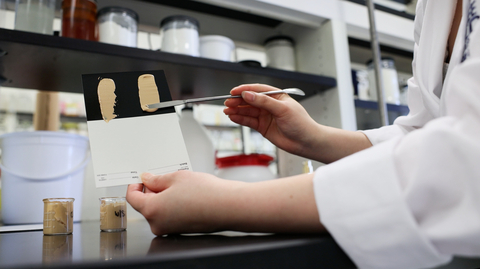
Foundation shades are evaluated as part of color science research.
By combining advanced color science with research into how consumers perceive their own skin, this partnership aims to strengthen the development of luxury and prestige complexion-enhancing products with more precise shade matching and improved formulas. The findings could help establish new scientific benchmarks for evaluating foundation, concealer and other complexion products to deliver more natural-looking results in everyday life.
The project, led by Dr. Kaida Xiao, Professor of Color and Imaging Science at the Leeds Institute of Textiles and Color (LITAC), School of Design, University of
By examining the relationship between how color is measured by scientific instruments and human visual perception of the same colors, particularly in real-world viewing conditions, the research seeks to identify when subtle differences in tone become noticeable to consumers and when they do not. These insights will help improve how complexion products are evaluated and developed, reducing mismatches and enabling more natural-looking results.
“Delivering transformative innovation in complexion and color cosmetics begins with a deeper understanding of how consumers perceive their own skin tone,” said Claude Saliou, Senior Vice President, Advanced Technologies and Global Clinical and Consumer Sciences, The Estée Lauder Companies.
“While skin tone can be measured with increasing precision, understanding how consumers perceive their tone in the real world remains a complex scientific challenge. By partnering with the University of
“Skin color perception is highly complex, shaped by subtle interactions between multiple factors,” said Dr. Kaida Xiao, Professor of Color and Imaging Science, University of
About The Estée Lauder Companies
The Estée Lauder Companies Inc. is one of the world’s leading manufacturers, marketers, and sellers of quality skin care, makeup, fragrance, and hair care products, and is a steward of luxury and prestige brands globally. The company’s products are sold in approximately 150 countries and territories under brand names including: Estée Lauder, Aramis, Clinique, Lab Series, Origins, M·A·C, La Mer, Bobbi Brown Cosmetics, Aveda, Jo Malone London, Bumble and bumble, Darphin Paris, TOM FORD, Smashbox, AERIN Beauty, Le Labo, Editions de Parfums Frédéric Malle, GLAMGLOW, KILIAN
With Research & Innovation Centers around the world, The Estée Lauder Companies’ scientists have multidisciplinary expertise ranging from basic science and advanced technologies to the intersections of physics, chemistry, biology, and engineering. The company has 75 years of formulation authority and is deeply integrated into the scientific community, regularly presenting at leading events, publishing in peer-reviewed journals, including partnerships with leading scientists, institutions, and academia across a broad array of sectors. The Estée Lauder Companies’ Research & Innovation team consistently aims to develop the next generation of transformative, science-driven prestige beauty products, packaging, and experiences that deliver exceptional quality and performance for our consumers around the world.
The
About the University of Leeds
The University of Leeds is one of the largest higher education institutions in the UK, with more than 40,000 students from about 140 different countries. The university is renowned globally for the quality of our teaching and research. The University of Leeds is a values-driven university and harnesses its expertise in research and education to help shape a better future for humanity, working through collaboration to tackle inequalities, achieve societal impact and drive change. The University is a member of the Russell Group of research-intensive universities, and is a major partner in the Alan Turing, Rosalind Franklin and Royce Institutes.
The School of Design was established in 1874 and has evolved into a globally renowned institution at the University of Leeds. Today, that legacy of applied science and creativity is supported by a robust community of over 100 academics and research fellows. Its profound impact is further cemented by the Leeds Institute of Textiles and Color (LITAC), an interdisciplinary research institute established within the School through a significant
ELC-C
View source version on businesswire.com: https://www.businesswire.com/news/home/20260814256032/en/
News Contacts:
Global Media: Brendan Riley
briley@estee.com
767 Fifth Avenue
New York, NY 10153
UK Media: Maria Allen
maallen@estee-lauder.co.uk
6 Mortimer Street
London W1T 3JJ
Source: The Estée Lauder Companies Inc.