
All Nippon Airways Builds Cloud Network Hub with Equinix
Equinix (Nasdaq: EQIX) announced that All Nippon Airways (ANA) has built a centralized cloud network hub using Equinix Fabric to modernize digital infrastructure for passenger services and operations.
Rhea-AI Summary
Equinix (Nasdaq: EQIX) announced that All Nippon Airways (ANA) has built a centralized cloud network hub using Equinix Fabric to modernize digital infrastructure for passenger services and operations. ANA shifted from traditional dedicated circuits to a software-defined interconnection model that provides secure, on-demand connectivity to major cloud providers including AWS, Microsoft Azure and Google Cloud.
According to Equinix, ANA has reduced network provisioning time by about 80%, freeing resources for application development and testing, and is targeting a 30% reduction in five-year total cost of ownership while preparing for a projected tenfold increase in global data volumes.
Positive
- Network provisioning time reduced by ~80%, according to Equinix
- Targeted 30% reduction in five-year total cost of ownership
- Centralized cloud hub enables on-demand links to multiple major cloud providers
- Software-defined model supports emerging AI and advanced analytics workloads
Negative
- None.
Details
News Market Reaction – EQIX
On Aug 5, the day this news came out, EQIX closed 0.44% above the previous close.
Data tracked by StockTitan Argus for the Aug 5 session.
Key Figures
- Global data volume increase
- 10x
- Projected increase facing ANA
- Provisioning time reduction
- 80%
- Network provisioning time reduction
- Targeted TCO reduction
- 30%
- Five-year total cost of ownership target
- Aircraft operated
- 280 aircraft
- ANA operating fleet
- Routes served
- More than 200 routes
- ANA domestic and international network
- Company founding year
- 1952
- ANA company history
Historical Context
-
Two leaders appointed to oversee products, services and global market operations.
-
Expanded collaboration launched secure AI factory deployments across Equinix data centers.
-
Geo Zones expansion added geographic routing controls for hybrid multicloud environments.
-
Quarterly cash dividend declared at $5.16 per common share.
-
Quarterly results included raised full-year revenue and AFFO outlook ranges.
24h Move is the share-price change in the day after each event; other market factors may also have contributed.
Key Terms
network-as-a-service technical
hybrid multicloud technical
software-defined interconnection platform technical
private connectivity technical
AI-generated analysis. How Rhea-AI works. Not financial advice.




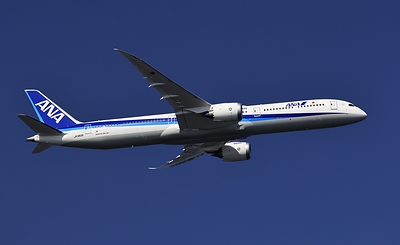
As organizations modernize digital infrastructure for hybrid multicloud environments and growing data volumes, many are adopting more agile and scalable connectivity models. ANA's deployment of Equinix Fabric reflects this broader shift, transforming its network into a future-ready digital foundation that enhances passenger services, increases business agility, and supports long-term growth. Through Equinix Fabric, ANA has accelerated connectivity deployment, improved cost efficiency and strengthened its ability to support the next generation of data-driven passenger experiences. Equinix helps ANA ensure security and compliance through private connectivity, consistent centralized policy enforcement and alignment with modern security frameworks.
Jun Nakazato, Manager, IT Infrastructure Team, Digital Governance Department, Digital Transformation Division, All Nippon Airways, said, "Our rapid business expansion demanded a network with unprecedented flexibility. Rather than continuing to expand our existing network environment, we recognized that implementing network-as-a-service was the most effective path forward. Equinix Fabric delivers the dynamic foundation we need to scale seamlessly. Equinix serves not merely as a vendor, but as a critical strategic partner in modernizing our global systems and enabling our future growth."
Operating approximately 280 aircraft across more than 200 domestic and international routes, ANA's operations are built on a highly resilient digital infrastructure that serves as the foundation for mission-critical passenger services, including reservations, boarding, customer communications and operational systems. As ANA expanded its business and accelerated adoption of hybrid and multicloud environments, the organization faced growing pressure to integrate increasingly sophisticated systems while maintaining the speed, flexibility and reliability expected of a world-class airline. Traditional network architectures that relied on dedicated circuits for individual systems became increasingly complex and costly to scale as connectivity requirements continued to evolve.
To address these challenges, ANA redesigned its network architecture around a centralized cloud network hub powered by Equinix Fabric. The software-defined interconnection platform enables secure, on-demand connectivity to leading cloud providers, including Amazon Web Services (AWS), Microsoft Azure and Google Cloud, without the need to deploy additional physical circuits.
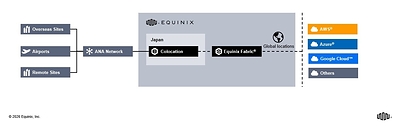
By centralizing connectivity through Equinix Fabric, ANA has transformed its network from a traditionally provisioned infrastructure into a more agile, software-defined platform. The cloud network hub provides secure, on-demand access to leading cloud environments while enabling ANA to scale connectivity more efficiently as business needs evolve. Faster infrastructure provisioning and seamless connectivity across cloud environments can enable more integrated customer services, real-time operational coordination, and earlier adoption of new applications and services. This flexible architecture supports ANA's broader passenger service modernization strategy and provides a resilient foundation for advanced analytics, automation, emerging AI workloads and future digital innovation.
Kuniko Ogawa, Managing Director,
About All Nippon Airways (ANA)
Founded in 1952 with just two helicopters, All Nippon Airways (ANA) has grown to become
ANA operates an extensive international and domestic network, connecting destinations across
ANA is the only Japanese airline to have earned SKYTRAX's 5-Star rating every year since 2013, underscoring its consistent excellence. The airline is also a four-time recipient of the Air Transport World's (ATW) Airline of the Year award. In 2025, ANA was honored with FlightGlobal's Executive Leadership: Asia-Pacific Award, reflecting its continued focus on innovation and strategic growth.
As part of ANA HOLDINGS Inc., ANA continues to invest in the onboard experience, its fleet and digital services to enhance the travel experience for passengers worldwide.
For more information about ANA and ANA HD, please visit: https://www.ana.co.jp/group/en/
About Equinix
Equinix, Inc. (Nasdaq: EQIX) shortens the path to boundless connectivity anywhere in the world. Its digital infrastructure, data center footprint and interconnected ecosystems empower innovations that enhance our work, life and planet. Equinix connects economies, countries, organizations and communities, delivering seamless digital experiences and cutting-edge AI—quickly, efficiently and everywhere.
Forward-Looking Statements
This press release contains forward-looking statements that involve risks and uncertainties. Actual results may differ materially from expectations discussed in such forward-looking statements. Factors that might cause such differences include, but are not limited to, risks to our business and operating results related to the current inflationary environment; foreign currency exchange rate fluctuations; stock price fluctuations; increased costs to procure power and the general volatility in the global energy market; the challenges of building and operating IBX® and xScale® data centers, including those related to sourcing suitable power and land, and any supply chain constraints or increased costs of supplies; the challenges of developing, deploying and delivering Equinix products and solutions; unanticipated costs or difficulties relating to the integration of companies we have acquired or will acquire into Equinix; a failure to receive significant revenues from customers in recently built out or acquired data centers; failure to complete any financing arrangements contemplated from time to time; competition from existing and new competitors; the ability to generate sufficient cash flow or otherwise obtain funds to repay new or outstanding indebtedness; the loss or decline in business from our key customers; risks related to our taxation as a REIT; risks related to regulatory inquiries or litigation; and other risks described from time to time in Equinix filings with the Securities and Exchange Commission. In particular, see recent and upcoming Equinix quarterly and annual reports filed with the Securities and Exchange Commission, copies of which are available upon request from Equinix. Equinix does not assume any obligation to update the forward-looking information contained in this press release.
 View original content to download multimedia:https://www.prnewswire.com/news-releases/all-nippon-airways-builds-cloud-network-hub-with-equinix-302843573.html
SOURCE Equinix, Inc.
FAQ
AI-generated questions and answers. How Rhea-AI works. Not financial advice.