
Four Nines Gold Intersects 67 Metres at 1.78 g/t Gold, Reinforing Emerging Gold Corridor at Hayden Hill
Five completed holes in the Lower Telegraph Corridor await assays as drilling continues at Hayden Hill.
Sentiment and the balance of points
Rhea-AI Sentiment reads the wording of the document, how positive or negative its language is on a 1 to 5 scale. The balance of points shown with the takes weighs what the document actually discloses, so the two can disagree, for example when a trial that missed its main goal is described in upbeat language.
Rhea-AI Summary
Four Nines Gold (FNAUF) reported a 67.0-metre gold intersection at Hayden Hill in northern California, its best gold grade-thickness result to date. Hole HH26-005 averaged 1.78 grams per tonne gold and 13 grams per tonne silver. It included 35.9 metres averaging 2.30 grams per tonne gold and 15 grams per tonne silver.
The first three reported holes in the Lower Telegraph Corridor each intersected more than 30 metres averaging above 1 gram per tonne gold, beginning less than 25 metres below the historic pit. Twelve holes totaling 1,995.7 metres have been completed, including eight targeting the corridor; five corridor holes await assays. Hole HH26-013 is in progress. Four Nines is investigating the corridor's potential continuation at depth. Reported intervals are downhole lengths; further drilling is required to establish true widths, continuity, geometry and extent.
How this balance works
Rhea-AI gives every point it takes from this document a weight. Minor counts 1, Moderate 3 and Major 9, so one Major point outweighs several Minor ones. The bar adds up the weights on each side, and when neither side holds more than 65% of the total the balance reads Mixed.
It reads the document as published, with the same rules for every company, and it does not look at what the market expected or at how the stock traded, so a point can be objectively good on a day the stock falls.
Rhea-AI Sentiment measures something else, the tone of the wording.
Hollow bars mark forward-looking points. How the balance works
Positive
- Moderate pointHH26-005 returned 67.0 metres averaging 1.78 g/t gold and 13 g/t silver.
- Minor pointHigher-grade interval included 35.9 metres averaging 2.30 g/t gold and 15 g/t silver.
- Minor pointPeak sample returned 16.90 g/t gold and 182 g/t silver over 0.4 metres.
- Minor pointEarlier corridor results included 31.9 metres at 1.05 g/t gold and 80.1 metres at 1.08 g/t gold.
- Minor pointExploration has completed 12 holes totaling 1,995.7 metres; HH26-013 is in progress.
- Minor point. Forward-looking: it has not happened yet and may not happen.Four Nines continues investigating potential structural controls at depth.
Negative
- Minor pointAssays remain pending for five completed corridor holes, including HH26-011.
- Minor point. Forward-looking: it has not happened yet and may not happen.Corridor continuity, geometry and extent require further drilling to establish.
AI-generated analysis. How Rhea-AI works. Not financial advice.


VANCOUVER, BC / ACCESS Newswire / November 10, 2026 / Four Nines Gold Inc. (CSE:FNAU)(OTCQB:FNAUF)(FWB:F8NA) ("Four Nines" or the "Company") is pleased to announce its best gold intersection to date at the Hayden Hill Project, northern California.
Highlights
Best Gold Grade-Thickness Intersection to Date: HH26-005 returned 67.0 metres averaging 1.78 grams per tonne ("g/t") gold ("Au") and 13 g/t silver ("Ag"), marking continued positive results in the Company's inaugural drill campaign on this low sulphidation epithermal gold system.
- Higher-Grade Gold and Silver Within the Corridor: The intersection includes 35.9 metres averaging 2.30 g/t Au and 15 g/t Ag, with a peak sample of 16.90 g/t Au and 182 g/t Ag over 0.4 metres, highlighting higher-grade precious-metal concentrations within the broader mineralized interval.
- Three Significant Gold Intersections Strengthen the Geological Model: HH26-001 (31.9 metres averaging 1.05 g/t Au, press release October 19,2026), HH26-003 (80.1 metres averaging 1.08 g/t Au ) and HH26-005 have each returned gold-bearing intervals exceeding 30 metres at average grades above 1 g/t Au, all starting at shallow depths (<25m) beneath the historic pit.
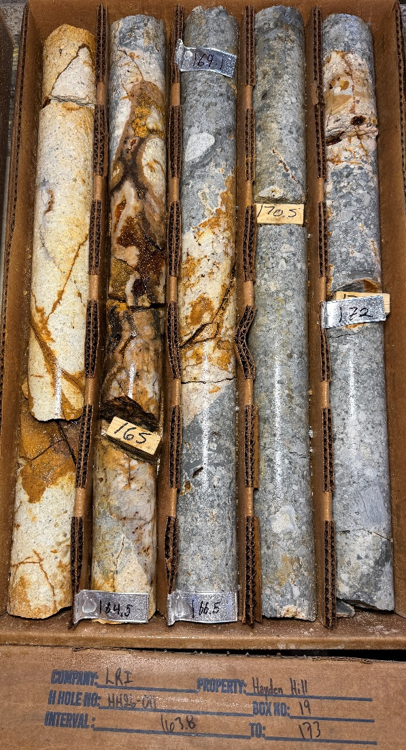
- Further Drilling: HH26-011, drilled at a steeper angle, encountered approximately 58.9 metres of hydrothermal brecciation comparable to those observed in mineralized holes. Assays are pending.
- Additional Drill Results and Exploration Catalysts Ahead: A total of 12 drill holes have been completed across Hayden Hill, including eight within the LTC, with assays reported from the first three.
Three Significant Gold-Silver Intersections Reinforce the Emerging Lower Telegraph Corridor
The results mark the third significant gold-silver intersection from the Company's first three reported holes targeting the LTC, further strengthening the emerging geological model beneath the historic Lookout Pit. HH26-005 also returned 13 g/t Ag across 67.0 metres, with a peak sample of 182 g/t Ag alongside 16.90 g/t Au over 0.4 metres, demonstrating the presence of both high-grade gold and silver within the mineralized system.
Together, these intersections provide growing evidence of a structurally controlled gold-silver corridor beneath and adjacent to the historic mine. The improvement in gold grade-thickness in HH26-005 is particularly encouraging, providing additional information about the distribution of mineralization as the Company advances toward defining the corridor's dimensions, identifying the geological controls on higher-grade gold deposition and investigating its potential continuation to depth.
Reported intervals are downhole lengths. Further drilling is required to establish true mineralized widths, continuity, geometry and extent.
Management Commentary
Charles Ross, President and CEO of Four Nines Gold, commented:
"Hole 005 represents another significant step forward at Hayden Hill. Three substantial gold intersections from our first three reported holes in the Lower Telegraph Corridor, with our best gold grade-thickness result yet, delivering 67 metres at 1.78 g/t Au, is an exceptional start to our inaugural drill campaign.
"What makes this particularly exciting is how much remains to be investigated. We've now encountered substantial gold mineralization at multiple locations beneath the historic mine, with Hole 005 delivering stronger average grades and adding another important dimension to our understanding of the system. Five additional completed holes in the corridor await assay results and seven other exploration targets remain to be systematically investigated.
"We believe we're only beginning to define what Hayden Hill may host beneath and beyond the areas historically mined. Our objective is to build on these early results and determine the true dimensions and potential of the gold-silver system at Hayden Hill."
Geological Interpretation: Following the Gold System Deeper
The LTC is interpreted as part of a low-sulfidation epithermal gold system, where gold-bearing fluids historically moved upward through fractures and geological structures, depositing gold and silver under favourable conditions. In these systems, mineralization can extend across multiple structures, with higher-grade concentrations developing where the geological conditions were particularly favourable.
HH26-005 provides another important piece of this geological picture. Drilled from the same general location as HH26-003, but approximately 40 degrees apart in direction, both holes encountered similar gold-bearing rock formations characterized by silicification, quartz veining and hydrothermal brecciation. The higher grades in HH26-005, combined with substantial mineralized intervals in both holes, help the geological team to better understand gold distribution within the emerging corridor.
Of particular interest is the system's potential at depth. In epithermal deposits, gold can become concentrated within specific vertical intervals and structural settings, including areas influenced by changes in pressure and fluid boiling. Separate mineralized veins and structures can sometimes converge or coalesce at depth, potentially creating favourable settings for high-grade gold deposition. Previous drilling identified a separate, deeper gold intersection in HH26-003, potentially associated with the historic 214 Vein, providing another important structural clue. The Company continues to investigate potential structural controls at depth as an important part of its ongoing exploration strategy.
Why These Results Matter for Investors
With three significant results from its first three reported holes, Four Nines is building a stronger geological picture of a gold-silver system beneath the historic Lookout Pit. Hole 005's improved grades add important information as exploration advances from confirming mineralization toward investigating the corridor's continuity, structural controls and potential at depth.
Hayden Hill historically produced approximately 480,000 ounces of gold and 1.3 million ounces of silver, but had not undergone systematic exploration drilling since 1997, before the Company's inaugural drill campaign began in 2026. With five additional completed holes in the LTC awaiting assay results, drilling continuing, and seven others currently identified exploration zones yet to be systematically investigated, the Company remains in the early stages of evaluating the property's broader potential.
Hayden Hill Technical Information
Phase 1 Drill Program
To date, twelve (12) core holes (Figure 1) have been completed in 2026 for a total of 1,995.7 metres (6547.6 ft) (Table 1). Hole HH26-013 is in progress.
Most of the 2026 drilling has targeted the Lower Telegraph Corridor (LTC), offsetting from the favorable geology and gold intercept in HH26-001 (press release Oct 1, 2026).
Figure 1: Lower Telegraph Corridor Drill Hole Location Map
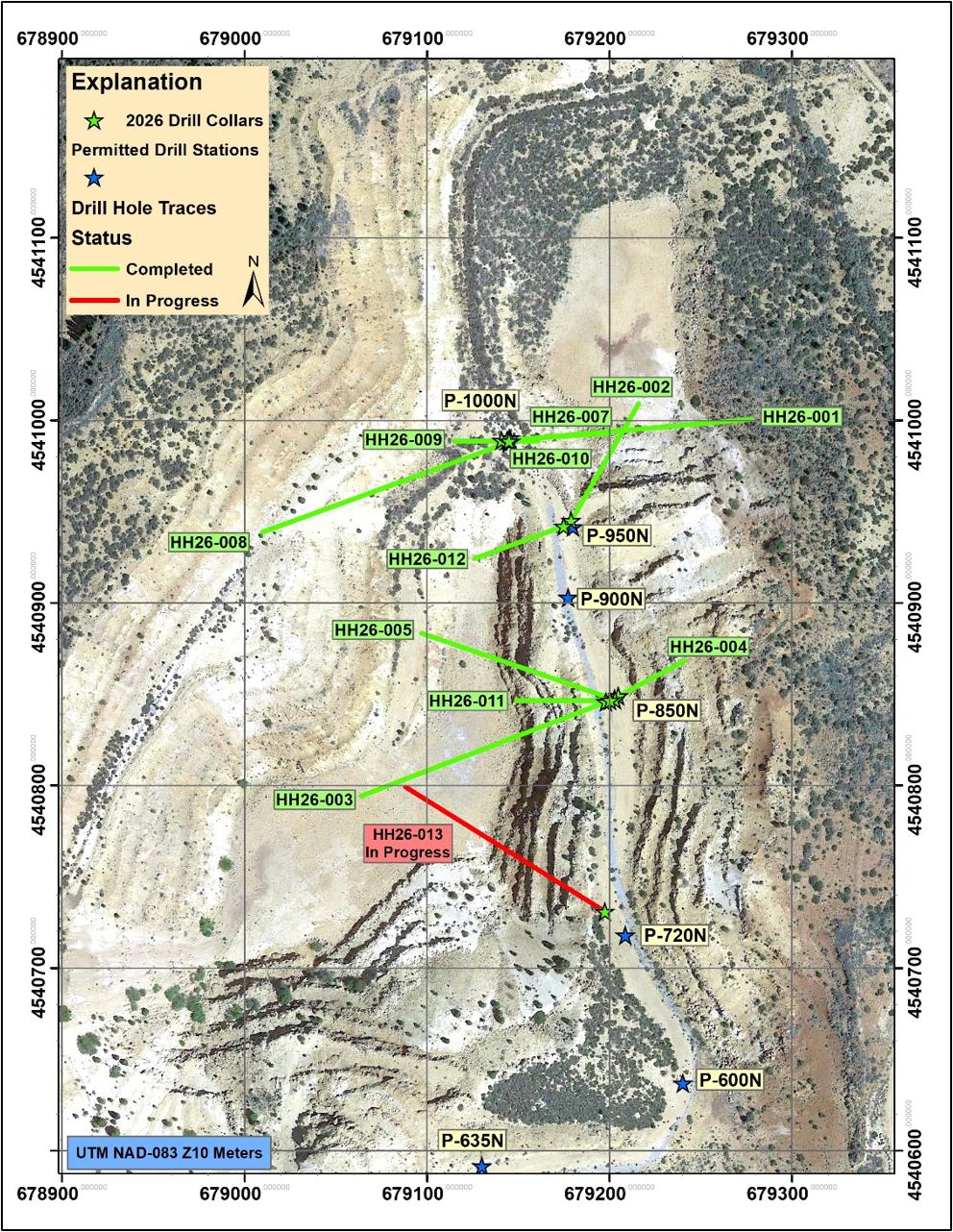
Table 1: Hayden Hill 2026 Drill Hole Collar File
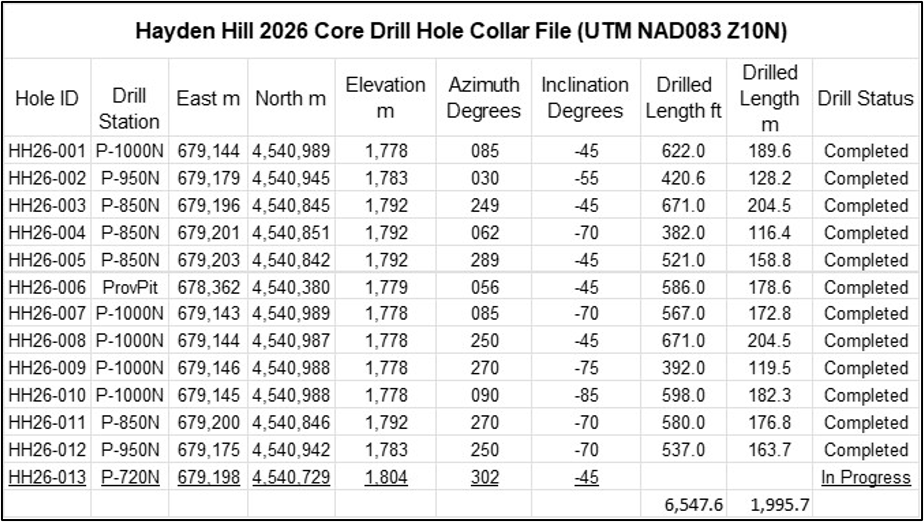
Table 2:
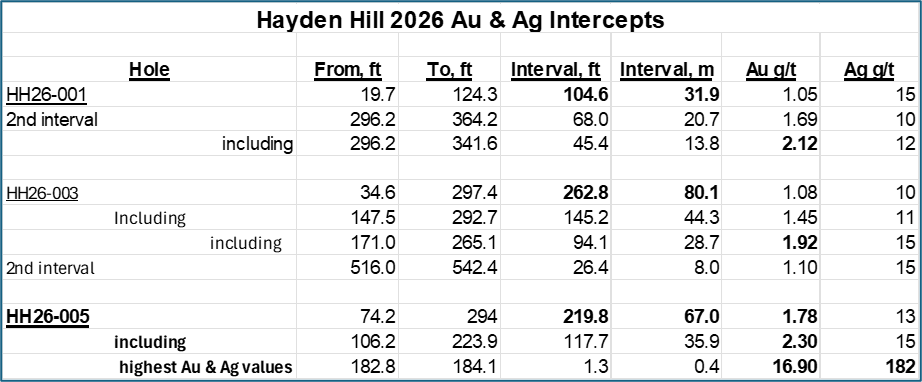
Note: the true thicknesses of mineralization are unknown
Lower Telegraph Corridor Drill Program
The Lower Telegraph Corridor (LTC), which lies below a portion of the historical Amax Gold open pit, is an extensive zone of multi-phase silicified hydrothermal breccia, silica veins and sulfide veins, identified from surface mapping and drill core.
To date, eight (8) holes (HH26-001, 003, 005, 007, 009, 010, 011, & 012) have been completed specifically to explore the LTC. Assays have been received for three (3): HH26-001, 003 & 005 - each intersected gold mineralization of at least 30 metres length (100ft), at an average gold grade > 1 g/t (Table 2). Another three holes (002, 004 & 008, Figure 1), drilled primarily to explore other mineral zones, have also provided data at the collars to further characterize the LTC.
HH26-005
HH26-005 has been completed to explore the LTC: 1) from the P-850N station (Figure 1), 2) at an azimuth of 289 degrees, inclined at -45 degrees (Figure 2), and 4) to a length of 158.8 metres (521ft) (Table 1).
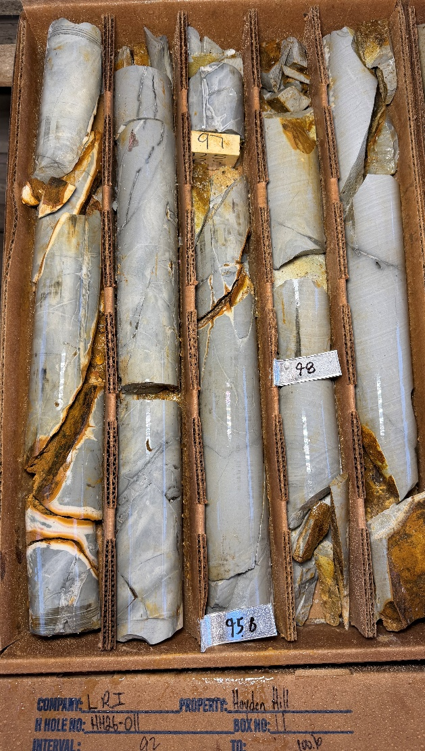
HH26-005 intersected 67 metres (219.8ft) of precious-metal mineralization at an average grade of 1.78 g/t gold and 13 g/t Ag (Table 2), hosted in pervasively silicified & veined volcaniclastic and multi-stage silicified hydrothermal breccia (Figure 3). The character of the hydrothermal brecciation and veining in HH26-005 is like that of HH26-003.
Figure 2: Station P-850N Mineral Cross Section Along HH26-005
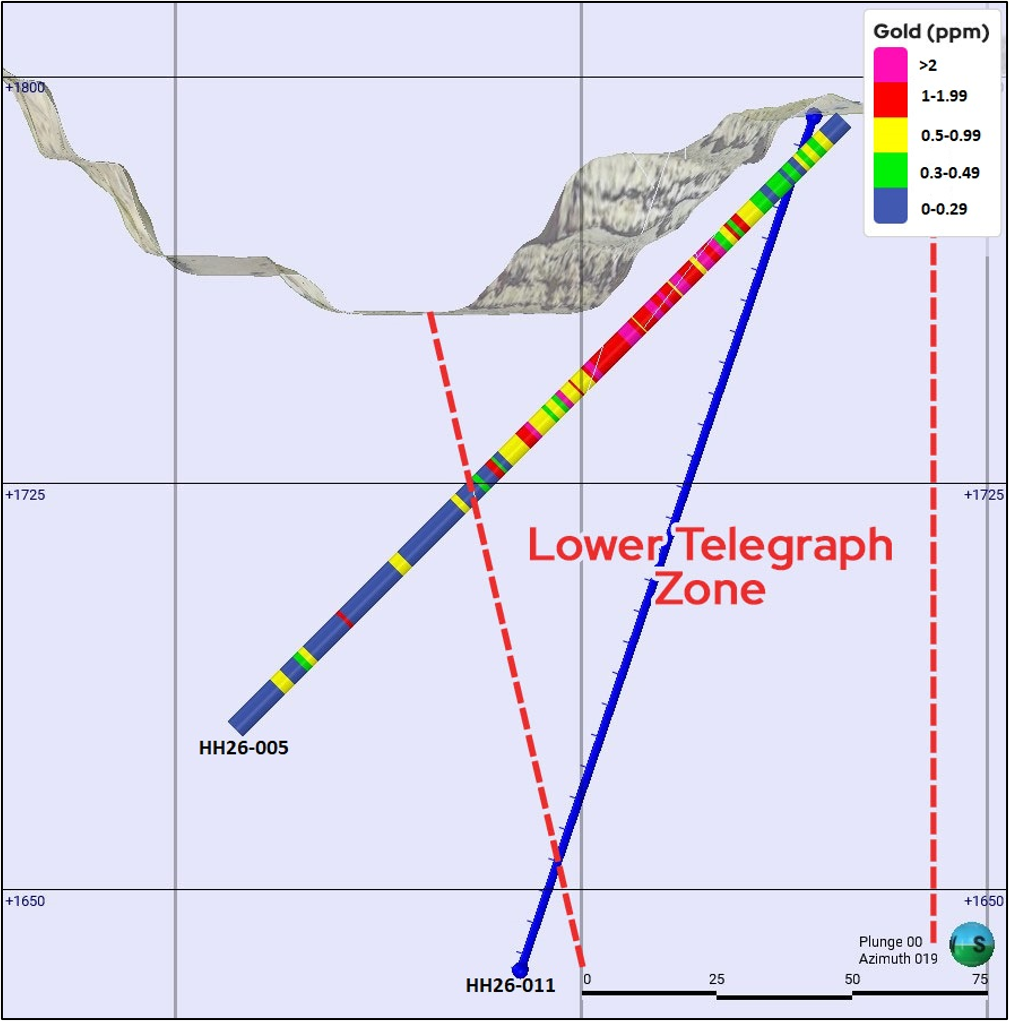
Figure 3: HH26-005 Photos of Mineralized Core
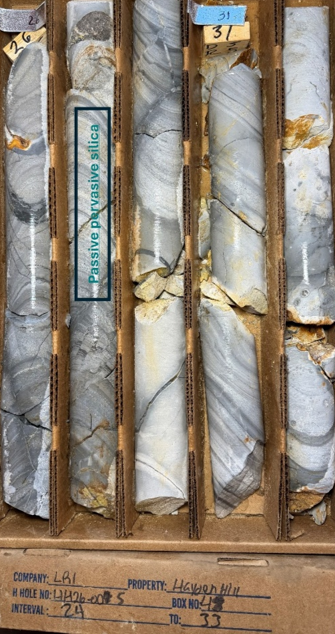
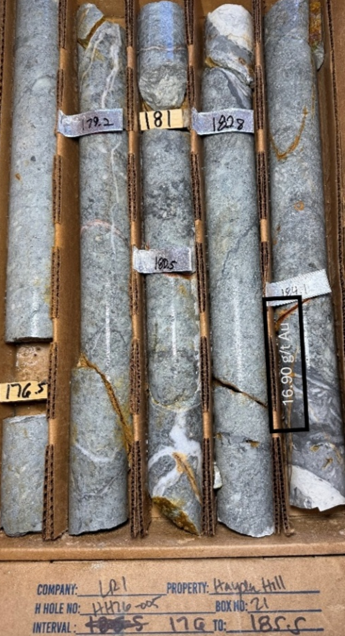
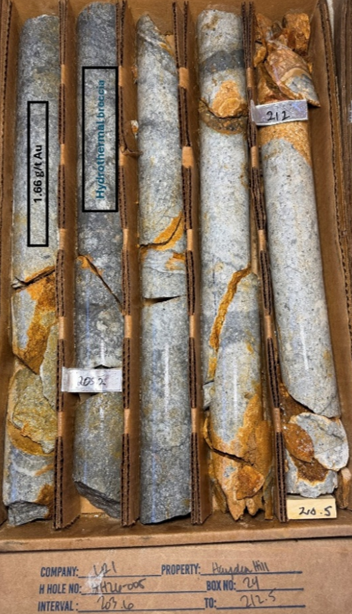
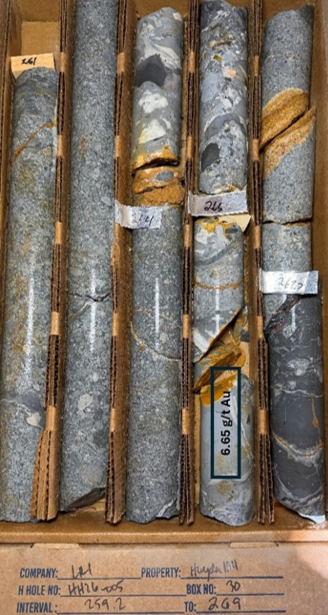
Notes: core is HQ diametre for scale, measurements are in feet, depth shown on wood blocks
HH26-011
HH26-011 has been completed: 1) from station P-850N (Figure 1), 2) at an azimuth of 270 degrees, 3) inclined at -70 degrees, and 4) to a length of 176.8 metres (580ft) (Table 1).
The hole intersected the LTC along a length of 14.9 - 73.8 metres (49 - 242 feet), consisting of passive-pervasive silicification, quartz veining overprinting previous pervasive silicification and hydrothermal breccia (Figure 4). This alteration character is comparable to that encountered in HH26-005. The assays for HH26-011 are pending.
Figure 4: HH26-011 Core Photos
Drilling & QA/QC
- The core drilling is being conducted by LSG Drilling LLC using an Everdigm ECR‑18 core rig, with drill depth data collected in "feet".
- Downhole surveys are being conducted by LSG, utilizing a Reflex Omnix42 north‑seeking gyro tool.
- Core is logged near the project in a secure facility. Logging and specific sample intervals are being recorded in "feet". Logged core is being transported under chain of custody to the laboratory by the geologic team.
- Whole core is being submitted to the ALS facility in Reno NV, which is cutting, preparing and analyzing the split core samples. The core samples are being prepared according to ALS code PREP-31BY, with gold and silver values being determined by ME-GRA21 (fire assay with gravimetric finish). The remaining half of the core is being stored in the ALS facility.
- Standards, blanks, and crush and pulp stage lab duplicates are being inserted into the core sample stream at a frequency of ~
10% . Chain of custody is being maintained from the drill rig to the assay laboratory. - The Hayden Hill field program is managed by Bryan Kellie, AIPG-CPG.
Qualified Person
David Flint, MSc, AIPG-CPG, Director & Vice President of Exploration for Four Nines Gold Inc.
and a Qualified Person as defined in National Instrument 43-101, has reviewed and approved the technical information contained in this news release.
About Four Nines Gold Inc.
Four Nines Gold Inc. is a North American gold exploration company focused on unlocking high-grade potential at past-producing assets. The Company's flagship Hayden Hill Gold Project in northern California produced 480,000 ounces of gold and 1.3 million ounces of silver and is now undergoing the first systematic exploration drilling since 1997. Leveraging modern 3D geological modelling, historical exploration data and systematic drilling, Four Nines is advancing its understanding of a potentially extensive, structurally controlled gold system beneath and adjacent to historic workings, with eight distinct exploration zones identified across the property.
Four Nines is advancing the inaugural drill campaign at Hayden Hill, systematically evaluating multiple exploration zones with the potential to reveal a substantially larger gold-bearing system than historically recognized. Led by an experienced technical team with a strong discovery record in epithermal gold systems, the Company is integrating modern geological modelling, historical data and ongoing drilling to investigate near-surface mineralization, deeper structural extensions and the broader exploration potential across the property. Four Nines continues to assess additional opportunities in stable jurisdictions and is committed to responsible exploration, transparent communication, and long-term value creation for shareholders.
Four Nines has a right to acquire
Follow Four Nines Gold as the next chapter at Hayden Hill unfolds through ongoing news, field updates, videos, and exclusive project content.
LinkedIn: @Four Nines Gold Inc.
YouTube: @FourNines
Facebook: @FourNinesGoldInc
Instagram: @FourNinesGoldInc
X (formerly Twitter): @FourNinesGold
For more information, please contact the Company at info@fourninesgold.ca or visit our website at www.fourninesgold.ca for project updates and related background information or call 604.977.1999
ON BEHALF OF THE BOARD OF DIRECTORS
FOUR NINES GOLD INC.
Charles Ross
CEO & Director
1600 - 409 Granville Street
Vancouver, BC, V6C 1T2
Tel: 604.977.1999
Forward-looking statements
This press release contains forward-looking statements and forward-looking information within the meaning of Canadian securities laws (collectively, "forward-looking statements"). Statements and information that are not historical facts are forward-looking statements. Forward-looking statements are frequently, but not always, identified by words such as "expects", "anticipates", "believes", "intends", "estimates", "potential", "possible" and similar expressions, or statements that events, conditions or results "will", "may", "could" or "should" occur or be achieved. Forward-looking statements and the assumptions made in respect thereof involve known and unknown risks, uncertainties, and other factors beyond the Company's control. Forward-looking statements in this press release include statements regarding any geological, geochemical, or geophysical survey, or drilling program, the anticipation that the proposed results will positively refine and prioritize drill targets, such exploration activities will further delineate and identify new mineralized areas and additional high-priority targets. Mineral exploration is highly speculative and characterized by significant risk, including risks related to mineral exploration in general, industry risks, risks that anticipated results may not occur as intended, as well as general risks related to the economy, fluctuating gold prices, capital markets and mining stocks in particular which even a combination of careful evaluation, experience and knowledge may not eliminate. Forward-looking statements in this press release are made as of the date herein. Although the Company believes that the assumptions and factors used in preparing the forward-looking statements in this press release are reasonable, undue reliance should not be placed on such statements. The Company undertakes no obligation to update publicly or otherwise revise any forward-looking statements, whether as a result of new information or future events or otherwise, except as may be required by law.
SOURCE: Four Nines Gold Inc.
View the original press release on ACCESS Newswire
FAQ
AI-generated questions and answers. How Rhea-AI works. Not financial advice.
What did Four Nines Gold find in Hayden Hill hole HH26-005?
HH26-005 returned 67.0 metres averaging 1.78 g/t gold and 13 g/t silver. Within that interval, 35.9 metres averaged 2.30 g/t gold and 15 g/t silver. These are downhole lengths, and true mineralized widths remain unknown.
What has Four Nines Gold observed in Hayden Hill hole HH26-011?
HH26-011 encountered approximately 58.9 metres of hydrothermal brecciation comparable to that observed in mineralized holes, but assays are pending. The hole was drilled at a steeper angle and completed to a length of 176.8 metres. Its geological observations do not yet establish gold or silver grades.