
STOCK TITAN

U.S. GoldMining Identifies New Au-Cu Porphyry Targets from 2025 Exploration Program at the Whistler Gold-Copper Project, Alaska

Rhea-AI Impact
(Moderate)
Rhea-AI Sentiment
(Neutral)
Tags

U.S. GoldMining (GLDG) reported initial results from its 2025 scout exploration at the 100%‑owned Whistler Gold‑Copper Project, Alaska. A 169‑hole shallow program (3–8 m) collected basal till in all holes and top‑of‑bedrock chips in 63% of holes, identifying four high‑priority Au±Cu target areas (Whistler extensions, Mammoth & Snow Ridge, Raintree, Hotfoot) across a ~7.5 km by 4.5 km porphyry cluster. Follow‑up infill and deeper diamond core drilling is planned for summer 2026; a project PEA is targeted before end of Q1 2026.

Loading...
Loading translation...

Positive

  • 169 scout drillholes completed (3–8 m depth) across Whistler Orbit
  • Basal till samples recovered in 100% of holes; bedrock chips in 63%
  • Four high‑priority Au±Cu target areas identified across a 7.5 km × 4.5 km cluster
  • Existing deep intercept WH24‑05: 138.00 m at 0.99 g/t AuEq supports nearby porphyry potential
  • Planned deeper diamond core drilling scheduled to commence summer 2026

Negative

  • Scout holes were shallow (3–8 m), so bedrock mineralization remains unconfirmed by core
  • New targets require infill and deeper core drilling before resource expansion can be demonstrated
  • PEA results not yet released; company aims to publish before end of Q1 2026

Key Figures

Scout drillholes: 169 holes Drillhole depth range: 3 m to 8 m Whistler Orbit footprint: 7.5 km by 4.5 km +5 more
8 metrics
Scout drillholes 169 holes Whistler–Raintree ‘Whistler Orbit’ program, Aug–Oct 2025
Drillhole depth range 3 m to 8 m Shallow scout drilling over Whistler–Raintree mineral system
Whistler Orbit footprint 7.5 km by 4.5 km Approximate area of porphyry cluster around Whistler and Raintree
Porphyry targets Over 25 targets Potential porphyry intrusive bodies from geophysical modelling
Till cover thickness 2–10 m Average thickness over ~80% of Whistler Orbit area
Robust Z-Score thresholds 1, 2, 3 Defined for moderate, high and intense geochemical anomalism
Hotfoot intercept length 138.00 m Diamond core hole WH24-05 referenced for gold-equivalent interval
Hotfoot grade (AuEq) 0.99 g/t AuEq Interval in WH24-05 with associated Au, Cu, Ag, Pb, Zn values

Market Reality Check

Price: $1.56 Vol: Volume 4,862,679 vs 20-da...
normal vol
$1.56 Last Close
Volume Volume 4,862,679 vs 20-day average 3,457,328 (relative volume 1.41) ahead of this update. normal
Technical Price 1.54 is trading above 200-day MA at 1.06, showing a pre-news uptrend.

Peers on Argus

Gold peers showed mixed moves: HYMC, VGZ and CTGO were up, while USAU and GORO w...
2 Up

Gold peers showed mixed moves: HYMC, VGZ and CTGO were up, while USAU and GORO were down. Scanner momentum flagged HYMC and TRX moving up, but the mixed direction across several close peers suggests stock-specific drivers rather than a uniform sector move.

Historical Context

5 past events · Latest: Jan 02 (Neutral)
Pattern 5 events
Date Event Sentiment Move Catalyst
Jan 02 Management change Neutral +0.0% Executive role changes, CEO assuming additional President responsibilities.
Dec 08 ATM equity program Negative -8.9% Renewed at-the-market equity program for up to US$50 million.
Oct 30 Conference participation Positive +4.5% Presentation at Red Cloud's Fall Mining Showcase 2025.
Oct 20 Drill results update Positive +9.2% Initial 2025 RC drill results and new gold prospects at São Jorge.
Aug 27 Stake reduction Negative -0.1% Disposition of 3.5M NevGold shares and reduced ownership stake.
Pattern Detected

Across the last 5 news events, price reactions generally aligned with the perceived news tone: exploration updates and conference participation coincided with gains, while financing-related and stake-disposition news saw flat to negative reactions.

Recent Company History

Recent news for GoldMining (NYSE American: GLDG) covered management changes, financing capacity, exploration progress and portfolio moves. A renewed ATM program for up to US$50 million on Dec 8, 2025 coincided with a -8.9% move, while initial drill results at São Jorge on Oct 20, 2025 saw shares up 9.15%. A conference appearance on Nov 5, 2025 and an early warning report on Aug 27, 2025 had smaller moves. The current Whistler exploration update fits the pattern of technically focused project news following prior drilling and resource work.

Market Pulse Summary

This announcement details the 2025 Whistler Orbit scout drilling program, including 169 shallow hole...
Analysis

This announcement details the 2025 Whistler Orbit scout drilling program, including 169 shallow holes over a 7.5 km by 4.5 km porphyry cluster and the emergence of several Au-Cu targets like Whistler extensions, Mammoth, Raintree and Hotfoot. It builds on prior technical reports and earlier drilling, including a 138.00 m interval at 0.99 g/t AuEq. Investors may watch for the planned 2026 diamond core drilling results and progress on the Whistler PEA targeted before the end of Q1 2026.

Key Terms

porphyry, basal till, diamond core drilling, 3d inversion modelling, +2 more
6 terms
porphyry technical
"porphyry distribution and geophysical surveys (magnetics ± IP chargeability)"
A porphyry is a type of large, underground mineral deposit that contains valuable metals such as copper, gold, or molybdenum, often spread over a wide area. Think of it as a giant underground treasure chest, where the metals are embedded in rock formations. These deposits are important to investors because they can be the source of significant resource extraction projects with the potential for substantial economic returns.
basal till technical
"new high priority target areas identified from basal till and/or top of bedrock"
Basal till is the unsorted mix of rocks, sand and clay that was scooped up and deposited directly beneath a moving glacier; think of it as the muddy foundation left behind when an ice sheet slides over bedrock. For investors, basal till matters in mineral exploration because it can contain fragments of buried ores that point to nearby deposits, acting like a natural clue or soil sample that helps companies decide where to drill.
diamond core drilling technical
"follow-up infill and expansion scout drilling, followed by deeper diamond core drilling"
Diamond core drilling is a method of mining exploration that cuts a cylindrical plug of rock using a diamond-lined drill bit, producing an intact core sample like taking a tissue biopsy from the earth. Investors care because those samples are tested to show the type, concentration and continuity of minerals, which directly affects how much a deposit might be worth, how risky development is, and how confidently companies can plan budgets and timelines.
3d inversion modelling technical
"a large magnetic-high feature, which in 3D inversion modelling demonstrates similar"
3D inversion modelling is a computer technique that turns surface measurements (like gravity, magnetic or seismic readings) into a three-dimensional picture of what lies underground. For investors, it matters because those pictures help estimate the size, shape and depth of mineral, oil or gas targets and reduce the guesswork before costly drilling—think of it as reconstructing a buried object from X-rays to decide whether it’s worth digging for.
phyllic technical
"IP chargeability which detects potential phyllic (quartz-sericite-pyrite) alteration zones"
Phyllic describes a type of chemical change in rock caused by hot fluids underground that replaces original minerals with fine-grained clay and silica-rich minerals. For investors in mining projects, spotting phyllic alteration is like finding a cooking recipe that often accompanies nearby concentrations of valuable metals—it can signal that an area has been altered by the same processes that form ore deposits, helping gauge exploration potential and risk.
quartz-sericite-pyrite technical
"IP chargeability which detects potential phyllic (quartz-sericite-pyrite) alteration zones"
A quartz-sericite-pyrite assemblage is a pattern of three minerals commonly formed when hot, metal-bearing fluids alter surrounding rock during underground mineral formation. Geologists treat this trio like a set of footprints leading toward potential copper, gold or other metal deposits; its presence on a property can raise the chance of a valuable deposit and influence exploration decisions and company valuation.

AI-generated analysis. Not financial advice.

ANCHORAGE, Alaska, Jan. 20, 2026 /PRNewswire/ - U.S. GoldMining Inc. (NASDAQ: USGO) ("U.S. GoldMining" or the "Company") is pleased to announce the initial results of the 2025 exploration program at its 100% owned Whistler Gold-Copper Project (the "Whistler Project" or "Project"). The 2025 exploration program focused on targeting potential resource growth through developing new drill targets at the Whistler Orbit and Muddy Creek prospect areas; this release compiles the results from the scout drilling program completed over the Whistler Orbit.

2025 Whistler Orbit Exploration Results:

  • Four new high priority target areas identified from basal till and/or top of bedrock gold-copper geochemistry, combined with geological mapping of porphyry distribution and geophysical surveys (magnetics ± IP chargeability), suggestive of potential for the future discovery of new bedrock porphyry gold-copper mineralization:
    • Whistler extensions – new zones of copper anomalism in both basal till and top of bedrock sampling located immediately east of the currently delineated Whistler deposit.
    • Mammoth & Snow Ridge – two new large gold ± copper anomalies located 2-3 kilometers north of the Whistler deposit comprised of broad intense gold anomalies in tills and bedrock.
    • Raintree area – widespread gold ± copper anomalism indicative of wingspan extensions immediately adjacent to the existing Raintree deposit and throughout the broader target area.
    • Hotfoot – emerging new target defined by an intense bedrock gold anomaly associated with a large 'Whistler look-alike' magnetic anomaly 1 kilometer south of Raintree deposit.  
  • The highest priority targets are now being prepared for follow-up infill and expansion scout drilling, followed by deeper diamond core drilling, projected to commence in summer 2026. 
  • The Company continues to advance its previously announced initial assessment study ("PEA") for the Project (see news release dated June 9, 2025).

Tim Smith, Chief Executive Officer of U.S. GoldMining, commented: "We are pleased with the outcome of the scout drilling program completed over the Whistler Orbit area in 2025, which provided further indication of the potential for discovery of new Au-Cu porphyry deposits. The objective of the 2025 summer program was to follow up on the over 25 individual geophysical intrusive targets previously identified from magnetic inversion modelling, by systematically collecting geochemical data across the Whistler-Raintree porphyry cluster to provide an additional vector to defining high priority drill targets. Several zones of strongly anomalous Au & Cu in basal till and top of bedrock samples, in conjunction with lithologic mapping and the existing geophysical data, provide compelling evidence in support of conducting deeper systematic core drilling to test for new discoveries of bedrock hosted economic Au-Cu mineralization, which is currently being planned for the upcoming 2026 field season.

Additional pending exploration results for the Muddy Creek program, also completed during the 2025 field season, will be provided in due course as analysis and interpretation is completed. The Whistler PEA is progressing, and the Company is currently aiming to release results before the end of Q1 2026. We believe that the combination of gold, copper and silver hitting all-time high commodity prices over recent months, the existing large gold-copper-silver mineral resource and district-scale exploration potential and the project's location in one of America's most prospective and mining-friendly jurisdictions, Alaska, marks a potential inflection point for the Company over the coming year. We look forward to providing further updates on the Whistler Project, including our plans for ongoing exploration and further mine scoping studies throughout the year ahead."
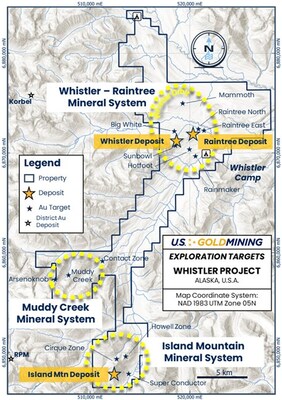
Figure 1 The Whistler Project, containing three gold ± copper ± silver mineral systems:  Whistler – Raintree, which contains the currently delineated Whistler and Raintree deposits; Island Mountain which contains the namesake gold deposit and several additional undrilled targets; and Muddy Creek which holds potential for discovery of an intrusive related gold system. (CNW Group/GoldMining Inc.)

2025 Whistler Exploration Program Details

The Company completed a scout drilling program (the "Program") in August-October 2025, of 169 shallow drillholes (ranging from 3m to 8m hole depth) over the Whistler–Raintree mineral system, or 'Whistler Orbit' – see Figure 1. The Whistler Orbit represents a classic porphyry cluster over an area of approximately 7.5 km by 4.5 km comprising multiple porphyry targets surrounding the existing Whistler and Raintree gold-copper porphyry deposits. The Program had the objective of adding geochemical pathfinder vectors to build upon geophysical modelling which indicates over 25 individual potential porphyry intrusive bodies located beneath glacial till cover in the Whistler Orbit.
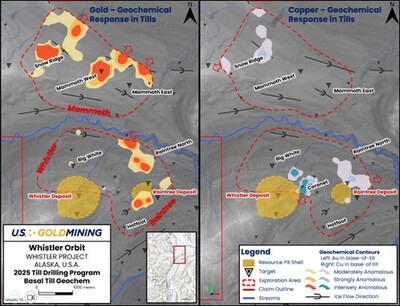
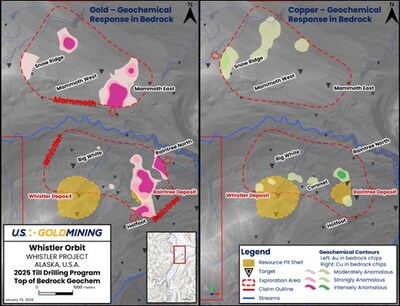
Figure 2 Top: Geochemical response in basal till samples (left: gold; right: copper). (CNW Group/GoldMining Inc.)

Figure 2 Bottom: Geochemical response in top of bedrock samples (left: gold; right: copper). (CNW Group/GoldMining Inc.)

The scout drilling program was conducted by SLR Consulting (Canada) Ltd. ("SLR"), using a helicopter portable 'Shock Auger' drilling system, which is designed to penetrate glacial till deposits to collect a sample at the base of glacial deposits (the overburden-bedrock interface). Where possible, a top-of-bedrock rock chip sample is also collected from the underlying bedrock. A pattern of evenly spaced scout drillholes was completed over exploration areas interpreted from surficial geological mapping to have shallow glacial till cover, comprised of unconsolidated gravel, sand and clay which overlies ('covers') the bedrock which is prospective for porphyry Au-Cu mineralization. The drill hole pattern was designed on a perpendicular alignment to the ancient glacial ice-flow direction, with the objective of being able to track basal-till anomalies in the 'up ice' direction towards a possible bedrock source. Two exploration areas were targeted with contiguous grids of evenly spaced scout drill holes:  the Whistler-Raintree area, and the Mammoth exploration area north of Portage Creek.

The objective of the Program was to collect geochemical data to vector towards potential undetected porphyry Au-Cu mineralization beneath the till cover, which averages 2-10 meters in thickness over 80% of the Whistler Orbit area. The Company has previously defined over 25 individual potential exploration targets within the Whistler Orbit (see news release dated May 27, 2025), each comprising a geophysical signature similar to the known Whistler deposit.

The Program was successful in collecting a basal till sample in all 169 drill holes and collected top of bedrock chips in 63% of the holes drilled, intersecting multiple occurrences of previously unmapped porphyry intrusive rocks beneath till cover. Porphyry-related geochemical anomalism is defined via a statistical process, to determine relative enrichment of Au, Cu and related pathfinder elements, above naturally occurring 'background' levels. Statistical thresholds for moderate, high, and intense geochemical anomalism were established as Robust Z-Score values of 1, 2, and 3 respectively.

Four principle Au ± Cu target areas are emerging within the Whistler Orbit area: Whistler extensions, Raintree extensions, Mammoth, and Hotfoot (see Figure 2).

Whistler wingspan target area: Scout drilling adjacent to the Whistler deposit targeted Induced Polarity ("IP") chargeability anomalies in bedrock beneath till cover located north and east of the drill delineated mineral resources (see news release dated October 7, 2024). Drilling discovered a strong to intense copper anomaly in basal till with an associated moderately anomalous bedrock response at the 'Coronet' target area, located immediately east of the Whistler deposit. This new geochemical anomaly is suggestive of the potential for additional wingspan expansion of the known Whistler deposit mineralization.

Mammoth & Snow Ridge target area: The Mammoth area of exploration interest, located 2 kilometers north of the Whistler deposit, was first detected from 2024 top-of-till geochemistry results, which showed anomalous gold values overlying a large magnetic-high feature, which in 3D inversion modelling demonstrates similar geometry to the Whistler host porphyry diorite stock i.e. a 'Whistler look-alike' magnetic anomaly. The Program comprised a broad wide-spaced scout drill grid over the magnetic anomaly and additional exploratory holes 'up-ice' of the anomalous top-of-till values in the 'Snow Ridge' area. Strong to intensely anomalous gold values were reported in both tills and top of bedrock samples over the Mammoth East & West areas. Additionally, an emerging zone of moderate to intensely anomalous gold and moderate to strong copper, in both tills and bedrock, was identified at the Snow Ridge area located 1 kilometer northwest of Mammoth. Both prospect areas require further exploration to improve delineation of the new targets, followed by deeper diamond core drilling.

Raintree target area: The Raintree area of exploration interest aimed to explore surface expressions adjacent to the Raintree West deposit, including chargeability features to the north and south of the deposit, and historically under-drilled parts of the Raintree North and Raintree East prospects. The program identified widespread copper and gold anomalies throughout the broad target area. Anomalous values overlying and surrounding the delineated Raintree deposit helps to confirm the effectiveness of the exploration methodology and in addition suggests potential for additional wingspan extensions. Broad zones of strong to intense gold in tills and bedrock, supported by moderate copper values in basal till over the Raintree North and East targets further supports additional exploration in these areas which have only been lightly drilled historically with diamond core. 

Hotfoot target area: Scout drilling was extended to the southwest of the Raintree target area to explore the emerging 'Hotfoot' target area, an underexplored magnetic feature with similar geometry (from 3D inversion modelling) to the Whistler deposit and Mammoth magnetic anomalies. The drilling returned anomalous gold-in-till down-ice of the Hotfoot target, and a large intense gold-in-bedrock anomaly directly overlying high gold values previously reported in deep diamond core drilling (WH24-05: 138.00 m at 0.99 g/t AuEq, comprised of 0.89 g/t Au, 0.05 % Cu and 17.57 g/t Ag, plus 0.44% Pb and 0.95% Zn, from 635.0 m downhole; see news release February 10, 2025), which is interpreted to represent 'D-style' porphyry veins potentially associated with an as yet unidentified nearby source porphyry. Additional infill and step out scout drilling will need to be conducted over the Hotfoot target area to better refine this target.

Overall, the 2025 scout drilling program over the Whistler Orbit returned multiple zones of highly anomalous gold ± copper in both basal till and top of bedrock sampling. These anomalies are frequently coincident with newly mapped porphyry lithologies beneath the till cover, logged from top of bedrock drill chips. Combined with the geophysical datasets, including 3D magnetic inversion modelling of porphyry stocks and dykes, and/or  IP chargeability which detects potential phyllic (quartz-sericite-pyrite) alteration zones, the scout drill method provides a robust basis for the Company to identify and prioritize diamond core drill targets for the upcoming 2026 summer field season. Additional information on the future planned diamond core drilling program and budget will be released in the coming months.

Technical Information

For further information regarding the Project and the mineral resource estimates referenced herein, refer to the technical report summary titled "S-K 1300 Technical Report Summary Initial Assessment for the Whistler Project, South Central Alaska" with an effective date of September 12, 2024, and the technical report titled "NI 43-101 2024 Updated Mineral Resource Estimate for the Whistler Project, South Central Alaska" with an effective date of September 12, 2024, available under the Company's respective profiles at www.sec.gov and www.sedarplus.ca.

Tim Smith, P.Geo., Chief Executive Officer of U.S. GoldMining, has supervised the preparation of this news release and has reviewed and approved the scientific and technical information contained herein. Mr. Smith is a "qualified person" as defined in Canadian National Instrument 43-101 – Standards of Disclosure for Mineral Projects.

About U.S. GoldMining Inc.

U.S. GoldMining Inc. is an exploration and development company focused on advancing the 100% owned Whistler Gold-Copper Project, located 105 miles (170 kilometers) northwest of Anchorage, Alaska, U.S.A. The Whistler Project consists of several gold-copper porphyry deposits and exploration targets within a large regional land package entirely on State of Alaska Mining claims totaling approximately 53,700 acres (217.5 square kilometers). The Whistler Project Mineral Resource Estimate comprises 294 Mt at 0.68 g/t AuEq for 6.48 Moz AuEq Indicated, plus 198 Mt at 0.65 g/t AuEq for 4.16 Moz AuEq Inferred.

Visit www.usgoldmining.us for more information, including high resolution figures.

Forward-Looking Statements

Except for the statements of historical fact contained herein, the information presented in this news release constitutes "forward-looking statements" within the meaning of the United States federal securities laws and "forward-looking information" within the meaning of applicable Canadian securities laws (collectively, "forward-looking statements"). Such statements include statements with regard to the Company's expectations regarding the Project, its planned exploration programs and PEA and the Project's exploration potential. Words such as "expects", "anticipates", "plans", estimates" and "intends" or similar expressions are intended to identify forward-looking statements. Forward-looking statements are based on U.S. GoldMining's current expectations and are subject to inherent uncertainties, risks and assumptions that are difficult to predict and involve known and unknown risks, uncertainties and other factors, which may cause the actual results, performance or achievements of the Company to be materially different from any future results, performance or achievements expressed or implied by such forward-looking statements. Such risks and other factors include, among others, the actual results of future exploration may not confirm expectations, variations in the underlying assumptions associated with the estimation or realization of mineral resources, the availability of capital to fund programs, accidents, labor disputes and other risks of the mining industry including, without limitation, those associated with the environment, delays in obtaining governmental approvals or permits, title disputes other risks inherent in the exploration and development of mineral properties and the other risk factors set forth in the Company's filings with the U.S. Securities and Exchange Commission at.www.sec.gov and Canadian Securities Administrators at www.sedarplus.ca. Although the Company has attempted to identify important factors that could cause actual actions, events or results to differ materially from those described in forward-looking statements, there may be other factors that cause actions, events or results not to be as anticipated, estimated or intended. Accordingly, readers should not place undue reliance on forward-looking statements contained in this news release. Forward-looking statements contained in this news release are made as of this date, and U.S. GoldMining does not undertake any duty to update such information except as required under applicable law.

Cision View original content to download multimedia:https://www.prnewswire.com/news-releases/us-goldmining-identifies-new-au-cu-porphyry-targets-from-2025-exploration-program-at-the-whistler-gold-copper-project-alaska-302664938.html

SOURCE GoldMining Inc.

FAQ

What did U.S. GoldMining (GLDG) find in the 2025 Whistler scout drilling program?

The program collected basal till in all 169 holes and top‑of‑bedrock chips in 63% of holes, identifying four high‑priority Au±Cu target areas: Whistler extensions, Mammoth & Snow Ridge, Raintree, and Hotfoot.

When will GLDG start deeper diamond core drilling at Whistler?

The company projects follow‑up infill and deeper diamond core drilling to commence in summer 2026.

How extensive was the 2025 Whistler exploration area for GLDG?

The Whistler Orbit porphyry cluster covers approximately 7.5 km by 4.5 km with over 25 modeled potential intrusive targets beneath till cover.

Did the 2025 program return any notable historical deep intercepts near new targets?

Yes — referenced deep intercept WH24‑05: 138.00 m at 0.99 g/t AuEq, indicating nearby porphyry‑style mineralization potential.

When will GLDG release the Whistler project PEA results?

The company is aiming to release the initial PEA results before the end of Q1 2026.

What drilling method was used for the 2025 GLDG scout program and why?

A helicopter‑portable 'Shock Auger' system was used to penetrate glacial till and collect basal‑till and top‑of‑bedrock samples to vector toward concealed porphyry sources.
Goldmining

NYSE:GLDG

GLDG Rankings

GLDG Latest News

GLDG Latest SEC Filings

GLDG Stock Data

350.33M
199.88M
5.04%
8.39%
0.75%
Gold
Basic Materials
Link
Canada
Vancouver
