ESS Introduces Bridge™, a Modular Sodium-Ion Battery Energy Storage System for Grid-Scale, Data Center, and Commercial Applications
ESS Introduces Bridge™, a Modular Sodium-Ion Battery Energy Storage System for Grid-Scale, Data Center, and Commercial Applications
ESS (NYSE:GWH) launched Bridge™, a modular 1.2 MWh AC sodium-ion battery energy storage system for utilities, AI data centers, critical infrastructure and commercial users.
New Non-Lithium Platform Expands ESS Technology Portfolio, Addressable Market for U.S.-Based Company
WILSONVILLE, Ore.--(BUSINESS WIRE)--
ESS Tech, Inc. (NYSE: GWH) (“ESS” or the “company”), a leading provider of non-lithium energy storage solutions, today announced the launch of the ESS Bridge™, a modular sodium-ion battery energy storage system (BESS) designed for utilities, AI-driven data centers, critical infrastructure operators, and commercial and industrial customers seeking superior alternatives to conventional lithium-ion technologies.
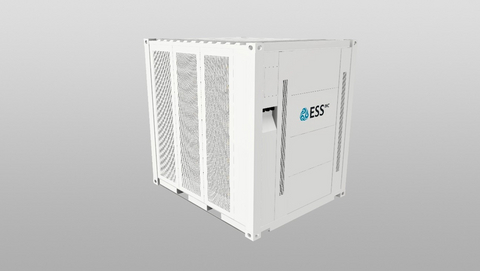
Illustrative Rendering of ESS’ Stackable 1.2 MWh Bridge™ AC Sodium-Ion Battery System
The introduction of Bridge marks a significant milestone in ESS's strategy to become a leading provider of U.S.-made, non-lithium energy storage solutions spanning short-, medium-, and long-duration applications.
The Bridge name reflects the platform’s role in connecting energy generation and consumption while bridging the gap between today's energy needs and a more secure and resilient energy future.
The release follows ESS's recent news that it has generated more than $1 billion in early-stage customer opportunities since announcing its sodium-ion market entry, reflecting growing demand for safer energy storage technologies that can meet the power needs of AI data centers and other critical infrastructure.
"Bridge is how we meet the demand we're already seeing," said Drew Buckley, CEO of ESS. "AI workloads are reshaping what data centers need from energy storage, and sodium-ion handles those power needs more effectively than conventional technologies. Bridge is built to deliver that, which is why we've generated nearly a billion dollars in early-stage opportunity since entering sodium-ion."
Bridge is a 1.2 MWh building-block AC battery system that combines advanced sodium-ion technology with ESS's expertise in system integration, controls, energy management, and project execution. With the solution, ESS provides complete system integration, including battery cells, modules, racking, power conversion, cabling, and battery management system (BMS) hardware and software in a 10-foot container. ESS is also providing an energy management system (EMS) to enable plant-level monitoring, optimization, and control.
The plug-and-play unit simplifies logistics, can be installed with a heavy-duty forklift and can operate in myriad environments with simple air cooling. The modular blocks are stackable, delivering up to 4.8 MWh of storage capacity in the same footprint as a traditional 20-foot battery container, maximizing site utilization. The building block system scales easily to support both commercial and large, utility-scale applications.
Unlike conventional lithium-ion systems, Bridge is designed to eliminate the risk of fire from thermal runaway and requires nocomplex HVAC or liquid coolingsystems, reducing operational complexity, maintenance requirements, and total cost of ownership. It is capable of a wide range of charge and discharge profiles, from 1 to 16 hours or more depending on configuration.
Engineered for demanding environments, Bridge is designed to reliably provide power in environments from -40° C to 50°Cwith a 20-year operating design life, helping owners avoid costly battery replacement and risky augmentation cycles.
Built around abundant, widely available materials, Bridge is designed to leverage an emerging alternative supply chain to conventional lithium-ion batteries, reducing exposure to constrained critical minerals and geopolitical sourcing risks. The solution supports the development of a future domestic energy storage supply chain while helping customers manage exposure to Foreign Entities of Concern (FEOC).
"Today’s battery asset owners are looking for solutions that improve upon the conventional model," said Randall Selesky, Chief Commercial Officer, ESS. "They want systems that improve safety, simplify operations, provide flexibility and support long-term energy security objectives. Bridge is designed to deliver those benefits in a single platform."
Forward-Looking Statements
This communication contains forward-looking statements (including within the meaning of Section 21E of the Securities Exchange Act of 1934, as amended, and Section 27A of the Securities Act of 1933, as amended) concerning the company and other matters that involve substantial risks and uncertainties. These statements may discuss the management team’s goals, beliefs, hopes, intentions and expectations as to future plans, trends, events, results of operations and financial condition, or otherwise, based on current beliefs of the management of the company, as well as assumptions made by, and information currently available to, the company’s management. These forward-looking statements can be identified by the use of forward-looking terminology, including the words “anticipate,” “believe,” “continue,” “could,” “estimate,” “expect,” “intends,” “may,” “might,” “plan,” “possible,” “potential,” “predict,” “project,” “should,” “will,” “would,” or, in each case, their negative or other variations or comparable terminology may identify forward-looking statements, but the absence of these words does not mean that a statement is not forward-looking. These forward-looking statements, which are subject to risks, uncertainties and assumptions about us, may include our anticipated growth strategies and anticipated trends in our business. Examples of forward-looking statements include, among others, ESS’ plans for its business, ESS’ potential opportunities that approach $1 billion for sodium-ion product, the demand for non-lithium and domestic battery solutions, the timeline for ESS’ development of the Bridge product, power demands and energy storage, domestic supply chain availability, statements by ESS’ CEO, and ESS’ ability to grow and our ability to meet the growing demand for energy storage. These forward-looking statements are based on ESS’ current expectations and beliefs concerning future developments and their potential effects on ESS. Many factors could cause actual future events to differ materially from the forward-looking statements in this communication. There can be no assurance that the future developments affecting ESS will be those that we have anticipated. These forward-looking statements involve a number of risks, uncertainties (some of which are beyond ESS control) or other assumptions that may cause actual results or performance to be materially different from those expressed or implied by these forward-looking statements, which include, but are not limited to, the demand for our Bridge product not developing as anticipated; our ability to realize and capitalize on sodium-ion opportunities; delays in the development of the Bridge product; our ability to expand our portfolio; our products being in the early stage of commercialization and aspects of our technology not having been fully field tested; our inability to develop our business and effectively commercialize our energy storage products; our dependence on third-party suppliers; our ability to secure or maintain long-term supply relationships with critical suppliers; our ability to secure or maintain a domestic supply chain; our ability to secure binding orders; failure to deliver the benefits offered by our technology; inability to achieve market acceptance of our products; our ability to sell effectively to large customers; failure to accurately estimate future supply and demand for our products and services; expansions into new markets, product lines or services; and our ability to raise capital in the near future and other risks and uncertainties described more fully in Exhibit 99.2 of the Current Report on Form 8-K filed by the Company on June 23, 2026 and the Company's other filings with the U.S. Securities and Exchange Commission. Except as required by law, ESS is not undertaking any obligation to update or revise any forward-looking statements whether as a result of new information, future events or otherwise.
A battery energy storage system is a device that stores electricity for later use, much like a rechargeable battery for a phone or laptop. It allows energy generated during times of low demand or from renewable sources to be saved and released when needed, helping to balance supply and demand. For investors, it represents a way to support reliable energy flow and capitalize on the increasing demand for flexible, clean power solutions.
besstechnical
BESS stands for Battery Energy Storage System, a technology that stores electricity for later use. Think of it as a large rechargeable battery that can hold excess power generated during times of low demand and release it when usage is high, helping balance supply and demand. This is important for investors because it supports the stability of energy grids, enables the integration of renewable sources, and can create new opportunities for profitability in the energy market.
battery management systemtechnical
A battery management system (BMS) is the electronic control unit that monitors and regulates a rechargeable battery pack’s health, charge level, temperature and balance between cells to keep it safe and working efficiently. Think of it as a traffic manager and thermostat for a battery: it prevents overcharging, overheating and uneven wear, estimates remaining range or runtime, and communicates status to the device. Investors care because a strong BMS improves product safety, lifespan, performance, regulatory compliance and can reduce warranty costs and reputational risk, all of which affect a company’s costs and competitive position.
energy management systemtechnical
An energy management system is a technology that monitors, controls, and optimizes how energy is used within a building or facility. Think of it as a smart thermostat that helps save energy and reduce costs by making sure electricity, heating, and cooling are used efficiently. For investors, it matters because it can lower expenses, improve sustainability, and support long-term value in organizations focused on energy efficiency.
thermal runawaytechnical
Thermal runaway is an uncontrolled, accelerating rise in temperature inside batteries, chemical systems, or equipment where heat being produced exceeds the system’s ability to shed it, often leading to fire, explosion, or permanent damage. Investors care because it creates safety recalls, regulatory scrutiny, liability and production stoppages that can sharply hurt a company’s finances and reputation — like a small spark that rapidly becomes a larger, costly disaster.
foreign entities of concernregulatory
Foreign entities of concern are companies, organizations, or government-linked bodies located outside a country that regulators have flagged as posing national security, economic, or supply-chain risks. Think of them like parties placed on an official watchlist that can face export controls, sanctions, investment limits, or reporting requirements; such designations can affect trading, ownership, contracts, and disclosure for investors and counterparties.