
The Hackett Group® Establishes AI World Class Information Technology Benchmarks
The benchmarks span 16 end-to-end business processes and establish future-state performance standards.
Sentiment and the balance of points
Rhea-AI Sentiment reads the wording of the document, how positive or negative its language is on a 1 to 5 scale. The balance of points shown with the takes weighs what the document actually discloses, so the two can disagree, for example when a trial that missed its main goal is described in upbeat language.




New research shows AI World Class technology organizations reduce IT process costs by
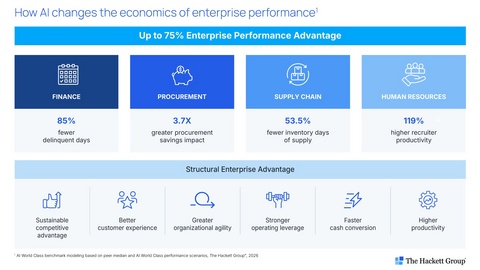
How AI value compounds across the enterprise: AI World Class organizations fund AI investment by reducing technical debt, rationalizing applications and modernizing operating models. By reducing that burden, technology leaders create capacity to invest. That same discipline improves the economics of the technology function, reducing IT process costs by
The research reveals that a
“CIOs face a paradox: AI requires greater investment while the business expects lower costs with higher performance,” said Michael Fuller, principal, The Hackett Group®. “Leaders are creating capacity for AI by simplifying technology, reducing technical debt and redesigning operating models, then directing that capacity to the investments with the greatest return.”
The results are significant. AI World Class technology organizations reduce information technology (IT) process costs by
The findings also demonstrate how the benefits of disciplined AI investment compound across business functions. Benchmark modeling identified opportunities for organizations to achieve
Rather than pursuing isolated use cases, AI World Class organizations start with the business outcome. They identify the enterprise priorities with the greatest potential impact, then manage AI as an enterprise investment portfolio, continuously identifying, prioritizing, and scaling initiatives that deliver measurable business outcomes. By directing investments to the highest-value opportunities, they maximize enterprise return and accelerate performance improvement.
“The CIO’s role is rapidly expanding from managing technology performance to enabling enterprise performance," said Kyle Robichaud, principal, The Hackett Group®. “CIOs must help determine where AI can create the greatest value and build capabilities to scale it securely and efficiently. Those that consistently identify and scale high-return AI investments will create a lasting competitive advantage.”
Spanning 16 end-to-end business processes, AI World Class benchmarks quantify where AI-enabled transformation can create the greatest value and establish future-state performance standards for organizations seeking to improve both technology and enterprise performance. The AI World Class benchmark methodology draws on more than three decades of benchmarking data, process intelligence and transformation experience with
The full research paper, “Close the Enterprise AI Performance Gap: How Disciplined AI Investment Changes the Economics of Enterprise Performance,” is available for complimentary download.
About The Hackett Group®
The Hackett Group, Inc. (NASDAQ: HCKT) is an ROI-led, AI enterprise transformation firm that helps clients enable AI World Class performance. Its experts and engineers leverage Hackett AI platforms, including XT™, AIXelerator™, Hackett AI XPLR™, ZBrain® and XDA™, to accelerate and enhance the delivery of the company’s solutions and services.
The Hackett AI platforms are powered by the company’s domain-specific Solution Language Model informed by Hackett Process and Performance Intelligence, including Digital World Class® and AI World Class benchmark metrics, industry-specific best-practice process flows and service delivery model frameworks. The Hackett Group’s proprietary insights are based on benchmarking results from leading global organizations, including
Trademarks
The Hackett Group®, quadrant logo, ZBrain® and Digital World Class® are the registered marks of The Hackett Group®.
Cautionary Statement Regarding “Forward-Looking” Statements
This release contains “forward-looking” statements within the meaning of Section 27A of the Securities Act of 1933 as amended and Section 21E of the Securities Exchange Act of 1934, as amended. Statements including without limitation, words such as “expects,” “anticipates,” “intends,” “plans,” “believes,” “seeks,” “estimates,” or other similar phrases or variations of such words or similar expressions indicating, present or future anticipated or expected occurrences or outcomes are intended to identify such forward-looking statements. Forward-looking statements are not statements of historical fact and involve known and unknown risks, uncertainties and other factors that may cause the Company’s actual results, performance or achievements to be materially different from the results, performance or achievements expressed or implied by the forward-looking statements. Factors that may impact such forward-looking statements include without limitation, the ability of The Hackett Group® to effectively market its digital transformation services, our ability to transition our capabilities to support generative artificial intelligence (AI)-related consulting services and solutions and other consulting services, our ability to effectively integrate acquisitions into our operations, our ability to manage joint ventures and successfully cooperate with our joint venture partners, competition from other consulting and technology companies that may have or develop in the future, similar offerings, the commercial viability of The Hackett Group® and its services as well as other risk detailed in The Hackett Group’s reports filed with the United States Securities and Exchange Commission. The Hackett Group® does not undertake any duty to update this release or any forward-looking statements contained herein.
View source version on businesswire.com: https://www.businesswire.com/news/home/20261006987338/en/
Source: The Hackett Group, Inc.