
STOCK TITAN

The Hackett Group®: HR Leaders Ramp Up AI Investment as Pressure to Evolve Intensifies

(Moderate)
(Neutral)
Tags
AI

Key Terms

gen ai technical
Software that uses learned patterns from large amounts of data to produce new content — such as text, images, code or audio — on demand, much like a virtual assistant that composes original work when given a prompt. Investors care because it can rapidly lower costs, create new products and revenue streams, and change competitive dynamics across industries, while also introducing risks around accuracy, regulation and intellectual property.
ai-powered technical
"AI-powered" describes technology that uses artificial intelligence to perform tasks, make decisions, or analyze information automatically. It’s similar to having a highly skilled assistant that can learn from data, recognize patterns, and improve over time, helping to make processes faster and more accurate. For investors, this means better insights and more efficient operations, potentially leading to smarter investment choices.
return on investment (roi) financial
Return on investment (ROI) measures how much money you gain or lose compared with what you originally put in, usually shown as a percentage. Investors use it to compare the efficiency of different investments—like checking miles per gallon when choosing a car—so you can see which option gives the biggest payoff for each dollar, helping weigh potential reward against cost and risk.
data privacy regulatory
Data privacy is the practice of protecting people’s personal and sensitive information—like names, health details, financial records, or browsing habits—from unauthorized access or misuse. For investors, strong data privacy is like good locks and alarms on a business: it preserves customer trust and revenue, reduces the risk of fines and lawsuits, and lowers the chance of costly breaches that can hurt a company’s reputation and stock value.
regulatory compliance regulatory
Regulatory compliance is the process of ensuring that a company follows all applicable laws, rules, and standards set by government authorities or industry bodies. It is important to investors because it helps prevent legal penalties, financial losses, and reputational damage, contributing to the overall stability and trustworthiness of a business. Think of it as following the rules of a game to play fairly and avoid penalties.
operating model technical
An operating model is the way a company organizes and manages its resources, processes, and activities to deliver its products or services. It acts like a blueprint that shows how different parts of the business work together to create value. For investors, understanding a company's operating model helps assess how efficiently it operates and how well it can adapt to change or grow over time.
time-to-fill technical
Time-to-fill is the average number of days it takes a company to fill a job opening from the moment the need is approved or posted until an offer is accepted and the role is filled. Investors watch this metric because a short time-to-fill suggests the company can staff projects and grow quickly with lower recruiting costs, while a long time-to-fill can slow execution, raise costs, and signal trouble attracting talent — like how quickly a household replaces a broken appliance affects how smoothly daily life runs.
workforce planning technical
Workforce planning is the process a company uses to make sure it has the right number of people with the right skills in the right roles now and in the future, by aligning hiring, training, redeployment and separations with its business needs — like planning staffing for a growing neighborhood so services keep up. Investors care because workforce planning influences labor costs, productivity and the company’s ability to execute strategy and adapt to change; strong planning can boost profitability and reduce operational risk, while poor planning can lead to unexpected expenses or missed growth opportunities.
See more from StockTitan in Google Search and AI answers. Adds StockTitan as a preferred source · opens Google
Add on Google

2026 Key Issues Study reveals a gap between ambition and execution – and a clear path to realizing AI’s full potential in HR
MIAMI--(BUSINESS WIRE)-- The Hackett Group, Inc. (NASDAQ: HCKT), a leading Gen AI consultancy and enterprise digital transformation firm, today announced findings from its 2026 Human Resources Key Issues Study. The research shows that human resources (HR) leaders broadly recognize the need to transform, but execution remains uneven – creating a widening disconnect between strategic priorities and day-to-day activities as workforce demands intensify.

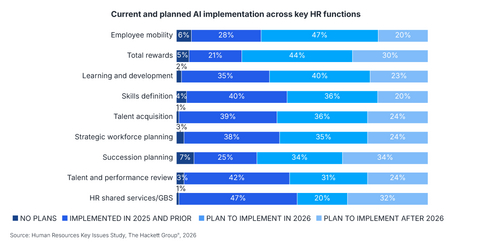
The 2026 Key Issues Study found that while AI adoption in HR is advancing, organizations are still looking to gain traction in many capabilities. By the close of 2026, AI adoption in HR was projected to reach 47% in shared services and 42% in talent and performance review – demonstrating its role in streamlining transactions, enhancing evaluations, reducing bias and aligning performance with strategic goals. On the other hand, capabilities such as skill definition and strategic workforce planning remain underdeveloped.

The 2026 Key Issues Study found that while AI adoption in HR is advancing, organizations are still looking to gain traction in many capabilities. By the close of 2026, AI adoption in HR was projected to reach 47% in shared services and 42% in talent and performance review – demonstrating its role in streamlining transactions, enhancing evaluations, reducing bias and aligning performance with strategic goals. On the other hand, capabilities such as skill definition and strategic workforce planning remain underdeveloped.

The numbers tell a clear story: HR workloads are expected to rise 9% in 2026, yet staffing levels remain flat and operating budgets will edge up just 1%. Despite these constraints, 83% of organizations expect more from HR. A 9% surge in technology investment reflects an intentional pivot – yet without operational model change, technology alone will not deliver the required impact.

From awareness to action: The execution gap

The research surfaces a consistent pattern with strong strategic intent but limited follow-through:

  • 84% of HR leaders emphasize flexibility and skills fluidity, yet 61% have not implemented plans to redesign their work models
  • 78% acknowledge resilience as critical, but 49% lack a defined resilience strategy
  • 81% recognize the value of intelligent technology, yet 59% lack a clear implementation road map – leaving HR focused more on maintaining systems than transforming how work gets done

“Leaders are clear on the priorities – greater flexibility, stronger resilience and smarter use of technology,” said Amanda Newfield, global HR Applied Intelligence program leader at The Hackett Group®. “What’s holding many back is the growing gap between aspiration and capability. The organizations that will lead are those willing to reimagine how work gets done, not just adding new tools to legacy processes.”

AI gains momentum in HR – but adoption remains uneven

AI adoption in HR is accelerating, particularly in transactional and talent-focused domains. By the close of 2026, adoption is projected to reach 47% in HR shared services and 42% in talent and performance management. Employee mobility is quickly rising as a strategic priority, with AI adoption expected to nearly double from 28% to 47%. These gains signal growing recognition that AI can streamline transactions, reduce bias and better align performance with business goals. Yet more strategic capabilities – including skills architecture and workforce planning – remain underdeveloped, limiting HR’s ability to unlock full enterprise value.

The Hackett Group® Innovation Award winners demonstrate what is possible when organizations move beyond incremental adoption: Johnson & Johnson's AI-powered employee engagement platform has delivered 200%+ return on investment (ROI), while Intermountain Health's Gen AI-driven talent acquisition redesign reduced time-to-fill from 65 to 35 days and generated cost savings exceeding 2,000%.

Overcoming barriers to unlocking AI’s full value

Realizing AI’s potential in HR requires confronting the obstacles that most often stall progress. Leaders cite data quality concerns (48%), workforce change management challenges (44%), data privacy and regulatory compliance (42%), limited AI talent (42%), and insufficient executive sponsorship (38%) as the primary barriers to value realization.

The study, however, makes clear that these challenges are manageable. Organizations that take targeted, disciplined action – rather than attempting sweeping, simultaneous overhauls – are more likely to move from experimentation to measurable impact.

To accelerate progress, the study outlines three strategic mandates for HR leaders:

  1. Design workplaces without borders that enable talent mobility, skills fluidity, and seamless collaboration across job, organization, and geographic boundaries.
  2. Build a resilient, AI-infused workforce through continuous reskilling and capability development.
  3. Elevate HR as a catalyst for workforce transformation by reimaging the HR operating model while also unifying HR data and embedding intelligent technologies that simplify work, orchestrate workflows, and strengthen enterprise decision intelligence.

“The real impact of AI in HR is when it reshapes how work is structured and decisions are made,” said Meena Singh, senior research manager at The Hackett Group®. “Now is the moment for HR to reimagine its operating model – strengthening data, governance and digital capabilities to keep pace with rising organizational expectations.”

Download The Hackett Group® 2026 HR Key Issues Study.

About The Hackett Group®

The Hackett Group, Inc. (NASDAQ: HCKT) is a Gen AI strategic consulting and digital transformation firm that enables Digital World Class® performance. Using Hackett AI XPLR™, ZBrain™, XT™, AIXelerator™, AskHackett™, and Quantum Leap® platforms, the company’s experienced professionals and engineers help organizations realize the power of Gen AI from ideation through implementation to achieve quantifiable, breakthrough results with unprecedented speed, allowing it to be key architects of their Gen AI journey. The company’s expertise is grounded in unparalleled best practices insights from enterprise performance benchmarks from the world’s leading businesses – including 97% of the Dow Jones Industrials, 90% of the Fortune 100, 68% of the DAX 40 and 53% of the FTSE 100. Visit us at www.thehackettgroup.com.

Trademarks

The Hackett Group®, quadrant logo, and Digital World Class® are the registered marks of The Hackett Group®.

Cautionary Statement Regarding “Forward-Looking” Statements

This release contains “forward-looking” statements within the meaning of Section 27A of the Securities Act of 1933 as amended and Section 21E of the Securities Exchange Act of 1934, as amended. Statements including without limitation, words such as “expects,” “anticipates,” “intends,” “plans,” “believes,” “seeks,” “estimates,” or other similar phrases or variations of such words or similar expressions indicating, present or future anticipated or expected occurrences or outcomes are intended to identify such forward-looking statements. Forward-looking statements are not statements of historical fact and involve known and unknown risks, uncertainties and other factors that may cause the Company’s actual results, performance or achievements to be materially different from the results, performance or achievements expressed or implied by the forward-looking statements. Factors that may impact such forward-looking statements include without limitation, the ability of The Hackett Group® to effectively market its digital transformation, our ability to transition our capabilities to support generative artificial intelligence (AI)-related consulting services and solutions and other consulting services, our ability to effectively integrate acquisitions into our operations, our ability to manage joint ventures and successfully cooperate with our joint venture partners, competition from other consulting and technology companies that may have or develop in the future, similar offerings, the commercial viability of The Hackett Group® and its services as well as other risk detailed in The Hackett Group’s reports filed with the United States Securities and Exchange Commission. The Hackett Group® does not undertake any duty to update this release or any forward-looking statements contained herein.

media@thehackettgroup.com

Source: The Hackett Group
