
Supermicro Now Shipping NVIDIA Vera Rubin NVL72 Racks
Supermicro begins shipping fully integrated, liquid-cooled NVIDIA Vera Rubin NVL72 racks and scalable blueprints from 5 MW to gigawatt AI clusters.
Rhea-AI Summary
Supermicro (SMCI) is now shipping NVIDIA Vera Rubin NVL72 racks integrated with its Data Center Building Block Solutions (DCBBS) and DLC-2 liquid-cooling stack.
Each NVL72 rack combines 72 NVIDIA Rubin GPUs and 36 NVIDIA Vera CPUs in a single liquid‑cooled machine, offering 20.7 TB of HBM4 and up to 54 TB of LPDDR5X memory. Supermicro’s DCBBS Blueprints define balanced deployments from 5 MW to gigawatt scale, with a Scalable Unit delivering 1,152 Rubin GPUs and 331 TB of HBM4 across 16 compute racks, plus integrated cooling, power, storage, and networking.
Positive
- None.
Negative
- None.
Key Figures
- GPUs per rack
- 72 GPUs
- NVIDIA Vera Rubin NVL72 liquid-cooled rack
- CPUs per rack
- 36 CPUs
- NVIDIA Vera Rubin NVL72 liquid-cooled rack
- Scale-up bandwidth
- 216 TB/s
- NVIDIA NVLink switch trays per rack
- HBM4 memory per rack
- 20.7 TB
- NVIDIA Vera Rubin NVL72 rack
- LPDDR5X memory per rack
- up to 54 TB
- NVIDIA Vera Rubin NVL72 rack
- CDU rating
- 1.8 MW per CDU
- Supermicro in-row cooling distribution units
- GPUs per Scalable Unit
- 1,152 GPUs
- DCBBS Blueprint across 16 compute racks
- HBM4 memory per Scalable Unit
- 331 TB
- DCBBS Blueprint across 16 compute racks
Previous AI Reports
-
Expanded DCBBS AI rack portfolio across configurations and reported capacity of 3,000 racks monthly.
-
Expanded DCBBS rear-door heat-exchanger portfolio with cooling capacity up to 240 kW per rack.
24h Move is the share-price change in the day after each event; other market factors may also have contributed.
Key Terms
direct liquid cooling technical
cooling distribution units technical
lpddr5x technical
n+1 redundancy technical
AI-generated analysis. How Rhea-AI works. Not financial advice.




- Supermicro's DCBBS now supports all critical computing infrastructure to speed time-to-online for NVIDIA Vera Rubin NVL72 deployments
- Full liquid-cooling stack optimized for the NVIDIA Vera Rubin platform, from cold plates to CDUs, to cooling towers
- From a power envelope to an operational cluster: DCBBS Blueprints define a balanced bill-of-materials from 5 MW to gigawatt scale, with 1,152 GPUs and 331 TB of HBM4 per Scalable Unit
- One accountable team across site survey, project design, integration, L11 and L12 testing, on-site deployment, and ongoing support
"We have spent years building the liquid-cooling stack, the manufacturing capacity, and the deployment teams for exactly this moment," said Charles Liang, president and CEO, Supermicro. "Our customers can now order a Scalable Unit and receive production-ready systems with end-to-end integration, because we design and build every layer between the cold plate and the cooling tower. Our development of DLC-2 technology is what sets Supermicro apart and allows us to deliver the most complete solution for the NVIDIA Vera Rubin platform."
Learn more about Supermicro's NVIDIA Vera Rubin NVL72 racks.
The NVIDIA Vera Rubin platform was designed in conjunction with direct liquid cooling technology to deliver AI-throughput-per-watt at efficiency levels unachievable with air cooling alone. With far greater AI operations per second comes a greater heat load: heat must be moved through the full fluid distribution loop, from the cold plates through manifolds, to the cooling tower. Supermicro tests and validates every rack with the full liquid cooling stack, speeding up time-to-online when deployed.
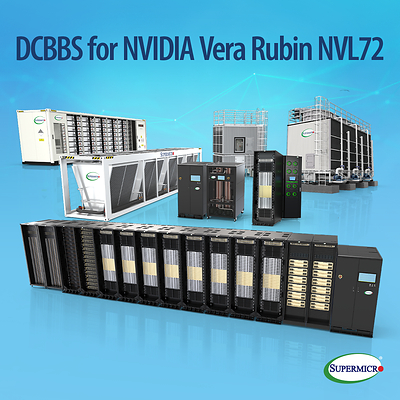
Supermicro's path-to-production spans from the mechanical engineering of individual system nodes, the large-scale manufacturing of liquid-cooled racks, to the full onsite deployment of clusters based on NVIDIA reference architecture. Supermicro's DCBBS provides unmatched thermal expertise and a comprehensive in-house portfolio of liquid cooling components. Cold plates, manifolds, hose kits, rack power shelves, in-row cooling distribution units (CDUs), in-rack CDUs, Liquid-to-Air sidecar CDUs, rear door heat exchangers, and facility-side cooling towers all come from the same portfolio.
Supermicro's DCBBS Solutions for NVIDIA Vera Rubin NVL72 include:
- NVIDIA Vera Rubin NVL72 racks. 72 NVIDIA Rubin GPUs and 36 NVIDIA Vera CPUs in a single liquid-cooled rack operating as one machine; Eighteen 1U compute trays, each with four Rubin GPUs and two Vera CPUs, connect through nine sixth-generation NVIDIA NVLink switch trays delivering 216 TB/s of scale-up bandwidth; Each rack provides 20.7 TB of HBM4 memory and up to 54 TB of LPDDR5X
- Supermicro in-row cooling distribution units, rated at 1.8MW per CDU, deployed with N+1 redundancy
- Optional Supermicro Rear Door Heat Exchangers ensure capture of residual heat load
- Networking integration and cabling services based on NVIDIA Reference Architecture, including the AI compute fabric, converged fabric, and out-of-band management cabling
To ease deployment of NVIDIA Vera Rubin NVL72 racks, Supermicro's DCBBS Blueprint defines a balanced bill-of-materials for a given power envelope, from 5 MW to gigawatt scale. The DCBBS Blueprint based on one Vera Rubin NVL72 Scalable Unit provides 1,152 NVIDIA Rubin GPUs with 331 TB of HBM4 memory across 16 compute racks, with balanced cooling capacity, power delivery, high-performance storage, context memory storage, and networking. A Supermicro team manages the project across site survey, design, integration, testing, delivery, deployment, and ongoing support.
Explore here to learn how DCBBS can help build and scale your next-generation AI infrastructure.
About Super Micro Computer, Inc.
Supermicro (NASDAQ: SMCI) is a global leader in Application-Optimized Total IT Solutions. Founded and operating in San Jose, California, Supermicro is committed to delivering first-to-market innovation for Enterprise, Cloud, AI, and 5G Telco/Edge IT Infrastructure. We are a Total IT Solutions provider with server, AI, storage, IoT, switch systems, software, and support services. Supermicro's motherboard, power, and chassis design expertise further enables our development and production, enabling next-generation innovation from cloud to edge for our global customers. Our products are designed and manufactured in-house (in the US, Taiwan, and the Netherlands), leveraging global operations for scale and efficiency and optimized to improve TCO and reduce environmental impact (Green Computing). The award-winning portfolio of Server Building Block Solutions® allows customers to optimize for their exact workload and application by selecting from a broad family of systems built from our flexible and reusable building blocks that support a comprehensive set of form factors, processors, memory, GPUs, storage, networking, power, and cooling solutions (air-conditioned, free air cooling or liquid cooling).
Supermicro, Server Building Block Solutions, and We Keep IT Green are trademarks and/or registered trademarks of Super Micro Computer, Inc.
All other brands, names, and trademarks are the property of their respective owners.

 View original content to download multimedia:https://www.prnewswire.com/news-releases/supermicro-now-shipping-nvidia-vera-rubin-nvl72-racks-302886839.html
SOURCE Super Micro Computer, Inc.
FAQ
AI-generated questions and answers. How Rhea-AI works. Not financial advice.
What liquid-cooling components are included in Supermicro’s stack for NVIDIA Vera Rubin NVL72 racks?
The liquid-cooling stack includes cold plates, manifolds, hose kits, rack power shelves, in-row cooling distribution units (CDUs), in-rack CDUs, Liquid-to-Air sidecar CDUs, rear door heat exchangers, and facility-side cooling towers, all from Supermicro’s in-house portfolio.
What performance and memory configuration does each NVIDIA Vera Rubin NVL72 rack provide?
Each rack contains 72 NVIDIA Rubin GPUs and 36 NVIDIA Vera CPUs in eighteen 1U compute trays, connected through nine sixth-generation NVIDIA NVLink switch trays that deliver 216 TB/s of scale-up bandwidth. It offers 20.7 TB of HBM4 memory and up to 54 TB of LPDDR5X.
How does the DCBBS Blueprint scale NVIDIA Vera Rubin NVL72 deployments?
The DCBBS Blueprint defines a balanced bill-of-materials for power envelopes from 5 MW to gigawatt scale. A Blueprint based on one Vera Rubin NVL72 Scalable Unit provides 1,152 NVIDIA Rubin GPUs and 331 TB of HBM4 memory across 16 compute racks, with matching cooling capacity, power delivery, high-performance storage, context memory storage, and networking.
What role do Supermicro’s cooling distribution units play in these deployments?
Supermicro in-row cooling distribution units are rated at 1.8 MW per CDU and can be deployed with N+1 redundancy. Optional Supermicro rear door heat exchangers are available to capture residual heat load.
What services does Supermicro provide around NVIDIA Vera Rubin NVL72 rack deployment?
Supermicro manages projects across site survey, design, integration, L11 and L12 testing, delivery, on-site deployment, and ongoing support. It also offers networking integration and cabling services based on NVIDIA reference architecture, covering AI compute fabric, converged fabric, and out-of-band management cabling.