
HII Introduces Distributed Maritime Operations Framework in Support of U.S. Navy’s “Hedge Strategy”
HII (NYSE: HII) unveiled a distributed maritime operations framework on April 17, 2026, integrating manned warships, autonomous systems, containerized payloads, and open-architecture mission tech to support the U.S. Navy’s Hedge Strategy.
Rhea-AI Summary
HII (NYSE: HII) unveiled a distributed maritime operations framework on April 17, 2026, integrating manned warships, autonomous systems, containerized payloads, and open-architecture mission tech to support the U.S. Navy’s Hedge Strategy.
The framework centers on the Minotaur Mission Management System, Odyssey autonomous control, ROMULUS and REMUS unmanned vessels, and modular effects to enable scalable, joint, multi‑domain ISR and strike.
Positive
- None.
Negative
- None.
Details
News Market Reaction – HII
In the Apr 17 session, HII declined 0.34%, reflecting a mild negative market reaction.
Data tracked by StockTitan Argus on the day of publication.
Historical Context
-
Announcement of HII’s presence and demos at Sea-Air-Space Expo 2026.
-
Scheduling of Q1 2026 results release and investor webcast details.
-
Media briefing invite on HII’s support for the Navy’s “Hedge Strategy.”
-
Hosted Navy PAE Maritime leader, highlighting >$1B Ingalls investments and programs.
-
MoU with GrayMatter Robotics to integrate Physical AI into shipbuilding.
24h Move is the share-price change in the day after each event; other market factors may also have contributed.
Key Terms
autonomous unmanned systems technical
open-architecture technical
intelligence, surveillance and reconnaissance (ISR) technical
Odyssey Autonomous Control System (ACS) technical
kill chain technical
common operating picture technical
AI-generated analysis. How Rhea-AI works. Not financial advice.




America’s Seapower Company Integrates Autonomous Systems and Modular Combat Power to Enable Delivery of Advanced Effects
ARLINGTON, Va., April 17, 2026 (GLOBE NEWSWIRE) -- At the Navy League of the United States Sea-Air-Space Expo 2026 in National Harbor, Maryland, HII (NYSE: HII) will showcase a next-generation framework for joint, mission-enabled maritime operations. The framework integrates HII’s portfolio of naval warships, modular and containerized capabilities, autonomous unmanned systems, and open-architecture mission technologies — aligned with the U.S. Navy chief of naval operations’ “Hedge Strategy” Fighting Instructions.
HII’s approach spans maritime, air, space, cyber and land domains for flexible, interoperable assets that allow commanders to generate intelligence, surveillance and reconnaissance (ISR) capabilities and combat power from anywhere in the battlespace.
HII’s framework involves:
- Integrating core manned fleet and autonomous unmanned capabilities
- Data-driven command and control of autonomous platforms
- Containerized, modular, rapidly deployable effects
- HII’s unique open architecture strategy
The approach represents a force-multiplying system-of-systems built to plug directly into the joint force and deliver tailored distributed maritime effects at scale.
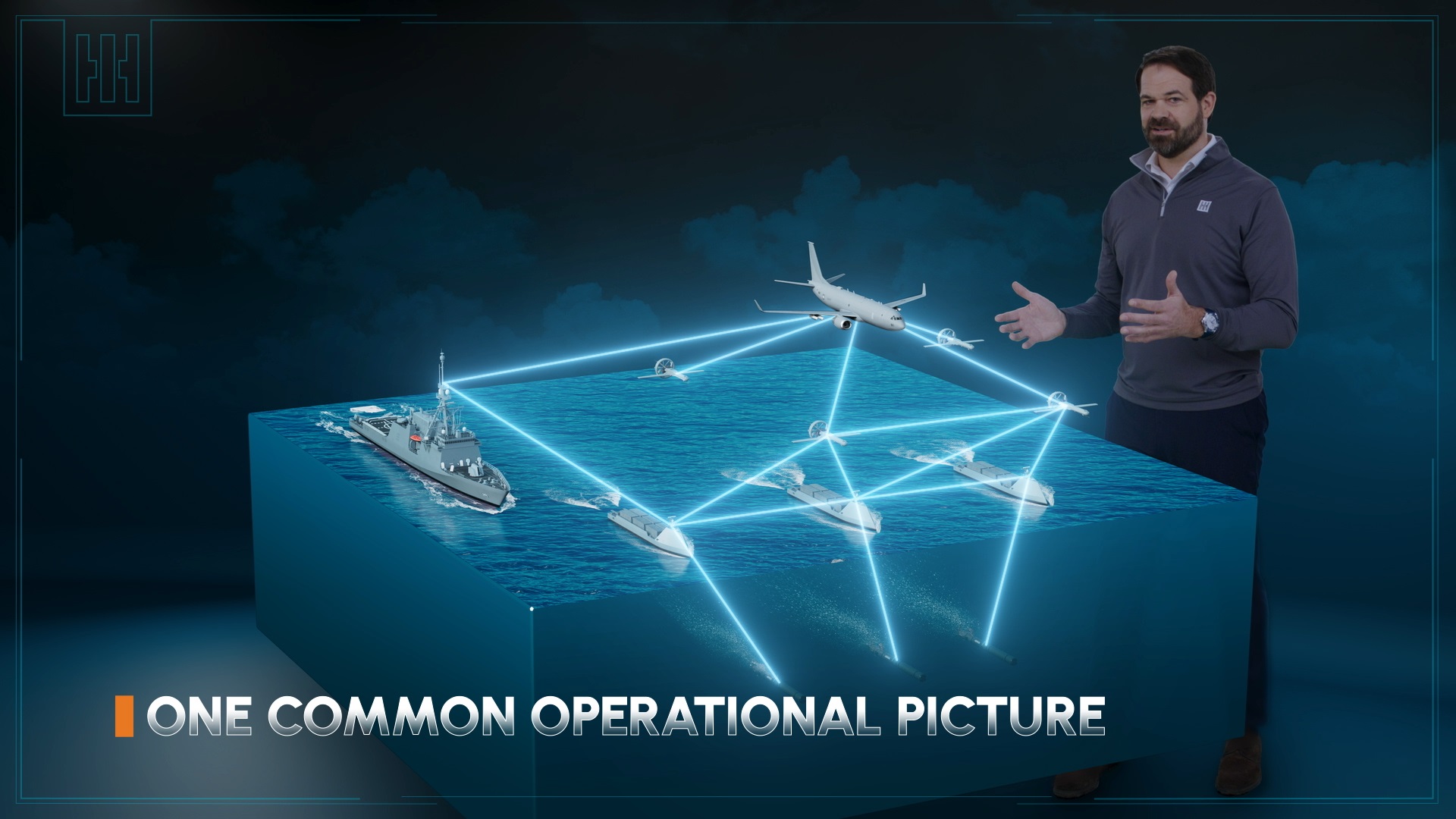
A video accompanying this news release is available at: http://hii.com/news/hii-introduces-distributed-maritime-operations-framework-in-support-of-u-s-navys-hedge-strategy/.
“This is about connecting platforms and enabling the mission,” said Eric Chewning, executive vice president of maritime systems and corporate strategy at HII. “Through open architecture, modular design, and rapid deployment models, we enable seamless integration of advanced technologies across platforms. By investing in autonomy and AI, we ensure that the U.S. Navy, Joint Force, and allied navies can adapt in real time to emerging threats using scalable, interoperable solutions.”
Enabling Delivery of Distributed, Joint Effects
The industrial strategy reflects a fundamental shift in naval warfare: moving from concentrated force to distributed, integrated operations across domains with autonomy and manned-unmanned platform teaming and reflects the shift from platform-centric operations to a networked, distributed manned-unmanned teaming model where sensing, decision-making, and effects are no longer tied to a single system or linear kill chain.
HII’s framework promotes the integration of:
- Surface combatants: Provide command and control for multi-domain unmanned capabilities through a common control station (CCS).
- ROMULUS unmanned surface vessels: Broadens the fleet’s sensing and strike capabilities through modular, containerized payloads.
- Minotaur Mission Management System (MMS): Fuses multi-domain sensor data to integrate the battlespace and provide a common operating picture across the network.
- Odyssey Autonomous Control System (ACS): Coordinates autonomous operations across multiple unmanned platforms.
- REMUS unmanned undersea vehicles: Extends the maritime force network to the subsea domain, integrating with surface operations via the ROMULUS 7 gateway buoy and enhancing undersea warfare capabilities through torpedo tube launch and recovery (TTLR) teaming with attack submarines.
The combination of core fleet ships, autonomous systems, and mission-enabling technologies enables commanders to tailor forces in accordance with the U.S. Navy’s Fighting Instructions to operationalize the Hedge Strategy and warfighting concepts through scalable formations of manned-unmanned platforms.
It also enables data collected in one domain to produce effects in another, supporting joint and coalition operations and allowing commanders to deliver outcomes from geographically dispersed forces with unprecedented speed, scale, and tempo.
Turning Data into Operational Advantage
The operational backbone of HII’s approach is the HII-developed and government-owned Minotaur Mission Management System, open-architecture command-and-control platform. Minotaur enables naval forces to contribute directly to joint tracking, targeting and fires by fusing data from maritime, air, space and undersea sensors into a unified operational picture.
Built on open architecture, Minotaur ensures that platforms like ROMULUS and future systems can integrate seamlessly into joint and coalition operations without creating dependencies on any single platform.
The result: faster decisions, tighter integration, and the ability to deliver effects across the battlespace with speed and precision.
Autonomy and Adaptability at Scale
Autonomous operations in HII’s framework are coordinated through HII’s Odyssey Autonomous Control System, which uses autonomy algorithms and artificial intelligence to support navigation, coordinated behaviors, and distributed sensing missions.
Integrated with the Minotaur MMS, Odyssey enables operators to supervise and manage multiple unmanned platforms at the same time. The integration also enables centralized command and control of distributed unmanned platforms, increases data collection and operational reach, and shortens the sensor-to-shooter timeline improving survivability and lethality in contested environments.
Containerized Capability: Speed, Flexibility, and Scale
A key differentiator in HII’s portfolio is its emphasis on containerized, mission-ready payloads that can be deployed rapidly across a variety of manned and unmanned maritime platforms. The approach supports reduced integration timelines and cost; rapid reconfiguration of forces; and distributed maritime and joint operations without platform dependency.
Expanding Options for Commanders While Reinforcing Aircraft Carrier Power
HII’s concept directly supports the U.S. Navy’s evolving Hedge Strategy and provides commanders with more flexible, scalable options for presence and combat power.
Aircraft carriers strike groups remain the centerpiece of U.S. naval power projection. Distributed, unmanned-enabled forces expand their reach, extend their awareness, and create additional dilemmas for adversaries.
HII Unique Approach to A New Era of Maritime Power
By embracing open architecture and interoperability, commercial acquisition models, rapid integration and deployment cycles, and continuous iteration at the operational edge, HII is driving a cultural and operational shift toward speed, adaptability, and mission-focused innovation.
About HII
HII is America’s largest shipbuilder, delivering the world’s most powerful ships and all-domain mission technologies, including unmanned systems, to U.S. and allied defense customers. HII is the largest producer of unmanned underwater vehicles for the U.S. Navy and the world.
With a more than 140-year history of advancing U.S. national security, HII builds and integrates defense capabilities extending from the core fleet to C6ISR, AI/ML, EW and synthetic training. Headquartered in Virginia, HII’s workforce is 44,000 strong. For more information, visit:
- HII on the web: https://www.HII.com/
- HII on Facebook: https://www.facebook.com/TeamHII
- HII on X: https://www.twitter.com/WeAreHII
- HII on Instagram: https://www.instagram.com/WeAreHII
- HII on LinkedIn: https://www.linkedin.com/company/wearehii
Contact:
Greg McCarthy
(202) 264-7126
gregory.j.mccarthy@hii-co.com
A photo accompanying this announcement is available at https://www.globenewswire.com/NewsRoom/AttachmentNg/7f7fbc65-0a9a-40cd-adfa-1117a6cb7f59

FAQ
AI-generated questions and answers. How Rhea-AI works. Not financial advice.