
Harrow Announces IHEEZO® Data in Patient-Reported Discomfort Following Intravitreal Injections
Harrow (Nasdaq: HROW) reported new data from a prospective, randomized, contralateral-eye study of IHEEZO (chloroprocaine hydrochloride ophthalmic gel) 3% in 50 adults (100 eyes) receiving same-day bilateral intravitreal injections.
Sentiment and the balance of points
Rhea-AI Sentiment reads the wording of the document, how positive or negative its language is on a 1 to 5 scale. The balance of points shown with the takes weighs what the document actually discloses, so the two can disagree, for example when a trial that missed its main goal is described in upbeat language.
Rhea-AI Summary
Harrow (Nasdaq: HROW) reported new data from a prospective, randomized, contralateral-eye study of IHEEZO (chloroprocaine hydrochloride ophthalmic gel) 3% in 50 adults (100 eyes) receiving same-day bilateral intravitreal injections.
Each patient received IHEEZO in one eye and preservative-containing proparacaine 0.5% in the fellow eye, after 2% lidocaine-soaked pledgets in both eyes. According to Harrow, patients reported approximately 58% less overall discomfort in the IHEEZO-treated eye, with statistically significant differences at all four post-injection assessments (all p≤0.048) on a 0–10 numeric rating scale.
The largest absolute differences occurred when discomfort is typically highest, immediately after injection: scores of 1.44 vs 3.06 at two minutes and 1.26 vs 2.82 at one hour, favoring IHEEZO. Lower discomfort scores with IHEEZO persisted through the 24-hour assessment. IHEEZO is indicated for ocular surface anesthesia; the most common adverse reaction is mydriasis (approximately 25%), and it is contraindicated in patients with hypersensitivity to any component.
Positive
- ≈58% reduction in overall discomfort in IHEEZO-treated eyes versus proparacaine, all p≤0.048
- Largest absolute pain score gaps shortly post-injection: 1.44 vs 3.06 at 2 minutes; 1.26 vs 2.82 at 1 hour
- Consistent lower discomfort with IHEEZO at all four time points through 24 hours in 100-eye study
- Randomized contralateral-eye design lets each of 50 patients serve as own control, reducing between-patient variability
Negative
- Data from single-center study in a single private retina practice with 50 adult patients
- Adverse reaction mydriasis reported in approximately 25% of IHEEZO-treated cases
- Contraindicated in hypersensitivity to any component of IHEEZO, limiting use in those patients
- Not for injection or intraocular use; must be administered only by a healthcare provider
Details
News Market Reaction – HROW
On Aug 20, the day this news came out, HROW closed 1.08% above the previous close.
Data tracked by StockTitan Argus for the Aug 20 session.
Key Figures
- Overall discomfort reduction
- approximately 58%
- IHEEZO-treated eye versus fellow eye
- Statistical significance
- all p≤0.048
- four post-injection assessments
- 2-minute discomfort scores
- 1.44 versus 3.06
- IHEEZO versus proparacaine
- 1-hour discomfort scores
- 1.26 versus 2.82
- IHEEZO versus proparacaine
- 2-minute treatment difference
- 1.62 points
- numeric discomfort rating scale
- 1-hour treatment difference
- 1.56 points
- numeric discomfort rating scale
- Study size
- 100 eyes from 50 adult patients
- prospective randomized contralateral-eye study
- Most common adverse reaction
- approximately 25%
- mydriasis
Historical Context
-
Revenue growth accompanied a quarterly net loss and reduced Adjusted EBITDA.
-
Global TYRVAYA rights acquired for cash and contingent milestone payments.
-
Scheduled second-quarter results release and conference call for August 10–11.
-
Interim BYOOVIZ surveillance results reported significant BCVA and CST changes.
-
ASRS presentations cited IHEEZO trends and ongoing QUELL enrollment.
24h Move is the share-price change in the day after each event; other market factors may also have contributed.
Key Terms
contralateral-eye study medical
intravitreal injections medical
numeric rating scale medical
ocular surface anesthesia medical
mydriasis medical
AI-generated analysis. How Rhea-AI works. Not financial advice.




Patients reported approximately
NASHVILLE, Tenn., Aug. 20, 2026 (GLOBE NEWSWIRE) -- Harrow (Nasdaq: HROW), a leading provider of ophthalmic disease management solutions in North America, today announced positive results from a prospective, randomized, contralateral-eye study evaluating IHEEZO® (chloroprocaine hydrochloride ophthalmic gel)
Patients reported approximately
Millionsi of intravitreal injections are performed in the United States each year — making them among the most frequently performed procedures in ophthalmology — and they are often administered repeatedly over months or years to patients with retinal diseases. As a result, the injection experience, including patient discomfort, can become an important consideration for both patients and retina specialists, particularly in practices managing a high volume of patients who return regularly for treatment.
Study Results
IHEEZO was associated with lower patient-reported discomfort at all four post-injection assessments, measured using a standard 0-to-10 numeric rating scale:
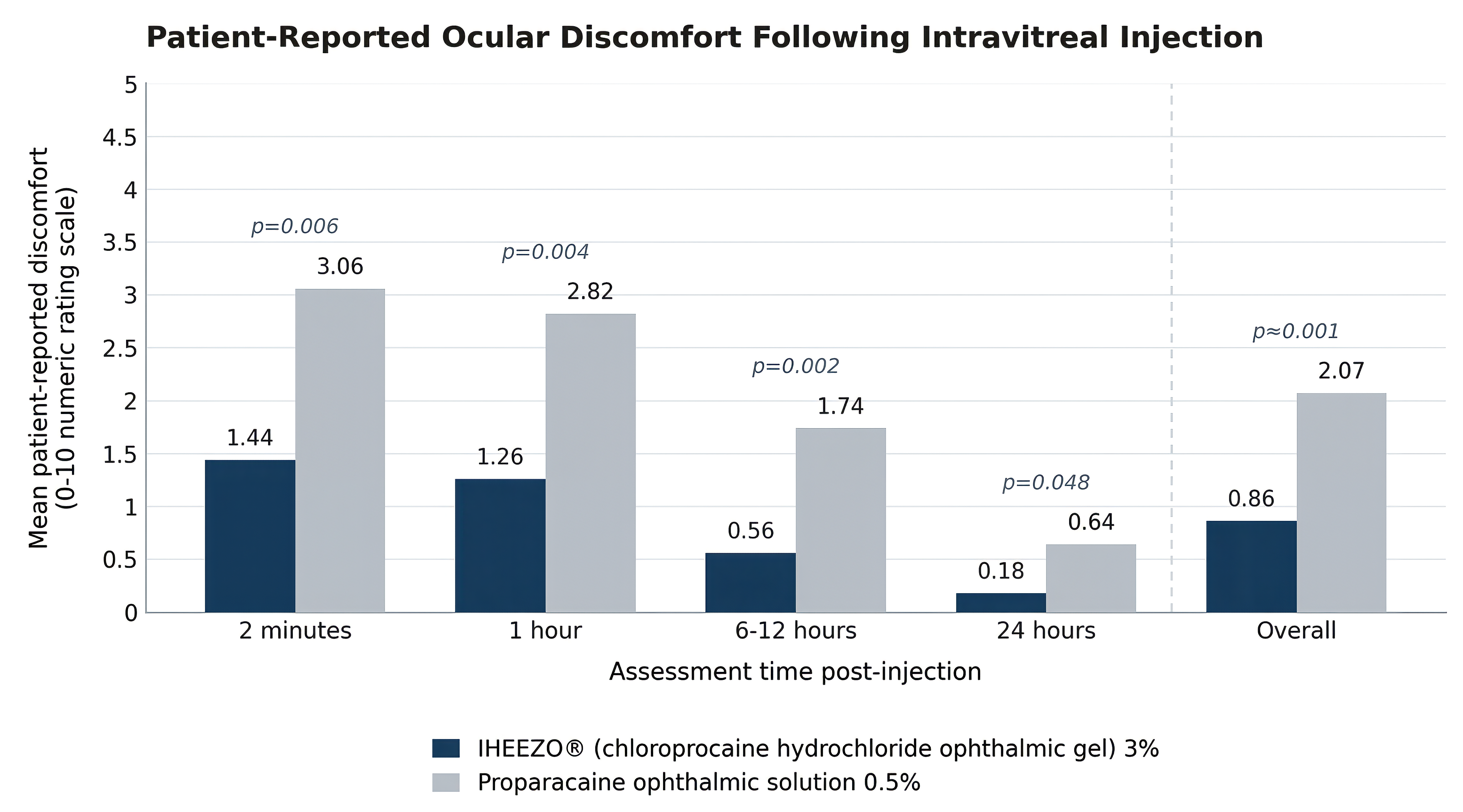
The results showed a consistent benefit with IHEEZO throughout the 24-hour assessment period, with lower patient-reported discomfort at every time point. The largest absolute differences occurred shortly after injection, when discomfort is highest. Absolute treatment differences were 1.62 points at two minutes and 1.56 points at one hour, and lower discomfort scores with IHEEZO remained evident through the 24-hour assessment.
“Patient comfort is a larger part of the intravitreal injection experience than it is sometimes given credit for,” said Travis Peck, MD, Retina Consultants of Delmarva, principal investigator of the study. “Because each patient received both anesthetic approaches on the same day, we were able to directly compare the patient experience. Patients consistently reported less discomfort in the IHEEZO-treated eye across all time points we measured. For retina specialists who perform a high volume of injections and care for patients who return repeatedly for treatment, these are practical and clinically relevant findings.”
“These results provide new clinical evidence from a real-world practice setting supporting IHEEZO’s differentiated clinical profile versus commonly administered legacy ophthalmic anesthesia modalities – demonstrating a measurable improvement in patient-reported comfort following intravitreal injections,” said Mark L. Baum, Chief Executive Officer of Harrow. “Retina specialists work to preserve vision in patients who require ongoing treatment over many years, and the experience of each of those visits matters and ideally, should be optimized. The consistency and magnitude of the reduction in patient discomfort should strengthen physician confidence in IHEEZO’s clinical profile and support broader utilization of the product across retina practices.”
About the Study
The investigator-initiated study was a prospective, randomized, contralateral-eye comparison conducted in a private retina practice. The study evaluated 100 eyes from 50 adult patients undergoing same-day bilateral intravitreal injections. Both eyes received
Patient-reported ocular discomfort was assessed using a 0-to-10 numeric rating scale at 2 minutes, 1 hour, 6–12 hours, and 24 hours following injection.
IHEEZO® (chloroprocaine hydrochloride ophthalmic gel)
INDICATIONS AND USAGE
IHEEZO is an ester anesthetic indicated for ocular surface anesthesia.
IMPORTANT SAFETY INFORMATION
CONTRAINDICATIONS
IHEEZO is contraindicated in patients with a history of hypersensitivity to any component of this preparation
WARNINGS AND PRECAUTIONS
- Not for Injection or Intraocular Administration
- Corneal Injury Due to Insensitivity
- Corneal Opacification
- For Administration by Healthcare Provider: IHEEZO is not intended for patient self-administration
ADVERSE REACTIONS
- Most common adverse reaction is mydriasis (approximately
25% )
Please see full Prescribing information
About Harrow
Harrow, Inc. (Nasdaq: HROW) is a leading provider of ophthalmic disease management solutions in North America, offering a comprehensive portfolio of products that address conditions affecting both the front and back of the eye, such as dry eye disease, wet (or neovascular) age-related macular degeneration, cataracts, refractive errors, glaucoma and a range of other ocular surface conditions and diseases of the retina. Harrow was founded with a commitment to deliver safe, effective, accessible, and affordable medications that enhance patient compliance and improve clinical outcomes. For more information about Harrow, please visit harrow.com and connect with us on LinkedIn.
Forward-Looking Statements
This press release contains “forward-looking statements” within the meaning of the U.S. Private Securities Litigation Reform Act of 1995. Any statements in this release that are not historical facts may be considered such “forward-looking statements.” Forward-looking statements are based on management's current expectations and are subject to risks and uncertainties which may cause results to differ materially and adversely from the statements contained herein. Some of the potential risks and uncertainties that could cause actual results to differ from those predicted include, among others, risks related to: liquidity or results of operations; our ability to successfully implement our business plan, develop and commercialize our products, product candidates and proprietary formulations in a timely manner or at all, identify and acquire additional products, manage our pharmacy operations, service our debt, obtain financing necessary to operate our business, recruit and retain qualified personnel, manage any growth we may experience and successfully realize the benefits of our previous acquisitions and any other acquisitions and collaborative arrangements we may pursue; competition from pharmaceutical companies, outsourcing facilities and pharmacies; general economic and business conditions, including inflation and supply chain challenges; regulatory and legal risks and uncertainties related to our pharmacy operations and the pharmacy and pharmaceutical business in general, including the ongoing communications with the U.S. Food and Drug Administration relating to compliance and quality plans at our outsourcing facility in New Jersey; physician interest in and market acceptance of our current and any future formulations and compounding pharmacies generally. These and additional risks and uncertainties are more fully described in Harrow’s filings with the Securities and Exchange Commission (SEC), including its Annual Report on Form 10-K for the year ended December 31, 2025, and other filings with the SEC. Such documents may be read free of charge on the SEC's web site at sec.gov. Undue reliance should not be placed on forward-looking statements, which speak only as of the date they are made. Except as required by law, Harrow undertakes no obligation to update any forward-looking statements to reflect new information, events, or circumstances after the date they are made, or to reflect the occurrence of unanticipated events.
Contacts:
Mike Biega
Vice President of Investor Relations and Communications
mbiega@harrowinc.com
617-913-8890
i Comparative incidence of endophthalmitis after intravitreal dexamethasone implant versus anti-VEGF injections: a retrospective study. International Journal of Retina and Vitreous. 2026
A photo accompanying this announcement is available at https://www.globenewswire.com/NewsRoom/AttachmentNg/0eb365b1-2cee-40b7-880d-fba9189e1d92

FAQ
AI-generated questions and answers. How Rhea-AI works. Not financial advice.