
IBM and Qedma Demonstrate Quantum Advantage, Modeling Physics Beyond Classical Capabilities Through Trusted Quantum Computation
IBM (NYSE: IBM) and Qedma Quantum Computing reported a breakthrough study showing trusted, error-mitigated quantum computation surpassing leading classical simulations, including those run on the Fugaku supercomputer.
Rhea-AI Summary
IBM (NYSE: IBM) and Qedma Quantum Computing reported a breakthrough study showing trusted, error-mitigated quantum computation surpassing leading classical simulations, including those run on the Fugaku supercomputer. By combining IBM quantum computers, powered by the Heron processor, with Qedma’s QESEM error reduction software, researchers modeled long-lived quantum dynamics in systems up to 74 qubits.
The work explored a two-dimensional Floquet Ising model and found consistent, long-time oscillatory behavior where multiple classical methods disagreed. Results were cross-validated with RIKEN, BlueQubit, and Quantinuum hardware and uploaded to IBM’s Quantum Advantage Tracker to enable community benchmarking.
Details
News Market Reaction – IBM
On Jul 30, the day this news came out, IBM closed 2.08% below the previous close.
Data tracked by StockTitan Argus for the Jul 30 session.
Key Figures
- Quantum system size
- 74 qubits
- Error-mitigated quantum dynamics study
- Model dimensionality
- 2-dimensional
- Floquet Ising model
Historical Context
-
IBM agreed to acquire HRL Laboratories, with closing expected by end of Q3.
-
IBM reported Q2 revenue of $17.2 billion and diluted EPS of $2.27.
-
IBM introduced Power platform offerings, including Autonomous Operations and Power S1112 server.
-
Preliminary Q2 results cited infrastructure weakness and cybersecurity-related delays to large deals.
-
IBM upgraded Bob with multi-agent capabilities, analytics, and modernization workflows.
24h Move is the share-price change in the day after each event; other market factors may also have contributed.
Key Terms
error mitigation technical
qubits technical
floquet ising model technical
trapped-ion systems technical
AI-generated analysis. How Rhea-AI works. Not financial advice.




Qedma's quantum error reduction software, running on IBM quantum computers and tested against RIKEN and BlueQubit's supercomputing resources, has accurately resolved the dynamics of quantum materials unseen in classical simulation.
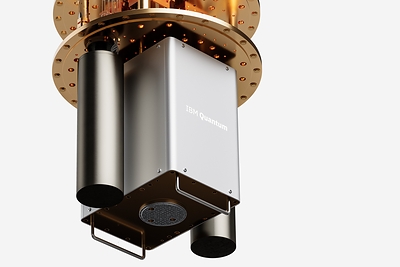
The results mark the first time quantum advantage has been achieved with commercially available hardware and software to establish error-mitigated, advanced quantum computers as trusted scientific instruments for exploring physics that could lead to better and ultrafast optoelectronics, light-induced superconductors, and other advanced materials applications.
Exploring Physics at the Classical Frontier
The collaboration investigated the subtle, oscillatory dynamics of a two-dimensional Floquet Ising model, which is a system that physicists use to study how a material's magnetic properties evolve when rhythmically driven by external pulses. Understanding whether such oscillations persist in larger systems has remained an open challenge because the relevant regimes rapidly overwhelm classical computational methods. Using an IBM quantum computer, which is powered by the IBM Quantum Heron processor and available on the cloud, together with Qedma's Quantum Error Suppression and Error Mitigation (QESEM) software, which is also available on the cloud, the team was able to resolve these dynamics with precision.
Beyond Leading Classical Methods
To evaluate the significance of the quantum results, the team worked with RIKEN,
Building Trust Through Validation
A defining feature of the study is its extensive validation strategy. The team first employed an unbiased error-mitigation protocol against classical calculations wherever such comparisons remained possible, before pushing the protocol to the point where these classical simulations lost accuracy. Then, they benchmarked a more scalable mitigation approach against those trusted results before extending to larger system sizes and longer evolution times. Independent validation was also performed across quantum hardware platforms, including trapped-ion systems from Quantinuum. The consistent behavior observed across technologies provided additional evidence that the measured physics originated from the simulated quantum system, rather than from device-specific or mitigation errors.
"IBM quantum computers have reached a maturity where they can produce solutions that, for the first time, achieve both trust in the solution through extensive testing and outperform the best classical simulation methods. I look forward to seeing future results benchmarked through the Quantum Advantage Tracker as we deepen our understanding of the boundary between quantum and classical computation," said Jay Gambetta, Director of IBM Research and IBM Fellow. "By combining IBM's quantum computers with Qedma's advanced error reduction technology, we are transforming quantum computing into a practical tool to expand the frontier of knowledge."
"For decades, quantum computing has promised discoveries beyond the reach of classical computers. Today, we're beginning to see that promise become reality," said Dr. Asif Sinay, CEO and co-founder of Qedma. "By leveraging Qedma's software to make today's quantum computers significantly more powerful and reliable, we're helping move the quantum computing industry closer to real-world, commercial impact."
"Quantum computers are beginning to open new possibilities for scientific discovery within the high-performance computing environment," said Dr. Mitsuhisa Sato, Division Director of the Quantum-HPC Hybrid Platform Division, RIKEN Center for Computational Science. "This work leveraged RIKEN's leadership in advanced classical simulation and supercomputing, alongside Qedma's error mitigation software on IBM quantum computers, to demonstrate the ability of quantum computing to surpass the capabilities of leading classical methods. It is an important step towards a future where quantum and classical computing work together to advance science."
Qedma's advanced error reduction software, QESEM, available in the Qiskit Functions Catalog on the IBM Quantum Platform, mitigates the impact of noise present in today's quantum computers. Rather than waiting for large-scale, fully fault-tolerant quantum computers, QESEM's patented approach unlocks the ability to execute larger and more complex quantum workloads while producing more accurate results. The software offers various error mitigation methods, including an unbiased approach which provides guaranteed accuracy in extracting reliable results from noisy quantum hardware. It is currently being used by leading enterprises, academic institutions, and research laboratories around the world.
More Announcements of Quantum Advantage Emerge
Today, alongside this milestone from IBM and Qedma, partners from across IBM's ecosystem are announcing demonstrations of quantum advantage. To learn more, visit https://www.ibm.com/quantum/blog/quantum-advantage.
About Qedma Quantum Computing
Qedma is accelerating the path to practical quantum computing by dramatically reducing the impact of hardware errors. Its hardware-agnostic software, QESEM, enables researchers and enterprises to run larger and more complex quantum algorithms while obtaining more accurate and reliable results on today's quantum computers. By overcoming one of the biggest barriers facing the industry, Qedma helps unlock scientific discoveries and enables users to push beyond the limits of current quantum hardware. Qedma was founded by Dr. Asif Sinay together with two prominent scientists: Prof. Dorit Aharonov, who thirty years ago proved that error corrected quantum computation is possible and laid the foundations of quantum fault tolerance, and Prof. Netanel Lindner, a world-renowned theoretical condensed matter physicist known for his work on complex quantum systems. For more information, visit www.qedma.com.
About IBM
IBM is a leading provider of global hybrid cloud and AI, and consulting expertise. We help clients in more than 175 countries capitalize on insights from their data, streamline business processes, reduce costs and gain the competitive edge in their industries. Thousands of governments and corporate entities in critical infrastructure areas such as financial services, telecommunications and healthcare rely on IBM's hybrid cloud platform and Red Hat OpenShift to affect their digital transformations quickly, efficiently and securely. IBM's breakthrough innovations in AI, quantum computing, industry-specific cloud solutions and consulting deliver open and flexible options to our clients. All of this is backed by IBM's long-standing commitment to trust, transparency, responsibility, inclusivity and service. Visit www.ibm.com for more information.
Media contacts:
Brittany Forgione
IBM
Brittany.Forgione@ibm.com
Erin Angelini
IBM
edlehr@us.ibm.com

 View original content to download multimedia:https://www.prnewswire.com/news-releases/ibm-and-qedma-demonstrate-quantum-advantage-modeling-physics-beyond-classical-capabilities-through-trusted-quantum-computation-302838413.html
SOURCE IBM
FAQ
AI-generated questions and answers. How Rhea-AI works. Not financial advice.