
IBM Fellow and Quantum Pioneer Charles H. Bennett Receives A.M. Turing Award, Computing's Highest Honor
Charles H. Bennett (NYSE: IBM), an IBM Fellow, was named co-recipient of the 2025 ACM A.M.
Sentiment and the balance of points
Rhea-AI Sentiment reads the wording of the document, how positive or negative its language is on a 1 to 5 scale. The balance of points shown with the takes weighs what the document actually discloses, so the two can disagree, for example when a trial that missed its main goal is described in upbeat language.
Rhea-AI Summary
Charles H. Bennett (NYSE: IBM), an IBM Fellow, was named co-recipient of the 2025 ACM A.M. Turing Award alongside Gilles Brassard for founding contributions to quantum information science. Bennett is credited with BB84 quantum cryptography, quantum teleportation and five decades of work at IBM Research. He will receive a portion of a USD 1 million prize and plans to donate part of it.
The award marks the first ACM Turing recognition tied to quantum research and is the seventh time an IBM researcher has received the prize.
Details
News Market Reaction – IBM
On Mar 18, the day this news came out, IBM closed 1.76% below the previous close.
Data tracked by StockTitan Argus for the Mar 18 session.
Key Figures
- 2025 Revenue
- $67.5 billion
- Reported in 2026 DEF 14A proxy statement
- Revenue Growth
- 8%
- 2025 year-over-year growth from DEF 14A
- Gross Profit Margin
- 58%
- 2025 performance highlighted in DEF 14A
- Cash from Operations
- $13.2 billion
- 2025 cash from operations per DEF 14A
- Free Cash Flow
- $14.7 billion
- 2025 free cash flow from DEF 14A
- Acquisition Spend
- about $8 billion
- Amount spent on 10 acquisitions in 2025
- Dividends Paid
- over $6 billion
- Dividends distributed in 2025 per DEF 14A
- Turing Prize
- USD $1 million
- Total ACM A.M. Turing Award prize associated with Bennett’s recognition
Historical Context
-
Released industry’s first quantum-centric supercomputing reference architecture.
-
Announced five-year Lam Research collaboration on sub-1nm logic scaling.
-
Reported first half-Möbius molecule and quantum simulation breakthrough.
-
Won five-year Defense Commissary Agency ESL modernization contract.
-
Released 2026 X-Force Threat Index on AI-driven cyber risks.
24h Move is the share-price change in the day after each event; other market factors may also have contributed.
Key Terms
quantum information science technical
quantum cryptography technical
quantum teleportation technical
entanglement distillation technical
quantum-centric supercomputing architecture technical
fault-tolerant quantum computer technical
AI-generated analysis. How Rhea-AI works. Not financial advice.




- Charles H. Bennett helped pioneer the foundations of quantum information science alongside co-laureate Gilles Brassard of Université de
Montréal . - Bennett's more than five decades at IBM Research helped transform quantum theory into practical advances like quantum cryptography, teleportation, and entanglement-based protocols.
- He is the seventh IBM awardee recognized by ACM, the Association for Computing Machinery, with the A.M. Turing Award.
- The recognition joins IBM's long legacy of shaping quantum computing and the enduring impact of researchers who defined the field.
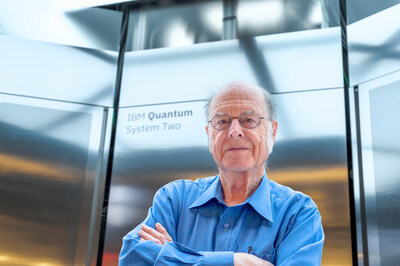
Described by the ACM as the "Nobel Prize in computing," the award cites Bennett for contributions that helped spark a "quantum revolution," establish the field of quantum information science and reshape how researchers think about computation, communication and the nature of information itself. He shares the award with longtime collaborator Gilles Brassard of the Université de
Over a career at IBM Research spanning more than five decades, Bennett pioneered explorations of how the unusual behavior of matter at the smallest scales can be harnessed to process and transmit information in ways impossible for classical computers. His efforts helped lay the scientific groundwork for quantum cryptography, quantum teleportation and entanglement distillation — all concepts that underpin modern quantum information science and ongoing advances in quantum computing today.
Born to
Bennett's curiosity drove him to explore the interplay between computation and the laws of physics as a graduate student at Harvard University, where he developed two pivotal professional relationships that helped shape the questions that would define Bennett's career.
The first was with research physicist Stephen Wiesner, who in 1968 developed a concept of "quantum money" that could not be counterfeited, but had trouble gaining academic acceptance of his idea. Bennett ultimately helped Wiesner advance the concept and, in handwritten notes from a conversation in 1970, prophetically scribbled and underlined the phrase "quantum information theory" across the top of a page. The second was attending a lecture by IBM Fellow and physicist Rolf Landauer, whose work on the thermodynamics of computation argued that information is not abstract but a physical quantity governed by the laws of nature.
"Rolf Landauer recruited me to IBM because we shared an interest in the physics of computation," said Bennett, who still works out of the IBM Thomas J. Watson Research Center in
At IBM, Bennett wrote a landmark 1973 paper on logical reversibility of computation, showing that computation need not be fundamentally tied to energy dissipation in the way many had assumed. That work helped establish information as a physical concept and set the stage for decades of breakthroughs in computing to come.
"IBM was an ideal place to do this kind of research because you had people working on the fundamental physics of computing and hardware, and in the same building people focused on the mathematics of computing. I could wander down the hall and talk to many people about fundamental ideas and in fields that, at that time, scarcely overlapped," Bennett said. "That environment made it possible to grow the field of quantum information science into what it is today."
Bennett and Brassard met at a 1979 computer science conference in
Bennett also helped quantum information science leap from on-paper conjectures into real-world experimentation. Bennett and then-summer student John Smolin, now an IBM researcher, built the first quantum cryptography apparatus in Bennett's office, and — joined by Brassard — carried out the first demonstration of BB84 in 1989. They made the custom two-meter-long device out of mirrors, polarizers, and photon detectors and ran it with software written by Brassard and his students. Bennett also co-authored a landmark 1993 study introducing quantum teleportation, which showed how an unknown quantum state could be transmitted using entanglement and classical communication, turning a once-philosophical curiosity into a practical resource for quantum engineering.
Today, the field Bennett helped establish has moved from foundational theory into increasingly powerful real-world systems and head-turning scientific results.
"Charlie is an inspiration to all of us. When many researchers saw quantum mechanics as a problem to solve for shrinking electronic components rather than a tool to be developed, he recognized the same physics could become a powerful new way to process and transmit information," said Jay Gambetta, Director of IBM Research and IBM Fellow. "That insight, and the decades of work that followed, helped lay the intellectual foundation for one of the most important scientific and technological frontiers of our time. Today at IBM, Charlie's legacy is also seen in the work our teams are doing to build increasingly capable quantum systems and bring useful quantum computing to the world."
Most recently, IBM unveiled an open, easy-to-integrate quantum-centric supercomputing architecture designed to scale quantum systems alongside classical computing resources, helping solve problems that classical methods alone struggle to address. The company also debuted a credible path to build IBM Quantum Starling, which it expects to be the world's first large-scale, fault-tolerant quantum computer, and deliver it to customers in 2029.
ACM's award is named after Alan M. Turing, the British mathematician who articulated the mathematical foundations of computing. The 2025 award is the organization's first associated with quantum research and Bennett, who plans to donate part of his portion of a USD
Previous IBM-associated Turing Award recipients include John Backus (1977), honored for FORTRAN and the design of practical high-level programming systems; Kenneth E. Iverson (1979), recognized for APL and its influence on programming languages and notation; Edgar F. Codd (1981), for fundamental contributions to database management systems; John Cocke (1987), for advances in compiler theory, computer architecture, and RISC; Frederick P. Brooks (1999), for landmark contributions to computer architecture, operating systems, and software engineering; and Frances E. Allen (2006), the first woman to receive the award, for pioneering optimizing compiler techniques and automatic parallel execution.
To learn more, watch a short video and read a blog post about Bennett and the work that led to the award.
About IBM
IBM is a leading global hybrid cloud and AI, and business services provider, helping clients in more than 175 countries capitalize on insights from their data, streamline business processes, reduce costs and gain the competitive edge in their industries. Thousands of governments and corporate entities in critical infrastructure areas such as financial services, telecommunications and healthcare rely on IBM's hybrid cloud platform and Red Hat OpenShift to effect their digital transformations quickly, efficiently and securely. IBM's breakthrough innovations in AI, quantum computing, industry-specific cloud solutions and business services deliver open and flexible options to our clients. All of this is backed by IBM's legendary commitment to trust, transparency, responsibility, inclusivity and service.
For more information, visit https://research.ibm.com.
Media Contact:
Dave Mosher
IBM Communications
dave.mosher@ibm.com
Chris Nay
IBM Communications
cnay@us.ibm.com

 View original content to download multimedia:https://www.prnewswire.com/news-releases/ibm-fellow-and-quantum-pioneer-charles-h-bennett-receives-am-turing-award-computings-highest-honor-302716730.html
SOURCE IBM
FAQ
AI-generated questions and answers. How Rhea-AI works. Not financial advice.