
IQM Demonstrates Entanglement Across a Complete 54-Qubit Processor, Bringing Full-Chip Performance to Cloud Users
Hardware and calibration improvements reduced error rates for quantum operations in the processor by up to 50%.
Sentiment and the balance of points
Rhea-AI Sentiment reads the wording of the document, how positive or negative its language is on a 1 to 5 scale. The balance of points shown with the takes weighs what the document actually discloses, so the two can disagree, for example when a trial that missed its main goal is described in upbeat language.


An automated state-preparation routine and enhanced calibration protocol keep fidelity above the entanglement threshold at full scale, and cloud users now have access to the same system performance.
ESPOO,
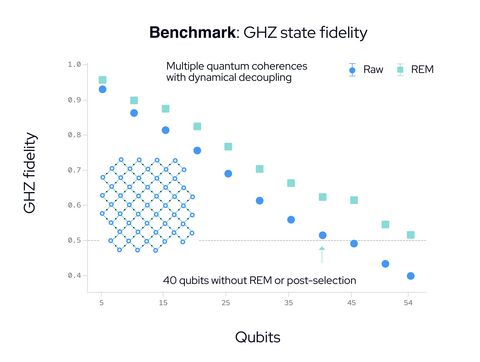
IQM measured a fidelity of 0.515 at 40 qubits without readout error mitigation (REM) and 0.516 at the full 54 qubits with REM applied, both above the classical threshold of 0.500 that separates genuine entanglement from noise.
These results rank among the strongest reported for any commercially available quantum computer, giving customers access to state-of-the-art, high-quality processors. Until now, a user running a comparable demonstration on IQM Emerald could reliably use on the order of 30 qubits within a single algorithm. Studies on large quantum chips often use only a fraction of the available qubits, commonly 10 to 20, even when the hardware has many more. Emerald's result shows the alternative: an entire processor working together on one computation.
"Entangling the entire chip means every qubit and every connection between them has to work correctly in the same circuit. Getting there came down to being smarter about how we prepare the state itself, choosing the gate order to keep idle time to a minimum," said Craig Ciesla, CTO, IQM Quantum Computers. "Our current and prospective cloud customers now have the chance to benefit from the same tools and system performance that made this achievement possible."
The demonstration used a Greenberger–Horne–Zeilinger (GHZ) state, a standard benchmark for large-scale entanglement, prepared across the entire IQM Emerald processor. The result was enabled by a smarter, automated routine for state preparation that selects the best two-qubit gates while weighing gate fidelity against qubit idle time, choosing both the qubits and the gate order to minimize idle time as the state is built. IQM measured a fidelity of 0.515 at 40 qubits without readout error mitigation (REM) and 0.516 at the full 54 qubits with REM applied, both above the classical threshold of 0.500 that separates genuine entanglement from noise.
The result builds on roughly a year of hardware and calibration work across IQM’s technical teams, including an updated calibration methodology, an improved gate set and continued deployment of error-reduction tools such as dynamical decoupling and qubit selection. These improvements led to an error rate reduction of up to
The automated state-preparation routine is part of IQM’s broader effort to automate the operation of quantum computers. This development, along with IQM’s AI-driven agentic calibration work, is part of a broader effort to automate the tuning of quantum systems.
About IQM Quantum Computers
IQM Quantum Computers (Nasdaq: IQMX) is a global leader in superconducting quantum computers, delivering full-stack quantum computers and cloud platform access to enterprises, research institutions, universities, high-performance computing centers and national laboratories worldwide. IQM’s on-premises deployment model gives customers direct ownership and control of their quantum infrastructure. Founded in 2018 and headquartered in Finland, with major operations in Munich, IQM employs over 450 people and operates across Europe, Asia and North America. IQM is the first publicly listed European quantum company on Nasdaq Stock Market.
View source version on businesswire.com: https://www.businesswire.com/news/home/20261029191153/en/
IQM Media Contact
press@iqm.tech
Source: IQM Quantum Computers