
JAGUAR URANIUM ANNOUNCES MAIDEN MINERAL RESOURCE ESTIMATE AT LAGUNA SALADA IN ARGENTINA
The resource footprint covers approximately 4.3% of the project, with further exploration targeted to upgrade and expand resources.
Sentiment and the balance of points
Rhea-AI Sentiment reads the wording of the document, how positive or negative its language is on a 1 to 5 scale. The balance of points shown with the takes weighs what the document actually discloses, so the two can disagree, for example when a trial that missed its main goal is described in upbeat language.
Rhea-AI Summary
Jaguar Uranium (JAGU) announced its maiden independent mineral resource estimate for the wholly owned Laguna Salada uranium-vanadium project in Argentina.
Effective October 5, 2026, the estimate reports 21.1 million tonnes of Indicated resources containing 4.2 million pounds of uranium oxide and 31.1 million pounds of vanadium oxide. Inferred resources total 34.0 million tonnes, containing 10.1 million pounds and 57.3 million pounds, respectively. Uranium-equivalent grades, incorporating vanadium value, are 119 parts per million for Indicated resources and 170 for Inferred resources.
The resource footprint covers approximately 4.3% of the project. Jaguar targets approximately 250 additional pits and trenches and 1,500 metres of sonic/vibrosonic drilling to upgrade and expand resources. It holds nearly US$18 million in cash with no debt. Mining and processing methods and costs require further technical studies.
How this balance works
Rhea-AI gives every point it takes from this document a weight. Minor counts 1, Moderate 3 and Major 9, so one Major point outweighs several Minor ones. The bar adds up the weights on each side, and when neither side holds more than 65% of the total the balance reads Mixed.
It reads the document as published, with the same rules for every company, and it does not look at what the market expected or at how the stock traded, so a point can be objectively good on a day the stock falls.
Rhea-AI Sentiment measures something else, the tone of the wording.
Hollow bars mark forward-looking points. How the balance works
Positive
- Major pointIndicated uranium resources contain 4.2 million pounds of uranium oxide at Laguna Salada.
- Major pointNearly US$18 million in cash supports Jaguar's balance sheet, with no debt.
- Minor pointInferred uranium resources contain 10.1 million pounds of uranium oxide at Laguna Salada.
- Minor pointIndicated vanadium resources contain 31.1 million pounds of vanadium oxide.
- Minor pointInferred vanadium resources contain 57.3 million pounds of vanadium oxide.
6 minor points
- Minor pointIndicated tonnage totals 21.1 million tonnes at 119 parts per million uranium-equivalent grade.
- Minor pointInferred tonnage totals 34.0 million tonnes at 170 parts per million uranium-equivalent grade.
- Minor pointExploration advancement is permitted at the Laguna Salada project.
- Minor point. Forward-looking: it has not happened yet and may not happen.Approximately 250 new pits and trenches are targeted for infill work at Pampa de Arroqui and Laguna Salada.
- Minor point. Forward-looking: it has not happened yet and may not happen.1,500 metres of sonic/vibrosonic drilling are targeted at Buried Lake, comprising about 100–150 holes.
- Minor point. Forward-looking: it has not happened yet and may not happen.Planned metallurgical studies target beneficiation and vanadium recovery optimization, alongside environmental baseline monitoring and updated resource modeling.
Negative
- Moderate pointMining and processing methods and costs have not been established and require further technical studies.
- Minor point. Forward-looking: it has not happened yet and may not happen.Conventional drilling limitations include poor core recovery and potential loss of uranium-bearing fine material, risking biased samples.
- Minor point. Forward-looking: it has not happened yet and may not happen.Lower equivalent uranium prices correspond to higher reporting cut-offs and lower retained resource tonnage.
News Explained
The estimate does not establish a mine: the release states that Mineral Resources have no demonstrated economic viability; Inferred resources have lower geological confidence than Indicated resources and must not be converted to Mineral Reserves.
Key Figures
- Indicated resource
- 21,100,000 tonnes at 119 ppm U₃O₈ Eq
- Total Indicated, all zones
- Inferred resource
- 34,000,000 tonnes at 170 ppm U₃O₈ Eq
- Total Inferred, all zones
- Indicated U₃O₈
- 4.2 million lbs.
- Total Indicated, all zones
- Inferred U₃O₈
- 10.1 million lbs.
- Total Inferred, all zones
- Indicated V₂O₅
- 31.1 million lbs.
- Total Indicated, all zones
- Inferred V₂O₅
- 57.3 million lbs.
- Total Inferred, all zones
- NSR cut-off
- US$12.08/t
- Mineral Resource Estimate reporting threshold
Key Terms
net smelter return technical
ni 43-101 regulatory
ordinary kriging technical
icp-ms technical
four-acid digestion technical
AI-generated analysis. How Rhea-AI works. Not financial advice.




- Large-Scale, Bulk-Tonnage, Near-Surface Potential Uranium-Vanadium Resource:
- 4.2 million lbs. of Indicated and 10.1 million lbs. of Inferred U₃O₈
- 31.1 million lbs. of Indicated and 57.3 million lbs. of Inferred V₂O₅
- Includes 21.1 Mt Indicated at 119 ppm U₃O₈ Eq¹. and 34.0 Mt Inferred at 170 ppm U₃O₈ Eq¹.
- Mineral Resource Footprint Covers Approximately
4.3% of Jaguar's 210,284 ha Laguna Salada Project, Highlighting Significant Potential for Resource Expansion. - Potential Western Supply of Reliable Critical Minerals: Offers the
U.S . and allied markets a secure source of uranium and vanadium in the Western Hemisphere. - Permitted for Exploration Advancement and Expansion Potential: Priority work program to undertake targeted infill pitting/trenching and sonic drilling.
- Well-Financed, Cash-Rich Balance Sheet: Company maintains nearly
US in cash and no debt$18 million
"The completion of this independent Regulation S-K 1300 compliant Mineral Resource Estimate marks a landmark milestone for Jaguar Uranium as we quantify the significant scale of Laguna Salada with this resource estimate representing only about
Mineral Resource Statement
The Mineral Resource Estimate has been prepared in accordance with Regulation S-K 1300 and the CIM Definition Standards for Mineral Resources and Mineral Reserves adopted by NI 43-101. Mineral Resources are reported using a Net Smelter Return ("NSR") cut-off value of
Table 1: Mineral Resource Statement for the Laguna Salada Uranium-Vanadium Deposit.
|
Zone |
Category |
Tonnage |
SG |
Grades |
|
Metallic Content |
||||||
|
U3O8 |
V2O5 |
U3O8 Eq1 |
NSR |
U3O8 |
U3O8 |
V2O5 |
V2O5 |
U3O8 Eq1 |
||||
|
(ppm) |
(ppm) |
(ppm) |
(US$/t) |
(t) |
(M lbs.) |
(t) |
(M lbs.) |
(t) |
||||
|
Near Surface Resources (upper horizon): NSR Cut-Off Value |
||||||||||||
|
Laguna Salada |
Indicated |
10,600,000 |
1.60 |
91 |
681 |
121 |
17 |
969 |
2.1 |
7,250 |
16.0 |
1,290 |
|
|
Inferred |
13,000,000 |
1.61 |
75 |
701 |
106 |
15 |
960 |
2.1 |
8,900 |
19.6 |
1,400 |
|
Pampa de Arroqui |
Indicated |
8,460,000 |
1.76 |
74 |
634 |
102 |
14 |
625 |
1.4 |
5,370 |
11.8 |
862 |
|
|
Inferred |
1,300,000 |
1.76 |
80 |
514 |
103 |
15 |
110 |
0.2 |
680 |
1.5 |
140 |
|
Pit Constrained Resources (lower horizon): |
||||||||||||
|
Pampa de Arroqui |
Indicated |
1,450,000 |
1.75 |
132 |
694 |
163 |
23 |
192 |
0.4 |
1,000 |
2.2 |
237 |
|
|
Inferred |
5,200,000 |
1.74 |
149 |
640 |
177 |
25 |
780 |
1.7 |
3,400 |
7.5 |
930 |
|
Buried Lake |
Indicated |
576,000 |
1.77 |
205 |
745 |
238 |
34 |
118 |
0.3 |
429 |
0.9 |
137 |
|
|
Inferred |
14,000,000 |
1.78 |
192 |
867 |
230 |
33 |
2,800 |
6.2 |
13,000 |
28.7 |
3,300 |
|
Totals Mineral Resources: |
||||||||||||
|
All Zones |
Total Indicated: |
21,100,000 |
1.68 |
90 |
665 |
119 |
17 |
1,900 |
4.2 |
14,100 |
31.1 |
2,530 |
|
|
Total Inferred: |
34,000,000 |
1.71 |
137 |
755 |
170 |
24 |
4,600 |
10.1 |
26,000 |
57.3 |
5,700 |
|
U₃O₈ Equivalent1: U₃O₈ Eq (ppm) = U₃O₈ (ppm) + V₂O₅ (ppm) × 0.0442. The NSR and U₃O₈ equivalent calculations use metallurgical recoveries of |
|
Notes to Table 1 - Mineral Resource Statement: |
|
|
1) |
Qualified Persons: The Mineral Resource Estimate was prepared under the direction of Simon Mortimer (FAIG) of Atticus Geoscience Consulting Ltd., Qualified Person. |
|
2) |
Resource Classification: The Mineral Resource has been classified in accordance with the CIM Definition Standards for Mineral Resources and Mineral Reserves (CIM, 2014), with consideration of the CIM Estimation of Mineral Resources and Mineral Reserves Best Practice Guidelines (CIM, 2019), into Indicated and Inferred categories within the Laguna Salada, Pampa de Arroqui and Buried Lake estimation domains. No Measured Mineral Resources have been classified. Classification considered geological confidence, mineralized-domain geometry, sample distribution, sample support, data quality, grade continuity, variography, Quantitative Kriging Neighborhood Analysis (QKNA), estimation pass and block model validation. Pass 2 was used to support Indicated classification and Pass 3 was used to support Inferred classification. Pass 4 was used as a global fill pass only and was not used to support classified Mineral Resources. |
|
3) |
Reporting Cut-Off: Mineral Resources are reported above an NSR cut-off value of |
|
4) |
High-Grade Capping: Top cuts were applied to U₃O₈ by estimation domain at distinct high-grade distribution breaks and affected fewer than |
|
5) |
Specific Gravity (SG): Density was assigned by lithological unit using 268 density measurements. The overall dataset has a mean density of 1.712 t/m³, with values ranging from 1.240 t/m³ to 2.095 t/m³. |
|
6) |
U₃O₈ Equivalent: U₃O₈ Eq (ppm) = U₃O₈ (ppm) + V₂O₅ (ppm) × 0.0442. The NSR and U₃O₈ equivalent calculations use metallurgical recoveries of |
|
7) |
Rounding: Numbers have been rounded to reflect the appropriate level of precision. Differences may occur in totals due to rounding. |
|
8) |
Mineral Resources are not Mineral Reserves: Mineral Resources are not Mineral Reserves and do not have demonstrated economic viability. Inferred Mineral Resources have a lower level of geological confidence than Indicated Mineral Resources and must not be converted to Mineral Reserves. It is reasonably expected that the majority of Inferred Mineral Resources could be upgraded to Indicated Mineral Resources with continued exploration; however, there is no certainty that further exploration will result in an upgrade in classification. |
|
9) |
Material Factors: Based on the information available as of the effective date, the Qualified Persons are not aware of any known legal, political, environmental or other relevant factors that would reasonably be expected to materially affect the Mineral Resource Estimate. Mineral Resources remain subject to permitting, environmental, technical, economic, social and other risks and uncertainties. |
Location, Geology and Mineralization
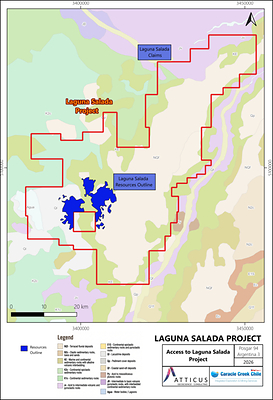
The Laguna Salada deposit is a district-scale, near-surface, surficial uranium-vanadium asset covering 28 mining concessions over 210,284.45 hectares in central Patagonia (Figure 1). Mineralization occurs as shallow, tabular, caliche-style gravels and unconformity-hosted zones that could be amenable to low-cost open-pit extraction and physical beneficiation. The potential mining and processing methods, costs, environmental effects and economic viability of the Mineral Resources have not been established and will require further technical studies.
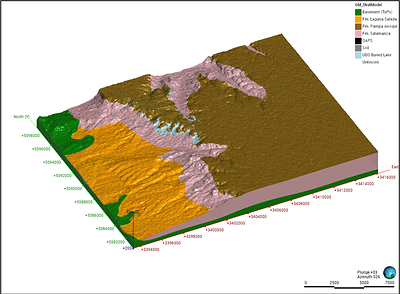
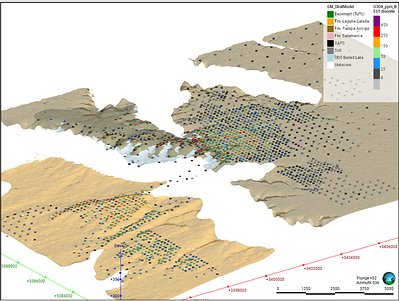
Uranium-vanadium mineralization at Laguna Salada occurs in unconsolidated gravels of the Pampa de Arroqui Formation, in unconsolidated gravels of the Gran Laguna Salada Formation, and near the unconformity between Quaternary strata and the underlying substratum, including sandstones and pelite of the Salamanca Formation and sandstones and conglomerates of the Puesto Manuel Arce Formation (Figure 2). The principal uranium-vanadium mineral recognized at Laguna Salada is carnotite, which commonly occurs as yellow-green powdery or finely crystalline material within the sandy matrix of the gravel, as partial rims on sand grains and clasts, and locally as staining within carbonate-cemented matrix material.
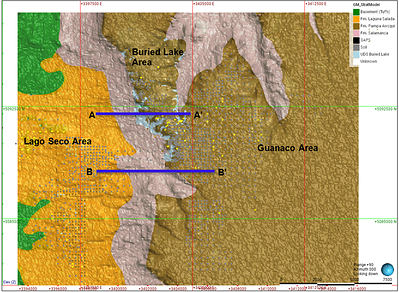
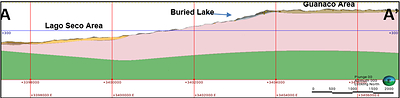
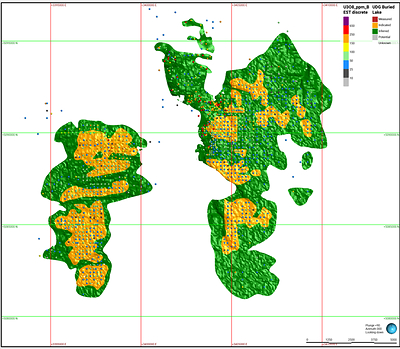
Three principal styles of uranium-vanadium mineralization are recognized on the Project: near-surface, tabular, caliche-style uranium-vanadium mineralization in unconsolidated sandy gravel at Guanaco and Lago Seco; unconformity-related uranium-vanadium mineralization at Buried Lake; and volcanic-hosted uranium-vanadium mineralization at La Rosada. The principal Mineral Resource areas are Laguna Salada, historically referred to as Lago Seco, Pampa de Arroqui, historically referred to as Guanaco, and Buried Lake (Figure 3 and Figure 4).
Upcoming Work Program
Jaguar is targeting a work program designed to upgrade Inferred resources and expand mineralization across open target areas:
- Pampa de Arroqui & Laguna Salada Infill: Excavation of approximately 250 new surface pits and trenches to achieve 200 m to 100 m grid coverage.
- Buried Lake Sonic Drilling: Completion of 1,500 metres of sonic/vibrosonic drilling (about 100–150 drill holes) to recover intact, representative core across the unconformity-hosted domain.
- Metallurgical & Field Studies: Representative sampling for bench-scale beneficiation/vanadium recovery optimization, environmental baseline monitoring, and updated MRE modeling.
Drilling, Sampling & Analytical Protocols
The Mineral Resource Estimate was primarily defined using data from 2,146 historical pits and trenches comprising whole, screened and paired samples. The Qualified Persons considered conventional drilling unsuitable for primary grade estimation because poor core recovery and preferential loss of fine-grained carnotite-bearing matrix may bias samples from the loose gravel host. Data from 57 historical reverse-circulation holes were used only to support interpretations of subsurface geological continuity because air-flushing may have biased the samples. Historical pit and trench sampling generally comprised continuous vertical sidewall channel samples that were analyzed either as whole samples or after screening to the less-than-one-quarter-inch fraction. Sample preparation and analysis were conducted by Alex Stewart Assayers and ALS Chemex using four-acid digestion and ICP-OES, ICP-AES or ICP-MS methods, with an over-limit method used for samples above 10,000 ppm. Area-specific regression formulas were used to convert screened results to estimated in-situ grades, and blocks estimated from derived grades were classified only as Inferred Mineral Resources.
Resource Estimation Methodology
The resource estimation workflow (see Figure 5) was executed using an integrated software suite (Geobank™, Leapfrog Geo™, Micromine™, Leapfrog Edge™, and Datamine NPV Scheduler) across three flat-lying hard-bounded domains: Pampa de Arroqui, Laguna Salada, and Buried Lake. Defined at a 25 ppm uranium threshold, the 3D domain wireframes were modeled using an unrotated block model (100 m x 100 m x 1 m) with sub-blocking down to 25 m x 25 m x 0.25 m to accurately resolve thin 1-4 m mineralized horizons. After compositing on a per-sample-location basis, domain-specific high-grade top-cuts were applied to U3O8 (ranging from 290 ppm at Laguna Salada to 1,110 ppm at Buried Lake, affecting <
Cut-Off Grade & Sensitivity Analysis
The MRE is reported at a NSR cut-off value of
Overall, the sensitivity analysis indicates that the effect of changing the reporting threshold varies between the three mineralized areas. Pampa de Arroqui shows the strongest grade-tonnage response around the selected reporting case, followed by Laguna Salada, while Buried Lake shows a comparatively flatter response. In all three areas, lower equivalent U₃O₈ prices correspond to higher NSR cut-offs, resulting in lower retained tonnage and generally higher average U₃O₈ grades.
Qualified Persons
The scientific and technical information in this news release relating to the technical reporting of the Mineral Resource Estimate has been reviewed and approved by independent Qualified Persons Dr. Scott Jobin-Bevans (P.Geo., Ph.D., PMP) of Caracle Creek Chile SpA and Caracle Creek International Consulting Inc. and Simon J.A. Mortimer (FAIG #7795, M.Sc.) of Atticus Geoscience Consulting Ltd. Each is a Qualified Person as defined by NI 43-101 and Regulation S-K 1300. The Qualified Persons have reviewed and verified the relevant data supporting the Mineral Resource Estimate, including the sampling, analytical and test data, and have found the data adequate for the purposes of the disclosure.
Additional scientific and technical content in this news release has been reviewed and approved by C. Gustavo Fernandez, P.Geo., a consultant to the Company and a Qualified Person as defined under Regulation S-K 1300 and NI 43-101.
A Technical Report to support the MRE and prepared in accordance with NI 43-101 will be filed on SEDAR+ within 45 days of this news release and a Technical Report Summary in support of the MRE and prepared in accordance with Regulation S-K 1300 will be filed with the SEC as an exhibit to the applicable SEC filing.
About Jaguar Uranium
Jaguar Uranium Corp. is a South America-focused uranium exploration company advancing a portfolio of prospective brownfield projects across Argentina and Colombia. In Argentina, Jaguar is advancing the Laguna Salada Project in Chubut Province and the historic Huemul uranium mine in Mendoza Province. Anchored by a former producing mine, a historic uranium district and exploration projects supported by historical drilling, the Company is focused on advancing and expanding uranium opportunities across the region. The Company's Berlin Project in Caldas Province, Colombia is a district-scale, sedimentary-hosted polymetallic system historically reported to host uranium alongside rare earth elements, vanadium, nickel, phosphate, molybdenum, rhenium and zinc. Jaguar completed a
Forward-Looking Statements
This news release contains "forward-looking statements" and/or "forward-looking information" (collectively, "forward-looking statements") within the meaning of applicable securities legislation. All statements, other than statements of historical fact, are forward-looking statements. Generally, forward-looking statements can be identified by the use of forward-looking terminology such as "plans", "expect", "is expected", "in order to", "is focused on" (a future event), "estimates", "intends", "anticipates", "believes" or variations of such words and phrases or statements that certain actions, events or results "may", "could", "would", or the negative connotation thereof. In particular, statements regarding the Company's future operations, future exploration and development activities or other development plans constitute forward-looking statements. By their nature, statements referring to mineral reserves or mineral resources constitute forward-looking statements. Forward-looking statements in this news release include, but are not limited to statements with respect to Laguna Salada's exploration and development potential, including any expansion or upgrade of mineral resources, the completion and timing for the filing of technical reports supporting the MRE, the Company's ability to ramp up exploration activity at the Laguna Salada Project, the Company's ability to utilize its cash and the anticipated effects thereof, and the Company's ability to revive and expand its uranium opportunities and any other information herein that is not a historical fact.
The Company considers its assumptions to be reasonable based on information currently available but cautions the reader that these assumptions regarding future events, many of which are beyond the control of the Company, may ultimately prove to be incorrect since they are subject to risks and uncertainties that affect the Company, its properties and business. Such risks and uncertainties include, but are not limited to, changes in demand for and price of uranium, vanadium and other commodities and currencies; changes or disruptions in the securities markets; legislative, political or economic developments in Argentina; changes in any of the assumptions underlying the MRE; the need to obtain permits and comply with laws and regulations and other regulatory requirements; the possibility that actual results of work may differ from projections/expectations or may not realize the perceived potential of the Company's projects; risks of accidents, equipment breakdowns and labor disputes or other unanticipated difficulties or interruptions; the possibility of cost overruns or unanticipated expenses in development programs; operating or technical difficulties in connection with exploration, mining or development activities; the speculative nature of exploration and development, including the risks of diminishing quantities of grades of reserves and resources; and the risks involved in the exploration, development and mining business and the additional risks discussed and identified in public filings made by the Company with the Securities and Exchange Commission and available on SEDAR+ at www.sedarplus.ca. The Company's anticipation of and success in managing the foregoing risks could cause actual results to differ materially from what is anticipated in such forward-looking statements. Although management of the Company has attempted to identify important factors that could cause actual results to differ materially from those contained in forward-looking statements, there may be other factors that cause results not to be as anticipated, estimated or intended. The Company disclaims any intention or obligation to update or revise any forward-looking statements whether as a result of new information, future events or otherwise, except as required by applicable securities laws.

 View original content to download multimedia:https://www.prnewswire.com/news-releases/jaguar-uranium-announces-maiden-mineral-resource-estimate-at-laguna-salada-in-argentina-302906426.html
SOURCE Jaguar Uranium
FAQ
AI-generated questions and answers. How Rhea-AI works. Not financial advice.
What price and recovery assumptions underpin Jaguar Uranium's Laguna Salada resource estimate?
The estimate uses prices of US$84/lb. for uranium oxide and US$5.30/lb. for vanadium oxide, with metallurgical recoveries of 84.9% and 59.5%, respectively. Resources are reported above a US$12.08-per-tonne net smelter return cut-off, a threshold based on estimated recoverable metal value.
What sampling data supports Jaguar Uranium's Laguna Salada resource estimate?
The estimate primarily uses data from 2,146 historical pits and trenches. Data from 57 historical reverse-circulation holes supported only interpretations of subsurface geological continuity because air-flushing may have biased samples. Blocks estimated from grades derived by converting screened sample results were classified only as Inferred resources.
When will Jaguar Uranium file technical reports supporting the Laguna Salada estimate?
The supporting NI 43-101 technical report will be filed on SEDAR+ within 45 days of the October 13, 2026 announcement. A Regulation S-K 1300 technical report summary will also be filed with the SEC as an exhibit to the applicable SEC filing.