
Japan Gold Identifies Multiple Geophysical Targets from 3D IP Survey at the Bajo Project
Japan Gold (OTCQB: JGLDF) reported completion of an expanded 3D induced polarization and resistivity survey at the Bajo Project in Japan, covering 37.6 line-kilometres across an 8 km by 5 km area between February and May 2026.
Sentiment and the balance of points
Rhea-AI Sentiment reads the wording of the document, how positive or negative its language is on a 1 to 5 scale. The balance of points shown with the takes weighs what the document actually discloses, so the two can disagree, for example when a trial that missed its main goal is described in upbeat language.
Rhea-AI Summary
Japan Gold (OTCQB: JGLDF) reported completion of an expanded 3D induced polarization and resistivity survey at the Bajo Project in Japan, covering 37.6 line-kilometres across an 8 km by 5 km area between February and May 2026.
The survey identified multiple chargeability and resistivity anomalies interpreted as comparable to signatures from historically mined areas, including zones with interpreted strike lengths exceeding 1 km that spatially correlate with mapped alteration, veins and structural trends. Japan Gold plans to prioritize these targets and design a diamond drilling program, while continuing community engagement and public consultations. Technical information was reviewed by Qualified Person Jason Letto.
Positive
- 37.6 line-km 3D IP survey completed over 8 km by 5 km area at Bajo
- Survey identified multiple geophysical anomalies with interpreted strike lengths exceeding 1 km
- Anomalies show strong correlation with mapped alteration, veins and structural trends
- Next phase includes target prioritization and planned diamond drilling program
- Ongoing community engagement, including groundwater resistivity survey and public consultation meetings
Negative
- None.
News Explained
The survey is complete and has generated exploration targets, while drilling remains a planned next phase rather than a reported result.
In its
This moves the Bajo exploration program from completed geophysical data collection into target prioritization, with planning and execution of a diamond-drilling program described as the next phase.
The anomalies are preliminary interpretations showing spatial correlation with mapped surface alteration, veins, and structural trends; the release says some interpreted features have strike lengths exceeding
The next concrete milestone is a prioritized target list followed by a drilling plan; the release says the program will be designed to test the highest-priority anomalies in consultation with local stakeholders.
Details
News Market Reaction – JGLDF
On Jul 13, the day this news came out, JGLDF closed 1.37% above the previous close.
Data tracked by StockTitan Argus for the Jul 13 session.
AI-generated analysis. How Rhea-AI works. Not financial advice.




Vancouver, British Columbia--(Newsfile Corp. - July 13, 2026) - Japan Gold Corp. (TSXV: JG) (OTCQB: JGLDF) ("Japan Gold" or the "Company") is pleased to announce the completion of an expanded 3D Induced Polarization ("3D IP") and resistivity geophysical survey at the Bajo Project in Japan (see news release dated February 26, 2026 ). A total of 37.6 line-kilometres of 3D IP was completed over an 8 km by 5 km area at Bajo between February and May 2026.
The 3D IP survey was successful in identifying multiple chargeability and resistivity anomalies that are interpreted to be comparable to geophysical signatures observed in areas of historical mining. The survey was designed to characterize the geophysical response associated with known veins, including the Sakuru-Hi vein, which historically reported grades of up to 125.9 g/t Au and 557 g/t Ag1, and apply this interpretation across the 8 km-long project area. Preliminary interpretations of the survey results suggest the presence of extensions and sub-parallel features that appear continuous across multiple survey lines, with interpreted strike lengths exceeding 1 km. These interpreted anomalies show strong spatial correlation with mapped surface alteration, veins, and structural trends across the project area.
With multiple prospective anomalies identified by the 3D IP survey, the next phase of exploration will focus on target prioritization, followed by the planning and execution of a diamond drilling program in consultation with local stakeholders. The drilling program will be designed to test the highest-priority geophysical anomalies supported by the integrated geological and structural interpretation of the project area.
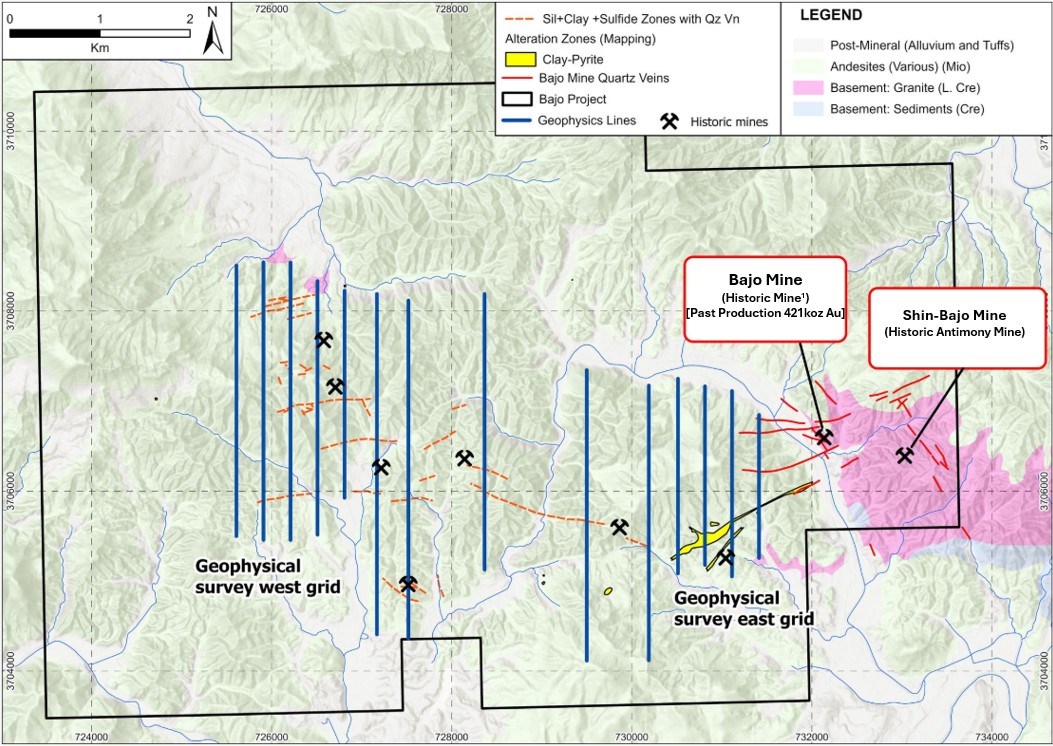
Figure 1: Map of the Bajo Project showing the 3D IP survey grid, the location of the historic Bajo Mine and Shin-Bajo Mine, and the interpreted westward strike extension of the mineralized trend.
To view an enhanced version of this graphic, please visit:
https://images.newsfilecorp.com/files/5665/304840_f934f48014e07b9a_001full.jpg
Community Engagement
Japan Gold continues to engage with local communities and municipal leaders as part of its commitment to responsible and collaborative exploration at the Bajo Project. In May 2026, Japan Gold, in partnership with Zonge Engineering and Research Organization (Aust) Pty Ltd., was proud to support a local community experiencing water supply challenges by conducting a resistivity survey to identify potential groundwater sources and evaluate suitable locations for a new water well. In June 2026, members of Japan Gold's management team held a public consultation meeting with community members and local leaders to provide an update on ongoing exploration activities and discuss future exploration plans within the project area.
Japan Gold remains committed to maintaining open communication with local stakeholders and working collaboratively with communities as exploration activities advance.
Qualified Person
The technical information in this news release has been reviewed and approved by Japan Gold's Vice President of Exploration, Jason Letto, B.Sc., P.Geo., who is a Qualified Person as defined by National Instrument 43-101.
About Japan Gold Corp.
Japan Gold Corp. is a Canadian mineral company focused on the exploration and discovery of high-grade epithermal gold deposits across the main islands of Japan. The Company holds a significant portfolio of tenements covering areas with known gold occurrences, history of mining and prospective for high-grade epithermal gold mineralization in one of the most stable and under explored countries in the world. The Japan Gold leadership and operational team of geologists, drillers and technical advisors have extensive experience exploring and operating in Japan and have a track record of discoveries world-wide.
On behalf of the Board of Japan Gold Corp.
John Proust
Chairman & CEO
For further information, please contact:
Alexia Helgason
Vice President, Corporate Communications
Phone: +1(604) 417-1265
Email: ahelgason@japangold.com
Cautionary Note
Neither the TSX Venture Exchange nor its Regulation Services Provider (as such term is defined in the policies of the TSX Venture Exchange) accepts responsibility for the adequacy or accuracy of this release. This news release contains forward-looking statements relating to expected or anticipated future events, including the results of the geophysical survey. These statements are forward-looking in nature and, as a result, are subject to certain risks and uncertainties that include, but are not limited to, general economic, market and business conditions, the stability of the financial and capital markets; the timing and granting of prospecting rights; the Company's ability to convert prospecting rights into digging rights within the timeframe prescribed by the Mining Act; competition for qualified staff; the regulatory process and actions; technical issues; new legislation; potential delays or changes in plans; working in a new political jurisdiction; results of exploration; and the occurrence of unexpected events. Actual results achieved may differ from the information provided herein and, consequently, readers are advised not to place undue reliance on forward-looking information. The forward-looking information contained herein speaks only as of the date of this News Release. The Company disclaims any intention or obligation to update or revise forward‐looking information or to explain any material difference between such and subsequent actual events, except as required by applicable laws.
1 Mining and Materials Processing Institute of Japan (1989), Gold Mines in Japan, Vol. 1: Kyushu, pp. 34-37.

To view the source version of this press release, please visit https://www.newsfilecorp.com/release/304840
FAQ
AI-generated questions and answers. How Rhea-AI works. Not financial advice.