STOCK TITAN

Americans Respond to Financial Pressures With Smarter Spending and Increased Saving, New KeyBank Pulse Poll Finds

Rhea-AI Impact
(Neutral)
Rhea-AI Sentiment
(Neutral)
Tags

KeyBank (NYSE: KEY) released its 2026 Financial Mobility Pulse Poll on April 6, 2026, showing Americans are adapting to economic pressure with smarter spending and more saving. 33% make daily financial trade-offs and 31% weekly; 88% made at least one meaningful adjustment. Key priorities include proactive planning, using supplemental income, and deeper bank relationships.

Loading...
Loading translation...

AI-generated analysis. Not financial advice.

Positive

  • 33% of Americans make daily financial trade-offs
  • 88% of respondents made at least one meaningful financial adjustment
  • Switching to cheaper brands rose to 59% (from 49% in 2025)
  • Cutting subscriptions rose to 51% (from 41% in 2025)
  • $184 billion in Key's reported assets at December 31, 2025

Negative

  • Overall optimism fell to 20% from 26% in 2025
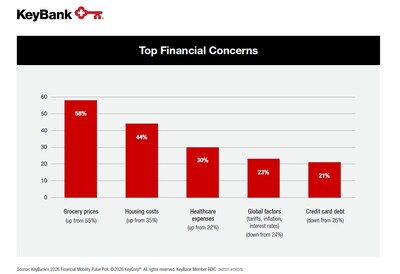
  • Household concerns focused on grocery prices (58%) and housing costs (44%)
  • Healthcare concern rose to 30% from 22% in 2025

News Market Reaction – KEY

+0.93%
1 alert
+0.93% News Effect

On the day this news was published, KEY gained 0.93%, reflecting a mild positive market reaction.

Data tracked by StockTitan Argus on the day of publication.

Key Figures

Total assets: approximately $184 billion Revenue growth: 16% year over year Net interest income growth: 23% +5 more
8 metrics
Total assets approximately $184 billion KeyCorp assets at December 31, 2025
Revenue growth 16% year over year Record 2025 revenue vs. 2024 (proxy summary)
Net interest income growth 23% 2025 vs. 2024 (proxy summary)
Pre‑provision net revenue growth 44% 2025 vs. 2024 (proxy summary)
Assets under management $70 billion Record AUM as of December 31, 2025
Common Equity Tier 1 ratio 11.8% Capital ratio reported in DEF 14A
Q4 2025 share repurchases $200 million Share buybacks in fourth quarter 2025
Planned 2026 buybacks more than $1.2 billion Planned share repurchases in 2026 (proxy summary)

Market Reality Check

Price: $21.33 Vol: Volume 12,973,416 vs 20-d...
normal vol
$21.33 Last Close
Volume Volume 12,973,416 vs 20-day average 16,803,892 (relative volume 0.77x), indicating quieter-than-typical trading. normal
Technical Price at 20.47 is trading above the 200-day MA of 19.22, reflecting a generally constructive longer-term trend before this release.

Peers on Argus

KEY gained 0.64% with multiple regional bank peers also higher: RF +2.72%, CFG +...

KEY gained 0.64% with multiple regional bank peers also higher: RF +2.72%, CFG +2.56%, SHG +2.59%, BAP +1.92%, HBAN +1.41%. The move fits a broader positive tone in regional banks despite no same-day peer headlines.

Historical Context

5 past events · Latest: Mar 23 (Positive)
Pattern 5 events
Date Event Sentiment Move Catalyst
Mar 23 Middle market expansion Positive +1.2% Launch of five-person Atlanta middle market team to drive Southeast growth.
Feb 25 Sports bank partnership Positive +2.2% Multi‑year Portland Thorns retail banking partnership and youth programs.
Feb 24 Industry awards Positive -0.1% Nine Coalition Greenwich awards for small business and middle market banking.
Feb 09 Family office build-out Positive -0.9% Hiring of five-person family office and private capital team in Kansas.
Feb 06 Wealth award win Positive +2.3% Key Family Wealth wins Best Educational Initiative at 2026 PAM Awards.
Pattern Detected

Recent news has focused on expansion and awards, with mostly positive but sometimes muted price responses, suggesting investors reward clear growth moves but can underreact to recognition-focused headlines.

Recent Company History

Over the past several months, KeyCorp has emphasized middle market expansion and brand strength. On Feb. 6, 2026, Key Family Wealth won a “Best Educational Initiative” award, with shares up 2.25%. Subsequent announcements in February and March added specialized middle market and family office teams and a new Atlanta commercial banking team, with mixed reactions from -0.86% to +2.24%. The current consumer-focused financial mobility survey continues this pattern of brand- and client-engagement messaging rather than hard financial guidance.

Market Pulse Summary

This announcement centers on KeyBank’s 2026 Financial Mobility Pulse Poll, highlighting that 88% of ...
Analysis

This announcement centers on KeyBank’s 2026 Financial Mobility Pulse Poll, highlighting that 88% of Americans have made at least one meaningful financial adjustment and that optimism has eased to 20%. For KeyCorp, it reinforces positioning as a financial wellness partner rather than changing fundamentals. In the background, 2025 results showed record revenue up 16%, pre‑provision net revenue up 44%, and a CET1 ratio of 11.8%, metrics investors can monitor alongside future earnings and capital return updates.

Key Terms

side hustles, pre‑provision net revenue, common equity tier 1 ratio, deferred shares, +4 more
8 terms
side hustles financial
"Side hustles are also rising. More than one in three Americans (35%)..."
Side hustles are small, informal businesses or paid activities that people run alongside their main job to earn extra income, like freelancing, gig work, or selling goods online. Investors watch trends in side hustles because they affect household spending, labor availability and consumer demand—similar to how a second income stream can change a household’s budget, widespread side hustles can shift company revenues and credit risks across an economy.
pre‑provision net revenue financial
"Pre‑provision net revenue grew 44% versus 2024..."
Pre-provision net revenue is a bank’s core operating income after paying day-to-day expenses but before setting aside money for bad loans or credit losses. It shows the cash a lender generates from its normal business—like interest, fees and costs—available to absorb future loan losses; investors use it like a thermometer of a bank’s earning strength and resilience, similar to how a household’s take-home pay indicates its ability to handle unexpected bills.
common equity tier 1 ratio financial
"KeyCorp reports a Common Equity Tier 1 ratio of 11.8%..."
The common equity tier 1 ratio is a measure of a bank's financial strength, showing how much high-quality core capital it has compared to its total risk-weighted assets. Think of it as a safety buffer or cushion that helps ensure the bank can withstand economic shocks. For investors, a higher ratio indicates a stronger, more resilient bank, making it a key indicator of its financial health.
deferred shares financial
"Todd J. Vasos received 2,306 deferred shares on March 31, 2026..."
Deferred shares are a class of stock whose economic benefits or certain shareholder rights are delayed or paid later than ordinary shares—for example, dividends may be paid only after other shareholders receive theirs, or voting or redemption rights may be postponed. For investors, that timing difference matters because deferred shares typically offer lower near-term income and different risk, affecting expected returns, priority in payouts, and the share’s market value; think of them like a delayed paycheck compared with a regular salary.
schedule 13g/a regulatory
"The Vanguard Group filed Amendment No. 14 to a Schedule 13G/A..."
A Schedule 13G/A is an amended public filing with the U.S. securities regulator that updates a previous Schedule 13G, disclosing when an individual or group holds a substantial (typically over 5%) stake in a company and is claiming a passive, non‑controlling intent. Investors monitor these updates because rising or falling holdings can signal changing confidence, potential future moves, or shifts in voting power — like watching a public ledger where large shareholders quietly adjust their positions.
investment agreement financial
"The disposition was made under an Investment Agreement dated August 12, 2024..."
A written contract between an investor and a company that lays out the exact terms of an investment — how much money is provided, what the investor receives in return, and the rights and obligations of each side. It matters to investors because it sets the rules for ownership, control, payout and exit, and protections against future changes; think of it like a lease or recipe that tells everyone what to expect and how disputes or changes will be handled.
say‑on‑pay vote regulatory
"approve an advisory say‑on‑pay vote, and approve a new 2026 Equity Compensation Plan..."
A say-on-pay vote is a shareholder vote on a company’s executive compensation policy, where investors express approval or disapproval of how top managers are paid. It is usually advisory (non-binding) but serves as a public signal and accountability tool — like a neighborhood meeting where residents voice approval of the landlord’s budget — and can influence board decisions, management behavior, and investor confidence.
form 4 regulatory
"This survey was conducted online by Schmidt Market Research..."
Form 4 is a official document that company insiders, such as executives or major shareholders, file with regulators whenever they buy or sell company shares. It provides transparency about how those with inside knowledge are trading, helping investors see if insiders are confident in the company's prospects or may be selling for personal reasons. This information can influence investor decisions by revealing insiders' perspectives on the company's value.

AI-generated analysis. Not financial advice.

See more from StockTitan in Google Search and AI answers. Adds StockTitan as a preferred source · opens Google
Add on Google

33% of Americans report making financial trade-offs daily, and another 31% are doing so weekly, as they adjust their financial behavior to match today's realities.

CLEVELAND, April 6, 2026 /PRNewswire/ -- Economic uncertainty hasn't slowed Americans down – it's spurred them into action. KeyBank's 2026 Financial Mobility Survey Pulse Poll, a follow-up to KeyBank's Financial Mobility Survey conducted in July 2025, reveals that, though concern about the economy has increased (rising from 26% in 2025 to 28% today across all income levels), Americans are responding to financial pressure with intention, adaptability, and proactive decision-making.

"The financial pressures people face today are real and widespread across the financial spectrum. What stands out, though, is that Americans aren't waiting for conditions to improve," said Daniel Brown, EVP & Director, Consumer Product Management at KeyBank. "They're being proactive and resourceful in response to these pressures, and these aren't just one-time reactions – 88% of Americans have made at least one meaningful adjustment to their finances. People are navigating the current economic climate through daily decisions that are quickly becoming lasting habits.

Financial Decision-Making Has Become a Daily Practice

Perhaps the most striking finding from KeyBank (NYSE: KEY): one in three Americans (33%) are making financial trade-offs every single day, and another 31% are doing so weekly. That means nearly two-thirds of Americans are actively managing their spending and savings on at least a weekly basis – a sign of financial engagement. Higher earners are not exempt, with a quarter (26%) of those with at least $100,000 in income making daily financial compromises.

Americans Are Finding Smart, Creative Ways to Stretch Their Dollars

The survey's most empowering finding: 88% of Americans have made at least one meaningful adjustment to their financial behavior, a figure that spans income levels and generations. The most common strategies include switching to less expensive brands or services (59%, up from 49% in 2025), cutting subscriptions or memberships (51%, up from 41%), and reducing discretionary spending (11%, up from 8% in 2025). Side hustles are also rising. More than one in three Americans (35%) has taken on additional work to generate supplemental income, with Gen Z leading the charge at 49%.

Confidence is Softening Across Every Income Level

Americans are taking a more measured view of their personal financial outlook, with optimism at 20% today compared to 26% in 2025. This shift cuts across income levels, with 29% of households earning $100,000 or more reporting a positive outlook, down from 34% in 2025. Notably, millennial adults, while maintaining a baseline level of confidence in their personal finances, are also seeing that sentiment ease, with optimism declining to 23% from 28% in 2025. 

Cost-of-Living Pressures Are Reshaping Financial Priorities

When asked about their top financial concerns, Americans pointed overwhelmingly to everyday expenses: grocery prices (58%), housing costs (44%), and healthcare expenses (30%) top the list. Healthcare is a notable mover, up from 22% in 2025, reflecting growing anxiety about medical costs as a driver of financial strain. Even so, 17% of Americans cite retirement savings as a top concern, a signal that despite near-term pressures, many are keeping one eye on the future.

Looking Ahead: KeyBank's Guidance for 2026

Based on the survey findings, KeyBank has identified five priorities to help Americans turn today's adjustments into tomorrow's financial strength:

  • Shift from reactive budgeting to proactive planning. With daily financial trade-offs becoming the norm, regularly reviewing spending habits, savings goals, and financial priorities can ensure that short-term adjustments support long-term stability.
  • Turn supplemental income into lasting progress. Channeling additional income toward emergency savings, debt reduction, or retirement contributions can compound its impact over time.
  • Seek personalized guidance. Working with a trusted financial partner to build a tailored plan can help Americans navigate uncertainty with greater confidence.
  • Deepen your relationship with your bank. A strong banking relationship can enhance your banking experience. Some banks have specific relationship programs, like KeyBank's relationship benefits, which can provide benefits to clients who have a deeper relationship with their bank.
  • Turn everyday banking into added value. The right checking account, like KeyBank's Key Select Checking, or right credit card may also unlock rewards, interest, and relationship benefits.

To learn more about the survey's findings, visit the KeyBank 2026 Financial Mobility Pulse Poll Executive Summary.

Access KeyBank's financial wellness online resources, including the Financial Wellness Center's Banking 101 curriculum, or meet with a local banker to complete a Key Financial Wellness Review to chart a path for a more financially confident future.

Methodology

This survey was conducted online by Schmidt Market Research in January 2026 polling 1,000 Americans ages 18-70. All respondents have sole or shared responsibility for household financial decisions and maintain a checking or savings account. The survey examined respondents' spending and savings habits, levels of financial confidence, stress and resiliency factors, economic sentiment, and debt impacts.

ABOUT KEYCORP
KeyCorp's roots trace back more than 200 years to Albany, New York. Headquartered in Cleveland, Ohio, Key is one of the nation's largest bank-based financial services companies, with assets of approximately $184 billion at December 31, 2025. Key provides deposit, lending, cash management, and investment services to individuals and businesses in 15 states under the name KeyBank National Association through a network of approximately 950 branches and approximately 1,200 ATMs. Key also provides a broad range of sophisticated corporate and investment banking products, such as merger and acquisition advice, public and private debt and equity, syndications and derivatives to middle market companies in selected industries throughout the United States under the KeyBanc Capital Markets trade name. For more information, visit https://www.key.com/. KeyBank Member FDIC.

CFMA #260327-4271628

2026 KeyBank Financial Mobility Pulse Poll


Cision View original content to download multimedia:https://www.prnewswire.com/news-releases/americans-respond-to-financial-pressures-with-smarter-spending-and-increased-saving-new-keybank-pulse-poll-finds-302733897.html

SOURCE KeyBank

FAQ

What did KeyBank's April 6, 2026 Pulse Poll find about daily financial trade-offs (KEY)?

About 33% of Americans make financial trade-offs daily, and 31% do so weekly. According to KeyBank, this indicates nearly two-thirds actively manage spending and savings at least weekly, signaling persistent short-term budgeting behavior.

How many Americans have adjusted their finances according to KeyBank's 2026 survey (KEY)?

88% of Americans have made at least one meaningful financial adjustment. According to KeyBank, adjustments span income and age groups and include switching brands, cutting subscriptions, and reducing discretionary spending.

What spending changes increased year-over-year in KeyBank's 2026 Pulse Poll (KEY)?

Switching to less expensive brands rose to 59% (from 49%) and cutting subscriptions rose to 51% (from 41%). According to KeyBank, these increases reflect growing cost-conscious consumer behaviors.

How did consumer optimism change in KeyBank's January 2026 survey (KEY)?

Reported optimism fell to 20% in 2026 from 26% in 2025. According to KeyBank, the decline appears across income levels, including households making $100,000+ where optimism fell to 29% from 34%.

What top financial concerns did KeyBank identify in the 2026 Pulse Poll (KEY)?

Top concerns were grocery prices (58%), housing costs (44%), and healthcare expenses (30%). According to KeyBank, everyday expenses remain the primary drivers of financial strain for respondents.

What guidance did KeyBank offer investors and consumers after the 2026 Pulse Poll (KEY)?

KeyBank advised shifting to proactive planning, channeling supplemental income into savings or debt reduction, and seeking personalized guidance. According to KeyBank, deeper bank relationships and the right accounts can provide added benefits and financial support.