
Kratos and GE Aerospace Win U.S. Air Force Award to Design Engine for Expendable Combat Collaborative Aircraft
Kratos (NASDAQ: KTOS) and GE Aerospace won a $12.4M U.S. Air Force contract announced Feb 23, 2026 to complete preliminary design of the GEK1500 — a 1,500-lb thrust engine for small CCAs, UAS, and missiles.
Rhea-AI Summary
Kratos (NASDAQ: KTOS) and GE Aerospace won a $12.4M U.S. Air Force contract announced Feb 23, 2026 to complete preliminary design of the GEK1500 — a 1,500-lb thrust engine for small CCAs, UAS, and missiles.
The program leverages GEK800 maturation to target higher thrust, more electrical power, lower lifecycle cost, and accelerated delivery; an optional follow-on will assess flight and installation performance.
Positive
- $12.4M U.S. Air Force contract awarded for GEK1500 preliminary design
- Design leverages GEK800 maturation to reduce cost and schedule
- GEK1500 targets 1,500-lb thrust for CCAs, UAS, and missiles
Negative
- Initial phase covers preliminary design only; further work depends on option exercise
- Performance characterization under flight and installation conditions is not yet complete
Details
News Market Reaction – KTOS
On Feb 23, the day this news came out, KTOS closed 1.84% below the previous close.
Data tracked by StockTitan Argus for the Feb 23 session.
Key Figures
- Air Force contract value
- $12.4M
- Initial phase to design GEK1500 CCA engine
- Engine thrust
- 1,500-lb thrust
- GEK1500 jet engine for UAS, CCAs, missiles
- Experience in small engines
- More than 25 years
- Kratos experience with small, affordable engines
- GE propulsion expertise
- A century
- GE Aerospace experience in propulsion technology
Historical Context
-
New 600-acre solid rocket motor manufacturing campus with up to $175M capital.
-
Contract to support test and evaluation for hypersonic vehicle materials.
-
Multi-million dollar Airbus contract for OmanSat-1 ground segment delivery.
-
Expansion of automated truck platooning for NASCAR 2026 logistics.
-
Announcement of Q4 and FY 2025 earnings release and conference call timing.
24h Move is the share-price change in the day after each event; other market factors may also have contributed.
Key Terms
collaborative combat aircraft technical
unmanned aerial systems technical
lifecycle cost technical
memorandum of understanding regulatory
AI-generated analysis. How Rhea-AI works. Not financial advice.




Joint team will complete preliminary design of the GEK1500 engine to meet high performance and aggressive cost targets, leveraging GEK800 maturation to accelerate delivery
SAN DIEGO, Feb. 23, 2026 (GLOBE NEWSWIRE) -- Kratos Defense & Security Solutions, Inc. (NASDAQ: KTOS), a leader in defense, national security and global markets, and GE Aerospace (NYSE: GE), today announced a joint U.S. Air Force contract for
Stacey Rock, President of Kratos Turbine Technologies Division, said, “Building on the success of our GEK800 engine program, the development of the GEK1500 further demonstrates our team’s ability and commitment to deliver high-performance, affordable, jet engines that can be rapidly produced to meet the demands of our defense customers.”
“Lessons learned from recent GEK800 altitude testing are directly informing GEK1500 —improving thrust, power generation, and lifecycle cost — so we can meet CCA requirements without compromising affordability or schedule,” said Steve “Doogie” Russell, Vice President and General Manager of Edison Works at GE Aerospace.
The GEK1500 is a 1,500-lb thrust jet engine that could potentially power unmanned aerial systems (UAS), collaborative combat aircraft (CCAs), and missiles. The design of the GEK1500 leverages the GEK800 cruise missile engine architecture which is successfully completing technical maturation. An additional option on the contract, if exercised, would enable the team to assess key design risks and characterize engine performance under relevant flight and installation conditions for the GEK1500 engine. The Air Force has prioritized the development of high performing and low-cost engines to enable the disruptive capabilities of small CCAs.
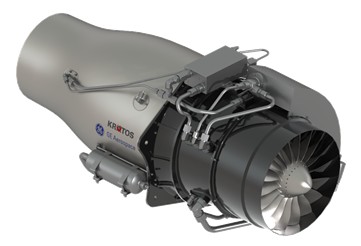
GEK1500 Engine (Concept Rendition: Kratos and GE Aerospace)
A photo accompanying this announcement is available at https://www.globenewswire.com/NewsRoom/AttachmentNg/ca515869-9da2-4fe8-8170-5af81deaed85
Recent altitude testing of the GEK800 engine demonstrated critical technologies that will provide future systems increased range, increased thrust, decreased life cycle cost, and increased electrical power. The investments and progress made to date on the GEK800 will reduce the cost and schedule timelines for the GEK1500 and provide enhanced performance for small CCAs.
In June, Kratos and GE Aerospace announced the signing of a formal teaming agreement to advance propulsion technologies for the next generation of affordable unmanned aerial systems and CCA-type aircraft, covering the GEK800 and a framework for partnering on additional engines. The result is another formal teaming agreement covering the GEK1500. This collaboration strengthens the companies’ ongoing partnership and builds on a 2024 Memorandum of Understanding (MOU) to advance the development and production of small, cost-effective engines for unmanned platforms. The teaming agreement expanded on that MOU and provided the framework for the two companies to develop, manufacture, test, and field the GEK800 and additional GEK engines in higher thrust classes.
Kratos brings more than 25 years of experience developing and producing small, affordable engines for UAS, drones, and missile platforms. GE Aerospace adds a century of expertise in propulsion technology and the ability to scale advanced designs into high-rate production, helping bridge the gap from prototype to deployment.
About GE Aerospace
GE Aerospace is a global aerospace propulsion, services, and systems leader with an installed base of approximately 49,000 commercial and 29,000 military aircraft engines. With a global team of approximately 53,000 employees building on more than a century of innovation and learning, GE Aerospace is committed to inventing the future of flight, lifting people up, and bringing them home safely. Learn more about how GE Aerospace and its partners are defining flight for today, tomorrow and the future at www.geaerospace.com.
About Kratos Defense & Security Solutions
Kratos Defense & Security Solutions, Inc. (NASDAQ: KTOS) is a technology, products, system and software company addressing the defense, national security, and commercial markets. Kratos makes true internally funded research, development, capital and other investments, to rapidly develop, produce and field solutions that address our customers’ mission critical needs and requirements. At Kratos, affordability is a technology, and we seek to utilize proven, leading edge approaches and technology, not unproven bleeding edge approaches or technology, with Kratos’ approach designed to reduce cost, schedule and risk, enabling us to be first to market with cost effective solutions. We believe that Kratos is known as an innovative disruptive change agent in the industry, a company that is an expert in designing products and systems up front for successful rapid, large quantity, low-cost future manufacturing which is a value add competitive differentiator for our large traditional prime system integrator partners and also to our government and commercial customers. Kratos intends to pursue program and contract opportunities as the prime or lead contractor when we believe that our probability of win (PWin) is high and any investment required by Kratos is within our capital resource comfort level. We intend to partner and team with a large, traditional system integrator when our assessment of PWin is greater or required investment is beyond Kratos’ comfort level. Kratos’ primary business areas include virtualized ground systems for satellites and space vehicles including software for command & control (C2) and telemetry, tracking and control (TT&C), jet powered unmanned aerial drone systems, advanced vehicles and rocket systems, propulsion systems for drones, missiles, loitering munitions, supersonic systems, space craft and launch systems, C5ISR and microwave electronic products for missile, radar, missile defense, space, satellite, counter UAS, directed energy, communication and other systems, and virtual & augmented reality training systems for the warfighter. For more information, visit www.KratosDefense.com.
Notice Regarding Forward-Looking Statements
Certain statements in this press release may constitute "forward-looking statements" within the meaning of the Private Securities Litigation Reform Act of 1995. These forward-looking statements are made on the basis of the current beliefs, expectations and assumptions of the management of Kratos and are subject to significant risks and uncertainty. Investors are cautioned not to place undue reliance on any such forward-looking statements. All such forward-looking statements speak only as of the date they are made, and Kratos undertakes no obligation to update or revise these statements, whether as a result of new information, future events or otherwise. Although Kratos believes that the expectations reflected in these forward-looking statements are reasonable, these statements involve many risks and uncertainties that may cause actual results to differ materially from what may be expressed or implied in these forward-looking statements. For a further discussion of risks and uncertainties that could cause actual results to differ from those expressed in these forward-looking statements, as well as risks relating to the business of Kratos in general, see the risk disclosures in the Annual Report on Form 10-K of Kratos for the year ended December 29, 2024, and in subsequent reports on Forms 10-Q and 8-K and other filings made with the SEC by Kratos.
Press Contact:
Claire Cantrell
claire.cantrell@kratosdefense.com
Investor Information:
877-934-4687
investor@kratosdefense.com
GE Aerospace:
Mandy Mayfield
Amanda.Mayfield@geaerospace.com

FAQ
AI-generated questions and answers. How Rhea-AI works. Not financial advice.