
Lockheed Martin and Venus Aerospace Collaborate to Advance Next-Generation Propulsion for Long-Range Precision Fires
Rhea-AI Summary
Lockheed Martin (NYSE: LMT) and Venus Aerospace entered a joint technology development agreement to evaluate and mature Rotating Detonation Rocket Engine (RDRE) propulsion for future long-range precision fires. The collaboration aims to accelerate transition of Venus Aerospace's flight-tested RDRE technology from subsystem demonstration into practical missile applications.
According to Lockheed Martin, RDREs use continuously traveling detonation waves rather than subsonic combustion, which could improve propulsion efficiency, extend range, increase speed and maintain compatibility with affordable, scalable production. Lockheed Martin will apply its systems integration and advanced manufacturing expertise to assess RDREs against operational military requirements and potential next-generation precision fires roles.
Positive
- None.
Negative
- None.
Historical Context
| Date | Event | Sentiment | 24h Move | Catalyst |
|---|---|---|---|---|
| Jul 20 | Interceptor introduction | Positive | +0.1% | Lockheed Martin introduced the lower-cost PAC-3 ACE interceptor for expanded air-defense capacity. |
| Jul 20 | Counter-drone introduction | Positive | +0.1% | Lockheed Martin unveiled MORFIUS X-Rotor with stated capacity against more than 50 hostile drones. |
| Jul 16 | Logistics contract award | Positive | -0.2% | Lockheed Martin received a $10.5 billion, 12-year logistics and sustainment contract. |
| Jul 16 | Venture investment expansion | Positive | -0.2% | Lockheed Martin earmarked at least $100 million for U.K. and European venture investments. |
| Jul 07 | Missile production MOU | Positive | -0.5% | Lockheed Martin and Rheinmetall advanced ATACMS co-production plans in Europe. |
24h Move is the share-price change in the day after each event; other market factors may also have contributed.
Recent positive Lockheed Martin announcements aligned with two product introductions but diverged on a contract award, venture investment, and co-production MOU.
Key Terms
rotating detonation rocket engine technical
subsonic combustion technical
detonation waves technical
AI-generated analysis. How Rhea-AI works. Not financial advice.




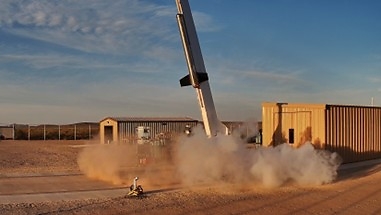
The collaboration combines Venus Aerospace's flight-tested propulsion technology with Lockheed Martin's expertise in developing, integrating and rapidly fielding advanced defense systems. Together, the companies will assess how this emerging propulsion architecture could support next-generation precision fires capabilities that require greater range, speed and operational flexibility.
THE BIG PICTURE
As threats evolve and mission demands multiply, the
WHY IT MATTERS
- Rotating detonation propulsion could enable future precision fires systems to achieve significantly greater range and speed while remaining compatible with the Army's need for affordable, scalable production.
- Unlike conventional rocket engines that rely on subsonic combustion, RDREs generate thrust through continuously traveling detonation waves. This approach has the potential to improve propulsion efficiency while reducing complexity, enabling systems to travel farther and respond faster to emerging threats.
- The agreement enables Lockheed Martin to evaluate RDRE technology within the context of operational military requirements to transition the advanced propulsion concept from a subsystem demonstration environment into practical missile applications.
- Lockheed Martin's expertise in system integration and advanced manufacturing allows advanced technologies to move more quickly from laboratory development into deployable defense solutions that can be produced at scale.
- By working with innovative
U.S . technology companies, Lockheed Martin is strengthening the nation's defense industrial base and helping accelerate advanced manufacturing capabilities critical to future readiness.
EXPERT PERSPECTIVE
- "Lockheed Martin is focused on rapidly delivering advanced capabilities that strengthen deterrence and provide decisive advantages for the warfighter," said Tim Cahill, president, Lockheed Martin Missiles and Fire Control. "Our collaboration with Venus Aerospace allows us to evaluate a promising propulsion technology and determine how it can be integrated into future precision fires solutions. Partnerships like this help accelerate innovation, reduce risk and rapidly advance from emerging technology to operational capability."
- "Defense customers are asking for more than incremental gains from legacy propulsion," said Sassie Duggleby, co-founder and CEO of Venus Aerospace. "Our RDRE technology offers a different propulsion architecture for systems that need more range, more speed and a realistic path to production. This agreement with Lockheed Martin moves our breakthrough closer to real precision fires applications."
About Lockheed Martin
Lockheed Martin is a global defense technology company driving innovation and advancing scientific discovery. Our all-domain mission solutions and 21st Century Security® vision accelerate the delivery of transformative technologies to ensure those we serve always stay ahead of ready. More information at Lockheedmartin.com.

 View original content to download multimedia:https://www.prnewswire.com/news-releases/lockheed-martin-and-venus-aerospace-collaborate-to-advance-next-generation-propulsion-for-long-range-precision-fires-302830966.html
SOURCE Lockheed Martin