
New Framework Agreement for Multiyear F‑35 Production and Sustainment
Final contract terms, pricing and schedules remain dependent on multiyear authority and associated appropriations.
Sentiment and the balance of points
Rhea-AI Sentiment reads the wording of the document, how positive or negative its language is on a 1 to 5 scale. The balance of points shown with the takes weighs what the document actually discloses, so the two can disagree, for example when a trial that missed its main goal is described in upbeat language.
Rhea-AI Summary
Lockheed Martin (LMT) and the Department of War unveiled a multiyear F-35 production and sustainment framework covering 850 U.S. aircraft.
The framework spans 10 years, including initial spares, modification kits and sustainment, plus international customer orders across Lots 21–30, at a continued production rate of 156 aircraft per year. Multiyear authority and associated appropriations must be granted before the parties finalize contract terms, pricing and schedules through a formal award. Lockheed Martin expects long-term pricing and volume discounts to save taxpayers billions of dollars over the aircraft's lifecycle, while capacity and logistics investments improve fleet readiness.
How this balance works
Rhea-AI gives every point it takes from this document a weight. Minor counts 1, Moderate 3 and Major 9, so one Major point outweighs several Minor ones. The bar adds up the weights on each side, and when neither side holds more than 65% of the total the balance reads Mixed.
It reads the document as published, with the same rules for every company, and it does not look at what the market expected or at how the stock traded, so a point can be objectively good on a day the stock falls.
Rhea-AI Sentiment measures something else, the tone of the wording.
Hollow bars mark forward-looking points. How the balance works
Positive
- Moderate point. Forward-looking: it has not happened yet and may not happen.Framework covers 850 U.S. aircraft over 10 years, with initial spares, modification kits and sustainment.
- Minor point. Forward-looking: it has not happened yet and may not happen.International customer orders span Lots 21–30, with a continued production rate of 156 aircraft per year.
- Minor point. Forward-looking: it has not happened yet and may not happen.Framework adds capacity and logistics investments that Lockheed Martin expects to improve fleet readiness.
Negative
- Moderate pointMultiyear authority and associated appropriations remain prerequisites to finalizing contract terms, pricing and schedules through a formal award.
Key Figures
- U.S. aircraft
- 850 aircraft
- Framework scope over 10 years
- Production rate
- 156 aircraft per year
- Continued production rate under the framework
- Modification kits and sustainment
- 10 years
- Framework coverage
- Expected taxpayer savings
- Billions of dollars
- Expected over the F-35 lifecycle
- U.S. jobs
- 317,000 jobs
- Program support over the next decade
AI-generated analysis. How Rhea-AI works. Not financial advice.


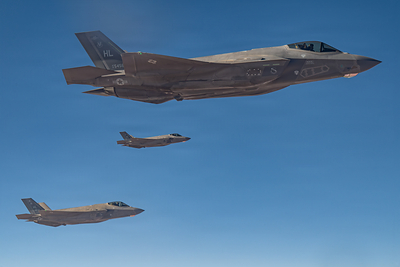
Multiyear F-35 production and sustainment strengthens the supply chain, saves billions in taxpayer dollars and improves fleet readiness.
"This multiyear framework strengthens the way we can plan and invest in the F-35 enterprise," said Lockheed Martin Chairman, President and CEO Jim Taiclet. "With the greater certainty that comes from the
If granted multiyear authority and associated appropriations in the coming months, the F-35 Joint Program Office and Lockheed Martin will work to finalize contract terms, pricing, and schedules through a formal contract award, which will fulfill the government's imperative for a predictable, affordable, and resilient fighter jet enterprise. This effort is expected to save taxpayers billions of dollars over F-35's lifecycle through long-term pricing and industry volume discounts.
The framework agreement directly addresses Department of War and Congressional priorities to improve F-35 readiness by:
- Providing predictable, multiyear procurement planning that eliminates the need for supplemental appropriations for, obsolescence management and production tooling.
- Delivering high-volume procurement efficiencies and discounts that translate into tangible taxpayer savings.
- Ensuring transparent, data driven decision-making through integrated analytics that link budget inputs to readiness outcomes.
- Providing real-time visibility into parts inventory and readiness metrics through integrated analytics.
Highlights
- Supply Chain Stability – Predictable demand from long-term contracts with suppliers will enable bulk procurement of raw materials and critical parts, slashing turnaround times and reducing logistics bottlenecks. This will result in better mission capable rates by eliminating the annual contracting cycle that has historically strained the industrial base.
- Affordability – The integrated procurement model that pairs aircraft production with purchases of spare and modification parts will deliver high-volume procurement discounts, drive down unit prices and provide the
U.S . government the cost predictability it requires. - Economic Impact – The program will support 317,000 U.S. jobs and generate approximately
$79 billion in annual economic activity over the next decade, strengthening the nation's industrial base and providing long-term stability for suppliers who have struggled to plan under the previous resourcing model. - Readiness – This framework adds investments in industry capacity and logistics that build upon Lockheed Martin's existing investments that inject parts into the global spares pool and will further improve fleet readiness and rapid repair turnaround for operations.
- International Benefits – The multiyear procurement model enables economies of scale that lower costs and enhance readiness for all F‑35 customers, reinforcing confidence in the global sustainment network and enhancing interoperability across allied fleets.
"Our new multiyear framework gives suppliers stability to plan for the future and invest with confidence, improving readiness across the F-35 fleet," said OJ Sanchez, president of Lockheed Martin Aeronautics. "This, in addition to the investments Lockheed Martin is making to the global spares pool, will directly translate into higher mission capable rates and a more resilient supply chain – critical capabilities the warfighter needs to meet today's mission and prepare for tomorrow's threats."
About the F-35 Lightning II
More than 1,375 F-35s are currently fielded around the globe, and the fleet has surpassed a million flight hours. The combat-proven F-35 operates from 42 bases worldwide, including 13 nations operating on home soil. As adversaries advance and legacy aircraft age, the F-35 is critical to maintaining air dominance into the future.
About Lockheed Martin
Lockheed Martin is a global defense technology company driving innovation and advancing scientific discovery. Our all-domain mission solutions and 21st Century Security® vision accelerate the delivery of transformative technologies to ensure those we serve always stay ahead of ready. More information at Lockheedmartin.com.

 View original content to download multimedia:https://www.prnewswire.com/news-releases/new-framework-agreement-for-multiyear-f35-production-and-sustainment-302916446.html
SOURCE Lockheed Martin Aeronautics
FAQ
AI-generated questions and answers. How Rhea-AI works. Not financial advice.
What does Lockheed Martin's multiyear F-35 framework cover?
The framework covers 850 U.S. aircraft over 10 years, associated initial spares, 10 years of modification kits and sustainment, and international customer orders across Lots 21–30. It maintains a production rate of 156 aircraft per year.
Is Lockheed Martin's F-35 framework a finalized contract award?
The framework is not yet a formal contract award. If multiyear authority and associated appropriations are granted in the coming months, the F-35 Joint Program Office and Lockheed Martin will work to finalize contract terms, pricing and schedules through a formal award.