
Skunk Works® Advances Sensor-Powered AI Fighter Intercept
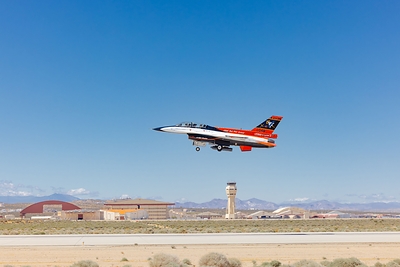
Lockheed Martin Skunk Works (NYSE: LMT), the U.S. Air Force Test Pilot School and industry partners demonstrated sensor‑powered AI autonomy on the X‑62 Variable In‑flight Simulation Test Aircraft (VISTA) at Edwards Air Force Base.
Rhea-AI Summary
Lockheed Martin Skunk Works (NYSE: LMT), the U.S. Air Force Test Pilot School and industry partners demonstrated sensor‑powered AI autonomy on the X‑62 Variable In‑flight Simulation Test Aircraft (VISTA) at Edwards Air Force Base. Across eight flights, the X‑62 executed 27 AI‑controlled air intercepts against a live T‑38 target, using targeting data from an operational Legion Pod sensor.
The objective was to prove that the X‑62’s integrated autonomy architecture can use real sensor data to inform AI behavior, validating the full cycle from development and simulation through training and flight. Skunk Works cites its “Supermassive” AI agent generation capability and a three‑month integration and ground test timeline, and plans a Mission Systems Upgrade to enable broader integration of combat systems, sensors and airborne AI agents within a next‑generation mesh network.
Positive
- None.
Negative
- None.
Details
News Market Reaction – LMT
In the Aug 4 session, LMT gained 0.52%, reflecting a mild positive market reaction.
Data tracked by StockTitan Argus on the day of publication.
Key Figures
- Test Flights
- 8 flights
- X-62 VISTA demonstration
- AI-Controlled Intercepts
- 27 AI-controlled intercepts
- Across eight X-62 VISTA flights
- Integration Timeline
- 3 months
- Ground test and integration of agents with X-62
Previous AI Reports
-
Astris AI launched a secure, high-assurance AI offering for federal agencies.
-
Live UAV testing demonstrated AI-driven contingency management across multiple unmanned systems.
-
Lockheed Martin and Google Public Sector announced secure generative AI deployment collaboration.
-
AI Fight Club introduced competitive testing for defense applications across multiple military domains.
-
Skunk Works and Arquimea demonstrated AI-enabled anomaly detection for ISR platforms.
24h Move is the share-price change in the day after each event; other market factors may also have contributed.
Key Terms
infrared search and track technical
mesh network technical
AI-generated analysis. How Rhea-AI works. Not financial advice.




Partnership with
EDWARDS AIR FORCE BASE, Calif., Aug. 4, 2026 /PRNewswire/ -- In a landmark step toward the future of airborne autonomy, Lockheed Martin Skunk Works® (NYSE: LMT), the
THE OBJECTIVE
Demonstrate that the X-62 and its integrated autonomy architecture can successfully use real sensor data to inform AI behavior, validating the full test cycle from development and simulation through training and flight execution.
THE SUCCESS AND WHY IT MATTERS
- Closed‑loop AI combat test: X‑62 equipped with the Lockheed Martin Legion Pod® tracks a live T‑38 jet and feeds secure data to an AI agent that autonomously pilots the fighter into a tactical intercept position.
- Real‑world sensor data: Moves AI testing from simulated target data to real-time, on‑board sensor streams, mirroring the data environment pilots will face in future high-stakes engagements.
- Accelerated autonomy: Skunk Works' "Supermassive" AI agent generation capability dramatically improves speed and agility. Full integration and ground test of the agents with the X-62 occurred in just three months.
- Strategic partnership: Connects the cutting‑edge of the
U.S . Air Force test community with industry expertise, expanding the TPS's AI and autonomy test portfolio to include mission‑critical onboard systems. - Enhanced pilot survivability: By delegating complex tasks to AI, pilots gain bandwidth to focus on tactical information that increases their effectiveness and survivability.
EXPERT PERSPECTIVES
"Our ongoing partnership with TPS is driving important progress with this latest flight test series demonstrating that our AI can effectively and reliably close the sensor‑to‑action loop aboard an operational combat aircraft," said Ron Fehlen, vice president and general manager, Lockheed Martin Skunk Works®. "Our autonomous agents consumed classified infrared search and track feeds and executed combat‑critical maneuvers in real time. This achievement marks a decisive advance toward delivering AI‑augmented air dominance for
"Our ability to provide reliable sensor data is critical, but the real advantage comes when that data can connect seamlessly with AI to take action," said Stacy Kubicek, vice president and general manager, Lockheed Martin Sensors and Global Sustainment. "This project demonstrates how sensing and autonomous AI can come together as a force multiplier to make faster, more informed action in complex environments."
FUTURE OUTLOOK AND NEXT STEPS
Skunk Works has been a key partner and integrator on X-62 for decades, providing open software and hardware architectures that enable pathfinding flight tests. Leveraging the proven framework from this experiment, the X-62's Mission Systems Upgrade will enable the aircraft to demonstrate seamless integration of combat systems, sensors and airborne AI agents within a next‑generation mesh network.
The path forward is exciting as this team aggressively executes technology roadmaps, in close coordination and partnership with operators, to guarantee American leadership in AI and autonomy. Skunk Works engineers are the best in the world, and their work to transform the future of air combat is ensuring air dominance now and for the years to come.
Learn more about recent X-62 flight test activity here.
ABOUT LOCKHEED MARTIN
Lockheed Martin is a global defense technology company driving innovation and advancing scientific discovery. Our all-domain mission solutions and 21st Century Security® vision accelerate the delivery of transformative technologies to ensure those we serve always stay ahead of ready. More information at Lockheedmartin.com.

 View original content to download multimedia:https://www.prnewswire.com/news-releases/skunk-works-advances-sensor-powered-ai-fighter-intercept-302842520.html
SOURCE Lockheed Martin Aeronautics
FAQ
AI-generated questions and answers. How Rhea-AI works. Not financial advice.