STOCK TITAN

LG Display OLED becomes world's first to achieve "Perfect Color/Brightness" certification

(Neutral)
(Neutral)
Tags

LG Display (NYSE:LPL) announced that its entire lineup of large OLED panels for TVs and monitors is the first globally to receive Intertek’s “Perfect Color/Brightness Accuracy up to 500 lux” certification.

The panels achieved 100% color accuracy, 100% brightness accuracy, and color crosstalk-free performance, highlighting pixel-level control advantages versus LCD backlit displays.

Loading...
Loading translation...

Positive

  • None.

Negative

  • None.

News Market Reaction – LPL

-4.31%
2 alerts
-4.31% Session close to close
$4.64B Market Cap
2.51K Volume

In the Jun 22 session, LPL declined 4.31%, reflecting a moderate negative market reaction. Our momentum scanner triggered 2 alerts that day, indicating moderate trading interest and price volatility.

Data tracked by StockTitan Argus on the day of publication.

Market Context

This announcement reinforces LG Display’s OLED strategy, adding objective third-party validation of ...
Analysis

This announcement reinforces LG Display’s OLED strategy, adding objective third-party validation of picture quality at up to 500 lux. With OLED already a majority of revenue, high investment needs and existing leverage remain important watchpoints.

Key Figures

Color accuracy: 100% Brightness accuracy: 100% Brightness certification level: 500 lux
3 metrics
Color accuracy 100% Intertek testing of LG Display large-sized OLED panels
Brightness accuracy 100% Intertek testing of LG Display large-sized OLED panels
Brightness certification level 500 lux Threshold for “Perfect Color/Brightness Accuracy up to 500 lux” certification

Historical Context

5 past events · Latest: Jun 01 (Positive)
Pattern 5 events
Date Event Sentiment 24h Move Catalyst
Jun 01 Automotive software recognition Positive +4.2% ASPICE Capability Level 2 certification supporting automotive display software competitiveness.
May 31 Gaming OLED showcase Positive -0.7% Roadshow for largest Gaming OLED lineup targeting global gaming monitor brands.
May 27 OLED mass production Positive +3.1% Start of mass production of 240Hz RGB Stripe OLED premium monitor panels.
May 04 Next-gen OLED showcase Positive +3.0% Unveiling next-generation Tandem OLED and high-refresh panels at SID Display Week.
Apr 28 Award recognition Positive -2.4% 27-inch DFR Gaming OLED winning SID’s “Display of the Year” award.

24h Move is the share-price change in the day after each event; other market factors may also have contributed.

Pattern Detected

Recent product and technology announcements have more often coincided with moderate price gains, though a couple of events saw negative follow-through.

Key Terms

color gamut, peak luminance, hdr, color crosstalk, +1 more
5 terms
color gamut technical
"display quality had largely been assessed based on specifications such as color gamut or peak luminance"
Color gamut is the range of colors a display or imaging system can produce, like the palette of paints an artist can choose from. A wider gamut means richer, more accurate colors that make screens, photos and videos look closer to real life. Investors care because gamut affects product quality and differentiation, influences consumer preference and pricing, and can impact manufacturing costs, supply-chain choices and competitive positioning in device and content markets.
peak luminance technical
"assessed based on specifications such as color gamut or peak luminance, which have limitations"
Peak luminance is the maximum brightness a screen, light source, or imaging device can produce, typically measured in nits. Think of it as how bright a flashlight can get at full power; higher peak luminance makes images look clearer in bright environments, supports premium display features, and can influence energy use and heat. Investors care because it affects product competitiveness, perceived quality, regulatory compliance for safety/medical imaging, and potential market pricing and margins.
hdr technical
"limitations when displaying high dynamic range (HDR) content such as starry night skies"
High-dose-rate (HDR) refers to a form of localized radiation therapy that delivers a strong, concentrated beam of radiation to a targeted spot for a short time, often using a temporary implant placed close to a tumor. Investors care because HDR treatments can offer faster procedures, shorter hospital stays and potentially better targeting than traditional options, which can affect adoption of related devices, treatment volumes, reimbursement and therefore a healthcare company's revenue prospects.
color crosstalk technical
"even premium LCD panels exhibit color crosstalk and reduced accuracy in brightness"
Color crosstalk is when a camera sensor or display lets light or signal meant for one color channel spill into others, so colors appear washed, mixed, or inaccurate. For investors, it matters because it reduces product image quality and sensor accuracy, can trigger redesigns or recalls, affect customer satisfaction, and influence manufacturing costs and competitive positioning—much like paint bleeding between sections ruins a finished picture.
pixel dimming technical
"LG Display's OLED panels operate using pixel dimming technology, with millions of individual pixels"
Pixel dimming is a display technique where individual pixels or small groups of pixels are made darker through software or hardware control to reduce power use or improve perceived contrast, similar to dimming a lamp in one corner of a room rather than the whole room. For investors, it matters because it affects device battery life, image quality, manufacturing complexity and component demand, which in turn influence product competitiveness, returns and costs across the supply chain.

AI-generated analysis. How Rhea-AI works. Not financial advice.

See more from StockTitan in Google Search and AI answers. Adds StockTitan as a preferred source · opens Google
Add on Google

SEOUL, South Korea, June 21, 2026 /PRNewswire/ -- LG Display, the world's leading innovator of display technologies, announced today that its entire lineup of large-sized OLED panels, including for monitors and TVs, has become the first in the world to receive "Perfect Color/Brightness Accuracy up to 500 lux" certification from global testing and certification organization Intertek. This certification confirms that a display can accurately reproduce both color and brightness regardless of viewing conditions or content.

The certification is particularly meaningful as it quantitatively validates how accurately a display reproduces color and brightness. Previously, display quality had largely been assessed based on specifications such as color gamut or peak luminance, which have limitations in objectively verifying how closely a display reproduces real-world colors.

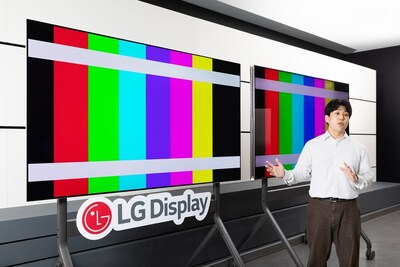
To address this, Intertek conducted comprehensive testing on OLED and LCD displays using a range of test patterns to measure variations in color and brightness, thereby objectively evaluating overall picture quality accuracy.

The test results revealed that LG Display's OLED panels — featuring self-emissive pixels — simultaneously recorded 100% color accuracy, 100% brightness accuracy, and color crosstalk-free performance. Therefore, they deliver the creator's intended color and brightness accurately, whatever the viewing environment or type of content. 100% color accuracy means consistent color reproduction regardless of test pattern size; 100% brightness accuracy refers to uniform brightness regardless of test pattern size; color crosstalk-free performance means no color interference between adjacent pixels, enabling precise color expression.

In contrast, LCD displays — which rely on backlight units larger than individual pixels — showed limitations when displaying high dynamic range (HDR) content such as starry night skies or fireworks, where brightness in highlighted areas can be diminished. In some premium LCD TVs using RGB LED backlights, color distortion was observed depending on the background colors.

These differences in picture quality accuracy stem from fundamental differences in light emission methods.

LCD-based displays control light by zones through a backlight, leading to light leakage into adjacent areas. This structural limitation means that even premium LCD panels exhibit color crosstalk and reduced accuracy in brightness and color reproduction.

LG Display's OLED panels operate using pixel dimming technology, with millions of individual pixels emitting light independently. This self-emissive structure fundamentally eliminates light leakage and interference, enabling precise reproduction of both bright and dark elements, regardless of content size or scene conditions, and delivering a superior viewing experience.

Through this certification, LG Display aims to take the lead in global picture quality competition by quantifying the value of real-world viewing experiences perceived by consumers.

"LG Display's OLED has now been objectively proven to deliver the most accurate color and brightness even in everyday viewing environments," said Hyeon-woo Lee, Head of the Large Display Business Unit at LG Display. "We will continue to strengthen our market leadership by more clearly communicating the differentiated value of premium picture quality that only OLED can deliver to customers worldwide."

About LG Display

LG Display Co., Ltd. [NYSE: LPL, KRX: 034220] is the world's leading innovator of display technologies, including thin-film transistor liquid crystal and OLED displays. The company manufactures display panels in a broad range of sizes and specifications primarily for use in TVs, notebook computers, desktop monitors, automobiles, and various other applications, including tablets and mobile devices. LG Display currently operates manufacturing facilities in Korea and China, and back-end assembly facilities in Korea, China, and Vietnam. The company has approximately 53,049 employees operating worldwide. For more news and information about LG Display, please visit www.lgdisplay.com.

Media Contact:
Joo Yeon Jennifer Ha, Team Leader, Communication Team
Email: hjy05@lgdisplay.com

Cision View original content to download multimedia:https://www.prnewswire.com/news-releases/lg-display-oled-becomes-worlds-first-to-achieve-perfect-colorbrightness-certification-302805835.html

SOURCE LG Display

FAQ

What is Intertek's "Perfect Color/Brightness Accuracy up to 500 lux" certification for LG Display (NYSE:LPL) OLED panels?

The certification confirms LG Display OLED panels accurately reproduce both color and brightness up to 500 lux. According to LG Display, Intertek’s tests showed 100% color accuracy, 100% brightness accuracy, and color crosstalk-free performance across varied test patterns and viewing conditions.

How do LG Display (NYSE:LPL) OLED panels achieve 100% color and brightness accuracy?

LG Display OLED panels use self-emissive pixels with pixel dimming technology to control light at the pixel level. According to LG Display, this structure eliminates light leakage and interference, enabling consistent color and uniform brightness regardless of test pattern size, content, or scene conditions.

How do LG Display OLED panels compare to LCD displays in HDR performance?

LG Display reports its OLED panels maintain accurate brightness and color in HDR scenes, such as starry skies or fireworks. According to LG Display, Intertek found LCDs showed diminished highlights and color distortion due to backlight zoning and light leakage into adjacent areas.

Why is the Intertek color and brightness certification important for LG Display (NYSE:LPL) OLED TVs and monitors?

The certification provides quantitative proof of real-world picture accuracy for LG Display OLED TVs and monitors. According to LG Display, it validates that viewers see creators’ intended colors and brightness across everyday environments, supporting the company’s strategy to lead in premium picture quality.

What does color crosstalk-free performance mean for LG Display OLED panels?

Color crosstalk-free performance means there is no color interference between adjacent pixels on LG Display OLED panels. According to LG Display, this pixel-level separation enables precise color expression and helps maintain accurate reproduction of both bright and dark elements in complex scenes.