
Lightbridge Letter to Shareholders Outlines Expedited Pathway to Bring Lightbridge Fuel™ to Commercial Reactors
Lightbridge details a DOE-backed pilot facility and parallel NRC-licensed plant plan that it says can speed bringing Lightbridge Fuel to reactors.
Sentiment and the balance of points
Rhea-AI Sentiment reads the wording of the document, how positive or negative its language is on a 1 to 5 scale. The balance of points shown with the takes weighs what the document actually discloses, so the two can disagree, for example when a trial that missed its main goal is described in upbeat language.
Rhea-AI Summary
Lightbridge (LTBR) outlined an expedited commercialization pathway for its Lightbridge Fuel™ following selection for the U.S. Department of Energy’s Launch Pad program at Idaho National Laboratory.
The company plans a two-pronged strategy: the DOE‑authorized Special HALEU Extrusion Demonstration (SHED) pilot facility at INL to produce Lead Test Assemblies, and a separate Lightbridge Expandable Fuel Facility (LEFF) that will seek U.S. Nuclear Regulatory Commission licensing for commercial‑scale fuel fabrication. Management expects this approach can accelerate time‑to‑market by several years versus prior plans and currently expects existing cash and financial resources to fund SHED’s construction, operation, and decommissioning.
Lightbridge reports that utilities want higher capacity factors, higher power output, and enhanced safety, with LTAs in commercial plants by the mid‑2030s and large‑scale use by 2040, and states that Lightbridge Fuel was designed against these requirements.
Positive
- Two-facility pathway using SHED under DOE and LEFF under NRC is expected to accelerate commercialization by several years versus previous projections
- DOE Launch Pad selection enables SHED pilot facility at INL to produce Lead Test Assemblies under DOE authorization only
- Existing cash currently expected to cover SHED construction, operation, and decommissioning costs
- SHED experience expected to streamline and lower the cost of NRC licensing for LEFF by providing real-plant data and inspections
- Fuel performance design targets reactor power increases of up to 10% without new steam generators and up to 20% with higher-capacity units
- New-build reactors using higher-capacity steam generators are described as potentially achieving roughly one-third more power with Lightbridge Fuel
Negative
- None.
News Explained
The selected pathway remains in design and site-selection, while SHED funding sufficiency remains a preliminary expectation pending detailed cost estimates.
Lightbridge says the DOE-selected plan remains in execution: SHED design work and LEFF site selection are proceeding in parallel, establishing an authorized development pathway rather than completed facilities.
The company says detailed SHED cost estimates are still being developed, so its expectation that existing cash and financial resources will fund construction, operation, and decommissioning is based on preliminary estimates rather than a finalized budget.
Over the next several quarters, the stated resolution points are SHED design and site work, LEFF site selection, and disclosed cost, timeline, and economic assumptions for both facilities.
Details
News Market Reaction – LTBR
On Sep 8, the day this news came out, LTBR closed 4.09% above the previous close. Argus tracked a peak move of +2.7% during that session. Our momentum scanner recorded 18 alerts for this stock that day. Relative volume reached 2.0x the daily average during tracking.
Data tracked by StockTitan Argus for the Sep 8 session.
Key Figures
- LTA availability target
- mid-2030s
- Commercial nuclear power plants
- Large-scale commercial use target
- 2040
- Lightbridge Fuel deployment
- Power output increase
- up to 10%
- Existing reactor without changing steam generators
- Power output increase
- up to 20%
- Plants with a high-capacity steam generator
- Power output increase
- roughly one third
- New-build reactors with higher-capacity steam generators
- Potential uprate
- well above 30%
- Reactors designed to optimize use of Lightbridge Fuel
Historical Context
-
DOE selected Lightbridge for Launch Pad INL commercialization program
24h Move is the share-price change in the day after each event; other market factors may also have contributed.
Key Terms
haleu technical
nqa-1 technical
post-irradiation examination technical
light water reactors technical
AI-generated analysis. How Rhea-AI works. Not financial advice.




RESTON, Va., Sept. 08, 2026 (GLOBE NEWSWIRE) -- Lightbridge Corporation (“Lightbridge” or the “Company”) (Nasdaq: LTBR), an advanced nuclear fuel technology company, today issued a letter to shareholders from Lightbridge’s Chairman & Chief Executive Officer, Seth Grae, following the Company’s selection for the U.S. Department of Energy’s Launch Pad INL Program.
Dear Shareholders,
Recently, we announced that Lightbridge has been selected to participate in the U.S. Department of Energy’s (DOE’s) Launch Pad program at Idaho National Laboratory (INL). This is an important milestone for our Company that can enable an accelerated pathway for the commercial deployment of Lightbridge Fuel™. In this letter, I want to provide additional context on the significance of this milestone and convey why we believe we will look back on this day as one of the most consequential milestones in Lightbridge’s history.
What makes this milestone so significant for Lightbridge?
DOE’s Launch Pad INL enables a new two-prong commercialization strategy. The Special HALEU Extrusion Demonstration (SHED) facility that will produce Lead Test Assemblies (LTAs) will be deployed under DOE authorization. The Lightbridge Expandable Fuel Facility (LEFF) will proceed separately toward U.S. Nuclear Regulatory Commission (NRC) licensing for commercial-scale production (see below). This two-pronged approach can accelerate our time-to-market by several years compared to our previous projections. While detailed cost estimates for SHED are still being developed, based on preliminary estimates, we currently expect our existing cash and financial resources to be sufficient to fund the construction, operation, and decommissioning of SHED.
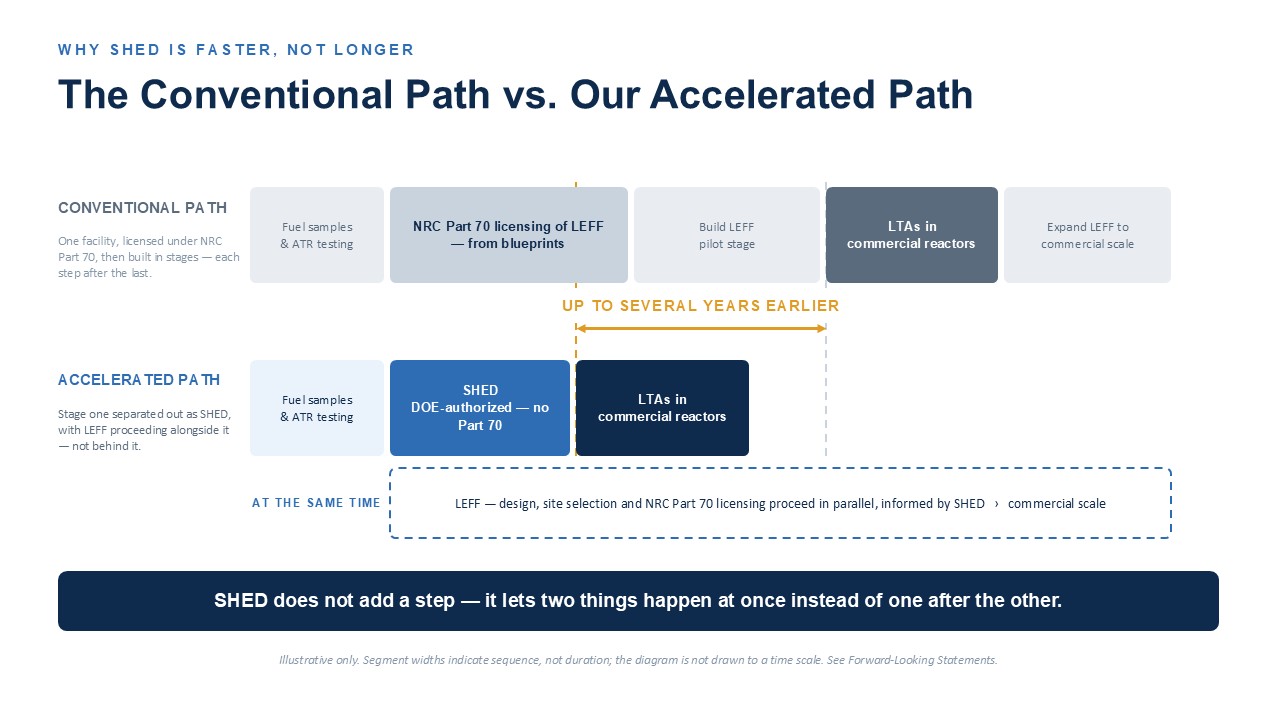
The path for SHED goes through the DOE. The path for LEFF runs through the NRC. Which one applies depends on the facility's scale and purpose. SHED, a pilot-scale facility that produces LTAs, the full-size assemblies of Lightbridge Fuel that a utility would load into the core of an operating commercial reactor, which the NRC treats as part of a testing program, does not require an NRC license. LEFF, a commercial-scale fuel fabrication facility, does.
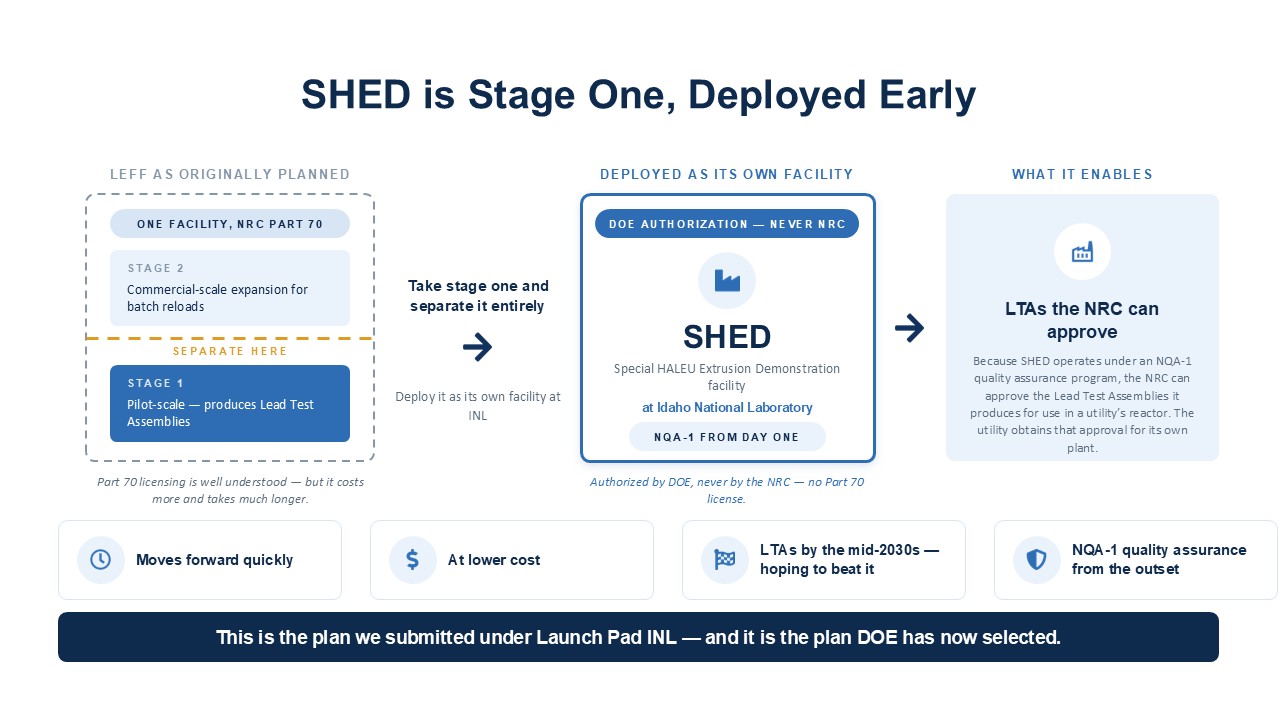
We’ve previously described LEFF as the world’s first fuel fabrication plant designed to expand in capacity as commercial demand for our fuel grows. Our original plan was to build LEFF under an NRC license in stages, starting with pilot-scale fabrication to produce LTAs, and then expand production to commercial scale to support batch reloads. That path is well understood from a regulatory licensing standpoint but would cost substantially more and take much longer.
Lightbridge engineers solved this the way they have solved most of our hard problems: by redesigning the thing itself rather than accepting constraints. Their idea was to take the first stage of LEFF, separate it entirely, and deploy it as its own facility at INL (see below). This is the Special HALEU Extrusion Demonstration (SHED) facility. SHED will only be authorized by DOE, never by the NRC, allowing it to move forward quickly and at lower cost, meeting the utilities’ desire for LTAs by the mid-2030s (a timeline we hope to beat). SHED will operate under a nuclear quality assurance (NQA-1) program from the outset, so the NRC can approve the LTAs it produces for testing in a utility's reactor. This is the plan we submitted under Launch Pad INL, and it is the plan DOE has now selected.
Launch Pad is a DOE initiative supporting the Trump Administration’s goal of widescale nuclear energy expansion through streamlined pathways for developers to demonstrate and accelerate commercial deployment.
SHED’s advantages for LEFF
We are moving rapidly to finalize the design for SHED and select a site for LEFF. Both are proceeding in parallel. SHED will have tremendous advantages for LEFF. In SHED, we will hone everything from equipment layout to process demonstration and opportunities for automation of production for full-length fuel rods to our NQA-1 quality assurance program, and all of it will inform the final design for LEFF. It will result in a much more refined design of LEFF, as one of the world’s most advanced commercial nuclear fuel fabrication facility. We expect that SHED will also make NRC licensing of LEFF occur more quickly (and hence at a lower cost). Rather than licensing LEFF based on blueprints, the NRC will have the opportunity to visit SHED and examine the LTAs produced there, which will be substantially similar to the commercial fuel that will be produced at LEFF.
The voice of the customer
We view utilities as the most powerful companies in the nuclear power industry. They operate the reactors, and they pull goods and services through the supply chains. If a utility does not want a product, it doesn’t matter how well a supplier makes it or how many it produces; no reactor operator will buy it. To succeed as a supplier to utilities, we need to know what utilities want.
In June, we launched and held an inaugural meeting of a reconstituted Nuclear Utility Fuel Advisory Board to ensure we are building toward what utilities actually want. The board provides us with direct input from utility industry representatives on fuel development priorities, licensing considerations, deployment strategies, operational requirements, and commercialization planning. What we have heard has been consistent.
Utilities want three things from a new fuel for their existing large reactors, and each can result in economic benefits.
Higher capacity factors. A reactor that runs more of the time earns more from the same plant and can spread fixed costs over more electricity sold. This results in more revenue for the utility and a lower cost per megawatt-hour, which ultimately reaches ratepayers.
Higher power output. The same result through a different mechanism: more power from the same plant, the same site, and the same operating license.
Enhanced safety. Beyond its own merit, an improved safety margin can reduce the cost of safety-related equipment. A plant whose backup diesel generators are not required to start as quickly, for example, may be able to use less expensive equipment.
Utilities have also been specific about timing. They want a fuel product that delivers all three, available as LTAs in commercial nuclear power plants by the mid-2030s, and in large-scale commercial use, by 2040. Those dates form the urgency behind SHED, and we believe our current plan positions us to meet them, with the goal of beating them.
Benefits of Lightbridge Fuel to utilities
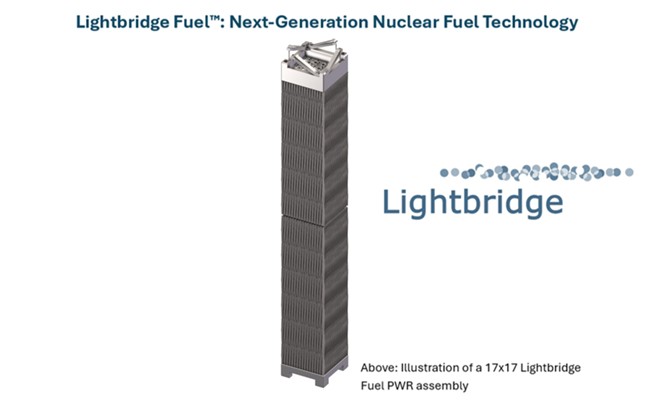
Lightbridge Fuel was designed against all three of those requirements. Its enhanced safety characteristics are inherent in the design and follow from the fuel's metallurgy rather than from any changes the utility would have to make; the operational gains described below are what a utility would see in its own numbers.
Capacity factor. Our fuel for existing light water reactors is designed to remain in the reactor longer between refuelings, which means fewer outages over the life of the plant and more days providing power. It is also designed for a faster ramp rate, allowing a reactor to reach full power and come down for a refueling outage more quickly than it can on current fuel, shortening the transition days at either end of an outage.
Power output. We expect our fuel to increase the power output of an existing reactor by up to
Onward in Idaho Falls
SHED will be deployed at INL, and that location matters more than it might appear.
At the INL Materials and Fuels Complex (MFC), Lightbridge engineers have worked alongside INL engineers to produce the fuel samples now undergoing testing. A short distance away at SHED, many of those same engineers — joined by new colleagues we are actively hiring — will produce Lead Test Assemblies, again with INL support. The people, the site, and the working relationships carry forward intact. Few technology companies get to scale up without also starting over.
Idaho Falls is now home to more Lightbridge employees than any other location, and that number continues to grow. Our job openings are updated frequently on the Career page of our website, and the quality of applicants we have seen has been a genuine source of confidence about what comes next.
The path from fuel samples at MFC to Lead Test Assemblies at SHED to commercial fuel at LEFF begins in Idaho. We are grateful to DOE and NRIC for selecting us under Launch Pad INL, and to our colleagues at INL who have brought us to this point.
I want to close by thanking our shareholders. Many of you have held our stock through years when the milestones were technical, and the timelines were long, and that patience is a large part of what made this moment possible.
Over the next several quarters, we expect to provide more detail on the plan described in this letter. That includes the results of post-irradiation examination of the fuel samples produced with INL, progress on the SHED design and site work, site selection for LEFF, and the cost, timeline, and economic assumptions that analysts need to model both facilities, including our expectations for the value our fuel creates for utilities through higher capacity factors, increased power output, and enhanced safety.
Selection under Launch Pad INL is what makes SHED possible, and SHED is what makes LTAs in a commercial reactor possible within the timeframe utilities have told us they need. That is why we believe we will look back on this as one of the most consequential milestones in Lightbridge's history. We are grateful to have you with us for what comes next.
Seth Grae
Chairman & CEO
Lightbridge Corporation
About Lightbridge Corporation
Lightbridge Corporation (Nasdaq: LTBR) is focused on developing advanced nuclear fuel technology essential to delivering abundant, zero-emission, clean energy and providing energy security to the world. The Company is developing Lightbridge Fuel™, a proprietary next-generation nuclear fuel technology for existing light-water and pressurized heavy-water reactors, significantly enhancing reactor safety, economics, and proliferation resistance. The Company is also developing Lightbridge Fuel for new small modular reactors to deliver the same benefits, when combined with load-following with renewables, on a zero-carbon electric grid.
Lightbridge has entered into two long-term framework agreements with Battelle Energy Alliance, LLC, the United States Department of Energy’s operating contractor for Idaho National Laboratory, the United States’ lead nuclear energy research and development laboratory. DOE’s Gateway for Accelerated Innovation in Nuclear program has twice awarded Lightbridge to support the development of Lightbridge Fuel over the past several years. An extensive worldwide patent portfolio backs Lightbridge’s innovative fuel technology. Lightbridge is included in the Russell 2000®, Russell 3000®, and Solactive Global Uranium & Nuclear Components Total Return Indexes. For more information, please visit www.ltbridge.com.
To receive Lightbridge Corporation updates via e-mail, subscribe at https://www.ltbridge.com/investors/news-events/email-alerts
Lightbridge is on YouTube. Subscribe to access past demonstrations, interviews, and other video content at https://www.youtube.com/@lightbridgecorporation
Lightbridge is on X (formerly Twitter). Sign up to follow @LightbridgeCorp at http://twitter.com/lightbridgecorp.
Forward Looking Statements
With the exception of historical matters, the matters discussed herein are forward-looking statements. These statements are based on current expectations on the date of this news release and involve a number of risks and uncertainties that may cause actual results to differ significantly from such estimates. The risks include, but are not limited to: Lightbridge’s ability to commercialize its nuclear fuel technology, including risks related to the design and testing of nuclear fuel incorporating its technology and the degree of market adoption of Lightbridge’s product and service offerings; dependence on strategic partners; any adverse changes to Lightbridge’s agreements or relationship with the U.S. government and its national laboratories; Lightbridge’s ability to fund its future operations, including general corporate overhead and outside research and development expenses, and continue as a going concern; the future market and demand for Lightbridge’s fuel for nuclear reactors and its ability to attract customers; Lightbridge’s ability to manage the business effectively in a rapidly evolving market; Lightbridge’s ability to employ and retain qualified employees and consultants that have experience in the nuclear industry; competition and competitive factors in the markets in which Lightbridge competes, including from accident-tolerant fuels; access to and availability of nuclear test reactors and the risks associated with unexpected changes in Lightbridge’s nuclear fuel development timeline; access to and availability of adequate resources and manufacturing capabilities at national laboratories that affect our nuclear fuel development timeline and project costs; the impact that Launch Pad INL will have on Lightbridge’s nuclear fuel development timeline; Lightbridge’s ability to deploy and operate a dedicated nuclear fuel fabrication facility; the increased costs associated with metallization of Lightbridge’s nuclear fuel; uncertainties related to conducting business in foreign countries; public perception of nuclear energy generally; changes in applicable laws, regulations, governmental policies, or regulatory interpretations, including those affecting the licensing, testing, manufacture, and commercialization of Lightbridge Fuel; changes in the political environment; development and utilization of, and challenges to, Lightbridge’s intellectual property domestically and abroad; the volatility of the trading price of Lightbridge’s securities and the potential for purchasers of its securities to incur substantial losses; and other factors described in Lightbridge’s filings with the Securities and Exchange Commission (the “SEC”). Lightbridge does not assume any obligation to update or revise any such forward-looking statements, whether as a result of new developments or otherwise, except as required by law. Readers are cautioned not to put undue reliance on forward-looking statements.
A further description of risks and uncertainties can be found in Lightbridge’s Annual Report on Form 10-K for the fiscal year ended December 31, 2025, and in its other filings with the SEC, including in the sections thereof captioned “Risk Factors” and “Forward-Looking Statements,” all of which are available at http://www.sec.gov/ and www.ltbridge.com.
Investor Relations Contact:
Matthew Abenante, IRC
Director of Investor Relations
Tel: +1 (347) 947-2093
ir@ltbridge.com
Photos accompanying this announcement are available at:
https://www.globenewswire.com/NewsRoom/AttachmentNg/00324ca6-82d7-41d6-8b1d-7a27d3cd3962
https://www.globenewswire.com/NewsRoom/AttachmentNg/e17b37ce-4f38-4632-b04f-eb5e32a21ab5
https://www.globenewswire.com/NewsRoom/AttachmentNg/f229d0c0-25c4-4953-8498-81dd8cb1f390

FAQ
AI-generated questions and answers. How Rhea-AI works. Not financial advice.
What are SHED and LEFF, and how do their regulatory paths differ?
SHED (Special HALEU Extrusion Demonstration) is a pilot-scale facility at Idaho National Laboratory that will produce full-size Lightbridge Fuel Lead Test Assemblies under U.S. Department of Energy authorization and does not require an NRC license. LEFF (Lightbridge Expandable Fuel Facility) is planned as a commercial-scale fuel fabrication plant that will seek U.S. Nuclear Regulatory Commission licensing and is intended to expand capacity as market demand grows.
Why does Lightbridge believe SHED will help speed and reduce the cost of LEFF licensing?
The company expects SHED to refine equipment layout, demonstrate processes, identify automation opportunities, and operate under an NQA‑1 nuclear quality assurance program. This would allow the NRC to visit SHED and examine Lead Test Assemblies that are substantially similar to LEFF’s planned commercial fuel, which Lightbridge believes will enable a quicker and lower‑cost licensing review for LEFF.
What timing have utilities indicated they want for Lightbridge Fuel deployment?
Lightbridge reports that utilities want a fuel product delivering higher capacity factors, higher power output, and enhanced safety available as Lead Test Assemblies in commercial nuclear power plants by the mid‑2030s, with large‑scale commercial use by 2040. The company states that these dates create urgency for SHED and that its current plan positions it to meet, and potentially beat, those timelines.
What benefits does Lightbridge say its fuel is designed to provide to utilities?
The company states that Lightbridge Fuel is designed to increase capacity factors by enabling longer cycles between refuelings and faster ramp rates into and out of outages. For existing reactors, it expects potential power uprates of up to 10% without changing steam generators and up to 20% for plants that install higher-capacity steam generators. It also describes inherent safety enhancements from the fuel’s metallurgy that may allow lower costs for some safety-related equipment.