STOCK TITAN

Global Talent Shortage Reaches Turning Point as AI Skills Claim Top Spot

Rhea-AI Impact
(Neutral)
Rhea-AI Sentiment
(Neutral)
Tags
AI

ManpowerGroup (NYSE:MAN) reports a turning point: 72% of 39,000 employers across 41 countries say they struggle to fill roles, with AI skills now the hardest to find. AI model & application development (20%) and AI literacy (19%) top the 2026 shortage ranking.

Employers favor upskilling (27%), schedule/location flexibility and wage increases to compete amid wide geographic and industry variation.

Loading...
Loading translation...

Positive

  • AI skills lead global shortages: 20% model/app dev, 19% AI literacy
  • 72% of employers report hiring difficulty across 41 countries
  • 91% of employers deploying strategies to address scarcity (upskilling, flexibility)
  • Upskilling prioritized by 27% of employers as top internal strategy
  • Largest firms (1,000–4,999 employees) report 75% shortage rate

Negative

  • Broad cross-industry shortages: Information 75%, Hospitality 74%, Public sector/Health/Social 74%
  • Geographic fragmentation: Germany 83%, France 74%, U.K. 73%, U.S. 69%, China 48%
  • Traditional IT/data fell to seventh place (17%), signaling rapid skills realignment
  • Small firms face lower hiring success: under-10 employees report 64% shortage

Market Reaction – MAN

+5.32% $27.21
15m delay 34 alerts
+5.32% Since News
$27.21 Last Price
$26.11 $28.43 Day Range
+$64M Valuation Impact
$1.26B Market Cap
0.5x Rel. Volume

Following this news, MAN has gained 5.32%, reflecting a notable positive market reaction. Our momentum scanner has triggered 34 alerts so far, indicating elevated trading interest and price volatility. The stock is currently trading at $27.21. This price movement has added approximately $64M to the company's valuation.

Data tracked by StockTitan Argus (15 min delayed). Upgrade to Silver for real-time data.

Key Figures

Employers surveyed: 39,000 employers Countries covered: 41 countries Hiring difficulty: 72% +5 more
8 metrics
Employers surveyed 39,000 employers 2026 Talent Shortage Survey sample size
Countries covered 41 countries Geographic scope of 2026 survey
Hiring difficulty 72% Employers reporting difficulty filling roles, 2026 survey
Prior-year difficulty 74% Employers reporting difficulty filling roles, prior year
AI model & app dev 20% Share of employers citing as hard-to-find skill
AI literacy 19% Share of employers citing as hard-to-find skill
Employers using strategies 91% Employers deploying mix of strategies to address scarcity
Largest firms’ shortage 75% Shortage rate at companies with 1,000–4,999 employees

Market Reality Check

Price: $25.83 Vol: Volume 2,447,920 is 1.33x...
normal vol
$25.83 Last Close
Volume Volume 2,447,920 is 1.33x the 20-day average of 1,844,739, indicating elevated trading interest ahead of this release. normal
Technical Shares trade 2.7% above the 52-week low of 25.15, well below the 200-day MA at 36.2, signalling a weak longer-term trend despite positive AI positioning.

Peers on Argus

Sector peers show mixed, stock-specific moves. BBSI appeared on momentum scans, ...
1 Down

Sector peers show mixed, stock-specific moves. BBSI appeared on momentum scans, falling about 10.07% without news, while other staffing names like NSP, KFRC, and HSII saw minimal changes, suggesting this AI-talent survey is not part of a broad sector rotation.

Previous AI Reports

5 past events · Latest: Jan 20 (Neutral)
Same Type Pattern 5 events
Date Event Sentiment Move Catalyst
Jan 20 AI workforce barometer Neutral -2.6% Published Global Talent Barometer on AI use, worker confidence, and training gaps.
Jan 16 AI readiness at Davos Neutral -2.9% Outlined AI workforce readiness agenda and large-scale training goals at Davos.
Nov 04 Career resilience research Neutral -0.6% Right Management report linking career development to AI-era workforce resilience.
Oct 28 CFO AI priorities survey Neutral -1.3% Jefferson Wells survey on CFO focus on AI, cybersecurity, tariffs, and headcount.
Sep 30 Tech hiring outlook Neutral -0.5% Experis Q4 2025 Tech Talent Outlook highlighting AI-driven skills demand.
Pattern Detected

AI-tagged thought-leadership and survey releases have historically led to modestly negative next-day moves, averaging about -1.58%, indicating limited upside re-pricing from similar announcements.

Recent Company History

Over the past several months, ManpowerGroup has repeatedly highlighted AI and workforce transformation through surveys and research. Prior AI-tagged releases, including the Global Talent Barometer and Davos workforce readiness initiatives, emphasized rapid AI adoption, skills obsolescence, and training gaps. Market reactions to these AI communications were generally small, with next-day moves clustering modestly negative around -1.58%. Today’s global talent shortage survey, again focused on AI capabilities and human skills, continues this narrative of structural skills mismatch and upskilling needs rather than introducing a new financial catalyst.

Historical Comparison

-1.6% avg move · In the last five AI-tagged releases, MAN’s average next-day move was -1.58%. Prior AI surveys and ou...
AI
-1.6%
Average Historical Move AI

In the last five AI-tagged releases, MAN’s average next-day move was -1.58%. Prior AI surveys and outlooks have been treated as modest, information-only catalysts by the market.

AI-tagged news shows a steady progression from broad tech hiring outlooks to detailed global surveys on AI adoption, worker confidence, and now AI-specific talent scarcity, reinforcing ManpowerGroup’s positioning as an AI workforce insights provider.

Market Pulse Summary

The stock is up +5.3% following this news. A strong positive reaction aligns with recurring AI-focus...
Analysis

The stock is up +5.3% following this news. A strong positive reaction aligns with recurring AI-focused surveys that highlight ManpowerGroup’s role in mapping global skills shortages. Past AI-tagged releases have typically produced modest average moves of about -1.58%, so a large gain would represent a break from that pattern and could reflect renewed interest in AI-driven staffing themes. Investors would need to weigh how quickly sentiment can shift back if enthusiasm for AI or labor data softens.

Key Terms

ai literacy, ai model & application development, upskilling/reskilling
3 terms
ai literacy technical
"AI Model & Application Development (20%) and AI Literacy (19%) now lead the global ranking"
AI literacy is the ability to understand how artificial intelligence systems work, including their capabilities, limitations, and impact. For investors, it means being able to evaluate how AI-driven tools and technologies influence markets, business strategies, and decision-making processes. Being AI literate helps individuals make better-informed choices in a world increasingly shaped by intelligent machines.
ai model & application development technical
"AI Model & Application Development (20%) and AI Literacy (19%) now lead the global ranking"
Designing and building artificial intelligence models and the software that uses them means creating computer programs that learn from data and embedding those programs into products or services people can use, like a smart recipe (the model) and the kitchen tools (the application) that make the dish. Investors care because success can lower costs, create new revenue streams, and provide a competitive edge, while failure can mean wasted investment, operational risk, and regulatory or ethical issues.
upskilling/reskilling technical
"Upskilling/Reskilling (27%) leads, followed by offering more Schedule Flexibility"
Upskilling is the process of teaching existing employees new abilities that build on what they already do, while reskilling trains people to move into different jobs or roles. For investors, these efforts are like updating a company's software or retraining a team to use new tools: they can lower future hiring costs, protect productivity as industries change, and reduce the risk that a company falls behind its competitors.

AI-generated analysis. Not financial advice.

ManpowerGroup's 2026 Talent Shortage Survey of 39,000 employers across 41 countries reveals 72% report difficulty filling roles as demand for AI capabilities overtakes engineering and traditional IT skills

MILWAUKEE, Feb. 26, 2026 /PRNewswire/ -- For the first time, Artificial Intelligence (AI) skills have surpassed all others to become the most difficult for employers to find globally, overtaking traditional engineering and IT capabilities. This historic shift highlights a new era in the persistent global talent crisis, with 72% of employers reporting hiring difficulty—down modestly from 74% last year—according to the 2026 Talent Shortage Survey released today by ManpowerGroup.

"The rise of AI skills to the top of the shortage list reflects how quickly the talent landscape is evolving," said Jonas Prising, ManpowerGroup Chair & CEO. "Companies are responding with upskilling and more flexible workforce models, recognizing they will need to hire for potential; while building AI literacy across their workforce so people can apply new technology with judgment and confidence. AI is not replacing jobs, it is reshaping work, and companies that connect productivity gains with opportunity and career growth will be best positioned to compete in a talent-scarce world."

The research, spanning more than 39,000 employers in 41 countries, reveals that modest relief in overall hiring has been offset by fierce competition for AI capabilities.

2026 TALENT SHORTAGE SURVEY KEY FINDINGS

  • AI Creates a New Hierarchy of Technical Demand
    AI Model & Application Development (20%) and AI Literacy (19%) now lead the global ranking of hard-to-find skills, followed by Engineering (19%), Sales & Marketing (18%), and Manufacturing & Production (17%). Together, these AI capabilities displace traditional IT & Data skills, which fell to seventh place (17%), signaling a rapid realignment of strategic talent investment toward AI-driven capabilities.

  • The Human Edge Becomes More Valuable
    Even amid the surge in demand for AI, core human skills remain in-demand. Communication, Collaboration & Teamwork are the most sought-after attributes at 39%, followed by Professionalism & Work Ethic (36%) and Adaptability & Willingness to Learn (34%), reinforcing the enduring value of interpersonal skills.

  • Geography Defines the Scarcity Experience
    The pressure to find talent is universal, yet its intensity varies dramatically by location. Employers in Germany (83%), France (74%), and the U.K. (73%) face significant shortages, while the U.S. (69%) tracks slightly below the global average. China (48%) stands out as the least constrained major market, revealing a fragmented global landscape where local conditions dictate competitive strategy.

  • Scarcity Is a Cross-Industry Phenomenon
    While the Information industry faces the highest shortage (75%), critical service sectors like Hospitality (74%) and Public Sector, Health & Social Services (74%) report nearly identical levels of strain. This widespread challenge extends across Professional, Scientific, and Technical Services (73%), Manufacturing (72%), and Finance and Insurance (71%), indicating a broad-based constraint on economic growth and service delivery.

  • Employer Strategy: Invest, Adapt, and Compete
    Faced with structural scarcity, 91% of employers are deploying a mix of strategies. The primary focus is on internal development and flexibility: Upskilling/Reskilling (27%) leads, followed by offering more Schedule Flexibility (20%) and Location Flexibility (18%). To compete externally, Increasing Wages (19%) and Targeting New Talent Pools (18%) are critical levers.

  • Scale Exacerbates the Challenge
    Organizational size significantly impacts hiring success. The largest companies—those with 1,000-4,999 employees—report the highest shortage rate (75%). This is 11 points higher than the smallest firms (under 10 employees at 64%).

For more information about ManpowerGroup's 2026 Talent Shortage Survey, visit: https://www.manpowergroup.com/en/insights/2026-global-talent-shortage 

ABOUT THE SURVEY METHODOLOGY
ManpowerGroup interviewed 39,063 employers in 41 countries: Argentina, Australia, Belgium, Brazil, Canada, Chile, China, Colombia, Costa Rica, Czech Republic, Finland, France, Germany, Greece, Guatemala, Hong Kong, Hungary, India, Ireland, Israel, Italy, Japan, Mexico, Norway, Panama, Peru, Poland, Portugal, Puerto Rico, Romania, Singapore, Slovakia, Spain, Sweden, Switzerland, Taiwan, The Netherlands, Türkiye, United Arab Emirates (U.A.E.), United Kingdom (U.K.), United States of America (U.S.). The fieldwork was completed in all markets between October 1 – 31, 2025.

ABOUT MANPOWERGROUP
ManpowerGroup® (NYSE: MAN), the leading global workforce solutions company, helps organizations transform in a fast-changing world of work by sourcing, assessing, developing, and managing the talent that enables them to win. We develop innovative solutions for hundreds of thousands of organizations every year, providing them with skilled talent while finding meaningful, sustainable employment for millions of people across a wide range of industries and skills. Our expert family of brands – Manpower, Experis, and Talent Solutions – creates substantially more value for candidates and clients across more than 70 countries and territories and has done so for more than 75 years. We are recognized consistently for our diversity – as a best place to work for Women, Inclusion, Equality, and Disability, and in 2025 ManpowerGroup was named one of the World's Most Ethical Companies for the 16th time – all confirming our position as the brand of choice for in-demand talent.

For more information, visit www.manpowergroup.com, or follow us on LinkedIn, Facebook, and Bluesky.

FORWARD-LOOKING STATEMENTS
This report contains forward-looking statements, including statements regarding labor demand in certain regions, countries and industries, and economic uncertainty. Actual events or results may differ materially from those contained in the forward-looking statements, due to risks, uncertainties and assumptions. These factors include those found in the Company's reports filed with the U.S. Securities and Exchange Commission (SEC), including the information under the heading "Risk Factors" in its Annual Report on Form 10-K for the year ended December 31, 2025, whose information is incorporated herein by reference. ManpowerGroup disclaims any obligation to update any forward-looking or other statements in this release, except as required by law.
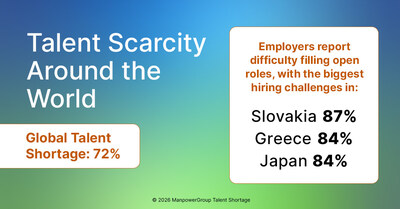
 

ManpowerGroup's 2026 Talent Shortage Survey finds 72% of employers reporting hiring difficulty.

Cision View original content to download multimedia:https://www.prnewswire.com/news-releases/global-talent-shortage-reaches-turning-point-as-ai-skills-claim-top-spot-302698509.html

SOURCE ManpowerGroup

FAQ

Why did ManpowerGroup (MAN) find AI skills top the 2026 global talent shortage?

AI capabilities overtook traditional skills as the most-cited gap, driven by demand for model/app development and AI literacy. According to the company, AI model & application development (20%) and AI literacy (19%) now lead the ranking of hardest-to-find skills globally.

How many employers reported hiring difficulty in ManpowerGroup's 2026 survey (MAN)?

Seventy-two percent of participating employers reported difficulty filling roles in 2026. According to the company, the survey covered more than 39,000 employers across 41 countries, down modestly from 74% in the prior year.

What strategies are employers using to address talent scarcity according to ManpowerGroup (MAN)?

Employers are prioritizing internal development and flexibility to compete for scarce talent. According to the company, 91% use mixes of tactics, led by upskilling/reskilling (27%), schedule flexibility (20%), and location flexibility (18%).

Which industries face the worst talent shortages in ManpowerGroup's 2026 survey (MAN)?

Shortages are widespread, with Information at 75%, Hospitality 74%, and Public sector/Health/Social services 74%. According to the company, Professional, Scientific & Technical services, Manufacturing, and Finance also report high shortage rates above 70%.

How does geographic location affect talent scarcity in the ManpowerGroup 2026 survey (MAN)?

Shortage intensity varies by market: Germany reports 83% difficulty while China reports 48%. According to the company, local conditions strongly shape hiring pressure and competitive talent strategies across countries.

What workforce-size differences did ManpowerGroup (MAN) identify in the 2026 talent shortage?

Larger companies face higher shortages: firms with 1,000–4,999 employees report 75% shortage versus 64% for firms under 10 employees. According to the company, organizational scale materially affects hiring success.
Manpowergroup

NYSE:MAN

MAN Rankings

MAN Latest News

MAN Latest SEC Filings

MAN Stock Data

1.19B
45.50M
Staffing & Employment Services
Services-help Supply Services
Link
United States
MILWAUKEE