
Moleculin Reports Positive Phase 2/3 MIRACLE Interim Results, With Annamycin Complete Remission Rates 3-fold Greater than Control
Moleculin (Nasdaq: MBRX) reported positive interim Phase 2/3 MIRACLE results for L-Annamycin in relapsed or refractory AML.
Sentiment and the balance of points
Rhea-AI Sentiment reads the wording of the document, how positive or negative its language is on a 1 to 5 scale. The balance of points shown with the takes weighs what the document actually discloses, so the two can disagree, for example when a trial that missed its main goal is described in upbeat language.
Rhea-AI Summary
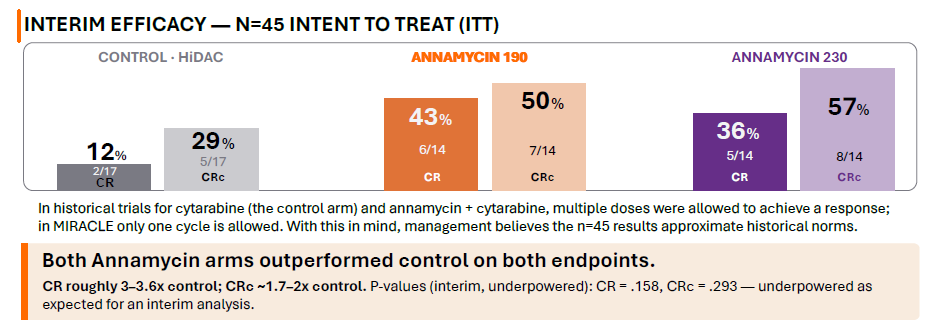
Moleculin (Nasdaq: MBRX) reported positive interim Phase 2/3 MIRACLE results for L-Annamycin in relapsed or refractory AML. In the first 45 patients, complete remission (CR) rates were 43% and 36% for the Annamycin arms versus 12% for control; composite CR (CRc) reached 50% and 57% versus 29% for control, all after a single treatment cycle.
The independent data monitoring committee saw a strong numeric efficacy trend favoring Annamycin, recommended continuing the trial without dropping any dose, and noted statistical significance was not expected at this first interim look. Part A enrollment has reached 67 of 90 planned patients, with Part B intended to use the selected dose in the pivotal analysis.
Positive
- Annamycin CR 43% and 36% vs 12% for control after one cycle
- Annamycin CRc 50% and 57% vs 29% for control after one cycle
- iDMC saw strong numeric efficacy trend favoring both Annamycin arms
- iDMC recommended continuing MIRACLE trial without dropping either dose arm
- Part A enrollment reached 67 of 90 planned patients (~74%)
Negative
- No formal statistical significance reached at first interim efficacy analysis
- Interim efficacy data based on only 45 patients and a single treatment cycle
Details
News Market Reaction – MBRX
On Jun 30, the day this news came out, MBRX closed 21.85% below the previous close.
Data tracked by StockTitan Argus for the Jun 30 session.
Key Figures
- CR rate (Ann 190 mg/m²)
- 43%
- Phase 2/3 MIRACLE Part A, single cycle, intent-to-treat
- CR rate (Ann 230 mg/m²)
- 36%
- Phase 2/3 MIRACLE Part A, single cycle, intent-to-treat
- CR rate (control)
- 12%
- Phase 2/3 MIRACLE Part A, single cycle, HiDAC alone
- CRc (Ann arms)
- 50% and 57%
- Composite complete remission for 190 and 230 mg/m² Annamycin arms
- CRc (control)
- 29%
- Composite complete remission for HiDAC control arm
- Interim sample size
- 45 patients
- First unblinded cohort in MIRACLE Part A
- Elderly proportion
- 75.6% over 60 years
- Interim MIRACLE population age distribution
- Planned total subjects
- 282 subjects
- MIRACLE trial full planned population for final analysis
Previous Clinical trial Reports
-
Positive pediatric brain tumor Phase 1 results with no significant toxicity reported.
-
Updated MIRACLE enrollment and timelines toward first interim unblinding and Part A completion.
-
Reported 60% consent toward 45-subject interim unblinding and detailed adaptive trial design.
-
Planned presentation on L‑Annamycin and pivotal MIRACLE AML trial at leukemia meeting.
-
Announced accelerated MIRACLE recruitment and site expansion across US and Europe.
24h Move is the share-price change in the day after each event; other market factors may also have contributed.
Key Terms
intent-to-treat clinical
composite complete remission clinical
independent data monitoring committee clinical
group-sequential clinical
o’brien-fleming spending function clinical
phase 2/3 clinical
AI-generated analysis. How Rhea-AI works. Not financial advice.




- Both Annamycin dose arms outperformed control on the primary endpoint of complete remission (CR):
43% and36% versus12% — reported on a full intent-to-treat (ITT) basis with no patient exclusions - Composite complete remission (CRc) reached
50% and57% in the respective Annamycin arms versus29% for control - Enrollment in the MIRACLE trial continues with more than two-thirds (67 of 90 subjects) of Part A target as Company advances toward optimal dose selection
HOUSTON, June 30, 2026 (GLOBE NEWSWIRE) -- Moleculin Biotech, Inc., (Nasdaq: MBRX) (“Moleculin” or the “Company”), today announced positive preliminary unblinded efficacy results from the first 45 patients enrolled in Part A of the Company's pivotal Phase 2/3 MIRACLE trial, analyzed on a full intent-to-treat basis with no patient exclusions. Both Annamycin treatment arms demonstrated favorable efficacy trends compared with the control arm in patients with relapsed or refractory acute myeloid leukemia (R/R AML).
The interim analysis demonstrated a clear efficacy advantage for both Annamycin treatment arms, 190 mg/m² plus HiDAC and 230 mg/m² plus HiDAC, over the HiDAC control arm. CR reached
Importantly, the remission rates for all three arms, including the control arm, reflect outcomes measured after only a single cycle of therapy, as specified by the MIRACLE protocol. The most commonly cited historical benchmarks in this setting, including the MIRROS and CLASSIC I studies, as well as Moleculin’s own MB-106 study, permitted multiple cycles of treatment. The Company therefore expected absolute remission rates for both the control and Annamycin arms in this single-cycle interim analysis to be lower than those reported in such multi-cycle datasets and believes the most meaningful comparison is the performance of the Annamycin arms relative to the concurrent, randomized control arm evaluated on the same single-cycle basis.
"These interim Phase 2/3 results on such a challenging subject population represent a defining moment for Moleculin and, we believe, the strongest clinical validation of Annamycin we have seen to date," said Walter Klemp, Chairman and Chief Executive Officer of Moleculin. "To see both Annamycin dose arms meaningfully outperform the control arm across both the primary endpoint of complete remission as well as composite complete remission in patients with relapsed or refractory AML is an exceptional outcome. Importantly, these responses were achieved after only a single treatment cycle, providing what we believe is compelling evidence of Annamycin's anti-leukemic activity. We believe these results further validate Annamycin's differentiated profile and strengthen our confidence as we advance the MIRACLE trial toward completion."
"From a clinical perspective, these interim results are highly encouraging," Mr. Klemp continued. "Historically, achieving meaningful remission rates in relapsed or refractory AML has been exceptionally difficult, especially with subjects pretreated with venetoclax, which is why seeing both Annamycin treatment arms outperform the control arm across both efficacy endpoints is so noteworthy. The remission rates observed to date are particularly compelling when viewed in the context of outcomes historically reported for currently available therapies in this setting, especially given that patients in MIRACLE were evaluated after only a single treatment cycle. While cross-trial comparisons should be made with caution, these findings suggest the potential for a level of clinical activity that could meaningfully advance the treatment landscape for patients with relapsed or refractory AML. If these results continue to be observed as the trial progresses, Annamycin could represent an important new option for patients facing a disease with substantial unmet medical need."
The interim review was conducted by the trial's Independent Data Monitoring Committee (iDMC). The committee unanimously concluded that for the primary efficacy endpoint of CR rates, although there was no statistical significance, there was a strong numeric trend suggesting that the experimental treatment arms (L-Annamycin at one of two doses plus high dose cytarabine) were superior to the placebo plus high dose cytarabine control arm. To that end, there was sufficient evidence of efficacy to support continuing the trial. The committee also concluded that the data did not support dropping either of the two experimental treatment arms since the efficacy data were too similar between these two treatment arms. The Company decided to accept the recommendation of the iDMC and continue with the MIRACLE trial as planned.
The absence of formal statistical significance at this first interim analysis reflects the trial’s prespecified statistical design, not the strength of the data. As in most group-sequential studies, MIRACLE distributes its statistical “budget” across three planned analyses using a conservative O’Brien-Fleming spending function, which by design sets a very high bar for significance at an early interim look and reserves essentially the entire budget for the final analysis in the full population of approximately 282 subjects. Statistical significance was therefore neither expected nor required at this stage; the relevant question at an interim look is the direction and strength of the efficacy trend, which the iDMC found clearly favored both Annamycin arms over control. The trial remains fully powered, at
The MIRACLE trial is a pivotal Phase 2/3, multi-center, randomized, double-blind, placebo-controlled, adaptive design study of L-Annamycin for injection in combination with Cytarabine injection versus placebo in combination with Cytarabine injection as second line therapy for remission induction in adult subjects with R/R AML. Part A of the study is designed to identify the optimal Annamycin dose before advancing into the pivotal portion of the trial. Moleculin reported that 67 of the targeted 90 patients for Part A have been enrolled, representing approximately
Acute myeloid leukemia remains an area of significant unmet medical need, particularly among patients who relapse after frontline therapy. Moleculin believes the preliminary MIRACLE results further support Annamycin's potential to improve remission outcomes in this patient population and strengthen the rationale for the program's continued advancement toward registration.
The interim results related to efficacy are final and other data remain subject to Part A final database review and readout.
About Moleculin Biotech, Inc.
Moleculin Biotech, Inc. is a Phase 3 clinical stage pharmaceutical company advancing a pipeline of therapeutic candidates addressing hard-to-treat tumors and viruses. The Company’s lead program, Annamycin (also known as naxtarubicin), is a highly efficacious and well tolerated anthracycline designed to avoid multidrug resistance mechanisms and to lack the cardiotoxicity common with currently prescribed anthracyclines. Annamycin is currently in development for the treatment of relapsed or refractory acute myeloid leukemia (AML) and soft tissue sarcoma (STS) lung metastases.
The Company has begun the MIRACLE (Moleculin R/R AML AnnAraC Clinical Evaluation) Trial (MB-108), a pivotal, adaptive design, multi-center, randomized, double-blind, placebo-controlled Phase 2/3 trial evaluating Annamycin in combination with cytarabine, together referred to as AnnAraC (the combination of Annamycin and cytarabine, also referred to as “Ara-C”) for the treatment of relapsed or refractory acute myeloid leukemia. Following a successful Phase 1B/2 study (MB-106), with input from the FDA, the Company believes it has substantially de-risked the development pathway towards a potential approval for Annamycin for the treatment of AML. This study remains subject to appropriate future filings with potential additional feedback from the FDA and their foreign equivalents.
Additionally, the Company is developing WP1066, an Immune/Transcription Modulator capable of inhibiting p-STAT3 and other oncogenic transcription factors while also stimulating a natural immune response, targeting brain tumors, pancreatic and other cancers. Moleculin also has in its pipeline a portfolio of antimetabolites, including WP1122 for the potential treatment of pathogenic viruses, as well as certain cancer indications.
For more information about the Company, please visit www.moleculin.com and connect on X, LinkedIn and Facebook.
Forward-Looking Statements
Some of the statements in this release are forward-looking statements within the meaning of Section 27A of the Securities Act of 1933, Section 21E of the Securities Exchange Act of 1934 and the Private Securities Litigation Reform Act of 1995, which involve risks and uncertainties. Forward-looking statements in this press release include, without limitation, the potential efficacy and safety of Annamycin and AnnAraC in R/R AML and the expectation that interim efficacy trends observed in a limited patient population will be confirmed in the full study population (the interim results presented are based on a small sample size (n=45), have not achieved statistical significance, and may not be predictive of results from the completed trial). Moleculin will require significant additional financing, for which the Company has no commitments, in order to conduct its clinical trials as described in this press release, and the milestones described in this press release assume the Company’s ability to secure such financing on a timely basis. Although Moleculin believes that the expectations reflected in such forward-looking statements are reasonable as of the date made, expectations may prove to have been materially different from the results expressed or implied by such forward-looking statements. The Company relies on the reports of its expert with regard to the absence of cardiotoxicity. The dataset referenced in this press release is subject to the review of the data from future subjects in its current and future clinical trials and long-term follow-up with subjects in its current trials. Moleculin has attempted to identify forward-looking statements by terminology including ‘believes,’ ‘estimates,’ ‘anticipates,’ ‘expects,’ ‘plans,’ ‘projects,’ ‘intends,’ ‘potential,’ ‘may,’ ‘could,’ ‘might,’ ‘will,’ ‘should,’ ‘approximately’ or other words that convey uncertainty of future events or outcomes to identify these forward-looking statements. These statements are only predictions and involve known and unknown risks, uncertainties, and other factors, including those discussed under Item 1A. “Risk Factors” in our most recently filed Form 10-K filed with the Securities and Exchange Commission (SEC) and updated from time to time in our Form 10-Q filings and in our other public filings with the SEC. Any forward-looking statements contained in this release speak only as of its date. We undertake no obligation to update any forward-looking statements contained in this release to reflect events or circumstances occurring after its date or to reflect the occurrence of unanticipated events.
Investor Contact:
JTC Team, LLC
Jenene Thomas
(908) 824-0775
MBRX@jtcir.com
Attachment

FAQ
AI-generated questions and answers. How Rhea-AI works. Not financial advice.