
Screen Time Emerges as Top Obstacle to Student Success Worldwide
McGraw Hill (NYSE: MH) released its 2026 Global Education Insights Report, based on a survey of more than 1,300 K-12 and higher-education educators across 19 countries.




McGraw Hill’s 2026 Global Education Insights Report:
Human connection remains essential to learning amid growing educator concerns about the impact of technology on students
Key Findings:
-
Screen time is now the biggest obstacle to student success worldwide, and
42% of educators say students’ ability to focus has declined compared to five years ago. -
68% of educators are concerned about their students' mental well-being, while managing student behavior and mental health remains the top challenge for educators for the second year in a row. -
Despite growing AI usage,
72% of educators do not expect in-person instructional time to decline over the next decade. -
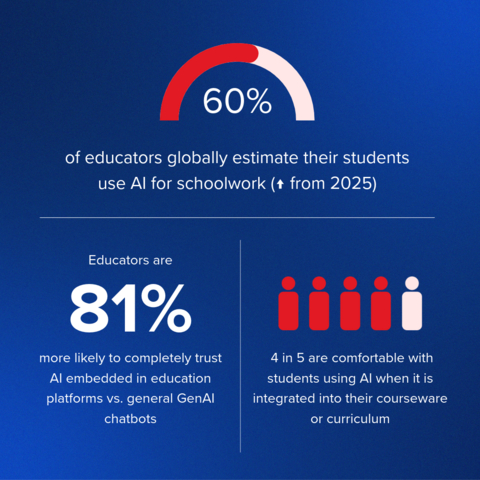
AI is saving educators time, but trust remains conditional: Educators are
81% more likely to completely trust AI embedded in education platforms than general GenAI chatbots, with trust in general chatbots declining33% vs. last year.
The 2026 McGraw Hill Global Education Insights Report is based on an annual survey of more than 1,300 K-12 and higher education educators across 19 countries.
The 2026 McGraw Hill Global Education Insights Report finds that educators globally view excessive screen time as the top barrier to student success. Two in five educators report declines over the past five years in students’ abilities to focus for extended periods and manage their emotions—a view that is higher among K-12 educators globally, and more pronounced in the
Despite the growing use of AI in education, educators continue to view the most important elements of teaching as distinctly human. Nearly three-quarters say social-emotional support and teacher-student relationships cannot be replaced by AI, and the majority (
“The future of education will be defined by how responsibly and effectively we use technology to support teaching, deepen learning and build the skills students need next,” said Philip Moyer, President and CEO of McGraw Hill. “The impact of social media and screen time is clear. In the AI era, we have a responsibility to build tools that strengthen—not diminish—the teacher-student relationships, critical thinking and human connection at the heart of learning.”
Conducted by Morning Consult on behalf of McGraw Hill, the Global Education Insights Report is based on an annual survey of more than 1,300 K-12 and higher education educators across 19 countries, exploring their perspectives on technology, artificial intelligence, student well-being and the skills students need to succeed in an increasingly digital world.
Educators Express Growing Concerns About Technology and Student Well-Being
Educators report growing concerns about students' relationships with technology and its impact on learning and well-being. Among the findings:
-
86% of K-12 educators—and68% of educators worldwide—say they are concerned about students' mental health. -
Managing student behavior and mental health remains the greatest challenge educators face (
42% ) for the second year in a row. -
Forty-two percent say social media has a mostly negative impact on educational outcomes – the highest negative rating of any technology tested. Educators view digital tools or applications that use embedded AI much more favorably, with
62% seeing it as a net positive for education.
Even amid these concerns, educators generally favor balance over bans when it comes to device usage in school. Forty-five percent support policies that allow students access to cell phones during lunch or other non-instructional periods, with K-12 educators more supportive of restrictions than higher education instructors.
Educators Are Cautiously Optimistic About AI
Sixty percent of educators globally believe their students use AI for schoolwork, an increase from 2025, with the highest rates reported by
As AI use grows, educators are seeing clear benefits—but trust remains conditional. Nearly four in five educators say AI tools have saved them time, but they are
More than 4 in 5 are comfortable with students using AI when it is integrated into their courseware or curriculum, and educators are most comfortable with students using AI to create study guides from text (
Educators Identify Critical Thinking as a Top Skill for the Future and a Key Gap
Almost all educators say critical thinking and problem-solving are essential for career success (
-
Real-world learning experiences (
95% ) -
Career exploration and vocational guidance (
93% ) -
Communication and collaboration (
91% ) -
Financial literacy (
91% ) -
Emotional intelligence/resilience (
87% ) -
Digital literacy (
87% ) -
AI literacy (
84% )
Overall optimism for the future remains high, with
To explore the full report and download reports by region, visit: mheducation.com/about-us/global-education-insights-report/global-education-insights-2026.html
McGraw Hill
McGraw Hill (NYSE: MH) is a leading global provider of education solutions for preK-12, higher education and professional learning, supporting the evolving needs of millions of educators and students around the world. We provide trusted, high-quality content and personalized learning experiences that use data, technology and learning science to help students progress towards their goals. Through our commitment to fostering a culture of innovation and belonging, we are dedicated to improving outcomes and access to education for all. We have over 30 offices across
View source version on businesswire.com: https://www.businesswire.com/news/home/20260729517130/en/
Ben Roselieb
McGraw Hill
614-673-3454
ben.roselieb@mheducation.com
Source: McGraw Hill