
Great Britain Leads Europe’s FMCG Inflation as NIQ Launches New Inflation Barometer
NIQ (NYSE: NIQ) has launched the monthly EU5 FMCG Inflation Barometer, tracking fast-moving consumer goods inflation and shopper behavior across France, Great Britain, Germany, Italy and Spain.
Sentiment and the balance of points
Rhea-AI Sentiment reads the wording of the document, how positive or negative its language is on a 1 to 5 scale. The balance of points shown with the takes weighs what the document actually discloses, so the two can disagree, for example when a trial that missed its main goal is described in upbeat language.




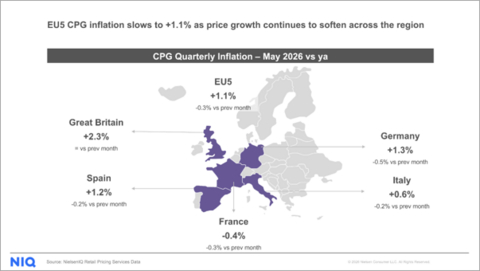
EU5 CPG Inflation slows to +
The first edition of the Barometer reveals that while inflation across Europe’s FMCG sector remains relatively contained overall, significant differences persist between countries.
Key findings include:
-
Great Britain recorded the highest FMCG inflation across the EU5 at +2.3% 1, above the European average of +1.1% . -
France andItaly reported the lowest inflation at -0.4% and +0.6% retrospectively, highlighting the uneven inflationary landscape acrossEurope's major economies.
The monthly Barometer also tracks department-level inflation, price elasticity, and how shoppers are reacting to inflation to manage higher grocery costs, including buying more on promotion, switching to cheaper products or reducing purchase volumes.
For example, in
Benjamin Cawthray, Client Director at NielsenIQ, said: “The first edition of the NIQ EU5 Inflation Barometer reveals a slowdown in FMCG inflation across
“While inflation is cooling at a regional level, the picture varies significantly by country.
He continued: “The findings highlight how inflation may be converging at a regional level, but shopper responses and category dynamics remain highly market specific, creating different opportunities and challenges for manufacturers and retailers across Europe.”
Notes to the Editor
1 NIQ Retailer Pricing Services Data; 13-week period ending May 24, 2026 vs. same period year ago.
About the NIQ EU5 Inflation Barometer
The NIQ EU5 Inflation Barometer is based on harmonised FMCG retail measurement, consumer panel data and advanced analytics. It provides monthly analysis of inflation trends, shopper behaviour and price elasticity across
About NIQ
NielsenIQ (NYSE: NIQ) is a leading consumer intelligence company, delivering the most complete and trusted understanding of consumer buying behaviour and revealing new pathways to growth. By combining an unmatched global data footprint and granular consumer and retail measurement with decades of AI modeling expertise, NIQ builds decision systems that help companies turn complex data into confident action.
With operations in more than 90 countries, NIQ covers approximately
For more information, please visit www.niq.com.
© 2026 Nielsen Consumer LLC. All Rights Reserved.
Forward Looking Statement:
This press release about NIQ’s Inflation Barometer, may contain forward-looking statements regarding anticipated consumer behaviors, market trends, and industry developments. These statements reflect current expectations and projections based on available data, historical patterns, and various assumptions. Words such as " will", “expects,” “anticipates,” “projects,” “believes,” “forecasts,” “plan,” “look ahead,” “indicates”, and similar expressions are intended to identify such forward-looking statements. These statements are not guarantees of future outcomes and are subject to inherent uncertainties, including changes in consumer preferences, economic conditions, technological advancements, and competitive dynamics. Actual results may differ materially from those expressed or implied in these statements. While we strive to base our insights on reliable data and sound methodologies, we undertake no obligation to update any forward-looking statements to reflect future events or circumstances, except to the extent required by applicable law.
View source version on businesswire.com: https://www.businesswire.com/news/home/20260806579111/en/
For media enquiries please contact: NielsenIQ@propellergroup.com
Source: NIQ Global Intelligence plc