
Northern Shield Confirms Surface Porphyry Copper Discovery at Creston; Identifies Further Copper Mineralization, Root & Cellar, Newfoundland
A second copper-bearing dike was identified approximately 700 m away, with assay results pending.
Sentiment and the balance of points
Rhea-AI Sentiment reads the wording of the document, how positive or negative its language is on a 1 to 5 scale. The balance of points shown with the takes weighs what the document actually discloses, so the two can disagree, for example when a trial that missed its main goal is described in upbeat language.
Rhea-AI Summary
Northern Shield Resources (NSHRF) reported surface copper assay results from its Creston discovery at the Root & Cellar property in Newfoundland. A composite sample of the full outcrop returned 0.31% copper; follow-up work confined mineralization to a porphyry dike within part of that outcrop. Wall-rock samples returned up to 11.6 ppm tellurium.
Additional copper mineralization was found approximately 700 m southwest, with assays pending. Northern Shield interprets the occurrences as part of a broader porphyry system and plans trenching and sampling to refine targets for maiden drilling at Creston; drilling will also test the quarry occurrence. The Creston outcrop lies beside a geophysical anomaly that strengthens downslope beneath shallow cover. Grade and scale remain to be determined by future drilling; selective surface samples are not necessarily representative of the property.
Positive
- Minor pointCreston full-outcrop composite sample assayed 0.31% copper, establishing surface porphyry-hosted copper mineralization.
- Minor pointAdditional copper mineralization was identified approximately 700 m southwest in and around a second porphyry dike.
- Minor pointWall-rock samples returned up to 11.6 ppm tellurium, providing an additional exploration indicator.
- Minor point. Forward-looking: it has not happened yet and may not happen.Northern Shield plans trenching and sampling to refine targets for maiden Creston drilling and drilling at the quarry occurrence.
Negative
- Minor pointSecond-occurrence assay results are pending, leaving its copper grade unconfirmed.
- Minor point. Forward-looking: it has not happened yet and may not happen.Copper grade and scale remain to be determined by future drilling.
- Minor pointGrab and composite samples are selective and not necessarily representative of property mineralization.
- Minor pointMineral and rock identifications are preliminary and subject to confirmation.
AI-generated analysis. How Rhea-AI works. Not financial advice.


Ottawa, Ontario--(Newsfile Corp. - October 20, 2026) - Northern Shield Resources Inc. (TSXV: NRN) ("Northern Shield" or the "Company") is pleased to report assay results from a copper-bearing feldspar porphyry dike (the "Creston Discovery"), discovered while ground truthing induced polarization ("IP") geophysical targets at the Company's flagship Root & Cellar Property ("Root & Cellar" or the "Property") on the Burin Peninsula of eastern Newfoundland. The Property is being explored for porphyry copper ± molybdenum, gold and tellurium, and for epithermal gold-silver-tellurium.
The Creston Discovery
A composite rock sample of the full outcrop, which included the copper-bearing feldspar porphyry dike at the Creston Target, assayed
Several specularite-bearing wall-rock samples from this area also returned anomalous tellurium (up to 11.6 ppm Te). Tellurium is a pathfinder element commonly associated with fertile alkalic copper-gold systems — lending further support to the alkalic to sub-alkalic porphyry interpretation and providing an additional vectoring tool for exploration.
Prospecting Identifies Additional Copper Mineralization
Approximately 700 m southwest of the above-mentioned Creston Discovery, follow-up prospecting has located additional copper mineralization in the quarry. Copper occurs as chalcopyrite-bornite veins over narrow widths along the contact of a second, narrow, similar-looking feldspar porphyry dike. The veins are accompanied by disseminated chalcopyrite, bornite, chalcocite and native copper distributed pervasively through the dike, the adjacent diatreme breccia and a rhyolite porphyry. The margins of the chalcopyrite-bornite veins also exhibit distinct reddening. The near-absence of pyrite argues against supergene enrichment, and together with the low-sulphur bornite-chalcocite (± native copper) assemblage and siliceous, co-precipitated textures, the copper is interpreted to be hypogene. Samples have been taken and submitted for assay, with results pending.
The second copper-bearing porphyry dike, reflecting the similar signature, and 700 m from the Creston Discovery, supports the Company's interpretation that these occurrences form part of a broader, developing porphyry system rather than isolated showings.
"These are genuinely exciting developments at Root & Cellar. Without a single drill hole, we have identified porphyry-hosted copper mineralization at surface. What we are seeing is interpreted as the upper expression of a larger system with roots at depth, as suggested by geophysics. The discovery of a second copper-bearing porphyry dike 700 metres away, carrying visible copper mineralization with the same distinctive reddened alteration, reinforces our view that this is part of a broader system — and that Root & Cellar, and the wider Burin, may host a new porphyry copper and epithermal gold district that has been overlooked. As the first to recognize this potential, Northern Shield has secured a dominant and strategic land position over much of this emerging district. The abundance of copper-rich minerals such as bornite and chalcocite is highly encouraging; grade and scale will be determined by future drilling."
- Ian Bliss, President and CEO, Northern Shield
The Company is planning a phased program to advance the porphyry copper found at the Creston Discovery. Near-term work will include mechanical trenching downslope of the Creston (IP-1) outcrop to expose and selectively sample the mineralized porphyry and test its continuity toward the stronger chargeability response, together with follow-up prospecting and sampling of the newly identified mineralization 700 metres to the southwest. This surface work is intended to refine and prioritize targets for a planned maiden drilling program at Creston designed to test the IP-1 target and the interpreted larger body at depth. Drilling will also test the copper occurrence in the quarry.
Samples were analyzed by ALS Global in Vancouver, BC, for Au by Fire Assay with ICP-AES finish (Au-ICP22) and multi-elements by four acid digestion and ICP-MS finish (ME-MS61). All standards and duplicates meet targeted values. The technical information in this news release has been reviewed and approved by Mike Muggridge, P. Geo., an independent consultant and "Qualified Person" within the meaning of National Instrument 43-101 – Standards of Disclosure for Mineral Projects. Grab and composite samples are selective by nature and are not necessarily representative of mineralization on the Property. Mineral and rock identifications are preliminary, based on field and hand-specimen examination, supported by geochemistry and subject to confirmation.
About Northern Shield Resources
Northern Shield Resources Inc. is a Canadian-based company, a leader in generating high-quality exploration targets, which views greenfield exploration as an opportunity to find a mineable, near surface deposit at relatively low cost. We implement a model driven exploration approach to reduce the risk associated with early-stage projects for ourselves, our shareholders, and the environment. This approach led us to option the Root & Cellar Property from a Newfoundland prospector, who discovered the copper mineralization, and then to its advancement to the gold-silver-tellurium and emerging porphyry copper system that it has become.
Northern Shield Resources Inc.
Ian Bliss
President and CEO
Tel.: (613) 232-0459
Fax: (613) 232-0760
info@northern-shield.com
Forward-Looking Statements Advisory
This news release contains statements concerning the exploration plans, results and potential for porphyry copper, epithermal gold, and other mineralization at the Company's Root & Cellar Property, geological, geophysical and geometrical analyses of the properties and comparisons of the properties to known porphyry copper and epithermal gold deposits and other expectations, plans, goals, objectives, assumptions, information or statements about future, conditions, results of exploration or performance that may constitute forward-looking statements or information under applicable securities legislation. Such forward-looking statements or information are based on a number of assumptions, which may prove to be incorrect.
Although Northern Shield believes that the expectations reflected in such forward-looking statements or information are reasonable, undue reliance should not be placed on forward looking statements because Northern Shield can give no assurance that such expectations will prove to be correct. Forward-looking statements or information are based on current expectations, estimates and projections that involve a number of risks and uncertainties which could cause actual results to differ materially from those anticipated by Northern Shield and described in the forward looking statements or information. These risks and uncertainties include, but are not limited to, risks associated with geological, geometrical and geophysical interpretation and analysis, the ability of Northern Shield to obtain financing, equipment, supplies and qualified personnel necessary to carry on exploration and the general risks and uncertainties involved in mineral exploration and analysis.
The forward-looking statements or information contained in this news release are made as of the date hereof and Northern Shield undertakes no obligation to update publicly or revise any forward looking statements or information, whether as a result of new information, future events or otherwise, unless so required by applicable securities laws.
Neither TSX Venture Exchange nor its Regulation Services Provider (as that term is defined in policies of the TSX Venture Exchange) accepts responsibility for the adequacy or accuracy of this release.
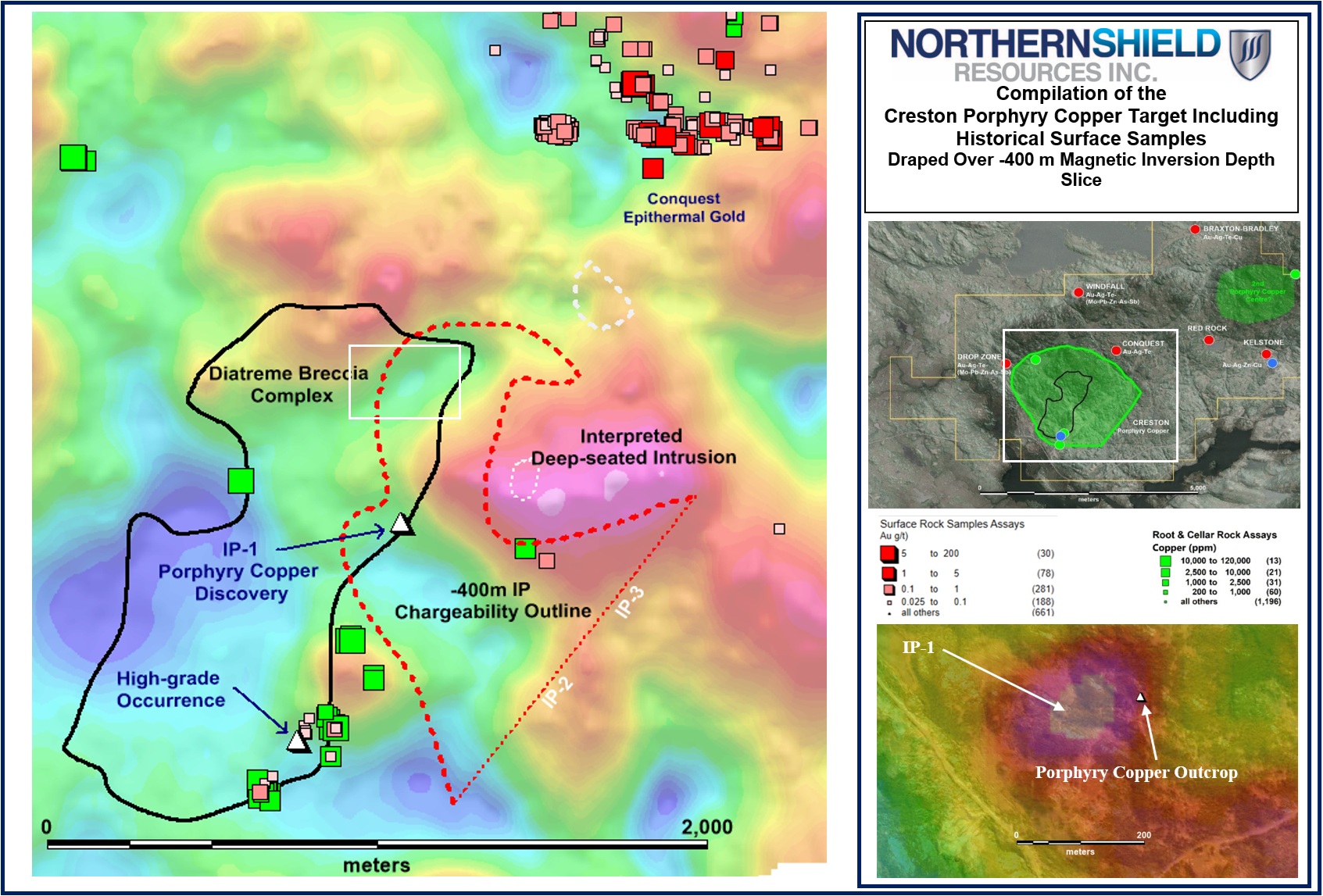
Figure 1 Compilation showing relative position of diatreme breccia complex and IP overlain on depth slice from -400 m magnetic inversion modelling. Red and green squares represent gold and copper-bearing surface samples.
To view an enhanced version of this graphic, please visit:
https://images.newsfilecorp.com/files/12808/319780_figureone.jpg
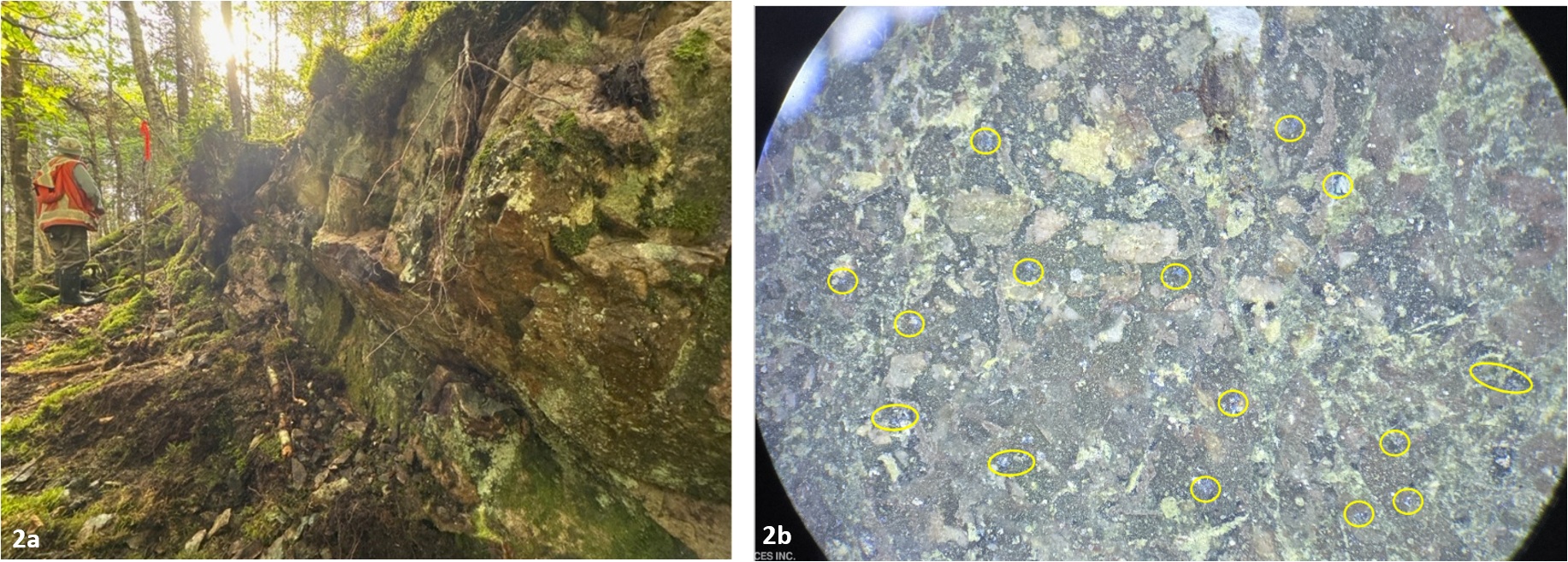
Figure 2a: Copper-bearing diorite to monzodiorite porphyry outcrop at Creston (IP-1). Figure 2b: close-up of disseminated chalcocite in diorite to monzodiorite porphyry
To view an enhanced version of this graphic, please visit:
https://images.newsfilecorp.com/files/12808/319780_figuretwo.jpg
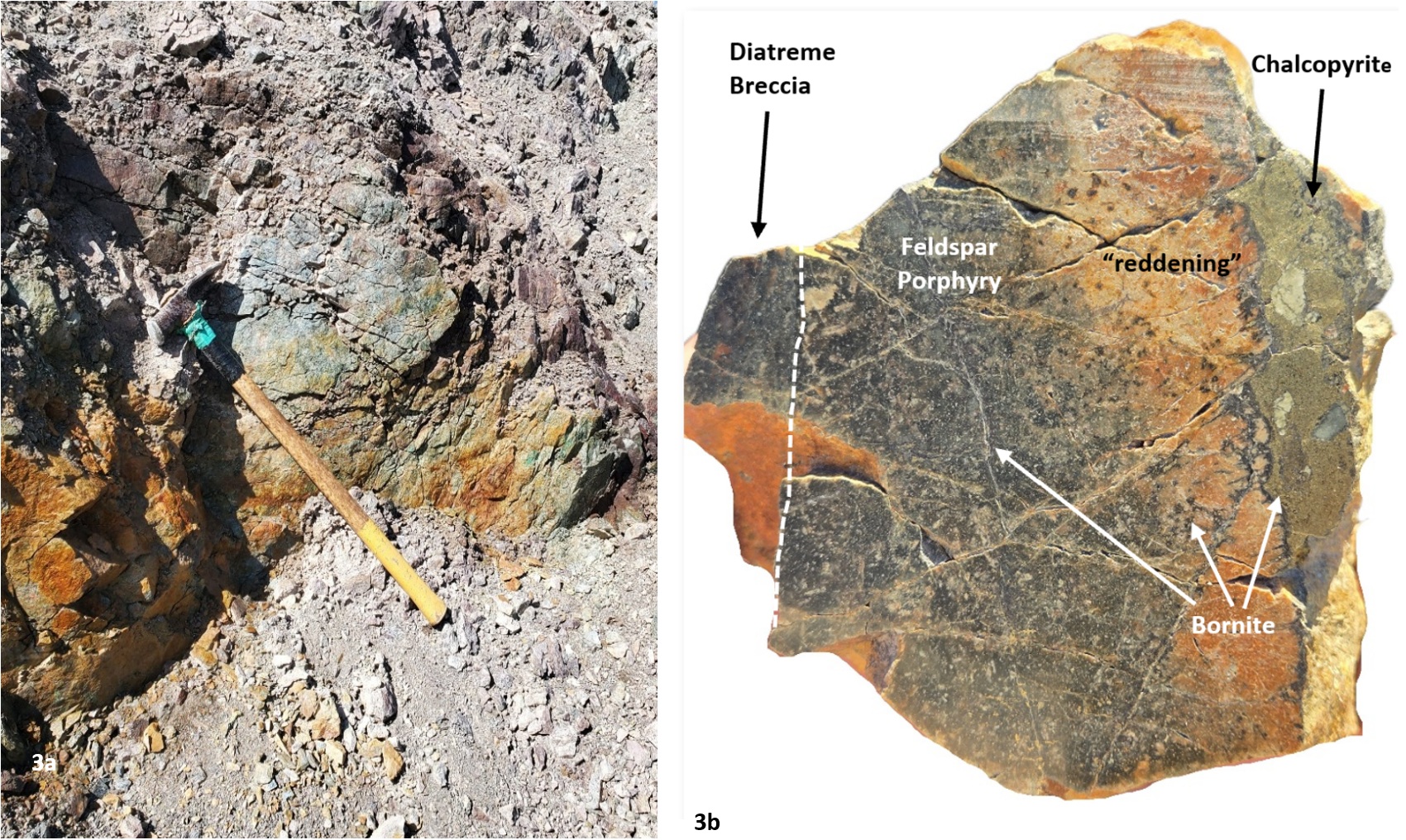
Figure 3a: new occurrence of copper mineralization exposed in quarry. Mineralization includes chalcopyrite, bornite, chalcocite and native copper. Figure 3b: Chalcopyrite-bornite vein along margin of a diorite to monzodiorite porphyry which exhibits intense reddening. The porphyry host disseminated and fracture filling chalcopyrite-bornite. Chalcocite becomes more prevalent in the diatreme breccia
To view an enhanced version of this graphic, please visit:
https://images.newsfilecorp.com/files/12808/319780_figurethreeab.jpg
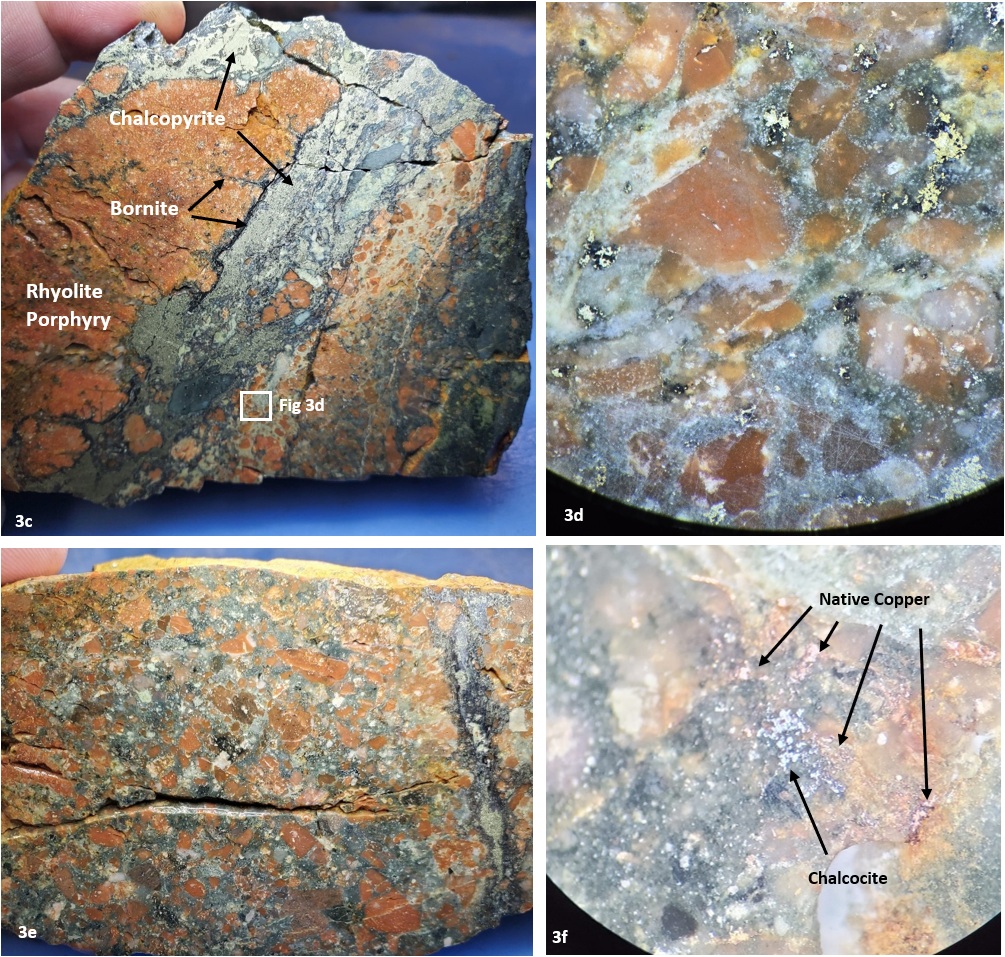
Figure 3c: Chalcopyrite-bornite vein along contact of rhyolite porphyry which contains disseminated chalcopyrite-bornite. Figure 3d: disseminated chalcopyrite-bornite within brecciated rhyolite porphyry/diatreme breccia. Figure 3e: Brecciated rhyolite porphyry with thin chalcopyrite-bornite vein on right side of image and hosting disseminated copper sulphides and native copper (Figure 3f)
To view an enhanced version of this graphic, please visit:
https://images.newsfilecorp.com/files/12808/319780_figurethreec-f.jpg

To view the source version of this press release, please visit https://www.newsfilecorp.com/release/319780
FAQ
AI-generated questions and answers. How Rhea-AI works. Not financial advice.
What copper grade did Northern Shield report at the Creston discovery?
A composite sample covering the full Creston outcrop assayed 0.31% copper. Follow-up work showed that copper mineralization is confined to an interpreted porphyry dike within part of the outcrop; the remainder comprises non-mineralized reddened basalt and diatreme breccia.
What exploration work does Northern Shield plan at Creston?
Northern Shield plans mechanical trenching downslope of the Creston outcrop, selective sampling and follow-up prospecting to refine drilling targets. Planned maiden drilling would test the IP-1 geophysical target and an interpreted larger body at depth. Drilling will also test the copper occurrence in the quarry.
How representative are Northern Shield's Root & Cellar surface samples?
Grab and composite samples are selective by nature and are not necessarily representative of mineralization on the property. Mineral and rock identifications are preliminary, based on field and hand-specimen examination supported by geochemistry, and remain subject to confirmation.