
Oracle Investor Day 2026: Accelerating Value Creation
Vendor financing, customer-provided hardware and customer prepayments are expected to reduce upfront cash requirements.
Sentiment and the balance of points
Rhea-AI Sentiment reads the wording of the document, how positive or negative its language is on a 1 to 5 scale. The balance of points shown with the takes weighs what the document actually discloses, so the two can disagree, for example when a trial that missed its main goal is described in upbeat language.
Rhea-AI Summary
Oracle (ORCL) set a fiscal 2030 revenue target of $225 billion or more at its Investor Day in Las Vegas. Oracle expects revenue growth of more than 35% compounded annually from FY26 through FY30, with FY30 non-GAAP operating margin of 40%+ and non-GAAP earnings per share of $21+.
The company targets positive free cash flow during the second half of FY28 and $30 billion+ in FY29, with growth self-funded beginning in FY29. Capital spending is expected to peak in FY27-FY28 and step down in FY29. Additional capital-market funding through FY30 is capped at $20 billion, excluding refinancing, currently expected to comprise $10 billion in equity and $10 billion in gross debt. This follows a completed $20 billion equity raise in the first quarter of FY27.
Oracle reaffirmed FY27 revenue guidance of at least $90 billion and non-GAAP earnings per share of $8.10, and targets net debt below 3.5 times adjusted EBITDA in FY29.
How this balance works
Rhea-AI gives every point it takes from this document a weight. Minor counts 1, Moderate 3 and Major 9, so one Major point outweighs several Minor ones. The bar adds up the weights on each side, and when neither side holds more than 65% of the total the balance reads Mixed.
It reads the document as published, with the same rules for every company, and it does not look at what the market expected or at how the stock traded, so a point can be objectively good on a day the stock falls.
Rhea-AI Sentiment measures something else, the tone of the wording.
Hollow bars mark forward-looking points. How the balance works
Positive
- Major point. Forward-looking: it has not happened yet and may not happen.FY30 revenue target of $225 billion+ represents more than 35% compound annual growth from FY26.
- Moderate point. Forward-looking: it has not happened yet and may not happen.FY30 non-GAAP operating margin target is 40%+.
- Moderate point. Forward-looking: it has not happened yet and may not happen.FY30 non-GAAP earnings per share target is $21+.
- Moderate point. Forward-looking: it has not happened yet and may not happen.Positive free cash flow is targeted during the second half of FY28.
- Moderate point. Forward-looking: it has not happened yet and may not happen.FY29 free cash flow target is $30 billion+.
- Moderate point. Forward-looking: it has not happened yet and may not happen.Growth is expected to be self-funded beginning in FY29.
- Moderate point. Forward-looking: it has not happened yet and may not happen.Additional capital-market funding is capped at $20 billion through FY30, excluding existing-debt refinancing. 5.1% of market cap
- Moderate point. Forward-looking: it has not happened yet and may not happen.FY29 net debt is targeted below 3.5 times adjusted EBITDA.
- Moderate point. Forward-looking: it has not happened yet and may not happen.FY27 revenue outlook reaffirmed at at least $90 billion.
- Moderate point. Forward-looking: it has not happened yet and may not happen.FY27 non-GAAP earnings per share outlook reaffirmed at $8.10.
2 minor points
- Minor point. Forward-looking: it has not happened yet and may not happen.Capital expenditures are expected to step down in FY29 after peaking in FY27-FY28.
- Minor point. Forward-looking: it has not happened yet and may not happen.Vendor financing, customer-provided hardware and customer prepayments are expected to reduce upfront cash requirements.
Negative
- Major pointCompleted $20 billion at-the-market equity raise in the first quarter of FY27 added dilution. 5.1% of market cap
- Moderate point. Forward-looking: it has not happened yet and may not happen.Additional funding currently includes an expected $10 billion in equity, implying further dilution. 2.5% of market cap
- Minor point. Forward-looking: it has not happened yet and may not happen.Additional funding currently includes an expected $10 billion in gross debt, adding borrowing obligations.
News Explained
FY29 net debt includes borrowings, vendor financing and lease liabilities, less cash and marketable securities; adjusted EBITDA adds back depreciation and operating-lease expense.
Oracle said at Investor Day that vendor financing, customer-provided hardware and customer prepayments are expected to reduce upfront cash requirements during the transition to positive free cash flow.
Details
Market Reaction – ORCL
On Oct 28, the day this news came out, the latest delayed price for ORCL is 11.72% above the previous close. Our momentum scanner has recorded 115 alerts for this stock so far that day. The latest delayed price is $145.83. Relative volume is very high at 3.2x the average.
Data tracked by StockTitan Argus (15 min delayed). Upgrade to Gold for real-time data.
Key Figures
- FY30 total revenue
- $225 billion+
- FY30 long-term outlook
- Revenue CAGR
- More than 35%
- FY26 through FY30
- Non-GAAP operating margin
- 40%+
- FY30 long-term outlook
- Non-GAAP EPS
- $21+
- FY30 long-term outlook
- Positive free cash flow timeline
- Second half of FY28
- Company-defined timeline
- Free cash flow target
- $30 billion+
- FY29
- Additional capital raises limit
- $20 billion
- Through FY30; excludes refinancing of existing debt
- Expected funding mix
- $10 billion equity and $10 billion gross debt
- Funding for the FY27-FY30 investment cycle
Key Terms
cagr financial
non-gaap financial
at-the-market equity raise financial
adjusted ebitda financial
AI-generated analysis. How Rhea-AI works. Not financial advice.


- Set long-term outlook for FY30 of
$225 billion + in total revenue, representing more than35% CAGR from FY26, non-GAAP operating margin of40% + and non-GAAP EPS$21 +. - Defined timeline to positive free cash flow during the second half of FY28 and set free cash flow target of
$30 - Committed to limiting additional capital raises through FY30 to
$20 billion $10 billion $10 billion - Confirmed that growth will be self-funded beginning in FY29 and net debt to adjusted EBITDA will be below 3.5 times in FY29.1
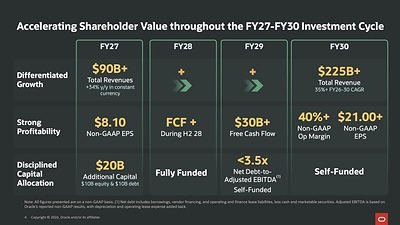
At its Investor Day, Oracle described how its unique portfolio positioning across cloud infrastructure, database and applications is expected to drive total revenue growth of more than
Oracle committed to limiting additional funding to be raised in the capital markets for its FY27-FY30 investment cycle to
Oracle reaffirmed its fiscal 2027 outlook for total revenue of at least
The Investor Day presentations and webcast replay will be available on the Oracle Investor Day website.
1. Net debt includes borrowings, vendor financing, and operating and finance lease liabilities, less cash and marketable securities. Adjusted EBITDA is based on Oracle's reported non-GAAP results, with depreciation and operating lease expense added back.
About Oracle
Oracle provides cloud applications and infrastructure for enterprises worldwide. For more information about Oracle (NYSE: ORCL), visit www.oracle.com.
Non GAAP Financial Measures
To supplement our financial results presented on a GAAP basis, we use non-GAAP measures, which exclude certain significant expenses including stock-based compensation, expenses related to acquisitions, restructuring and certain other operating expenses, that we believe are helpful in understanding our past financial performance and our future results. Our non-GAAP financial measures are not meant to be considered in isolation or as a substitute for comparable GAAP measures and should be read only in conjunction with our consolidated financial statements prepared in accordance with GAAP.
Safe Harbor Statement
Statements in this press release relating to Oracle's future plans, expectations, beliefs, intentions and prospects, including statements regarding future revenues and revenue growth, non-GAAP operating margin and earnings per share; the timing and amount of positive free cash flow; expected capital expenditures; future funding needs and financing strategy, including Oracle's commitment to limit additional capital raises; the expected effects of vendor financing, customer-provided hardware and customer prepayments on upfront cash requirements; the timing of self-funded growth; future net debt to adjusted EBITDA; and capital allocation priorities, including maintaining investment-grade credit ratings, paying dividends and funding growth opportunities, are "forward-looking statements" and are subject to material risks and uncertainties. Forward-looking statements may be identified by words such as "expect," "anticipate," "plan," "believe," "intend," "target," "will," and "committed," and similar expressions, although not all forward-looking statements contain these words. Risks and uncertainties that could affect our current expectations and our actual results, include, among others: our ability to develop new products and services, integrate acquired products and services and enhance our existing products and services, including our AI products; our AI products not operating as anticipated; our ability to successfully execute our Oracle Cloud strategy; our ability to anticipate, plan for, secure and manage datacenter capacity; our management of complex cloud and hardware offerings, including the sourcing of technologies and technology components such as graphic processing units; significant coding, manufacturing or configuration errors in our offerings; risks associated with acquisitions, joint ventures and strategic alliances; business volatility and risks associated with government contracting; economic, political and market conditions, including tariffs and trade wars; information technology system failures, privacy and data security concerns; cybersecurity breaches; disruptions from our period workforce restructurings; unfavorable legal proceedings, government investigations, and complex and changing laws and regulations, including healthcare regulations. A detailed discussion of these factors and other risks that affect our business is contained in our SEC filings, including our most recent reports on Form 10-K and Form 10-Q, particularly under the heading "Risk Factors." Copies of these filings are available online from the SEC or by contacting Oracle's Investor Relations Department at (650) 506-4073 or by clicking on SEC Filings on the Oracle Investor Relations website at www.oracle.com/investor/. All information set forth in this press release is current as of October 28, 2026. Oracle undertakes no duty to update any statement in light of new information or future events.

 View original content to download multimedia:https://www.prnewswire.com/news-releases/oracle-investor-day-2026-accelerating-value-creation-302922564.html
SOURCE Oracle
FAQ
AI-generated questions and answers. How Rhea-AI works. Not financial advice.
What are Oracle's FY30 revenue and profitability targets?
Oracle targets $225 billion or more in FY30 revenue, a non-GAAP operating margin of 40%+ and non-GAAP earnings per share of $21+. The revenue target represents more than 35% compound annual growth from FY26 through FY30.
When does Oracle expect positive free cash flow?
Oracle targets positive free cash flow during the second half of FY28 and $30 billion+ in FY29. The company expects capital expenditures to step down in FY29 following a peak in FY27-FY28, and growth to be self-funded beginning in FY29.
How does Oracle define its FY29 net debt to adjusted EBITDA target?
Oracle's target of net debt below 3.5 times adjusted EBITDA in FY29 includes borrowings, vendor financing, and operating and finance lease liabilities, less cash and marketable securities. Adjusted EBITDA uses Oracle's reported non-GAAP results, adding back depreciation and operating lease expense.